
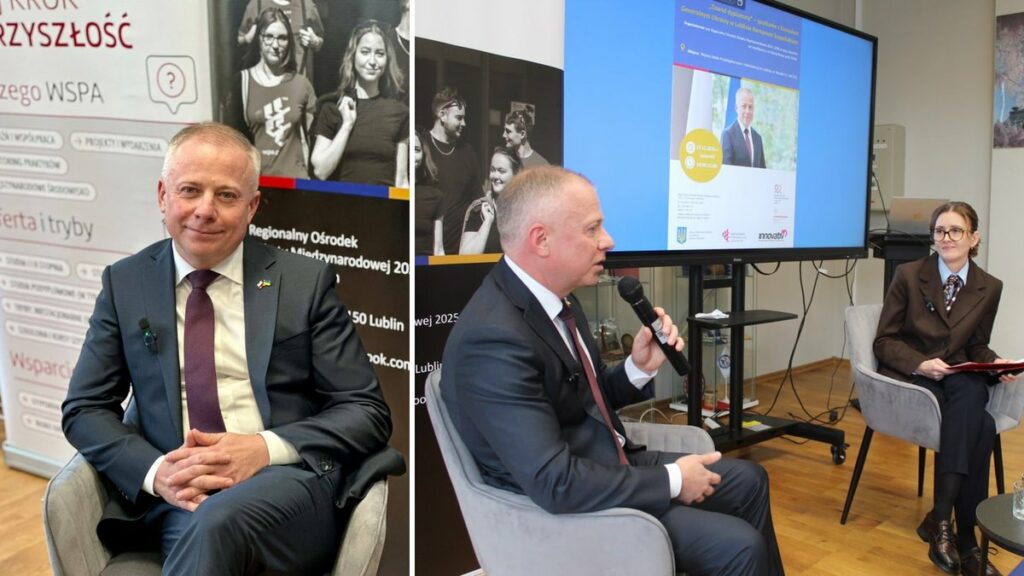
On November 17, International Student Day, the Consul General of Ukraine in Lublin, Roman Szepelak, visited the Lublin University of Entrepreneurship and Administration (WSPA). The conversation was supposed to be about the diplomatic profession, but it turned into a story about the border, refugees from 2022, winter that is just beginning, and the quietest part of the war – informational. At the end, students from Poland, Ukraine, and Belarus received certificates of completion for workshops on countering disinformation from the consul. In one room, three diplomacies – Ukrainian, Polish, and French – met, and all spoke about the same thing.
Source: private archive of Dr. Jarosław Kita / edited by Nowiny Wschodnie
Diplomacy is not about banquets


The meeting was organized by the Lublin Regional Center for International Debate – a network established by the Polish Ministry of Foreign Affairs in 2013 to bring Polish foreign policy closer to the inhabitants of the regions. The conversation was led by Dr. Maria Mazur, dean of international relations at WSPA. In the room, there were mainly students of international relations and listeners of the zero year, for whom it was their first encounter with a diplomat. Ukrainians represent the largest group of international students at the university.
The consul began by asking the audience: who has watched the series ‘The Diplomat’? Many hands were raised, and he immediately warned that he had to disappoint them a bit. Behind the image of elegant outfits and receptions lies the daily responsibility for the image of the country that the diplomat represents, and a workday that cannot be planned.
‘If this day ends at 8 or 7 PM, I can say that I am very lucky.’
Lublin, February 2022: diplomacy in emergency mode
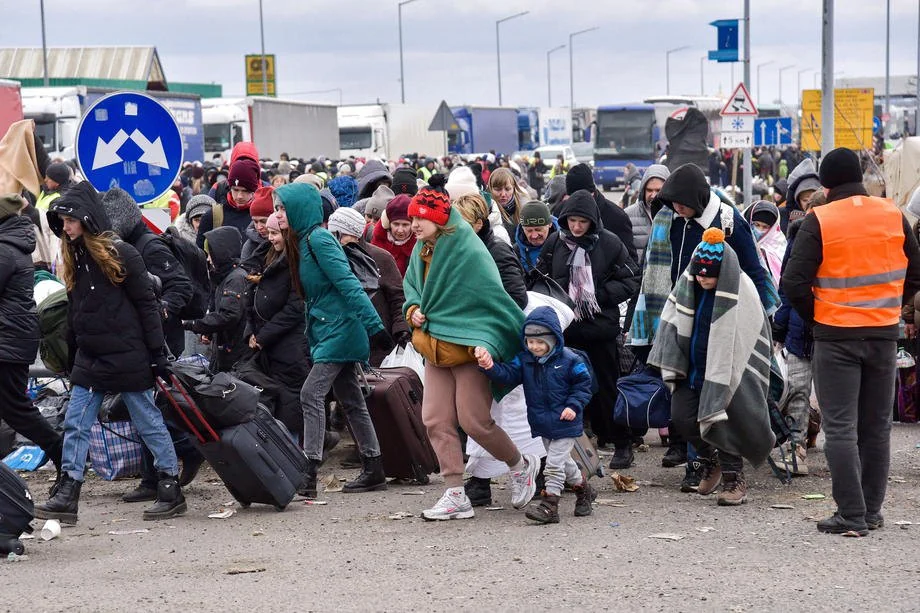
Until February 24, 2022, the Ukrainian embassy and consulates in Poland lived a regular diplomatic life: economic cooperation, cultural projects, talks about Ukraine’s entry into the European Union. Roman Szepelak, who at the time was dealing with international relations in the Lviv region, recalls how everything changed in one day. At each border crossing with Poland, 15,000 people appeared. In border towns like Lviv, up to a hundred thousand people arrived, fleeing from the war and not knowing where to go next.
Source: social media / illustrative view / edited by Nowiny Wschodnie
Lublin has become one of the main gateways. According to estimates from the city hall, in the first 90 days of the invasion, over 1.2 million refugees from Ukraine passed through the city. Lublin’s non-governmental organizations joined forces in the Lublin Social Committee for Aid to Ukraine, which sent its first truck with humanitarian aid to the east on the fourth day of the war. Students volunteered in collective accommodation centers, while the consulate, together with the provincial office and NGOs, dealt with thousands of individual cases.
Diplomacy then transformed into a humanitarian service: it was necessary to provide people with shelter, food, medical care, and help some of them continue their journey. As the consul says, the responsibility of a diplomat in the shadow of war has doubled, or even tripled.
“Every success may be invisible, but every failure in wartime can have very significant consequences.”
The border as a daily reality: from queues of trucks to delegations
Almost four years have passed, and the border still determines the rhythm of work at the Lublin consulate. Its district includes the Lubusz, Podlaskie, and most of the Subcarpathian provinces – in practice the entire Polish-Ukrainian border. Most of the problems reported by citizens begin right there.
The division of roles is best illustrated by an example that the consul provided to the students. When there are kilometer-long queues of trucks at the border, the embassy in Warsaw negotiates joint control and changes in regulations to shorten the queues. The general consul’s task is to ensure that drivers waiting in these queues have somewhere to warm up and wait in decent conditions. In addition, there are delegations: almost every official delegation going to or coming from Ukraine crosses the Polish border, and the consulate must service it.
The Ukrainian network of institutions in Poland has expanded over the years. In addition to the embassy, there are four general consulates and a consulate in Poznań, and in December 2025, a vice-consulate subordinate to Lublin was opened in Rzeszów – the seventh Ukrainian consular institution in Poland. The Ukrainian ambassador in Poland, Vasyl Bodnar, previously explained that there was more than one consulate for every 70,000 Ukrainian citizens.
The consul reminded that cooperation at the border began long before 2022. Over the years, the Interreg NEXT program (previously also involving Belarus, which was excluded after the outbreak of war) financed roads, border crossings, hospitals, schools, and ‘soft’ projects for youth. Districts and municipalities on both sides of the border had their partners. Therefore, when a full-scale war broke out, everyone in border Ukraine knew whom to turn to for help. According to the consul, these regions will be among the first participants in the reconstruction of Ukraine.
Winter is just beginning
The conversation about the border quickly shifted to the coming months. Russia continues to strike at Ukrainian civilian and energy infrastructure, and this winter, as the consul says, will not be easier than the previous one. Some people may be forced to leave again, as they cannot survive the winter in their homes, while others will simply lose their homes as a result of shelling. The consulate, along with regional authorities, is already thinking about how to prepare for this.
The consul recalled the ‘Warmth from Poland for Kyiv’ campaign from last winter. In his opinion, it became an impulse for other countries to resume fundraising, and thanks to such aid, Kyiv and other cities survived the most difficult months.
But in addition to the front where rockets are falling, there is another one.
The second front: culture and information
In Ukraine, it is said today that culture is the second front. While defenders are fighting on this real front, the embassy and consulates demonstrate the presence of the Ukrainian state abroad through cultural events. During the meeting, the consul invited everyone to the opening of a shelf with Ukrainian books, prepared by the consulate together with the Baobab organization. The shelf is already open – the consulate informed about it on social media.
However, the consul devoted most of his time to the other side of this front – the informational one. As he says, Russia, which fails to achieve its goals on the battlefield, is very effective in hybrid warfare and propaganda. He is convinced that the full-scale war itself was the result of years of disinformation: just ten years ago, ordinary people found it hard to imagine a large war in the middle of Europe in the 21st century. The consul mentioned provocations at the Polish-Belarusian border, which he believes have now shifted towards the Baltic states, as well as instigating nations against each other. Anyone interested in the onset of World War II will recognize the same methodology.
He spoke separately about Polish-Ukrainian relations. Neighborly relations are never easy, but during the war they have definitely improved. It is the task of diplomats and societies to prevent their deterioration, as there are always third forces that take advantage of every opportunity to sow discord between Poles and Ukrainians. This is not only his observation: a report by Demagog indicates that with the help of false information, the Kremlin fuels tensions between Poles and Ukrainians living in Poland.
When asked what advice a Ukrainian would give to Poles regarding social resilience, the consul replied with a story from his own experience. Before February 24th, warnings about war were issued in Ukraine, specific dates were even mentioned, but people did not believe it. He also received such signals and he too did not believe.
“Poland unfortunately – it’s hard to call it so – is a very good example of Ukraine. Whoever wants peace must prepare for war.”
Zero Fake: three diplomacies in one room
If disinformation is the front, then defense needs people who can recognize the attack. Dr. Jarosław Kit, a media education trainer and coordinator of the UA NEXT Lublin program, which helps active Ukrainians in the region build a dialogue with local communities, spoke about how they are being prepared during the meeting.
The Zero Fake project is fully titled “Countering disinformation among Ukrainian refugees residing in Poland.” It is being implemented by the Pro Futuro Foundation and the Ukrainian Educational Hub in Poland, supported by the French Ministry of Europe and Foreign Affairs. Although the project was designed with Ukrainians in mind, Poles, Belarusians, and Kazakhs living in Poland also attend the training. They learn to verify information and sources, recognize manipulations, navigate social media safely, and cope with information stress.
The results from 2025–2026 are no longer declarations. Twenty trainers conducted 41 in-person trainings for 812 people and six webinars for 944 participants. By mid-August 2026, over 2,500 people benefited from the platform zerofake.info, which features a fact-checking tool, an AI assistant, and media education tests, and the information campaign generated over 866,000 impressions. The most striking number concerns the participants themselves: before the training, one third of them declared a high level of confidence in recognizing fake news (33.5%), after the training – over 80% (82.5%).
Why is this being handled by the French diplomacy? The answer is contained in a letter from the French ambassador to Poland, Étienne de Poncins, dated September 14, 2026, a fragment of which was read in the room:
“Combating disinformation is one of the most important priorities of French diplomacy.”
Roman Szepelak knows the ambassador from Kyiv, where he represented France at the beginning of the full-scale war, and called him a great friend of Ukraine.
Source: private archive of Dr. Jarosław Kita / elaboration by Nowiny Wschodnie
In Lublin, what usually stays behind the scenes was on display. The Polish Ministry of Foreign Affairs, through RODM, provided a venue for the conversation, the French financed the training, and Ukrainian diplomacy supports those who pass on this knowledge. Diplomacy, usually associated with receptions and ties, acted here like an early warning system.
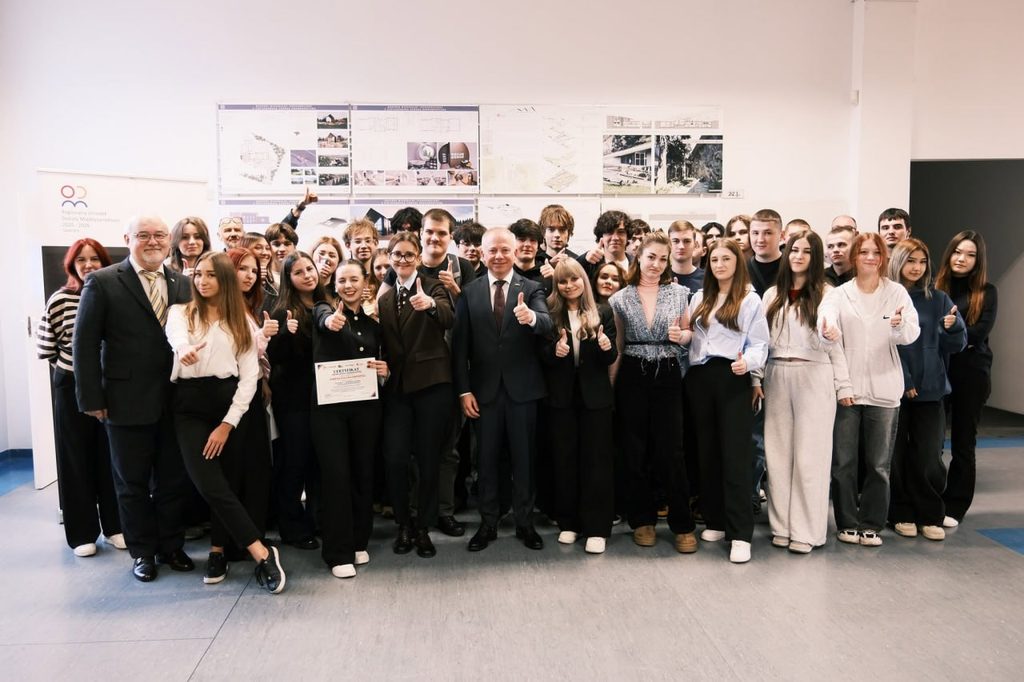
At the end of the meeting, eight WSPA students – out of thirteen who started the workshops – received Zéro Fake certificates from the consul. Among them were Poles, Ukrainians, and Belarusians.
Border guards stand at the border. On the second front – everyone who checks the source before clicking ‘share’.
Source: Radio Lublin, Demagog, Zéro Fake

Historian, ethnographer, and social media specialist. She has many years of experience developing YouTube channels, helping experts and businesses build their online presence. She has conducted academic research in ethnopsychology and ethnopedagogy in Galicia and the Northern Black Sea region. Her interests include the history of Ukraine and Europe, Polish-Ukrainian relations, and ethno-national and intercultural issues.
What do you think about this story?
Join the conversation. Please keep comments relevant to the article.
Write a comment