

A father’s funeral in Ukraine, a sick child abroad, a sister’s wedding — for thousands of people who legally live and work in Poland, all of this can remain out of reach for years. Not because of a ban, but because of the queue. The law gives the voivode 60 days to issue a decision on a temporary residence permit. In reality, even in the fastest voivodeship the average wait is 242 days, and in Silesia — 658.
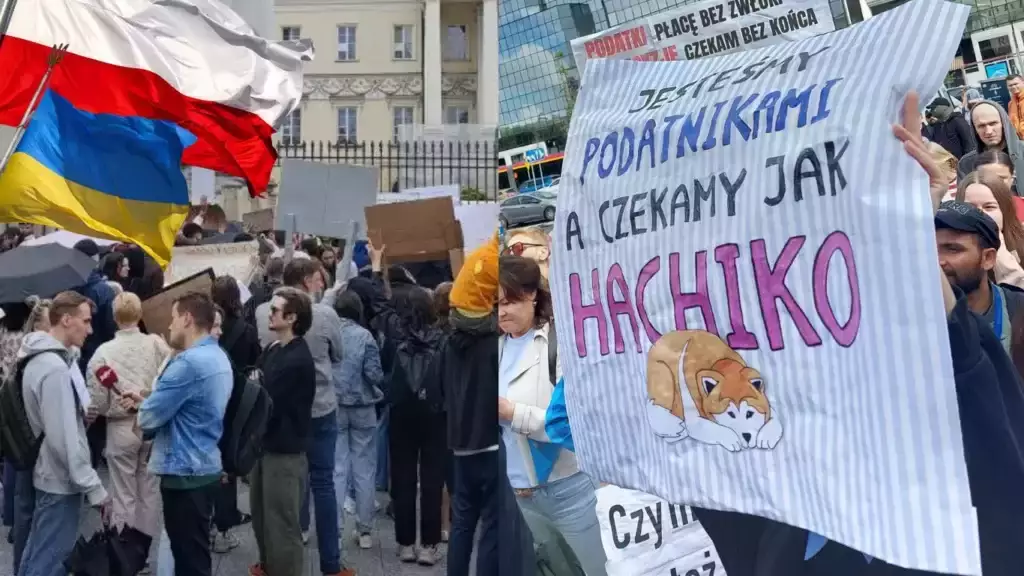


As long as the proceedings are ongoing, the foreigner stays in Poland legally, but instead of a residence card (editor’s note: a foreigner’s plastic document which, together with a passport, allows travel within the Schengen Area), they only have a certificate confirming the application was submitted. This certificate is valid only in Poland: it does not allow you to travel abroad and return without a visa. For Ukrainian men aged 23–60, leaving to obtain a new visa is in practice impossible, because after entering Ukraine, where mobilization is underway, as a rule they cannot leave it again.
What does waiting for a residence card mean in everyday life? A person works, pays taxes, pays a PLN 340 stamp duty for the application to be processed and another PLN 100 for the card itself — for each family member, including a child. And then, for months, often for years, they cannot go to their parents for the holidays, on a business trip to a neighboring country, or to a family celebration. The initiative Migrant’s Voice, which collected more than 1,200 official documents on the subject, also describes other consequences: problems with a bank account when the previous document expires, and with signing contracts.
The scale is shown by data from the Ministry of the Interior and Administration itself, from the reply to parliamentary interpellation No. 18089. In 15 of 16 voivodeships, people today wait longer than in 2023. In Mazovia alone, 738 people received a decision after more than two years of waiting. And these are only cases that have been completed — those who are still waiting are not yet included in the statistics.
The queue does not distinguish between “its own” and “outsiders.” The same rules apply to Ukrainians and Belarusians, students and researchers, as well as people of Polish origin with a Pole’s Card who return to the country and apply for permanent residence.
The Ministry of the Interior and Administration explains that there are far more applications — from 361 thousand in 2021 to 508 thousand in 2025, and two thirds are now submitted by Ukrainian citizens. The ministry links some of the delays to additional verifications serving state security.
Why does a state that has known about the problem for years still make people wait?
After the outbreak of the full-scale war, Poland reached for an extraordinary solution. Article 100d of the Act on Assistance to Ukrainian Citizens suspends the running of deadlines within which the voivode must examine a residence case, and deprives a complaint about inaction of its effects. The provision was meant to be temporary, but its validity has already been extended several times — currently until 4 March 2027.
In May 2025, the Supreme Administrative Court found that more than two years is enough time for the state to get the work of the voivodeship offices in order, and refused to apply this provision. In a letter to the Commissioner for Human Rights of 30 June 2026, the ministry admits what the consequences are:
(…) there is a high probability that the voivodeship administrative court (…) will refuse to apply this provision and will examine the complaint without taking it into account.
— MSWiA, letter to the Commissioner for Human Rights, BMP.0790.3.7.2026(6)
For a person in the queue, this means that the reminder—which the law requires to be filed first with the office—will still go unexamined. Only the court offers a chance—along with a separate fee, additional months of waiting, and no guarantee of the outcome.
Meanwhile, those standing in the queue are mostly people who [LINK WEWNĘTRZNY NW — na te słowa] work and pay taxes. According to estimates by Bank Gospodarstwa Krajowego, Ukrainian migrants alone contributed about PLN 15.1 billion to the budget in 2024. The queue is also not the result of filtering out “dangerous” people: in 2025, out of 218,000 positive decisions there were only 1,837 negative ones.
The government is preparing changes. Draft bill UD408 provides that if the voivode remains silent for 60 days, the permit is deemed to have been issued. But only for citizens of selected countries that the government will indicate—according to the MSWiA, Ukrainians will not be among them. As assessed by the Helsinki Foundation for Human Rights, the mechanism will cover “a little over 1% of applicants.”
The editorial team of Nowiny Wschodnie sent questions to the MSWiA and the Office for Foreigners about staffing plans and the further fate of Article 100d. By the time of publication, we had not received a response. As soon as we do, we will update the piece.
The queue is not an act of God. It is a decision that is made anew every year.
Source: MSWiA, Commissioner for Human Rights, Chancellery of the Prime Minister, Helsinki Foundation for Human Rights, Głos Migranta

Historian, ethnographer, and social media specialist. She has many years of experience developing YouTube channels, helping experts and businesses build their online presence. She has conducted academic research in ethnopsychology and ethnopedagogy in Galicia and the Northern Black Sea region. Her interests include the history of Ukraine and Europe, Polish-Ukrainian relations, and ethno-national and intercultural issues.
What do you think about this story?
Join the conversation. Please keep comments relevant to the article.
Write a comment