
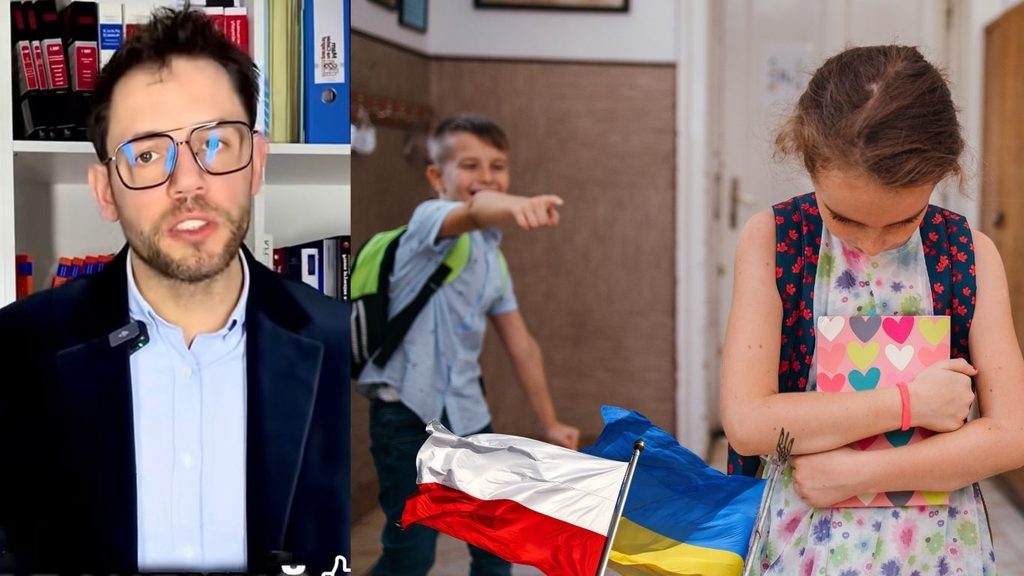
The beginning of the school year. Children are returning to classrooms, and with them returns a problem that unfortunately I discuss with parents more and more often: violence at school!!!


In recent months we have seen high-profile cases of attacks on children and young people from Ukraine. I myself was involved in helping victims in several such cases, including after incidents in Bydgoszcz and Słupsk. In my work I also deal with cases concerning violence and crimes motivated by prejudice.
And from these cases one basic thing emerges for me — parents very often do not know what they can actually do.
Is it enough to involve the homeroom teacher? Can you write letters to the principal? Should you demand that CCTV footage be secured? When should you notify the Police? How should you notify them? And above all — when does the school itself have an obligation to do it?
Let’s try to put this in order — as in a legal consultation.
I often hear from teachers or parents that: “They’re just kids” — this is a huge oversimplification and an improper excuse.
We all know that children argue. Children can say something stupid or hurtful to each other. Not every quarrel during recess should be turned into a criminal case.
But a beating (as defined in the Criminal Code) is not a quarrel. Threatening (Art. 190 of the Criminal Code) a child is not a quarrel.
Regular intimidation, taking money, destroying belongings, or forcing someone into certain behavior is also not a “normal peer conflict,” a “joke,” or a “prank.”
And above all: a prohibited act does not stop being one just because it was committed in a school hallway and the perpetrator is a minor.
This distinction is very important and we must remember it.
It has happened that our child has experienced violence! I myself am a parent of more than one child and I know it’s awful, but… What should we do first?
If a child says they were beaten or attacked, first of all let’s listen to them CALMLY. Let’s not fill in the story, let’s not suggest answers to them – this is very important!
First of all, let’s determine:
what happened, where, at what time, who took part in the incident, who saw it, whether there is CCTV monitoring in that place, and whether similar situations have happened before.
Let’s write it down. Or record it.
If there are injuries – we document them (photos, videos, a medical examination report) and of course we use medical assistance.
If there are messages – we take screenshots.
If someone recorded the incident – we secure the video – we do not interfere with its length, we do not cut anything out! This is very important – tampering with potential evidence material may result in legal consequences!
If the school has CCTV monitoring – we immediately request that the recording be secured.
Not in two weeks. Not after another talk with the class teacher. The recording may be overwritten and later we will be wondering why the most important evidence is already gone.
Report it to the school – preferably in writing (via Librus, email)
Of course, you can start with the class teacher – when there has been an argument between children and no prohibited act has been committed.
But if we are talking about repeated violence—beatings, threats, or serious intimidation—I also recommend submitting a written report to the school principal.
What and how to write—simply: briefly and to the point, without waffle or threats; it’s best to write in your own words—avoid AI generators; at most, use one for translation. Here is an example:
“On… at around… my child was… The incident was witnessed by the following people… There is CCTV at the location of the incident. I request that it be secured and that steps be taken to ensure the child’s safety.”
There is no need to write a legal treatise—no one expects that from you.
More important is that after a month it doesn’t turn out that the parent claims they reported the problem, the teacher remembers the conversation a bit differently, and the principal says they only learned about the matter yesterday—unfortunately, this is very often what it looks like in practice!
Remember! The principal is responsible for students’ safety at school!
This is not just my opinion or my wish.
Under Article 68(1)(6) of the Education Law, the principal performs tasks related to ensuring the safety of students and teachers during activities organized by the school.
In addition, there are the Child Protection Standards, which must be introduced pursuant to Articles 22b and 22c of the Act on counteracting threats of sexual crime and protecting minors.
And here is a very practical tip for parents when something concerning happens to your child:
ask the school for the Child Protection Standards.
Read this document!
The provisions in it should specify, among other things, the rules for safe relationships between children, prohibited behaviors, the intervention procedure in the event of suspected harm to a child, the persons receiving reports, the method of documenting incidents, and the procedure for submitting notifications of suspected commission of an offense.
So you can ask the principal directly:
“Which procedure предусмотрена in the Standards for the Protection of Minors was applied in my child’s case?”
And expect a specific answer.
And now the question is when, and whether already, to go to the Police?
If there is a direct threat to the child’s health or life – we call 112, and that’s it.
We do not wait then for the principal, the homeroom teacher, or the teacher.
If the danger has already passed, but there has been behavior that may constitute a prohibited act – for example, assault, threats, theft, robbery, coercion, persistent harassment, or a sexual offense – the matter can be reported to the Police.
You should not be afraid of the response: “But the perpetrator is 14, so they’re still a child,” because that is precisely why there is the Act on Supporting and Resocializing Juveniles and proceedings before the family court.
The parent of the harmed child does not have to classify the act on their own, determine the perpetrator’s liability, or decide what measures should be applied to them.
That is what the competent authorities are for.
Remember that not in every situation can the principal say: “we’ll handle this internally,” “we’ll somehow sort it out,” “the children will make up.”
Art. 4(3) of the Act on Supporting and Resocialising Juveniles provides for a special obligation, among others, for schools—if a school (the headteacher/principal), in connection with its activities, learns that a juvenile has committed a prohibited act meeting the elements of an offence prosecuted ex officio, it has a legal obligation to immediately notify the family court or the Police.
And there is one more thing—the school must take the necessary actions to prevent traces and evidence from being wiped out.
This is a very practical provision, because if a serious beating occurred in the corridor, it is not enough to say: “we’ll talk to the students tomorrow.”
Another issue—you also need to think about evidence.
CCTV. Witnesses. Recordings. Documentation.
There is also Art. 304 of the Code of Criminal Procedure
In the case of offences prosecuted ex officio, Art. 304 of the Code of Criminal Procedure may also be relevant.
Anyone who learns that such an offence has been committed has a social duty to notify the prosecutor or the Police.
However, state and local government institutions that learn of such an offence in connection with their activities have a duty to immediately notify the Police or the prosecutor and to secure traces and evidence until the competent authority arrives.
Therefore, in cases of serious school violence you always need to ask not only:
“What did the school do in terms of educational, disciplinary measures, etc.?”
but also: “In this situation, did the school have a legal obligation to notify the competent authorities?” These are two completely different issues.
Another issue—“Go back to Ukraine.” Don’t overlook this!
In the cases I have dealt with, it is also particularly important to determine why that specific child was chosen.
If during the attack the child heard terms referring to their Ukrainian background, nationality — this must be reported — to the Police. The school. The prosecutor’s office.
And you must provide the specific words.
Let’s not write only:
“my child was insulted”.
If they remember, let’s write exactly what they heard — even swear words.
The Polish Criminal Code contains provisions that directly relate to conduct motivated by national, ethnic, racial, or religious affiliation — including Articles 119, 256 and 257 of the Criminal Code.
This does not, of course, mean that every stupid or xenophobic word uttered by a student automatically fulfills the elements of one of these crimes.
But if the violence is accompanied by a nationality-based motive, the authorities should know about it.
Let’s not allow it to disappear from the case documentation that before being hit the child heard: “go back to Ukraine”.
Because then, in the files, a story about prejudice-motivated violence very easily turns into an ordinary “fight between two students”.
Another issue — not only beatings. Today violence continues even after classes
In school-related cases, the phone is increasingly as important as the school hallway.
The child comes home, but the violence comes back with them.
Class group chat. Telegram. Messenger. TikTok. Instagram.
Insults. Edited photos. A video of the beating. Threats. Ridicule.
Here my advice is very simple:
evidence first, blocking later.
Screenshot. Account name. Link. Date. Time. Recording.
We don’t respond to a threat with a threat.
And we don’t go to the school to take justice into our own hands
I understand the emotions of a parent whose child has been harmed.
I really do understand them.
But a parent should not wait outside the school for a fifteen-year-old perpetrator, threaten them, publish their photos online, or organize an online lynch mob against them.
You can defend your child very firmly and at the same time act within the law.
What’s more—this is precisely when we act most effectively.
Finally, the most important piece of advice
After all the talks with the homeroom teacher, the principal, the psychologist, or the Police, let’s ask one very simple question:
“Will my child be safe at this school tomorrow?”
Because if the school’s response to months of harassment is another disciplinary talk, and the next day the child meets the same perpetrators in the same locker room—then the problem has not been solved.
The law gives parents specific tools.
Document it. Secure the evidence. Demand the application of the Standards for the Protection of Minors. In serious cases, notify the Police. Ask the school whether it has fulfilled its statutory duty to report.
And above all, talk to your child—spend time with them; it pays off.
Because sometimes a child doesn’t tell anyone for weeks that they are being humiliated. Sometimes they only stop wanting to go to school. Their stomach starts to hurt before classes. A phone goes missing. They come back with a torn backpack. Or a tragedy happens.. A huge tragedy… I know such cases.
