
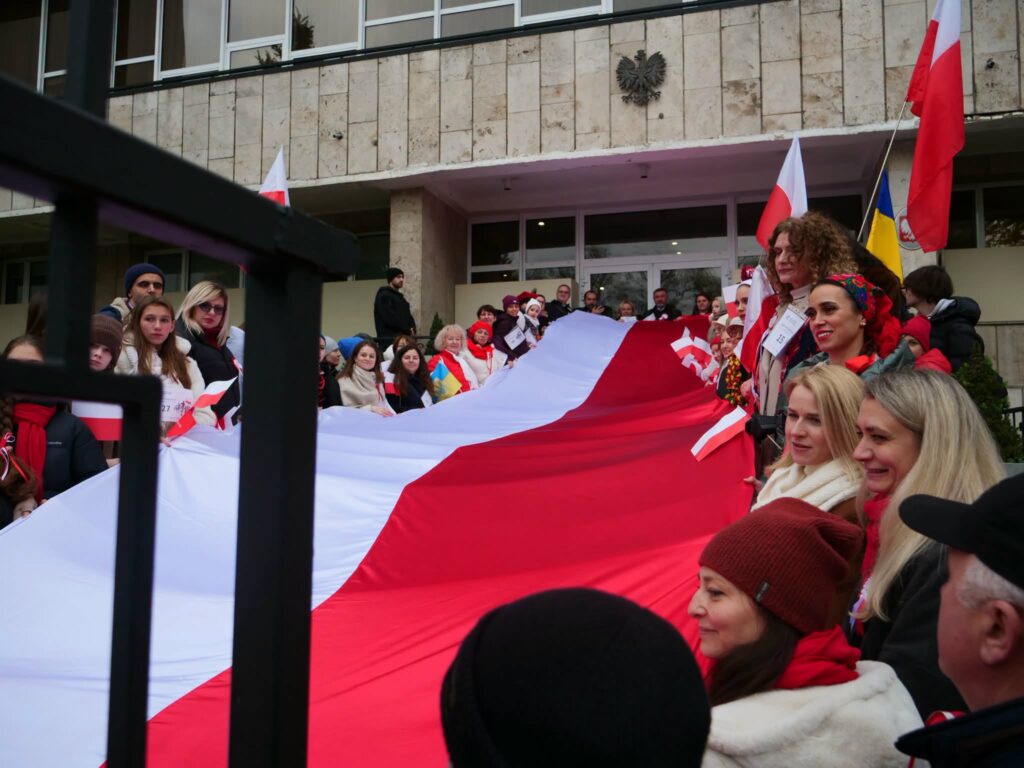
Poles and Ukrainians in Ukraine celebrate Polish Independence Day. In Poland we always do so on 11 November; unfortunately, that is not possible in Ukraine. The main reason is the constant air-raid alerts and attacks, which require flexible planning. No reasonable person needs an explanation of the danger. A fool, however, will still write something and talk about discos. There is also a second reason. In Poland it is a public holiday and always a day off work. In Ukraine, unfortunately, it is an ordinary working day, making it difficult to gather everyone needed to organise the events, as well as invited guests. Surely it is understandable that Ukraine celebrates Ukrainian holidays and Poland celebrates Polish ones. Let me add one small observation. There is a holiday that ought to be Polish, Ukrainian, Belarusian and Lithuanian: 3 May, the anniversary of the adoption of the world’s second constitution. It was passed by a parliament made up of nobles from those nations… But let us return to earth.
And yet it moves… as Galileo is said to have remarked.


Despite all these obstacles, Polish organisations throughout Ukraine strive to commemorate 11 November with dignity and as solemnly as possible. Browsing online, I counted at least a dozen cities and towns where Poles in Ukraine celebrated the anniversary of Polish independence. It should be stressed that celebrating Polish holidays is nothing unusual. It has become a Polish-Ukrainian tradition dating back to Ukraine’s independence, well over three decades ago. It is worth remembering that in Poland this holiday became a state holiday only three months (February 1989) before Poland regained its independence (I take 4 June 1989 as that date). So we have officially celebrated it for just over thirty years, too. This deserves emphasis because the hysteria of certain politicians has left a deeply unpleasant impression on Poles born in Ukraine who are Ukrainian citizens. How is someone supposed to feel after organising celebrations for over 30 years, attended by many friendly guests—mostly Poles, but also Ukrainians—when suddenly an MP comes out of nowhere with the idea of a march in Lviv? He asked no Pole and no member of any Polish organisation in Ukraine. He came up with it solely because refugees from Ukraine celebrate their own holidays in Poland. Let me stress this: Ukrainians in Poland have organised their holiday celebrations since 2022; Poles in Ukraine have done so for about 30 years longer.
What we allow refugees from Ukraine to do in Poland is RECIPROCITY.
Bearing in mind the restrictions mentioned earlier, I will describe several initiatives by Poles in Ukraine. I do not use the term “Polonia”, because it properly refers to Poles who emigrated from Poland. Our compatriots have lived on these lands for hundreds of years. Like Ukrainians, they belong to their local communities. They have the same rights and responsibilities as all citizens. They work, study and serve in the military. Many are at the front, many have been killed, and many are in captivity. As prisoners, they do not reveal their Polish identity because doing so would reduce their chances of survival. The Russians are cruel to prisoners of war and treat our compatriots with exceptional sadism.
KYIV
On the eve of 11 November, a reception was held at the Embassy of the Republic of Poland in Kyiv as part of the “Resilient Together” campaign run by the Polish Ministry of Foreign Affairs and the Embassy. During the gathering, Pro Patria medals and distinctions were presented to people and organisations involved in commemorating history and helping Ukraine (those honoured included Arkadiusz Sarna, First Counsellor at the Polish Embassy; Tetiana Sheptytska, Deputy Director for Research at the Bykivnia Graves National Historical Memorial Preserve; and volunteers and aid organisations, including Paweł Kost of the Solidarity Fund PL and the Exen initiative). An exhibition was also opened, with panels about Poles helping Ukraine physically displayed.
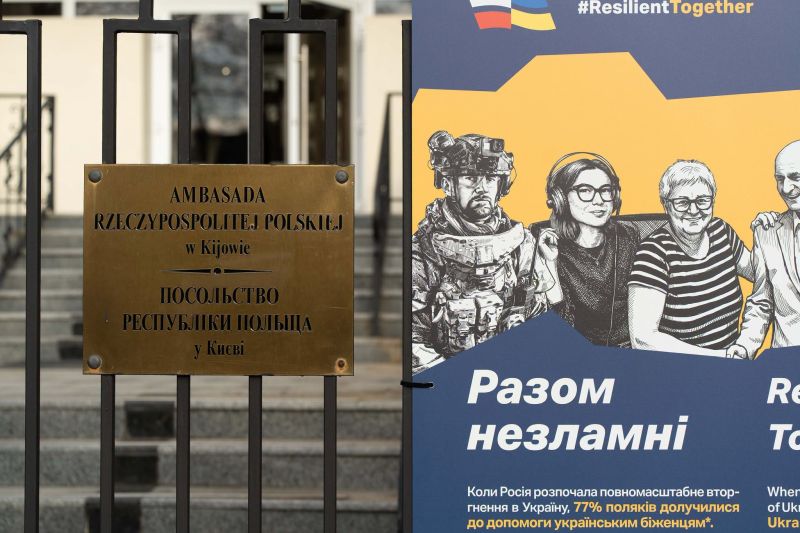
Exhibition on the fence of the Embassy of the Republic of Poland in Kyiv. Source: Facebook page of the Embassy of the Republic of Poland in Kyiv.
On 11 November, the Polish Hub in Kyiv hosted an open integration meeting and workshop entitled “White-and-Red Inspirations”, organised by the Union of Poles in Ukraine in cooperation with the Freedom and Democracy Foundation, using funds from the Institute for the Development of the Polish Language. On Sunday, 15 November, a grassroots gathering of the Polish community and friends of Poland was also held (linked to the Sunday gathering of worshippers in the capital), during which participants danced the traditional polonaise in a public space in Kyiv. Poles and Ukrainians took part together in all three events. The Sunday polonaise (15 November) and the Polish Hub meeting (11 November) were attended by members of Kyiv’s Polish community, parishioners and Ukrainian residents. The Polish Embassy welcomed Polish diplomats, volunteers and representatives of Ukrainian remembrance institutions and civil society.
Independence Day celebrations at the Polish Embassy. Source: Facebook page of the Embassy of the Republic of Poland in Kyiv.
LVIV
On 11 November, a Mass for Poland was celebrated at the Metropolitan Basilica in Lviv, presided over by Archbishop Mieczysław Mokrzycki, Metropolitan of Lviv. After the service, participants laid flowers and lit candles at the Cemetery of the Lviv Eaglets. The Main Board of the Polish Cultural Society of the Lviv Region scheduled a formal celebration for Sunday, 15 November, at St Mary Magdalene Lyceum No. 10. Representatives of Polish organisations in the Lviv region, pupils of Polish schools, scouts and local members of the Lviv archdiocese—both Poles and Ukrainians—took part.
LUTSK
On 11 November, a solemn Mass for Poland and for peace in Ukraine and the world was held at the Cathedral of Saints Peter and Paul in Lutsk. Members of Polish organisations operating in Volhynia and local parishioners, both Polish and Ukrainian, attended.
RIVNE
On 11 November, a concert marked the 108th anniversary of Poland regaining independence. According to information provided by the Volyn Monitor, representatives of the Polish community in Volhynia and Ukrainian residents of Rivne attended together.
ZBORIV
On 11 November, a Mass was celebrated at the military cemetery in Zboriv, presided over by Father Andrzej Malig, with organ accompaniment by Dr Natalia Izotova. The ceremony began at 12:00, immediately after an air-raid alert issued because of a drone attack on Ternopil region had been lifted. Representatives of the local Polish community (including people from Ternopil region), local worshippers and those helping to organise the music attended; both Poles and Ukrainians were among them.
KROPYVNYTSKYI
The Marko Kropyvnytskyi Theatre hosted a concert by winners of the student competition “Solidarity Through Art – I Like Poland”, featuring music and dance performances and an exhibition of works by students of the Oleksandr Osmiorkin Art School in the theatre foyer. Participants received diplomas and prizes. Students from Ukrainian and Polish-community educational institutions and city residents attended together. The ceremony was held with the participation and support of the Ukrainian regional administration; the Kirovohrad Regional State Administration published a report on the event.
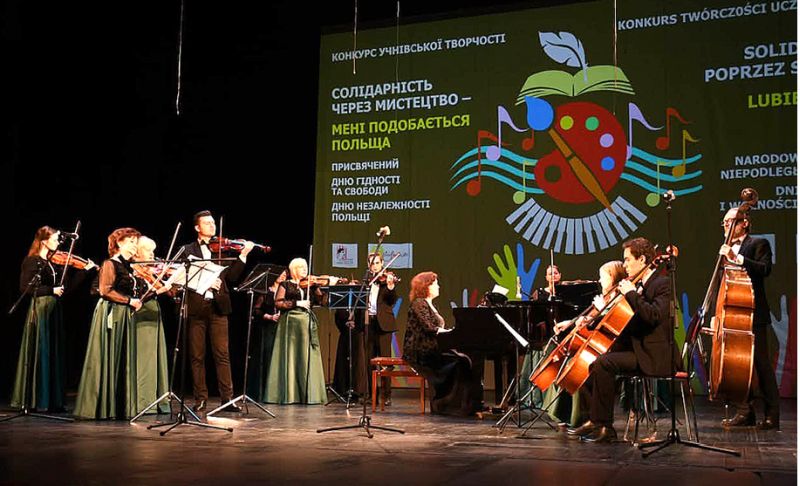
Photo: Kirovohrad Regional State Administration / reproduced by the editorial staff of “Dziennik Kijowski” (source: dk.com.ua), CC BY 4.0 licence. The work was made available as part of the “Polish Media Platform in Ukraine 2026” project implemented by the Freedom and Democracy Foundation under the Polish Senate’s programme of support for Polish communities and Poles abroad in 2026.
KOSTIUKHNIVKA
At the site of a bloody First World War battle (110th anniversary), the Flame of Independence was lit on 5 November at the cemetery of Polish legionnaires in the Polish Grove near Kostiukhnivka. Scouts carried it in a relay to Poland, including Lublin and Warsaw.
Between 8 and 10 November, local meetings were also held: at the Polish House in ZHYTOMYR a gathering was organised for pupils of Saturday Creative Clubs and their parents; at St John of Nepomuk Church in DUBNO after Sunday Mass, a concert of Polish songs and poems prepared by the Dubno Polish Cultural Society took place; and in ZBARAZH the Polish Cultural and Educational Society “Zbarazh” organised a members’ meeting. These were community and parish events bringing together members of Polish organisations, pupils of Saturday schools, scouts, caretakers of memorial sites and local parishioners, both Polish and Ukrainian.
Other towns also organised celebrations, but an article cannot go on forever. Even a brief account of every place where Poles celebrated Polish Independence Day would take several minutes to read. These celebrations are worth knowing about. Perhaps something good has come of a certain MP’s not-so-subtly misguided initiative: it has increased interest in how Poles in Ukraine manage to celebrate 11 November. They manage perfectly well, and have done so for only a few years less than in Poland. Let me remind you: the first celebrations of this holiday in Poland took place in 1989, and in Ukraine three years later. I will ask a rhetorical question. If Poles in Ukraine celebrate Polish holidays together with Ukrainians, do Ukrainians in Poland have the same right? They do. A thousand times over, they do. For more than 30 years, not a soul from the so-called right cared about Poles in Ukraine. The sudden agitation is rooted in a profoundly primitive hatred. Hatred as an emotion can still be understood. But the utter stupidity that prevented the MPs initiating a march in Lviv from looking online (!!!) to see whether and how Poles celebrate in Lviv cannot. Napoleon reportedly said that even theft can be forgiven—but not stupidity.
What do you think about this story?
Join the conversation. Please keep comments relevant to the article.
Write a comment