
Russian money, church tithes, and police inaction.
The investigation into the events in Odessa in 2014 has come to an end. Three people linked to the pro-Russian separatist movement will stand trial in absentia. According to Ukrainian investigators, they were preparing a takeover of power in the city, received money from Russia, and carried out a сценарий to create the so-called Odessa People’s Republic. The evidence includes not only traces of funding for the separatists, but also detailed accounts of the tent camp on Kulikovo Field, money transferred to church structures, and agreements with representatives of the police, which were supposed to make it possible to conduct activities with impunity. These findings shed new light on the events that on May 2, 2014 ended with the death of 48 people and the injury of hundreds more.
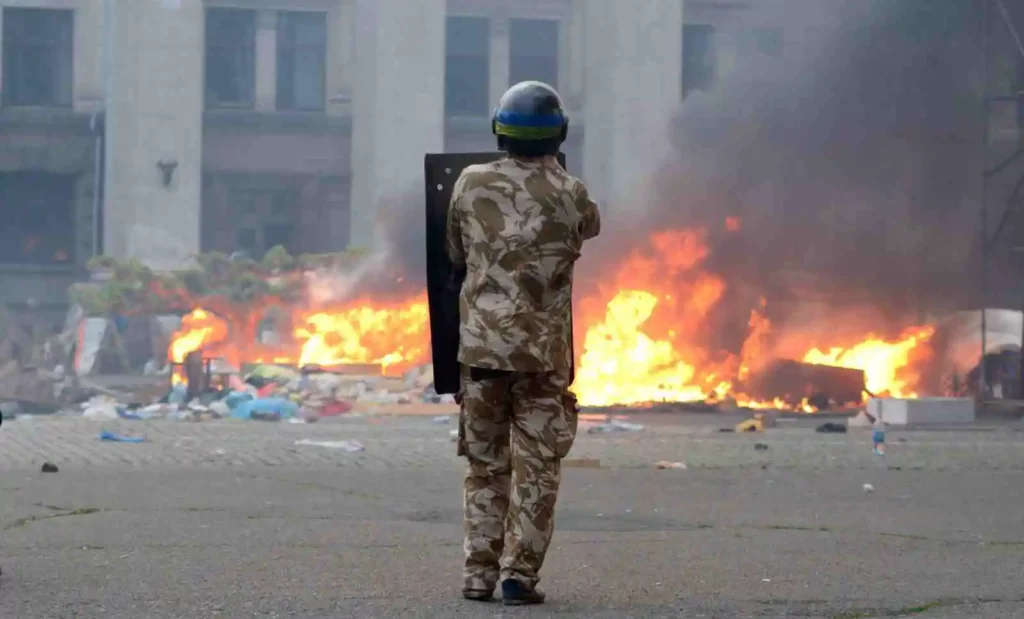
From pro-Russian demonstrations to a plan to seize power


The case concerns one of the most tragic and most propagandistically exploited episodes in Odessa’s modern history. The events of May 2, 2014 have for years been the subject of political disputes, manipulation, and Russian propaganda. Now Ukrainian investigators have presented findings concerning the people who were supposed to prepare the ground for a separatist project in the city, finance pro-Russian structures, and take part in actions leading to an escalation of the conflict.
The defendants’ bench is to be occupied by Valeriy Kaurov, a pro-Russian social activist and head of the “One Fatherland” organization; Andriy Novikov, secretary of the Odesa eparchy of the Ukrainian Orthodox Church of the Moscow Patriarchate; and Denys Yatsiuk, one of the leaders of the pro-Russian “Anti-Maidan” movement linked to the camp at Kulikove Field. According to investigators’ findings, all three cooperated with the Russian side, received financial resources from it, and carried out the tasks assigned to them.
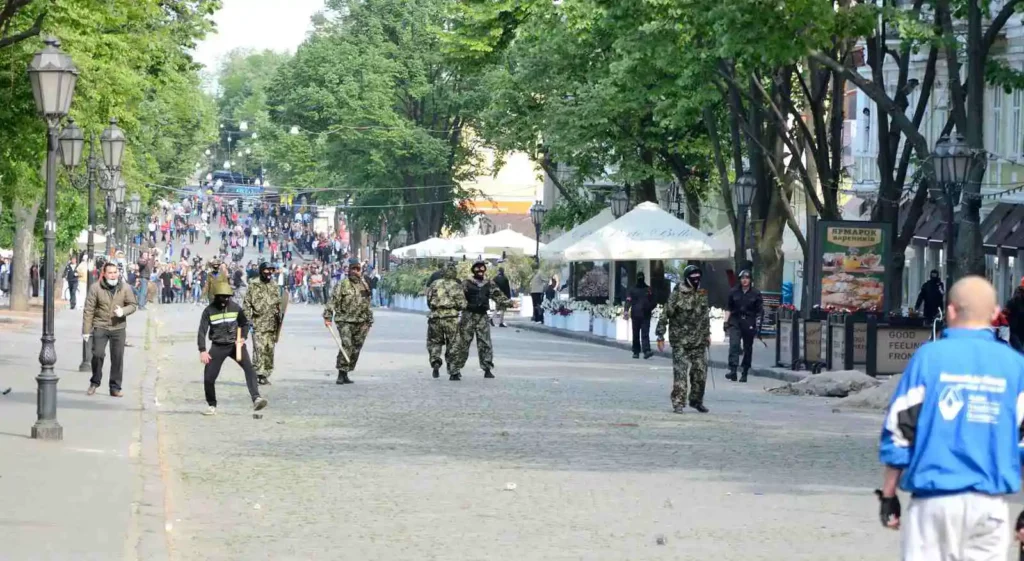
The prosecution accuses them of treason and of attempting to undermine Ukraine’s territorial integrity and inviolability. According to the collected materials, the accused were to receive about $40,000 from the Russian Federation. However, it was not solely about financing demonstrations or disseminating pro-Russian slogans. Investigators describe an extensive operating mechanism, including organizing mass gatherings, maintaining the camp at Kulikove Field, promoting the idea of the so-called Russian world (Russkiy Mir), challenging the legitimacy of the Ukrainian authorities, and attempts to bring about the creation of a separatist republic.
The case materials also contain information about inflated financial settlements, payouts to the organizers and participants of the camp, money transferred for the needs of church structures, and agreements with representatives of the militia. It is precisely this combination of political inspiration, money, and consent for unlawful actions that constitutes one of the most important threads of the entire investigation.
March 3, 2014. The first serious attempt to implement the Russian сценарий
Pro-Russian activity in Odesa did not begin on the day of the tragedy at Kulikove Pole. Its organizers had been active much earlier, and the beginnings of the story described in the investigation go back at least to the end of February 2014. At that time, according to investigative findings, the defendants cooperated with representatives of Russian political structures and organized mass gatherings in Odesa, during which participants called on the Russian authorities to send troops into Ukraine. The official justification was supposed to be the alleged need to protect the Russian-speaking population.
Of particular importance was the rally on March 3, 2014, organized in front of the building of the Odesa Regional State Administration. Two months before the tragic events at Kulikove Pole, thousands of pro-Russian activists gathered there. The Ukrainian state flag was taken down from the pole in the nearby square, and a Russian tricolor flag was hung in its place. Then there was an attempt to seize the administration building by force. Supporters of the Anti-Maidan also tried to pressure the deputies into calling a referendum that could have repeated the scenario known from Crimea, illegally annexed by Russia. The plan was to undermine Ukrainian sovereignty and create conditions for separating the region from the state.
This time the undertaking ended in failure. The deputies refused to support the separatist demands. Pro-Russian activists were forced to take down the Russian flag and re-hang the Ukrainian one. This symbolic moment can be regarded as the defeat of the project that Russian propaganda called the “Russian Spring” and linked to the concept of Novorossiya. Among the representatives of the pro-Russian side was Valeriy Kaurov. According to investigative findings, after the failed attempt to seize power, the accused received about $40,000 from representatives of the aggressor state. Despite the defeat on March 3, the separatist project was not abandoned. The method of operation was changed, and one of its most important elements became the camp on Kulikovo Field.
Kulikovo Field
In March and April 2014, a camp associated with the “Orthodox squad” and the “Odesa squad” groups was organized on Kulikovo Field. It was precisely there that the ideas of the so-called Russkiy Mir, that is, the Russian world, were promoted; a shared cultural and economic space of Ukraine and Russia was advocated; and at the same time the legitimacy of the authorities in Kyiv was undermined.
Over time, the activities of some camp participants ceased to be limited to propaganda. Members of pro-Russian groups began to get involved in clashes with representatives of national-patriotic circles associated with Euromaidan.
According to the investigation’s findings, the organizers of the tent camp were primarily Valeriy Kaurov and Denys Yatsiuk. Its core consisted of the two aforementioned organizations, and funds for its activities were to flow through church structures.
Particularly interesting is a document titled “Information-report,” dated April 10, 2014, obtained by the CyberAlliance hacker group. The information it contains concerns the financing of the Orthodox part of the camp. According to the document, $40,000 was allocated for this purpose, which was collected directly by Oleksandr Yakymenko, described as Kaurov’s “officer.” The accounting raises serious doubts. Yakymenko wrote in it about three large tents, although in reality only one belonged to the Orthodox part of the camp. The others were used by other organizations. The documentation also indicated the existence of an “Orthodox squad” numbering more than 200 people.
However, this is only the beginning of the financial details that were revealed during the analysis of the documents. According to the presented accounting, 40 rank-and-file members of the squad were to receive $35 per day each. Another 20 people, who allegedly stood guard around the clock and lived in three tents, were to receive $50 per day each. Money was also earmarked for the camp’s leadership. The commandant was to receive $60 per day, and his deputy responsible for Orthodox-ideological matters $50. The accounting also included a cook who was to prepare three meals a day for 65 people. Food costs were estimated at $18 per day per person. In addition, $100 per day was allocated for the camp’s operational needs. Ultimately, Yakymenko accounted for spending more than $90,000.
Comparing these amounts with information about the actual number of tents and participants raises questions about the credibility of the documentation. The presented accounts indicate that the camp’s financing was far more extensive than might follow from the picture of an ordinary political protest.
It is worth emphasizing that the documents describe not only the expenses for maintaining the participants. They also show the camp’s organizational structure, its leadership hierarchy, and the mechanism for paying out funds. That is precisely why they are an important element of the material that makes it possible to reconstruct how pro-Russian structures in Odesa functioned in the spring of 2014.
Church tithe
Within the entire financing mechanism, the church-related thread occupies a special place. According to the case materials, in line with the accepted custom, the tithe—i.e., 10% of the funds received—was to go to the Ukrainian Orthodox Church of the Moscow Patriarchate.
Andrii Novikov, the secretary of the Odesa eparchy of this church structure, was to receive, among other things, $4,000 for “support from the Odesa eparchy.” This information is significant because Novikov was not merely a person connected with the religious milieu who appeared at pro-Russian demonstrations. According to investigators, he was to have participated in organizing the financing of the Odesa Anti-Maidan from Russia via church channels. In this way, religious, political, and organizational structures were to form an interconnected system. Funds earmarked for separatist activity went to the camp, and part of the money was passed on to those responsible for church support.
Valerii Kaurov. An activist who for years maintained contacts with Russia
One of the central figures in the case is Valeriy Kaurov, a pro-Russian social activist and politician known in Odesa, as well as the leader of Orthodox associations linked to the Ukrainian Orthodox Church of the Moscow Patriarchate. His political activity did not begin in 2014. As early as 2004, he organized protests against the return of Eduard Hurwitz to the post of mayor of Odesa. At the same time, he registered the virtual organization “One Fatherland”. According to information about his activities, he received money from the then mayor of Odesa, Ruslan Bodelan, as well as from the Odesa diocese of the Ukrainian Orthodox Church of the Moscow Patriarchate.
He established contacts with the Russian side long before the outbreak of the war. He was known for organizing protest actions against the Ukrainian language. Through church structures, he obtained funds to organize pro-Russian demonstrations, including the “I Speak Russian” action in 2006 and an event connected with the “Ribbon of Saint George” in 2007.
In April 2007, during one of the rallies in defense of the Russian language, Kaurov was doused with feces by opponents. This incident became one of the episodes of his many years of activity in the city’s increasingly polarized political life.
Kaurov also advocated the federalization of Ukraine, presenting it as a political solution that in practice was meant to lead to a weakening of Ukrainian statehood. After breaking off contacts with Ihor Markov, a Verkhovna Rada of Ukraine deputy, later a convicted politician and one of the most active apologists of the Russian world, Kaurov lost two important sources of funding: Rossotrudnichestvo and the Odesa diocese of the Ukrainian Orthodox Church of the Moscow Patriarchate.
His Moscow handler was supposed to be Kyrylo Frolov, head of the Association of Orthodox Experts of the Russian Orthodox Church of the Moscow Patriarchate, who cooperated with Konstantin Zatulin, a deputy of the Russian State Duma known for his Ukrainophobic views. At the end of February 2014, Frolov urgently flew to Odesa. Soon after, there was a fundamental change in the rhetoric and actions of the local Antimaidan. The coincidence of these events is an important element of the picture of relations between Russian political circles and separatist activists in Odesa.
A call to Moscow and the dream of their own republic
On 3 March 2014, Kaurov, together with one of the leaders of the pro-Russian movement, Anton Davydchenko, burst into a session of the Regional Council. The meeting was taking place in the building on Shevchenko Avenue, which had been blocked by supporters of pro-Russian activists.
The attempt to take control of the proceedings was thwarted by deputy Oleksii Honcharenko, his friend and associate Mykhailo Shmushkovych, and Oleksandr Borniakov, who in later years became Deputy Minister of Digital Transformation of Ukraine. They pushed the Antimaidan representatives out of the session hall.
Euromaidan activists who arrived at the scene, however, did not allow the administration building to be taken over. Despite pressure from the conspirators, the regional council did not declare the “Odesa People’s Republic” and did not set a date for a separatist referendum. According to findings, during these events Kaurov phoned Moscow—calling the office of an assistant to Vladimir Putin—and demanded help. This episode shows how important support from Russian political structures was for the local separatists.
On 21 April 2014, Kaurov declared himself the leader of the so-called Odesa People’s Republic. Earlier, during a stay in Moscow, he signed a resolution appealing to Vladimir Putin to send troops into Ukraine, allegedly to protect the population from “Bandera terror.” The Russian TV channel LifeNews, loyal to separatist actions in eastern Ukraine and supporters of its federalization, reported his decision.
The events of 2 May became the next stage in this story. According to Kaurov’s account, later presented to Russian media, his aides were to break down the doors of the Trade Unions building and instruct people to go inside, after which they themselves barricaded themselves on the roof. During the riots, Kaurov was also said to have spread false information about Russian tanks from Transnistria, which allegedly crossed Ukraine’s border and were heading toward Odesa. He remained in constant contact with Colonel Oleksandr Yakymenko, the commandant of the tent camp. According to materials regarding his activities, he knew about the events and gave the commandant specific instructions.
After fleeing from Odesa to Moscow, Kaurov, through Russian media, declared himself president of the so-called Odesa People’s Republic. This declaration, however, met with hostility from some Anti-Maidan activists, and the Orthodox organization linked to Kaurov lost what remained of its authority.
Kyrylo Frolov’s correspondence further indicates that in the summer of 2014 Kaurov was seeking funding for the project “Protection of traditional family values,” carried out by the organization “One Fatherland.” For six months of activity he needed 116 thousand dollars.
Kaurov currently lives in Moscow. He appealed to the President of the Russian Federation, Vladimir Putin, with a request to grant him Russian citizenship.
Andrii Novikov. Church channels of financing and earlier controversies
Another of the accused is Andriy Novikov, secretary of the Odesa eparchy of the Ukrainian Orthodox Church of the Moscow Patriarchate. His name had previously appeared in connection with internal church scandals involving demands for bribes from clergy—primarily from rural parishes—for the benefit of the eparchy leadership. The priests from whom money was demanded openly pointed to Novikov.
His name surfaced again in March 2014, when Anton Davydchenko—one of the leaders of pro-Russian activists in Odesa—was detained. Asked about the sources of separatist funding, Davydchenko also mentioned Novikov. The eparchy secretary then hurriedly left Odesa and went to Moscow. There he claimed that his phone calls with Davydchenko were supposed to have been tapped by Ukrainian special services. Ukrainian investigators, however, determined that Novikov had indeed been organizing funding for the Odesa Anti-Maidan from Russia, using church channels to do so. In light of the other case materials, the information about money transferred as part of the tithe and about $4,000 paid out for support from the Odesa eparchy takes on particular significance.
The Novikov thread shows that, according to investigators’ findings, the financing of pro-Russian activities was not limited to direct transfers between political organizers. It was also to have used structures that formally dealt with religious activity.
Denys Yatsiuk. Separatist calls from occupied Crimea
The third accused is Denys Yatsiuk, one of the leaders of the Odesa group linked to a pro-Russian paramilitary organization and an initiator of the creation of the so-called Odesa People’s Republic.
In April 2019, the Primorsky District Court in Odesa sentenced him in absentia to five years in prison. According to investigators’ findings, while staying in Russia-annexed Crimea, Jaciuk recorded a video in which he publicly called for a separatist movement in Odesa and other Ukrainian cities. The goal was to separate the south-eastern regions from Ukraine and create the Republic of Novorossiya. In the recording, Jaciuk admitted the defeat of pro-Russian forces in Odesa, and at the same time called for supporting their actions in Sloviansk, which had then been taken over by Russian militants. He was accused of violating Ukraine’s territorial integrity and inviolability. During the court proceedings, eight witnesses testified that he took part in the tragic events of May 2, 2014, and supported separatists operating in Donbas. The Security Service of Ukraine was instructed to detain the convicted man and bring him to a penal facility. However, Jaciuk remains beyond the reach of Ukrainian law enforcement authorities.
Dimitrij Fuchedzhi and the agreement that was meant to paralyze the militia’s intervention
One of the most alarming threads of the case is the findings regarding contacts between pro-Russian militants and representatives of the law-enforcement structures of the time.
The files mention the name of Dimitrij Fuchedzhi, former deputy head of the Main Directorate of the Ministry of Internal Affairs of Ukraine in the Odesa region, who was responsible for public security. He is another fugitive, previously convicted in absentia.
According to investigators’ findings, pro-Russian groups reached an agreement with him not to undertake intervention against their unlawful activities. Earlier, the defendants were said to have agreed with a representative of the militia that it would not hinder them in carrying out their plans. The former officer has already been held criminally liable for this offense and convicted in separate proceedings.
This very element may be crucial to understanding why the situation in Odesa spiraled so dramatically out of control. If the organizers of the violence could count on the lack of effective intervention by the services, their ability to act increased significantly. So the case is not solely about the actions of the separatists themselves, but also about the responsibility of those who were supposed to safeguard public security. The findings concerning an agreement with Fuchedzhi indicate that the case also requires looking at the role of state institutions and the people responsible for public order.
What happened after the tragedy? More than $11,000 for a memorial ceremony
Financing of pro-Russian structures did not stop after May 2, 2014. An example is the memorial ceremony organized on June 8, forty days after the tragedy. The preserved cost estimate for the event, bearing the names and signatures of Artem Dawydchenko and Yurii Neustroiev, indicates that its cost exceeded $11,000. That day, 48 black balloons were released into the sky, one for each victim of the events of May 2. However, the estimate provided for the purchase of as many as a thousand balloons for a total of $2,000.
This discrepancy is another detail that draws attention when analyzing the financial documentation. As with the settlements for the camp at Kulikove Pole, questions arise about the method of calculating expenses and the actual use of the money being transferred. It is also worth noting that Yurii Neustroiev, described as an “Orthodox journalist,” ran in 2015 for the Oblast Council on behalf of the “Our Country” party.
The thread of the mourning ceremony shows that the documents concerning the activities of pro-Russian circles cover not only the period immediately preceding the tragedy, but also later events. They make it possible to trace how these circles operated, who took part in organizing their undertakings, and what amounts appeared in the settlements.
Trial in absentia. The accused are hiding in Russia and in the occupied territories
Ukrainian investigators have completed the pre-trial proceedings concerning the three main accused. The charges include high treason and an attempt on the territorial integrity and inviolability of Ukraine, committed by a group of persons acting in collusion. The legal classification cites Article 111(1), Article 110(2), and Article 28(2) of the Criminal Code of Ukraine. Because the accused have for a long time been hiding in the territory of the Russian Federation or in the temporarily occupied areas of Ukraine, the pre-trial proceedings were conducted in the in absentia procedure, i.e., in the absence of the suspects.
The case will go to court without their participation. This does not mean, however, that all charges can be treated as finally adjudicated. With regard to Kaurow, Nowikow and JacIuk, their liability in this case is to be decided by the court, which will assess the collected evidence. It is also important that Jacuk had already previously been convicted in absentia in separate proceedings, and Fuchedzhi had previously been convicted in a separate case. These rulings should be distinguished from the new trial concerning the charges brought against the whole trio.
A long road to the tragic events in Odesa on May 2, 2014
The story of the so-called Russian Spring in Odesa in 2014 did not begin on May 2. Earlier there were demonstrations calling for an intervention by Russian troops, an attempt to seize the administration building by force, a Russian flag on a mast in a Ukrainian city, demands for a referendum, the activity of the camp on Kulikove Pole, and funding for organizations promoting the concept of Novorossiya. There were also contacts with Russian political structures, money transferred through church channels, settlements raising serious doubts, and agreements with representatives of the police, who were supposed not to react to the unlawful actions of pro-Russian groups.
In this puzzle, three names play a special role: Valeriy Kaurov, Andriy Novikov, and Denys Yatsiuk. Each of them was to perform a different function, but according to investigators they were connected by a common goal and cooperation with the Russian side. Kaurov was the political organizer and the face of the separatist project, Novikov was to be responsible for using church channels for financing, and Yatsiuk was among the leaders of pro-Russian structures operating on the ground.
The findings concerning the camp, in turn, show that behind the slogans about defending the Russian-speaking population and cultural community there was a mechanism that required money, organization, logistical support, and cooperation with people who had influence in state institutions. That is precisely why the conclusion of the investigation matters beyond the trial of the three defendants itself. It is about reconstructing the mechanism by which external interference, local political ambitions, propaganda, and the inaction of part of the services could lead to such tragic consequences.
For years, Russian propaganda has portrayed the events of May 2 as evidence of Ukraine’s alleged hostility toward Russian-speaking residents. Meanwhile, the material gathered in the case indicates that they should also be viewed through the prism of earlier attempts to destabilize Odesa and to build a separatist project supported from Russia. A reliable explanation of the tragedy requires not only determining what happened that day, but also examining who laid the groundwork for the escalation, where the money came from, who benefited from that funding, and why those responsible for public security did not prevent the disaster. Only a full accounting of these mechanisms can help separate facts from propaganda and restore the Odesa events to their real historical context.
Judgment of the European Court of Human Rights of 13 March 2025
The events of 2 May 2014 ended with the deaths of 48 people and injuries to hundreds more. The tragedy later became one of the main tools of Russian propaganda directed against Ukraine.
On 13 March 2025, the European Court of Human Rights delivered a judgment concerning the tragic events in Odesa, often used in Russian propaganda.
The ECtHR found that Ukraine had violated Article 2 of the European Convention on Human Rights by failing to prevent the escalation of clashes and by not conducting an effective investigation. It also pointed to negligence by the police and the fire service, and awarded compensation to the families of the victims and the survivors.
However, the Court did not find deliberate destruction of evidence by the authorities, nor did it accept the claim that the victims were exclusively ethnic Russians killed by Ukrainian nationalists. Among those killed were activists from both sides of the conflict.
The ECtHR also emphasized the role of Russian propaganda in stoking tensions and destabilizing the situation in Odesa. This is a fact often omitted in narratives that manipulate public opinion.
Sources: Dumskaya, 12 October 2026; / Office of the Prosecutor General, 12 October 2026; / Judgment of the European Court of Human Rights of 13 March 2025 “Vyacheslavova and Others v. Ukraine”; Borys Tynka, Odessa 2 May 2014. The bloody trail of the Russian spring, e-bookowo Publishing, 2024.
Journalist, columnist, author of books about Ukraine, tour guide, and commentator on developments in Ukraine and Polish-Ukrainian relations.
A certified guide to Odesa, the Odesa catacombs, Ukrainian Bessarabia, and Kyiv. He is the author of numerous publications on Ukraine’s history, culture, and contemporary affairs, some of which have been translated into Ukrainian and published in Ukraine. In 2020, he received the honorary title of Ambassador of Odesa in Poland from the Mayor of Odesa.
On 24 February 2022, the day Russia launched its full-scale invasion of Ukraine, he was in Odesa. He remained there for several months, helping coordinate humanitarian aid and reporting on the war for Polish media outlets. He described his experiences during this period in his book Odessa 4.5.0.
At Nowiny Wschodnie, he publishes articles and commentary on the Russo-Ukrainian war, Russian propaganda and disinformation, Ukrainian history, particularly that of Odesa, as well as Polish-Ukrainian relations and changing public attitudes.
He collaborates with Ukrainian newsrooms and online news outlets and appears in Polish media as a commentator on Ukrainian affairs.

What do you think about this story?
Join the conversation. Please keep comments relevant to the article.
Write a comment