

U.S. military forces have seized the Russian oil tanker Marinera (formerly known as Bella 1), which was linked to a shipment of crude oil from Venezuela, Reuters reported, citing sources familiar with the operation.
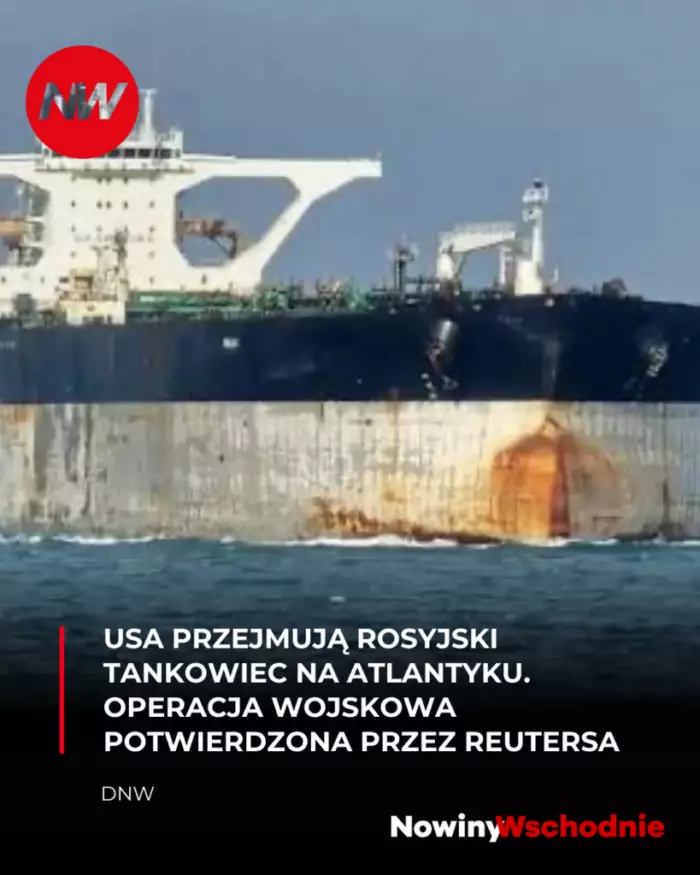


The raid took place in the Atlantic Ocean after more than two weeks of monitoring and chasing the vessel. According to Reuters, the decision to seize the vessel was made after the tanker had left the US naval blockade off the coast of Venezuela.
Denied boarding
Previously, the tanker’s crew had repeatedly rebuffed attempts by the US Coast Guard to board the vessel for inspection. Only after the vessel had left the blockade zone was the decision made to use military force.
Air-shielded operation
The tanker’s capture was carried out by a US landing force and secured by air. The operation involved, among others:
– KC-135T Stratotanker refueling aircraft,
– Boeing P-8A Poseidon maritime patrol aircraft,
– Pilatus U-28A Draco special purpose aircraft.
According to Reuters sources, Russian warships and a submarine were in the immediate vicinity of the tanker, but they did not take any action in response to the American operation.
Risk of escalation of tensions
Reuters points out that the seizure of the Russian tanker may exacerbate tensions in relations between the United States and Russia, especially in the context of:
– energy sanctions,
– transport of Venezuelan oil,
– military competition in international waters.
At this time, neither Washington nor Moscow have issued official, detailed statements, but experts emphasize that the incident has political and military potential that goes beyond the naval operation itself.
Source: Reuters

Journalist and Editor-in-Chief of Nowiny Wschodnie, a news platform followed by more than 140,000 people on social media. A graduate in Journalism and Social Communication, he has been co-creating and developing Nowiny Wschodnie since 2017. He gained professional experience working with local and international media.
He specializes in fact-checking, countering disinformation and propaganda, and information security. His work focuses on Poland, Ukraine, Eastern Europe, and Polish-Ukrainian relations. He is also the founder of a non-profit organization working in the fields of integration and intercultural dialogue.