
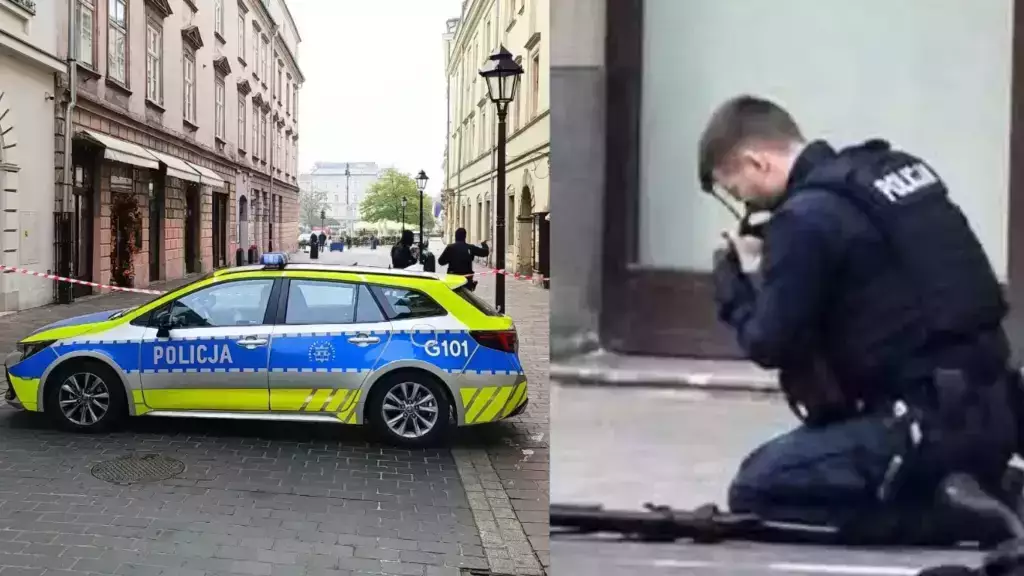
Six people are dead, several others have been injured, and two young police officers are fighting for their health after surgeries. Krakow experienced yesterday one of the most tragic Saturdays in its recent history. Meanwhile, even while the rescue operation was still underway, public accusations appeared that the police had fled the scene and did not respond to the threat. However, the official chronology presented by the Police Chief Commander shows a completely different picture.
Tragic Saturday in Krakow. Six people dead


Saturday, November 7, 2026, will long remain in the memory of Krakow residents. At around 3 p.m., an armed 24-year-old man drove a car onto the Main Market Square and began shooting at random people. A drama began, the consequences of which proved tragic. Six people were killed and several others were injured. Among the injured were also police officers who intervened against the attacker.
The perpetrator was shot and detained by officers. He was taken to hospital in critical condition. According to information provided by the authorities, he was a Polish citizen, a resident of the Świętokrzyskie Voivodeship.
A many-hour operation by the services began in Krakow. The Main Market Square was closed, and the police, prosecutor’s office and medical rescuers began securing the site of the tragedy and determining the course of events.
15:00:15 – report. Three minutes later, police exchange fire with the attacker
In a situation as dramatic as Saturday’s events in Kraków, it is particularly important to separate facts from emotions and hasty judgments. That is why it is worth looking at the precise chronology presented by the Commander-in-Chief of the Police, Gen. Insp. Marek Boroń.
The first report of the shooting reached the Provincial Emergency Notification Center at 15:00:15. In total, dispatchers received about 40 reports concerning the incident. By 15:03 there was already an exchange of gunfire between the attacker and police officers. Thirty police units were dispatched to the intervention. The first to take direct action were two officers who were seriously wounded.
Crucially, these are not guesses or interpretations by people observing the events from some distance. This is information presented by the head of the Polish Police during a meeting of the crisis staff at the Małopolska Voivodeship Office.
It is worth pausing on these times. Less than three minutes passed from the first report to the exchange of gunfire. The officers did not wait for the situation to develop, did not passively observe events, and did not flee the scene of the threat. They intervened, risking their own lives.
Two young officers ended up on the operating table. According to the latest statement from the Commander-in-Chief, both underwent surgery, but their condition remained serious. It is precisely them we should especially remember today, before we start repeating unverified accusations about the police’s work.
Six victims, wounded police officers, and further unexplained circumstances
According to information presented by the Commander-in-Chief of the Police, six people were killed in Saturday’s attack: four women and two men. The identities of four victims were confirmed—three Polish women and a citizen of the United Kingdom. The identities of the remaining two people had not yet been established. The total of 16 injured also includes the perpetrator himself. Among the wounded were two police officers.
Another important thread is the situation in Ostrowiec Świętokrzyski, where the perpetrator lived. In his home, the bodies of three people were found—two women and a man. Prime Minister Donald Tusk reported that they may be the attacker’s closest family members. The spokesperson for the Police Commander-in-Chief, Andrzej Fijołek, told PAP that it is probably his parents and sister. However, the final determinations regarding the identity of these people and the circumstances of their deaths belong to the investigators.
The perpetrator had a firearms permit and had not previously been convicted. The origin of the weapon used during the attack is under investigation.
Interior Minister Marcin Kierwiński spoke about the attacker’s possible fascination with far-right ideologies. However, this is not the same as establishing the motive for the attack. The prosecution and special services are examining the man’s past, any possible connections, and the possibility of involvement or inspiration by other people. At this stage, there is no confirmation that the attacker had accomplices.
It is also not allowed to link the discovery of the three bodies in Ostrowiec with the events in Kraków in a way that runs ahead of the investigators’ findings.
Disinformation after the tragedy: when rumor gets ahead of facts
The tragic events in Kraków almost immediately became the subject of numerous comments and speculations on the internet. Questions appeared about the presence of the police, the alleged origin of the attacker, his motives, and the possible involvement of other people. Some of this information was not confirmed in official statements from the services. Particularly dangerous was the spreading of reports about the alleged involvement of foreigners before investigators established the basic facts. In this case, the perpetrator turned out to be a Polish citizen.
Tragedies like the one in Kraków are fertile ground for disinformation. All it takes is to pull a single piece of information out of context, add one’s own interpretation, and spread it on social media. That is why it is so important not to share unverified messages concerning the victims, the perpetrator, the motives of the attack, or the actions of the police. Unconfirmed reports can quickly take on a life of their own, causing unnecessary fear, reinforcing prejudice, and undermining trust in state institutions. Disinformation does not help the victims, does not support the injured, and does not make the work of the services easier. On the contrary—it can further deepen the chaos that already accompanies every such tragedy.
National mourning and responsibility for words
President Karol Nawrocki signed a regulation on national mourning. It will apply on Sunday, 8 November, and Monday, 9 November. Earlier discrepancies regarding the dates have thus been clarified. In Kraków, the Main Market Square remains closed, and services are still working in its vicinity. Evidence is being secured and all circumstances of the tragedy are being clarified.
At moments like this, it is especially important to rely on official statements and not to amplify information that no one has confirmed. This applies both to the alleged identity of the victims, the perpetrator’s motives, and stories about supposed accomplices.
The tragedy in Kraków also shows how quickly accusations that are not supported by facts can appear on social media and in media coverage. Before anyone manages to verify the situation, false information can reach thousands or even millions of recipients.
Information from the author: The article presents the state of knowledge based on announcements and publications available up to the late hours of 7 November 2026. The perpetrator’s motive, the circumstances of the deaths of three people in Ostrowiec Świętokrzyski, and any possible links of the attacker require further findings by the prosecutor’s office.
Sources: Eastern News
Journalist, columnist, author of books about Ukraine, tour guide, and commentator on developments in Ukraine and Polish-Ukrainian relations.
A certified guide to Odesa, the Odesa catacombs, Ukrainian Bessarabia, and Kyiv. He is the author of numerous publications on Ukraine’s history, culture, and contemporary affairs, some of which have been translated into Ukrainian and published in Ukraine. In 2020, he received the honorary title of Ambassador of Odesa in Poland from the Mayor of Odesa.
On 24 February 2022, the day Russia launched its full-scale invasion of Ukraine, he was in Odesa. He remained there for several months, helping coordinate humanitarian aid and reporting on the war for Polish media outlets. He described his experiences during this period in his book Odessa 4.5.0.
At Nowiny Wschodnie, he publishes articles and commentary on the Russo-Ukrainian war, Russian propaganda and disinformation, Ukrainian history, particularly that of Odesa, as well as Polish-Ukrainian relations and changing public attitudes.
He collaborates with Ukrainian newsrooms and online news outlets and appears in Polish media as a commentator on Ukrainian affairs.
What do you think about this story?
Join the conversation. Please keep comments relevant to the article.
Write a comment