
The story of a 14-year-old boy who suffered injuries during an incident involving a group of masked individuals in Ukraine has taken on a life of its own online. Recordings showing the teenager became the subject of commentary and accusations, and his case began to be used in anti-Ukrainian messaging. Nowiny Wschodnie obtained recordings in which the boy personally presents his version of events and objects to the way his story is being used.
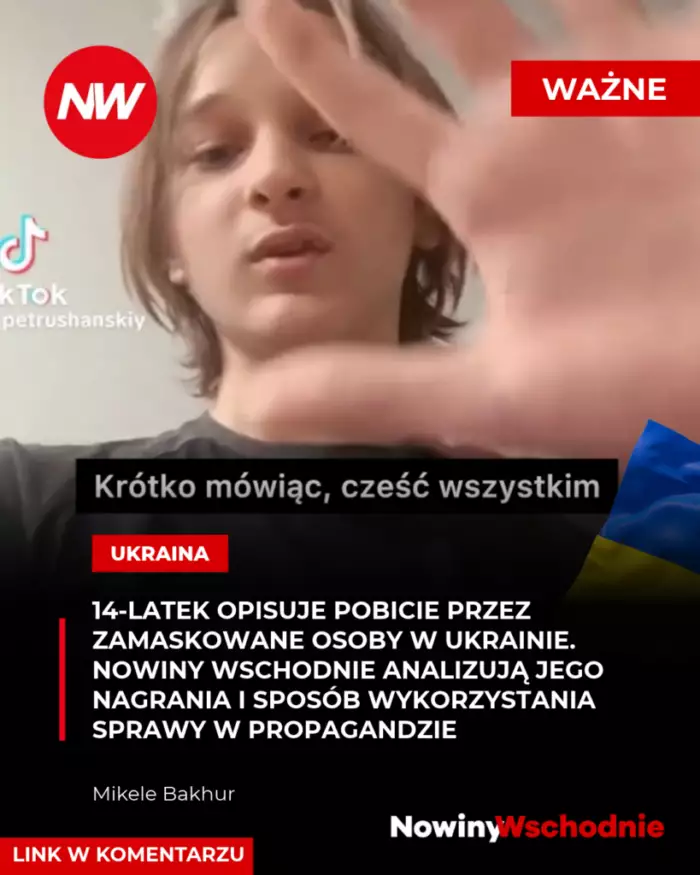
The boy who did not want to become a propaganda figurehead


The 14-year-old found himself at the center of media attention after an incident in which he sustained physical injuries. Materials about the event began circulating on social media, prompting emotional reactions and discussions about the situation in Ukraine.
However, the story did not end with the first publications.
The teenager decided to speak up himself and present the circumstances of the incident. In a series of recordings, he talks about what, in his view, happened at the scene, what injuries he sustained, and how his story began to be presented by other people.
Nowiny Wschodnie obtained these materials to analyze the boy’s statements in their broader context, rather than relying solely on the fragments circulated online.
Particularly significant is the third part of his account. In it, the teenager opposes using his experience to create anti-Ukrainian narratives.
This is an important element of the whole story, because it shows the difference between what the boy wants to convey about his own experiences and the way his case may be presented to audiences.
What happened at the scene?
According to the account presented to the editorial team, the fourteen-year-old found himself in a place where a confrontation occurred with a group of people with covered faces.
According to his statement, these people were wearing balaclavas, which made it difficult to identify them.
In online discussions, accusations appeared directed at Ukrainian military structures, including the Territorial Centers for Recruitment and Social Support, known by the abbreviation TCK.
However, the mere appearance of such accusations is not proof that the people involved in the incident actually belonged to the indicated formation.
In his account, the boy does not present the masked attackers as clearly identified Ukrainian soldiers.
This distinction is crucial for a reliable presentation of the case.
Determining who the perpetrators were requires independent confirmation, not merely an interpretation of the recording or comments published on social media.
The injuries were real. They must not be overlooked
An important element of the teenager’s statement is the description of the injuries he was said to have sustained during the incident.
The boy mentions, among other things, skin damage, head injuries, and a damaged tooth.
These are not details that can be ignored just because his story was later used in a political or propaganda discussion.
Regardless of who the attackers were and how individual media outlets portray the incident, the issue of violence against a minor requires serious attention.
At the same time, the injured person’s account—even a very detailed one—does not replace medical documentation or the findings of the relevant authorities.
Therefore, the injuries described by the teenager should be distinguished from independently confirmed findings regarding their causes and perpetrators.
How was the boy’s story used in the media?
After information about the incident was circulated, the fourteen-year-old’s story began to appear in messages critical of Ukraine.
According to the account analyzed by the editorial team of Nowiny Wschodnie, the teenager himself noticed that he had become an unwanted protagonist of materials and comments used to build anti-Ukrainian narratives.
He refers to this particularly clearly in the third part of his recording.
The boy objects to presenting his experience as an argument against Ukraine and Ukrainians.
It is worth emphasizing that opposition to using one’s own story in propaganda does not mean denying the injuries suffered.
One can be a victim of violence and at the same time disagree with one’s own suffering being used to spread unconfirmed accusations against an entire state or nation.
Why is the full statement so important?
Modern social media enables the lightning-fast spread of short video clips.
A recording lasting a dozen or so seconds can provoke enormous emotions, even if it does not show the entire course of events.
In the case of the fourteen-year-old, it is particularly important to listen to all parts of his account.
Only then can one see how he himself describes the incident, what he says about his injuries, how he portrays the attackers, and why he objects to later media interpretations.
This does not mean that every statement by the subject automatically resolves all doubts.
It does mean, however, that his voice cannot be omitted, especially since he is the injured party.
Violence and propaganda. Two issues that must not be confused
In this story there are two separate problems.
The first concerns the incident itself: the circumstances of the use of violence against a minor, the nature of his injuries, and establishing the responsibility of specific individuals.
The second concerns how the event is used in the information space.
The fact that some recording is being circulated by pro-Russian media does not automatically mean that the injuries shown in it are fabricated.
Likewise, real injuries do not automatically confirm all the accusations that later appear in comments and publications.
A reliable analysis requires separating these issues.
One must neither downplay the boy’s suffering nor use it to assign responsibility to people and institutions without sufficient evidence.
What do we know, and what has still not been determined?
Based on the account presented to the editorial team, several important elements can be identified.
The central figure in the case is a 14-year-old boy who describes an incident involving masked individuals and the injuries he sustained.
The teenager recorded his own explanation, and in one of the subsequent parts he spoke critically about his story being used in anti-Ukrainian narratives.
However, the exact circumstances of the event, the identity of the participants in the confrontation, and the extent of the injuries documented medically still require independent confirmation.
Nor should all publications about the case be treated as equivalent to the victim’s original account.
The fourteen-year-old’s voice should be heard
The most important figure in this story is not politicians, commentators, or the authors of online publications.
It is a fourteen-year-old boy who describes the violence he experienced and tries to regain control over how his own experiences are presented.
His account deserves to be heard, and the circumstances of the event deserve a reliable clarification.
At the same time, the teenager’s opposition to the propagandistic exploitation of his story should be treated just as seriously as his statements about his injuries.
Nowiny Wschodnie emphasize: condemning violence against a child and opposing manipulation of his story are not mutually exclusive. On the contrary — both stem from the duty to respect the victim and from responsibility for the information conveyed.
Therefore, we encourage readers to ознакомиться with the boy’s full account, and not only with excerpts taken out of context.
He should have the opportunity to tell his own story — without putting words in his mouth that he did not say, and without using his suffering for purposes that he himself opposes.
Source: NW / TSN / Espreso
Journalist and Editor-in-Chief of Nowiny Wschodnie, a news platform followed by more than 140,000 people on social media. A graduate in Journalism and Social Communication, he has been co-creating and developing Nowiny Wschodnie since 2017. He gained professional experience working with local and international media.
He specializes in fact-checking, countering disinformation and propaganda, and information security. His work focuses on Poland, Ukraine, Eastern Europe, and Polish-Ukrainian relations. He is also the founder of a non-profit organization working in the fields of integration and intercultural dialogue.
What do you think about this story?
Join the conversation. Please keep comments relevant to the article.
Write a comment