

According to the latest reports, the United States government has proposed to transfer approximately 250 used Stryker armored personnel carriers to Poland for… a symbolic 1 dollar.
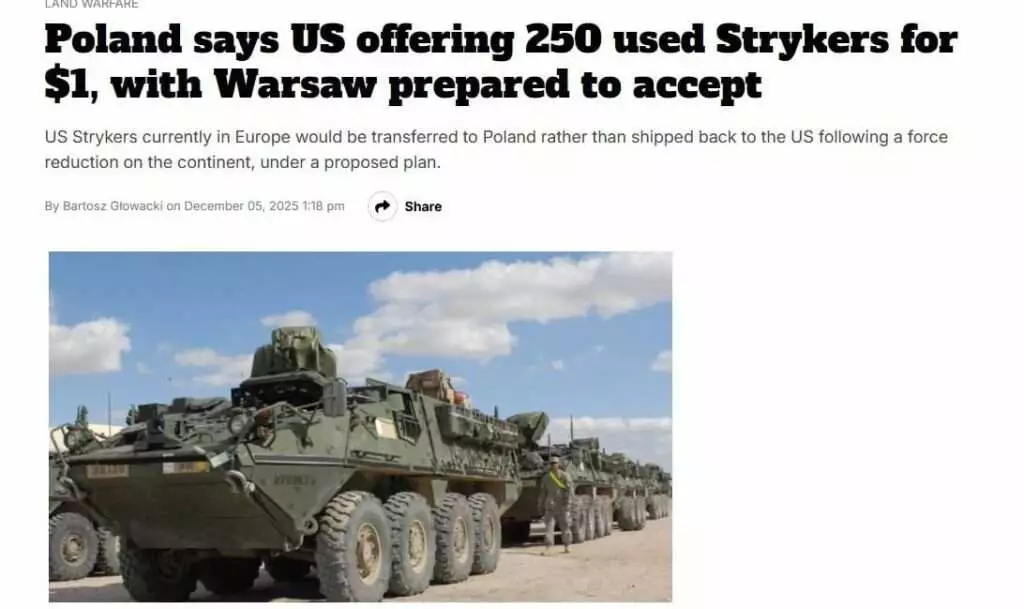


These vehicles are considered surplus by the US—parts of US forces in Europe are being reduced, and many Strykers were to be either returned to the US or transferred to “surplus” status. The plan proposes that, instead of transporting them to the US, they be transferred to Poland.
Formally, the donation would take place under the US mechanism for transferring surplus military equipment (the so-called Excess Defense Articles (EDA) program).
On behalf of the Polish government, Deputy Prime Minister and Minister of Defence, Władysław Kosiniak-Kamysz, confirmed that Poland is ready to accept this proposal — provided that logistical, technical and organizational issues are resolved in advance.
On behalf of the Polish government, Deputy Prime Minister and Minister of Defence, Władysław Kosiniak-Kamysz, confirmed that Poland is ready to accept this proposal – provided that logistical, technical and organisational issues are resolved first.
The Polish Army General Staff also expressed preliminary approval: in mid-November, it submitted a recommendation to the Technical Modernization Council regarding the adoption of Strykers.
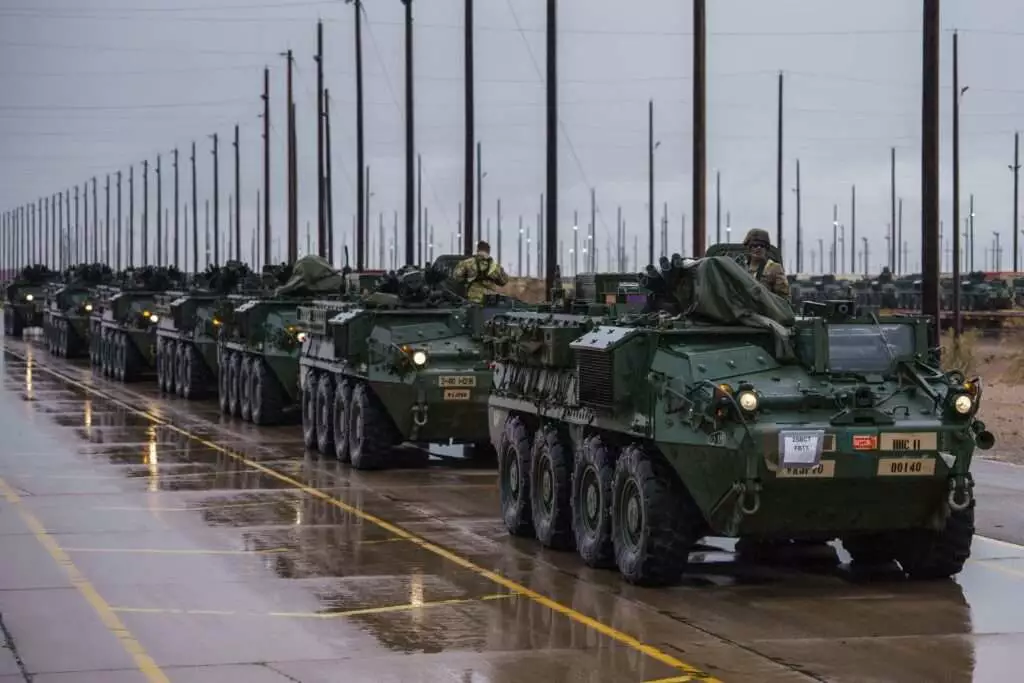
Photo credit: © GETTY | The Washington Post
The offer to donate 250 used Stryker armored personnel carriers to Poland for a symbolic dollar couldn’t go unnoticed. It sounds like the military’s version of a blockbuster sale: equipment that could significantly enhance the army’s capabilities, practically for free. But as is always the case with such offers, before someone says “we’ll take it,” you need to carefully examine what’s hidden between the lines.
What are the arguments for accepting this offer?
Firstly, it’s hard to hide the deficit of modern armored vehicles in the Polish Army. Much of the older equipment has been transferred to Ukraine or is naturally reaching the end of its service life. Additional Strykers could quickly and realistically enhance the combat capabilities of units, especially in the east of the country, where the needs are greatest.
Secondly, it’s difficult to find military equipment on the market at such a low price. Purchasing new armored personnel carriers is a huge expense, and the cost of acquiring the vehicles themselves is merely a formality. Even taking into account the necessary modernization work, we’re talking about a significantly cheaper solution than manufacturing new weapons from scratch.
Third, time is of the essence. The defense industry typically moves slowly, and the security situation in the region requires swift action. The Strykers are already in Europe, allowing for their introduction into service much more efficiently than equipment that has just been ordered.
What risks should be considered?
First and foremost, hidden costs. Transport, repairs, spare parts, and adapting vehicles to Polish requirements can significantly increase the total cost of operations. In the past, many countries have learned that “free equipment” can later prove to be a significant financial blow.
The second issue is the impact on the Polish defense industry. Important programs such as the Rosomak and Borsuk are under development in the country. Importing a large number of used vehicles from overseas could limit the number of orders for domestic companies, which would negatively impact skills and jobs built over the years.
Logistics also cannot be ignored. Each additional type of vehicle in the army means a new category of spare parts, training, and technical procedures. The diversity of equipment in the Polish Army is already considerable, which affects the pace and cost of its maintenance.
What condition are the vehicles offered in?
This requires detailed evaluation. Strykers are considered valuable, but until experts verify their technical condition, it’s impossible to determine whether they will be capable of front-line operations or whether they will be used more as supplemental or training equipment. If they require extensive modifications, this could significantly alter the cost-effectiveness balance.
Why is this offer appearing now?
The United States is reorganizing some of its forces stationed in Europe. Maintaining surplus vehicles or transporting them overseas would generate significant costs for them. Transferring the equipment to Poland simultaneously strengthens NATO’s eastern flank and provides the Americans with tangible savings. This is a win-win situation for both sides.
Conclusions
The Stryker offer has its advantages: a rapid increase in military capacity, low acquisition costs, and a tangible improvement in national security. At the same time, it raises serious questions regarding long-term expenditures, logistics, and the consequences for the domestic defense industry.
It is therefore crucial to conduct a full cost analysis and determine the realistic potential for using these vehicles. If the final balance is favorable, it may be worthwhile to consider additional reinforcement of the land forces. However, if real life proves that a nominal sum is only the prelude to enormous expenditures, the decision must be made with great caution.

Journalist and Editor-in-Chief of Nowiny Wschodnie, a news platform followed by more than 140,000 people on social media. A graduate in Journalism and Social Communication, he has been co-creating and developing Nowiny Wschodnie since 2017. He gained professional experience working with local and international media.
He specializes in fact-checking, countering disinformation and propaganda, and information security. His work focuses on Poland, Ukraine, Eastern Europe, and Polish-Ukrainian relations. He is also the founder of a non-profit organization working in the fields of integration and intercultural dialogue.