

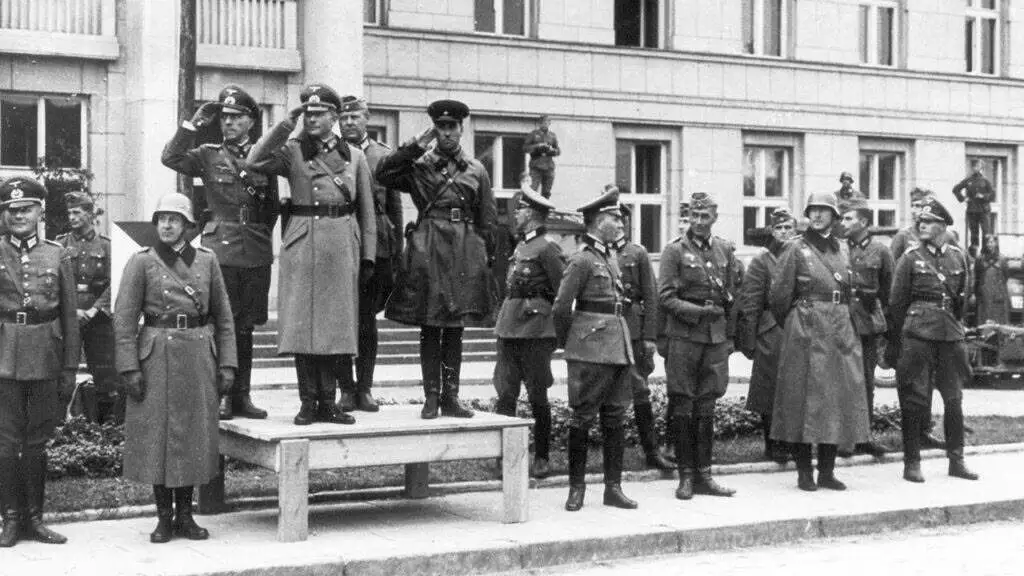


The problem of semantic and historical manipulation regularly resurfaces in Polish public discourse surrounding the anniversaries of 1939. Extremist groups and those inheriting the Russian narrative attempt to relativize the events of September 17th, employing impersonal concepts or pretending that the Soviet Union was an unrealistic entity, unconnected with Russian state and imperial continuity. Meanwhile, the aggression of September 17th was a direct consequence of a formal military-political alliance concluded in the Kremlin. It’s important to remember that the offer of an alliance to Germany came from Soviet Russia. It was they who proposed an alliance and a division of spheres of influence to Hitler. Doesn’t this resemble Russia’s current policy? The answer is so simple that it won’t even be mentioned here. There’s no point; facts are not discussed. Facts are presented.
The Pact on the Division of Europe: From the Baltic to Bessarabia
On August 23, 1939, an agreement known in Poland as the Molotov-Ribbentrop Pact and in world historiography commonly referred to as the Hitler-Stalin Pact was signed in Moscow. Its essence was a secret additional protocol in which the two totalitarian powers carved up Central and Eastern Europe into spheres of influence.
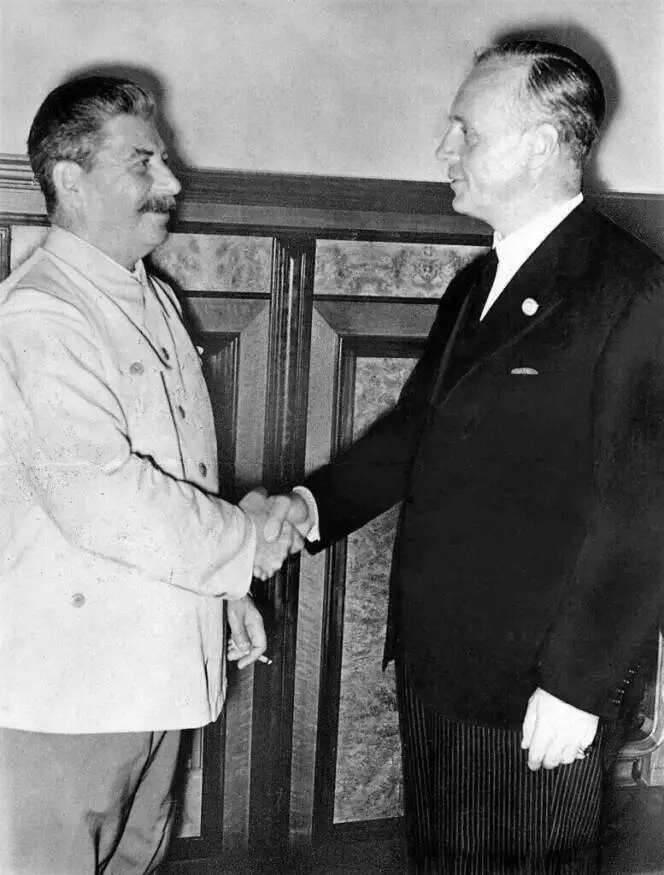
The attack on Poland was only the first stage in implementing this agreement. The signed document gave Russia a free hand to pursue its imperial claims against its remaining neighbors:
- Baltic countries (Lithuania, Latvia, Estonia): They were forced to sign so-called mutual assistance treaties and accept Red Army military bases, which in the summer of 1940 led to their full annexation, rigged “elections” and mass deportations of citizens to Siberia.
- Finland and the Winter War (1939–1940): Russia demanded Finland’s vassalage and cede its territories. Finland refused, so in November 1939, the USSR began hostilities with the bombing of Helsinki. Despite massive losses on the Russian side, Finland was forced to cede some territory (including the Karelian Isthmus), though it managed to defend its independence. It’s worth noting that the Russians herded mostly Ukrainians to slaughter under Finnish machine guns as cannon fodder. Therefore, they didn’t count on losses. Russians were also there, but mostly officers..
- Romania and the loss of Bessarabia and Northern Bukovina: In June 1940, taking advantage of Germany’s involvement in Western Europe, the USSR issued an ultimatum to Romania, occupying Bessarabia (from which the Moldavian SSR was created) and Northern Bukovina.
The cooperation between the two regimes also included raw materials and economic exchange, which supplied the German war industry with ammunition, oil and grain during the fighting in the West.
September 17: The situation on the front and the collapse of the defense
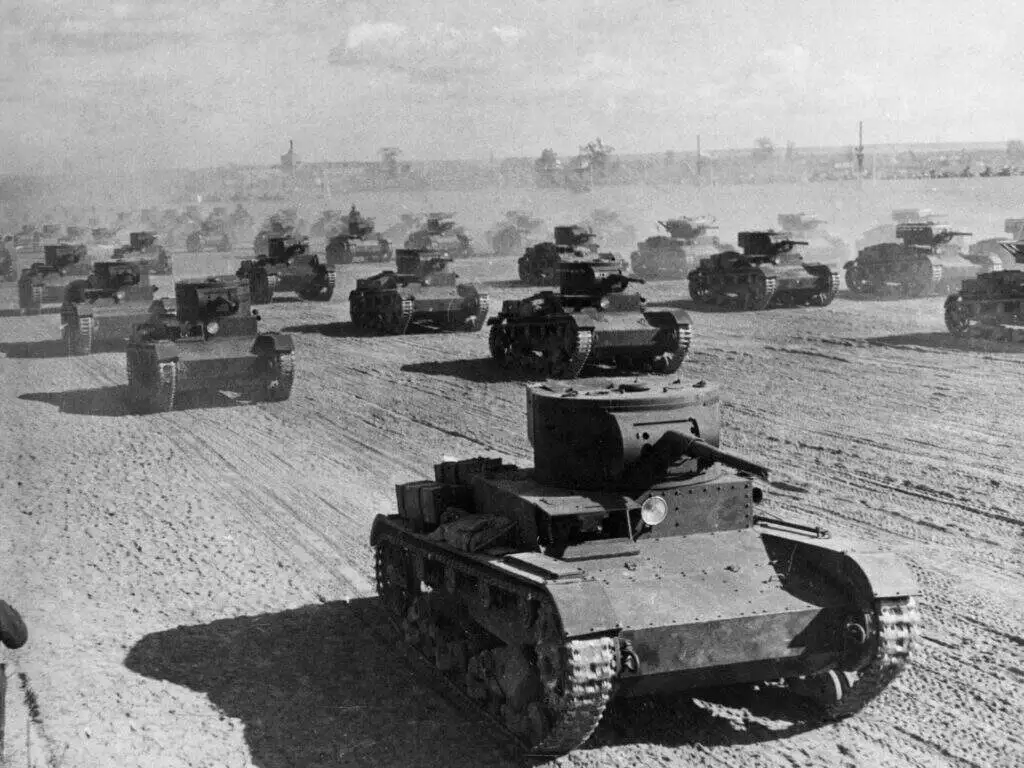
The Soviet attack on Poland came at a time when the momentum of the German offensive was beginning to wane. The shift of Polish units towards the so-called Romanian Bridgehead was intended to organize a long-term resistance based on the supply of war materials from France and Great Britain via Romanian territory, while awaiting the announced Western Allied offensive. This was consistent with the Polish defense plan.
German wheeled vehicles and armored vehicles suffered significant losses, and the Wehrmacht faced a severe shortage of ammunition. This prompted the German ambassador to Moscow, Friedrich Werner von Schulenburg, to repeatedly urge the People’s Commissar for Foreign Affairs, Vyacheslav Molotov, to take military action as quickly as possible.
The Red Army offensive along the entire eastern border of the Polish-Lithuanian Commonwealth thwarted Polish plans. The diplomatic pretext of the “collapse of the Polish state” and the “defection of the government” was untrue. The Polish-Lithuanian Commonwealth government was stationed in Kuty near the Romanian border and only decided to cross it in the evening of September 17th, after receiving confirmed reports of Soviet troops crossing the border.
Violation of international law and a diplomatic case
With the aggression, the USSR unilaterally terminated the existing Polish-Soviet Non-Aggression Pact of 1932 and the Convention on the Definition of the Aggressor of 1933. Soviet authorities also attempted to unlawfully arrest the Polish ambassador in Moscow, Wacław Grzybowski, claiming that the Polish state had ceased to exist and therefore its diplomats had lost diplomatic immunity.
Ambassador Grzybowski refused to accept the Soviet note, and after the intervention of the dean of the diplomatic corps – who, due to his seniority, was the aforementioned German ambassador von Schulenburg – the Soviets were forced to allow the Polish diplomat and embassy staff to leave the country.
The neutral consul in Kiev, Jerzy Matusiński, was less fortunate. He was summoned by the Soviet authorities under the pretext of discussing evacuation matters, then arrested by the NKVD and murdered. Diplomatic interventions on his behalf proved ineffective.
War crimes of the Red Army in September 1939
Contrary to claims of an “unlawful but bloodless march,” the invading Red Army violated the Geneva Conventions and committed mass murder of prisoners of war and civilians from the very first hours. Over 2,000 battles and skirmishes were fought.
Documented war crimes from this period include:
- Murder of General Józef Olszyna-Wilczyński (September 22): The commander of the Grodno Corps District was detained in a car in the Sopockinsky district, taken aside and shot without trial in front of his wife.
- Massacre of the defenders of Grodno (September 20–22): After taking the city, the Soviets murdered approximately 300 defenders – soldiers, police, schoolchildren, and scouts. During the fighting, Soviet forces used civilians, including children, as human shields against tank armor (this is how 13-year-old Tadzio Jasiński died, among others).
- Massacres of KOP and Polish Army prisoners of war: Following the battles of Sarny, Szack, and Wytyczno, mass executions of disarmed soldiers of the Border Protection Corps took place. Several hundred prisoners were murdered in Mielnik and the area around the forts on the Słucza River.
- Murder of the wounded and medical staff: In military hospitals in Złoczów, Lviv, and Vilnius, among others, Soviet soldiers finished off the wounded in their beds and arrested and shot medical personnel.
- The massacre of Rawa Ruska: Executions of students from cadet schools and cadets trying to break through to the Hungarian and Romanian borders.
- Execution of the defenders of the Sarny Fortified Area (September 23–25) – After the capitulation of the Słucza River fortifications, soldiers from the “Sarny” KOP regiment were disarmed. The Russians selected and shot several hundred Polish soldiers and officers on the spot (according to reports, between 280 and nearly 500).
The role of internal collaboration
With the arrival of the Red Army in the eastern territories of the Polish Republic, cells of the Polish Communist Party, dissolved in 1938, and local militias became active. They formed the so-called Red Militia and revolutionary committees, which seized power in towns, prepared proscription lists, and handed over Polish officials, policemen, teachers, and military settlers to the NKVD.
Figures such as: Wanda Wasilewska, Alfred Lampe Whether Stefan Jędrychowskiwho joined the propaganda and Sovietization apparatus, creating a base for later structures dependent on Moscow (such as the Polish Committee of National Liberation or the authorities of the People’s Republic of Poland represented by, among others, Bolesław Bierut and Edward Ochab).
The German-Soviet alliance, sealed in photographs from the joint parade in Brest-on-the-Bug, marked the beginning of a long occupation, the direct continuation of which were the crimes in Katyn, Kharkiv, and Tver, as well as the mass deportations of Polish citizens to the East. Historians to this day are unable to estimate the Polish losses resulting from the repressions Poles suffered in the territories occupied by Russia. However, the figure of approximately half a million does not appear to be an exaggeration. Unfortunately, after the war, no one even attempted to count the victims, because Russia did not allow it. Hence, the numbers vary widely..

What do you think about this story?
Join the conversation. Please keep comments relevant to the article.
Write a comment