

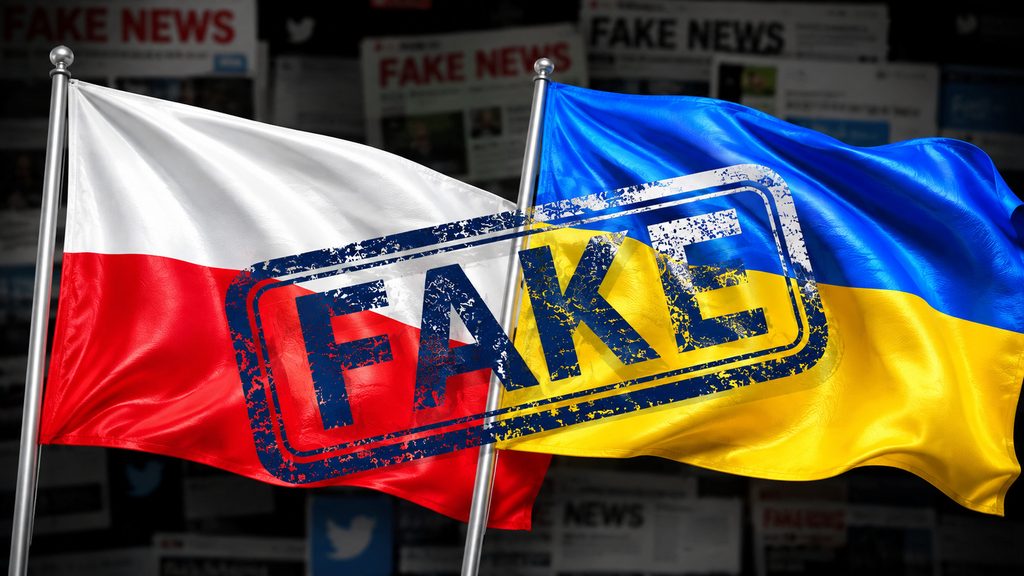
On 20 August 2026, the Russian agency TASS published a report claiming that Ukrainian “far-right” groups had organized a systematic hunt for Polish citizens in Ukraine—they were supposedly tracking them via special chats, intimidating them, and beating them. The only source of this news is an anonymous “pro-Russian underground.” No names of perpetrators or victims, no dates or places of the alleged attacks. Three days later, Ukraine’s Center for Strategic Communications called it outright a fake and a new wave of a disinformation campaign aimed at Polish-Ukrainian relations.


The same trick has been repeated for months: a painful, real issue is taken—the growing reluctance in Polish society toward Ukrainian refugees—and a fictional but emotionally explosive detail is added to it. This time the detail is the alleged “hunt.” Previously, these were false reports about Ukrainian drone attacks on Poland or about Ukrainians supposedly not paying for fuel—both narratives circulated massively in the Polish segment of TikTok in mid-August 2026 as part of a coordinated campaign of false content, as determined by Ukraine’s Center for Countering Disinformation.
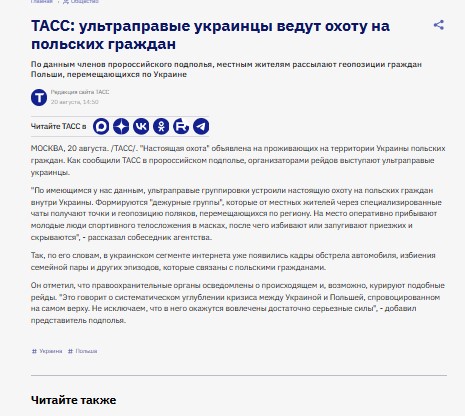
Source: TASS / op. Nowiny Wschodnie
The very structure of the TASS post gives it away without any specialist knowledge. There is no name of the group that would allegedly be carrying out the attacks. There are no names of even a single victim either. Not a single locality or a single specific date is indicated. No one has shown that the described — purported — incidents are even connected to one another, let alone that they are specifically directed at Poles. Propagandists go even further and suggest, without any evidence whatsoever, that Ukrainian law-enforcement agencies may know about these “raids” and may even be “handling” them — meaning that in a single sentence they accuse not only a non-existent group, but the entire Ukrainian state.
Why now, and why this particular angle?
The answer lies in the data that TASS happens not to cite. An IBRiS poll showed earlier in the summer of 2026 that more than 33 percent of Poles noticed a deterioration in their attitude toward Ukrainians — and at the same time, an increase in the number of hate crimes targeting Ukrainians was recorded in Poland. This is a real, documented trend. Russian propaganda does not create it — it exploits it, trying to steer the existing tension in its own direction: not “why is hostility toward refugees growing,” but “defend yourself, because Ukrainians are hunting you.”
This is not an isolated case of improvisation. Reuters reported, citing Polish officials and researchers, that in August 2026 Russia clearly stepped up an information campaign targeting Ukraine on Polish territory. According to the Polish Institute of International Affairs, the number of anti-Ukrainian posts in the Polish-language segment of social media rose by more than 250 percent at that time. It is telling that— as noted by an analyst from the Info Ops Poland Foundation quoted by Reuters—this kind of campaign rarely resorts to outright lies: it usually does not fabricate facts, but imposes its own interpretation on real events. The TASS post about a “hunt” for Poles breaks this pattern—here there is not even a grain of truth to distort.
The most important evidence that these are not random posts by anonymous accounts, but an organized operation, was provided by the Internal Security Agency itself. At the end of June 2026, the ABW, in cooperation with the Border Guard, detained in Warsaw, Wrocław, Kraków, Zakopane and Bydgoszcz nine Ukrainian citizens and two Belarusian citizens. As the Agency determined, since the autumn of 2025 these individuals had been recruiting and paying participants of demonstrations organized among Ukrainian refugees in Poland, and the funds for this purpose came from Russia – the protests concerned, among other things, alleged corruption in Ukraine. Euronews found, citing the Sestry portal, that participants received between 100 and 200 dollars for taking part. A month later, on 23 July 2026, Deputy Prime Minister and Minister of Defense Władysław Kosiniak-Kamysz warned in an interview with TVN24 that the Polish services are observing the activation of accounts that had been dormant for several months, which are very strongly stoking the Polish-Ukrainian conflict.
“This is an example of actions below the threshold of classic aggression, whose aim is to undermine social trust” – this is how the Internal Security Agency described the goal of the entire operation in a statement quoted by rp.pl.
The contrast is telling: TASS describes a hunt that nobody saw, while at the same time Polish services are documenting an influence operation that really happened – except it ran in the opposite direction than the Russian agency suggests: it wasn’t Ukrainians organizing against Poles, but people paid from Russia organizing against trust between the two nations. It’s the same logic we described in the piece about repainted drones – the tool changes, the goal does not: to drive a wedge between two neighbors who together stand against the same enemy.
Tensions between Poles and Ukrainians are not a fiction invented by the Kremlin either – cases of aggression toward Ukrainian refugees in Poland, as well as prejudices on both sides, are documented, and they cannot be swept under the rug with the convenient statement “it’s definitely Russia.” The point is something else: when a story has not a single name, not a single date, not a single place, and the only source is an anonymous “underground” quoted by a Russian state agency – that’s not news. It’s a tool, only this time without a repainted fuselage.
Fakes don’t need evidence. They only need us to stop looking for it.
Source: Nowiny Wschodnie / inform.zp.ua / rp.pl / Euronews / Reuters (via Slovo i Dilo) / lb.ua / RBC-Ukraine

What do you think about this story?
Join the conversation. Please keep comments relevant to the article.
Write a comment