
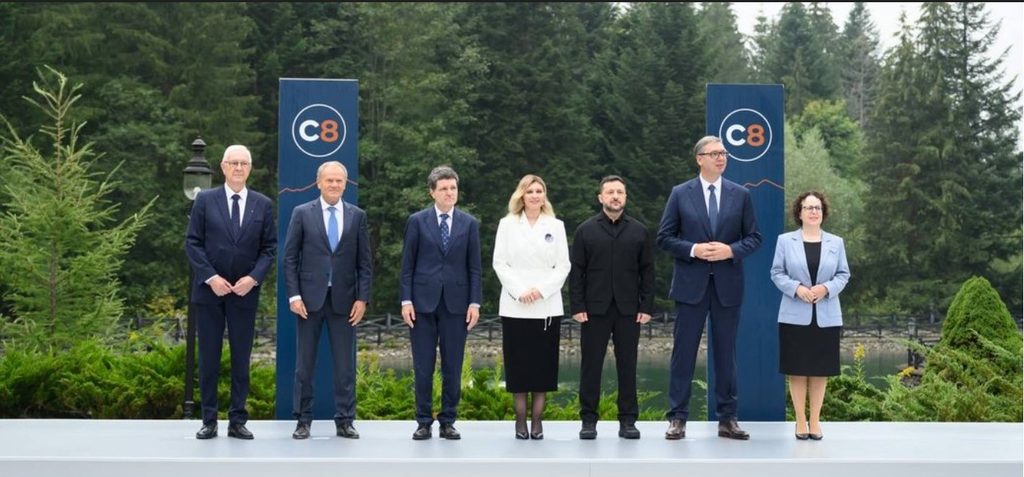
On 18–20 September 2026 in Bukovel, in the Ivano-Frankivsk region, the inaugural summit of a new regional format – the Carpathian Eight (C8) – took place. Prime Minister Donald Tusk went there in person – and it is precisely Poland’s participation, rather than the very idea of the forum, that is the most important part of this story. While Kyiv is counting billions in future investments, for Warsaw the real value of the summit turned out to be elsewhere: in a concrete arrangement for Poland to take part in an “anti-ballistic coalition” with Ukraine, agreed under the cover of an economic forum.
What this format is and what was agreed


The idea was born back in November 2024 as a Slovak proposal under the name “Carpathian Integration Initiative” – a platform for countries that are not ready to support Ukraine militarily but want to cooperate economically. On 18 September, Zelensky officially launched the format, which is to include Ukraine, Poland, Romania, Serbia, Slovakia, the Czech Republic, Hungary and Austria, as well as EU institutions.
After the first day, six countries – Ukraine, Austria, Poland, Romania, Serbia and Slovakia – signed a joint declaration. It defines eight areas of cooperation: security, energy resilience, modernization of critical infrastructure, transport and logistics, protection of the Carpathian environment, tourism, veterans’ policy, and creative industries. The participants announced annual summits and consideration of the EU Macro-Regional Strategy for the Carpathians – modeled on the already existing strategies for the Baltic or Danube region.
In the business segment, about 550 company representatives took part; more than 50 agreements were signed for a total amount of slightly over 1 billion euros. Zelensky announced nearly 100 projects worth 40 billion euros – however, for now this is a plan rather than signed contracts, and some commentators, including Myśl Polska, openly question the realism of these figures.
The level of representation from the other countries was uneven: only Tusk, Serbian President Vučić and Romanian President Dan came in person; Austria and the Czech Republic were each represented by a single MP; Slovak Prime Minister Fico cancelled the visit “due to illness”, which commentators dubbed a “diplomatic illness”; meanwhile, Hungary was not represented at the political level by anyone – only the deputy ambassador in Kyiv, and the declaration was signed by neither the Czech Republic nor Hungary. That is telling: despite the fact that since April Hungary has been ruled not by Orbán but by the new, formally pro-Ukrainian Prime Minister Péter Magyar, in practice Budapest still keeps Kyiv at arm’s length – it is worth noting this as context, without delving into the details of Hungarian domestic politics.
Why Tusk went – and what really happened in the Carpathians
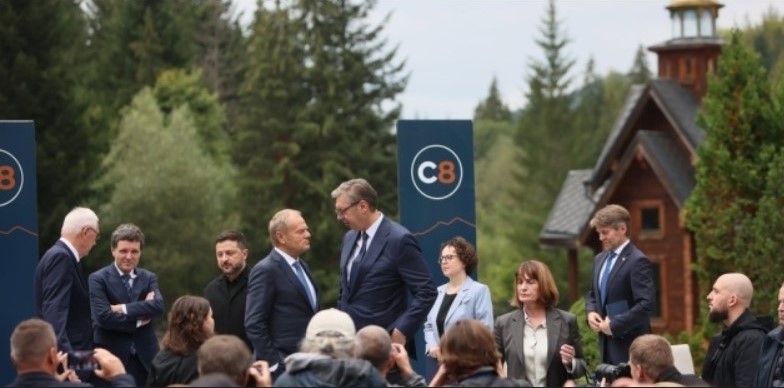
This is where the main part of this story begins. Tusk did not go to Ukraine in a vacuum: on the night of 16–17 September, a Russian drone, during another raid on western Ukraine, fell a few kilometres from the Polish border – near the Dorohusk–Yahodyn border crossing in the Lublin Voivodeship, one of the main crossings on the Polish-Ukrainian border. The incident was immediately perceived in Poland as the war moving directly closer to its own territory: fighter jets were scrambled, and the next day, 19 September, an alert was again announced in the eastern voivodeships. The summit therefore took place not as an abstract diplomatic ceremony, but against the backdrop of a literally overnight sense of danger right next to Poland’s border.
Sam Tusk explained to journalists that his presence is above all an “expression of solidarity”, but also an opportunity to talk with Zelensky about regional cooperation. And it was precisely during this meeting that the prime minister announced Poland’s joining the “anti-ballistic coalition” – a separate security cooperation mechanism with Ukraine, the terms of which the government is yet to disclose publicly. At the same time, Slovakia announced the deployment of 101 soldiers to strengthen Poland’s defense – a separate but contextually related development, showing that regional consolidation around Poland’s security is now happening through several channels at once, not only through C8.
This is the key to understanding the summit’s significance for Warsaw: the Carpathian Eight as a multilateral economic format serves as a convenient cover and platform for bilateral security arrangements that would otherwise have to be negotiated separately. Such a method allows Poland to bypass obstruction from less motivated participants in the region – such as Hungary or Slovakia – precisely on defense matters, using the economic format where it works and, where speed and concrete outcomes are needed, negotiating directly with Kyiv.
Why Poland needs this economically and institutionally
It is worth recalling that Poland is already a co-founder of another, much broader regional format – the Three Seas Initiative (13 EU countries, established in 2015 jointly with Croatia). The C8 partially overlaps with this geography (Poland, Austria, Romania, Slovakia and the Czech Republic belong to both formats), but there is a fundamental difference: here the host and initiator is Ukraine, not Poland. For Warsaw, this means a different kind of influence – not the role of the format’s architect, as in 3SI, but the role of a key, most important partner within a Ukrainian project. Both roles have their value: 3SI gives Poland institutional leadership in Central Europe, while C8 provides a direct channel of influence on the agenda of Ukrainian-European integration and on the use of the Carpathian macroregion, including the areas of Zakarpattia and Prykarpattia bordering Poland, as a logistics and energy hub.
Prykarpattia is not an abstract region for Poland. This is about directly cross-border infrastructure: gas storage facilities, transport corridors, power grids that physically connect the Polish and Ukrainian energy systems. Zelensky himself, speaking at the forum, emphasized the need for “military mobility” – modernization of dual-use roads and railway lines – and this directly intersects with Polish interests in the context of logistics for aid to Ukraine and Poland’s own defense readiness on the eastern border.
Is it worth paying attention to this format from the Polish perspective
The answer is: a cautious “yes,” with three caveats. First, the real weight of the C8 will become clear in the coming months—whether more than 50 signed agreements translate into real infrastructure projects, or whether the format remains an annual declarative formality. Second, the uncertain composition of participants—the lack of real engagement from Hungary and Slovakia—means that, for now, the C8 mainly brings together those who already cooperate with Ukraine anyway, rather than attracting the truly difficult partners in the region. Third—and most important from the Polish perspective—the value of the summit for Warsaw is defined not by the joint declaration, but by what happened alongside it: the arrangement concerning participation in the anti-ballistic coalition, which Tusk’s government now has to explain publicly and in detail.
The Carpathians Declaration has been signed. The question of whether it will bring even a little closer the protection of Poland’s own border—and not just paper economic indicators—remains open.
Source: rp.pl / Interia / Dziennik Narodowy / Myśl Polska / OKO.press / Fakty ICTV
