

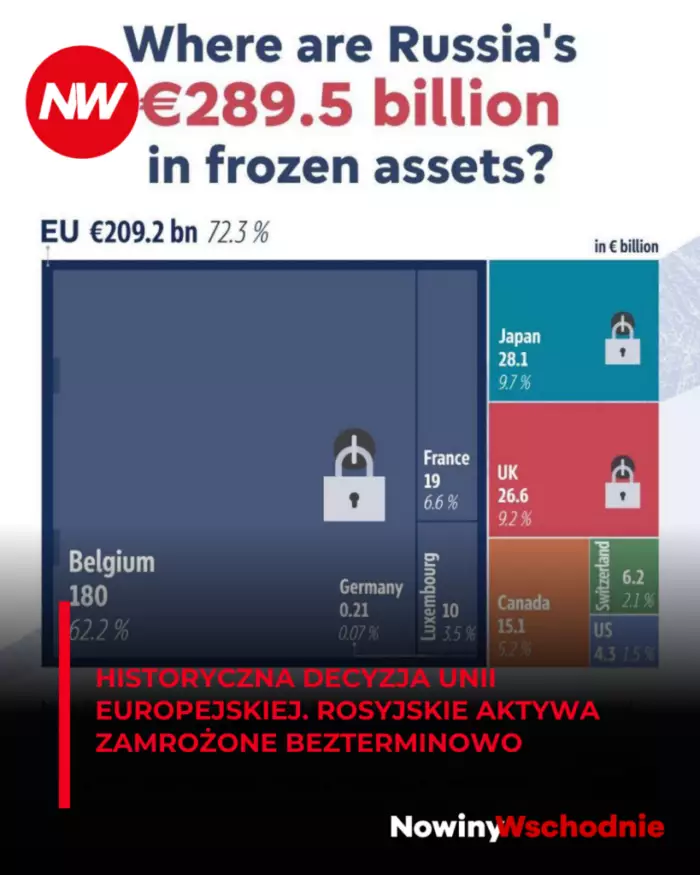
The European Union has taken an unprecedented decision to indefinitely freeze Russian assets located in the territory of its member states. This means that all financial resources of the Russian Federation and its affiliated institutions will remain under EU control indefinitely, with no date set for their eventual release.


This decision is considered one of the most serious financial sanctions in the history of the European Union and represents another stage of economic pressure on Moscow. According to information provided by European diplomats, the frozen assets primarily include funds from the Russian Central Bank, state investment funds, and assets covered by previous sanctions.
What’s next for Russian money?
Key decisions regarding the further use of the frozen funds are to be made at the European Council summit on December 18-19. This is when EU leaders are expected to decide whether and how Russian assets can be used as the basis for a reparations loan for Ukraine.
The scenario under consideration assumes that revenue generated by the frozen funds—for example, interest—could be used to financially support Ukraine, including rebuilding infrastructure and stabilizing the economy. However, some member states favor a more decisive solution, involving the direct use of assets as part of reparations.
Legal and political disputes
Not all EU countries are unanimous on this issue. Critics of such a solution point to the risk of violating international financial law and the potential consequences for the stability of the global banking system. Proponents of a hard line, on the other hand, argue that the scale of the destruction and losses requires extraordinary measures, and a precedent has already been set.
Experts emphasize that the indefinite asset freeze sends a clear political signal: the EU has no plans to normalize financial relations with Russia without resolving key international disputes. This decision may also influence future actions by other countries against sanctioned regimes.
Importance for Europe and the world
The indefinite blockade of Russian assets is a step that could redefine EU sanctions policy. It also demonstrates that the EU is increasingly using financial instruments as a tool for long-term political strategy.
The final decisions will be made in the second half of December, but one thing is already clear: the issue of Russian assets will become one of the key topics on the European political agenda in the coming months.
Source: EU diplomatic information

Journalist and Editor-in-Chief of Nowiny Wschodnie, a news platform followed by more than 140,000 people on social media. A graduate in Journalism and Social Communication, he has been co-creating and developing Nowiny Wschodnie since 2017. He gained professional experience working with local and international media.
He specializes in fact-checking, countering disinformation and propaganda, and information security. His work focuses on Poland, Ukraine, Eastern Europe, and Polish-Ukrainian relations. He is also the founder of a non-profit organization working in the fields of integration and intercultural dialogue.