

Changes in the mentality of Poles in the EU
In 2008, we had been in Germany for four years since joining the European Union and nine years since joining NATO. I went to a trade fair in Germany. We worked in Cologne and met people. Some of them were very young Poles. Some who barely remembered the communist era, or even remembered it at all. From my earlier trips to Western Europe in the 1990s, I remembered Poles trying to speak Polish as quietly as possible in public places, so no one would know where they were from. In 2008, I saw a change. Young people from Poland sat in German restaurants or beer bars. They spoke normally. They were very assertive with waiters. They were nothing like my generation, which had a massive inferiority complex about Western Europe. They quickly established relationships with their peers. These were different young people. That was the first time I truly felt it was worth it. It was worth fighting to be in the European Union.
Poland’s path to NATO despite Russia’s open threats


It’s been 27 years since Poland joined NATO and is protected by the might of the entire alliance. I remember how throngs of Russian politicians came to Poland to dissuade us. They assured us of undying love and happiness if we left NATO. However, they quietly threatened us. Sometimes the apples didn’t meet Russia’s “exceptionally high” standards, sometimes they introduced an inferior mixture into the oil pipeline, sometimes the pressure in the gas pipe suddenly dropped dramatically… In short, they used their own methods against Poland, which today have escalated into open aggression against Ukraine.
In the final act of the film, in 1998, they sent deputies to the Russian Duma, who met with our senior parliamentarians. The conversation was very heated. The tension was palpable. At one point, one of the most prominent Russians said in a brazen, arrogant manner (the meeting was broadcast live): “We do not agree to Poland joining NATO.” He was met with a calm, dignified, yet firm response from Bronisław Geremek: “We will not ask anyone whether Poland will be in NATO or not. This is ONLY OUR decision.” Then the Russians gave up and argued that they had nothing against us being in the European Union. But why do we need NATO? After all, Russia is so nice…
“Jno one will ever again raise a hand against you with impunity”
All this only increased the determination of the Polish elites and society. In 1999, barely six years had passed since the Russian occupation forces left Poland. And it wasn’t a pleasant or joyful event. They were clearly upset that they had to succumb to the blackmail of their former vassals. I use the plural because we were greatly assisted in this matter by first Czechoslovakia and then the Czech Republic. Six years is a short time, so it was easy to achieve such convergence of purpose. The memory of the Russian occupation was vivid. In March 1999, we heard an interview with an American general who, on the day of our accession to NATO, said: “No one will ever again raise a hand against you with impunity”. These words were worth it. It was worth going through these 10 years since 1989.
The Economy, Stupid (propagated by Clinton)
The second goal was joining the European Union, then still called the European Economic Community. There was consensus here too. It was clear that it was better to be one of many in a strong economic entity than a lonely island surrounded by economic, customs, border, and political barriers. Outside the union, we would have no influence on the direction of its development. Joining the union symbolically and truly closed a dark period in Poland’s history, when we were small, weak, and our fate was decided in Moscow. From then on, we were not only in a military alliance, but also an economic one. We placed Poland’s security and economic stability in the interest of Western countries. They have businesses here, meaning that peace and security for Poles are guaranteed by Western companies.
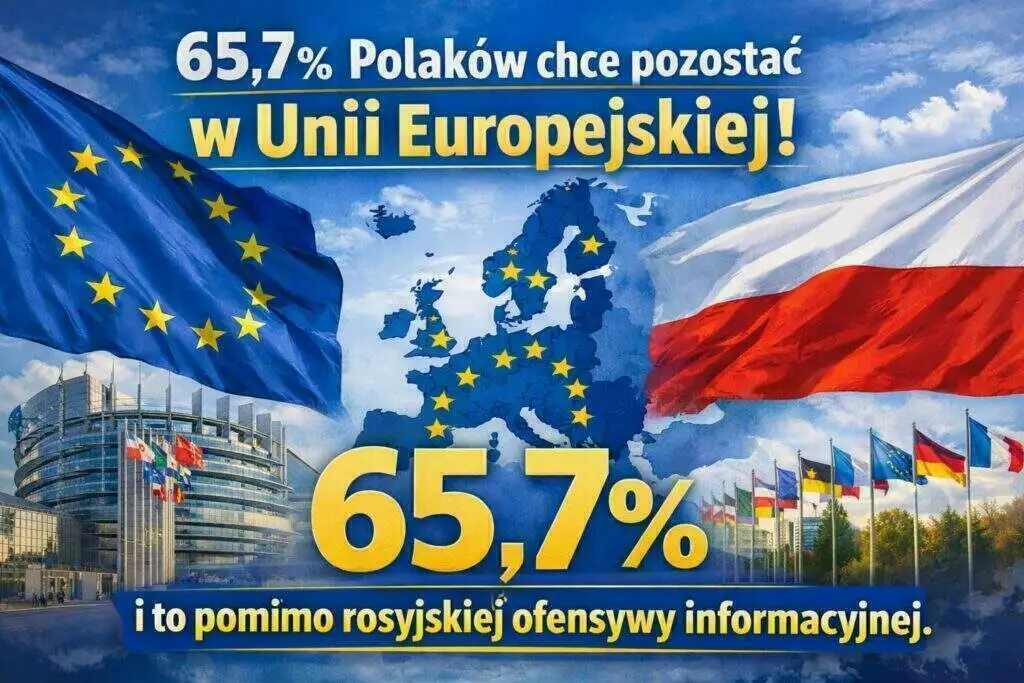
65.7% of Poles support the European Union
Now, almost 23 years after joining the European Union, support for this move remains high – 65.7%, according to IBRiS in a survey commissioned by Wirtualna Polska. Of this number, 48.6% “definitely in favor” of remaining in the EU, and 17.1% “rather in favor.” With such a massive attack by Russian intelligence agencies, the number of opponents of the EU isn’t very high. It’s only 25%, and that’s even when you add up those who “definitely want to leave” the EU and those who “rather want to leave.” Sure, support numbers were higher a few years ago, but we weren’t yet one of the main targets of Russia’s information warfare. The Confederation was barely in its infancy, and Braun was considered a clown, similar to Korwin-Mikke. And he is such a clown; unfortunately, his alliance with the Russian information warfare has made him a threat to Poland.
Even far-right voters are mostly in favour of remaining in the EU
Recent polls show something very optimistic. Even among Confederation supporters, only 41% want Poland to leave the European Union. That means almost 60% disagree or are undecided. So how does Zajączkowska-Hernik feel about babbling about collective farms? This woman, who’s taking our money by the handful, doesn’t know what she’s talking about. She has no idea what state-owned farms or Soviet collective farms were. Braun and Skalik know this well. They were the pampered servants of the communist system, which is probably why they’re attacking the European Union so strongly. They want a return to the days when they were better off.
Young Poles are definitely in favor of the EU
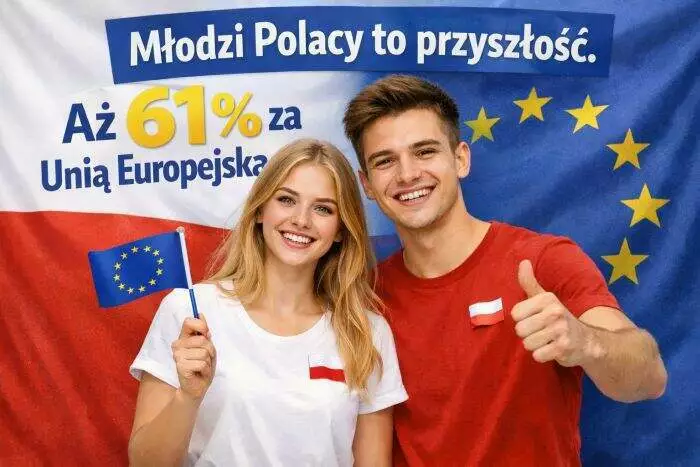
The most optimistic results are from a survey of young Poles aged 18-29. A staggering 61% of Polexit voters are strongly opposed (the average is 48.6%). Including those who are hesitant, this figure exceeds 80%. Combining strong supporters of Polexit with those who are hesitant, yields ONLY 13%. Russian intelligence agencies need to get to work; their results so far have been disappointing.
This glass is half full
Some might say the glass is half empty. I see it as half full, despite Russia’s fierce campaign. It’s no coincidence that Russia is using the para-right to attack democracy. It’s known for supporting all movements designed to dismantle democratic states from within. Unfortunately, the level of people isn’t high enough to distinguish the impostors posing as right-wingers from the conservatism they truly support. Conservatism isn’t Russia, where more and more Muslims and other nationalities are on the streets. Where the Orthodox Church, as in Stalin’s times, is completely subordinate to the ruler.
Conservatism doesn’t mean hatred of people. Conservatism is love of tradition. You won’t find that in the Confederacy or Braun. Instead, there are vast reserves of hatred. No, I was wrong. There is love—for Russia.
Source: WP / Legal Newspaper

What do you think about this story?
Join the conversation. Please keep comments relevant to the article.
Write a comment