
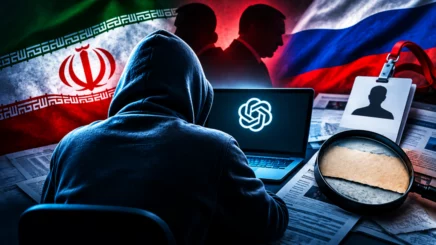
Fictitious journalists, a sham research center and articles published in genuine media outlets: this is how two influence operations originating in Iran and Russia reportedly worked, according to OpenAI’s report of October 8, 2026. The AI tools used in these operations helped edit articles, draft correspondence and prepare materials for those involved. Traces of one operation also reached Poland’s media environment, raising questions about how authors, sources and information are verified.
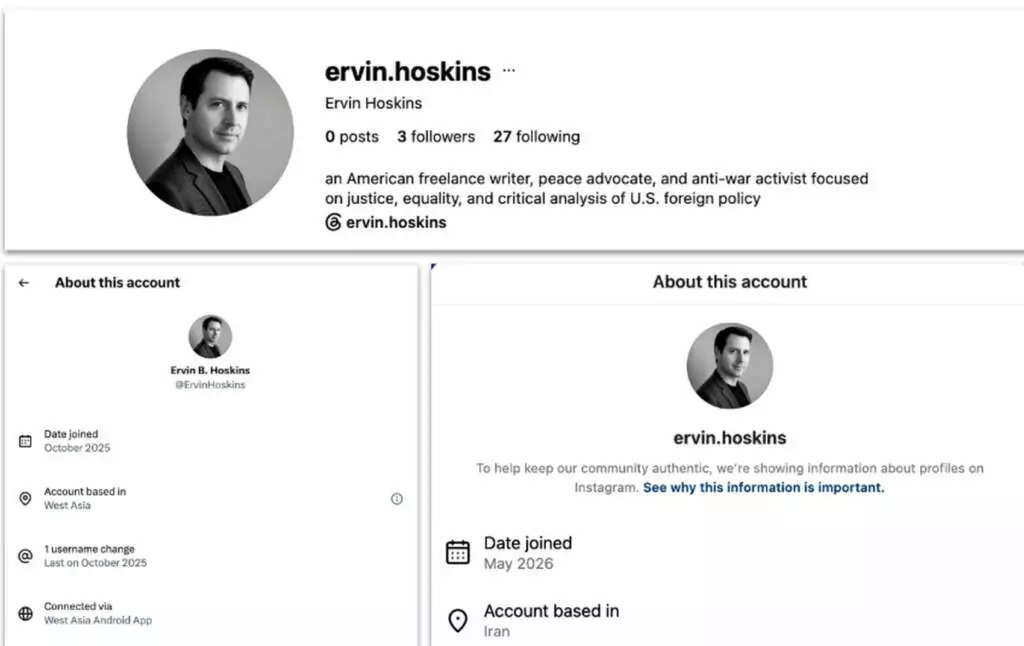


Illustration: Abdullah Al Hossain, “Disinformation.jpg”, Wikimedia Commons, licensed under CC BY-SA 4.0.
Iranian influence operation: seven names, nearly one hundred articles
The “Bogus Bylines” operation used seven fictitious journalistic identities. Those behind the names posed as Western journalists and commentators covering international politics, the Middle East and human rights. They wrote articles in English, tailored them to different websites and then pitched them to editors. Some of the invented personas also had social media profiles. Further details can be found in the original report describing the operation.
Nearly one hundred articles were published or republished under these fictitious names across approximately twelve small and medium-sized news websites. The operation ran from July 2025 to October 2026. The number of publications rose sharply after the conflict between the United States and Iran began. ChatGPT was used to draft and revise articles and write messages to newsrooms.
OpenAI linked the activity to Iran but did not establish who exactly was responsible. The campaign’s methods suggested that a commercial contractor might have been working on commission. However, there is no evidence that the Iranian government directly ran the operation.
Russian influence operation: a sham research center
The “Dark Clark” operation created the appearance of independent analytical work in Latin America. Its centerpiece was the Social Research Center (SRC), presented as an institution studying the Indian diaspora and India’s relations with countries in the region. According to findings in the report on AI-enabled influence operations , Russian operators controlled the SRC through a fictional persona named Mia Clark. Available evidence suggests that local employees did not know they were working for a Russian group.
More than 60 articles appeared on the SRC website, most of which seemed to be original reporting. Local staff interviewed experts and commentators from countries across the region and then prepared analyses based on those interviews. Topics included public opinion about BRICS and comparisons of Brazil’s economy under Presidents Jair Bolsonaro and Luiz Inácio Lula da Silva. Internal reports showed that Russian operators influenced the center’s operations, including decisions about hiring, pay and research projects.
Operators used ChatGPT mainly to prepare internal reports about the operation. In most cases, it was not used directly to produce propaganda materials. There were exceptions, however: the model helped prepare a forged letter intended to implicate Ukraine’s honorary consul in Panama, as well as a script for an audio recording meant to accompany its publication.
In Ecuador, a fake recording attributed to a Ukrainian consul was circulated in which he supposedly insulted the country’s residents. A TikTok video matching the description was found online, but it did not attract much attention. In Bolivia, another fake recording purported to feature an employee of the state water utility EPSAS announcing that water supplies to La Paz would be cut off and a state of emergency imposed. The company itself denied the claim.
Peru: the event was confirmed, but the link to the operation was not
According to internal reports, Russian operators claimed that in May 2026 they sent forged messages to schools in Lima, impersonating the Regional Directorate of Education. The messages encouraged schools to organize events about Ukraine and include the figure of Stepan Bandera. The operators also claimed that some schools complied and sent photographs. Not all of these claims could be independently verified.
On June 24, 2026, Extra Perú reported on an event at Romeo Luna Victoria school in Lima. According to the outlet, lessons about Ukraine featured Stepan Bandera, Symon Petliura and Volodymyr Zelenskyy, among others. It also reported support from the Ukrainian embassy, but provided no documents independently establishing the extent of its involvement.
The event itself was covered by local media. That does not prove the school received a forged email or that Russian operators caused the lessons to take place. The connection between the event and the “Dark Clark” operation remains unconfirmed.
In Poland, Bandera’s name carries particular pain because of the crimes committed against Polish civilians by the OUN and UPA. Historian Grzegorz Rossoliński-Liebe, in a study examining Bandera’s responsibility for mass violence , analyzes different forms of his responsibility for the actions of Ukrainian nationalists.
Bandera was arrested by the Germans on July 5, 1941, and remained in their custody until October 1944. He was therefore not in Ukraine during the 1943 Volhynia massacres and did not directly command UPA operations on the ground. This does not, however, absolve him of responsibility for the activities of the movement he led.
Rossoliński-Liebe identifies Bandera’s direct responsibility for some earlier OUN-B actions, as well as his political and moral responsibility for later mass crimes committed by OUN-B, the UPA and nationalists who identified with his ideology. The historian also stresses that Bandera did not condemn those crimes after his release from German captivity.
The operation’s Polish connection is also described by Disinfo Digest in its analysis of Dark Clark, Mateusz Piskorski and Grzegorz Braun. According to that analysis, material about the Lima event entered Polish media circulation partly through an article by Mateusz Piskorski in “Myśl Polska”, subsequently republished on i.pl. Grzegorz Braun also commented on the matter in the Polish public debate. Publication and republication alone do not prove that editors or authors knowingly cooperated with the operators.
OpenAI rated the Russian “Dark Clark” operation at level 5 on the six-level IO Breakout scale developed by Ben Nimmo. The scale measures the reach of influence operations. Level 1 denotes activity confined to one community and one platform. Level 2 covers the spread of content across several communities or platforms, while level 3 means reaching multiple communities via different platforms. At level 4, content is carried by mainstream media; level 5 means it is amplified by prominent public figures, such as politicians. The highest level, 6, denotes a concrete response or action, such as a political decision, or a call for violence. In the case of “Dark Clark”, level 5 was justified in part by public statements from politicians in several countries. This does not mean that the operation’s actual effect on audiences’ views was measured. More on the methodology can be found in Ben Nimmo’s paper published by the Brookings Institution.
It is worth remembering that OpenAI is both the source of the principal findings and the company whose tools were used in the activities described. Its report makes it possible to trace activity detected on its platform, but does not replace independent verification of all the operators’ claims or of the publications’ real impact on audiences.
What does artificial intelligence change?
AI did not create these operations, but made some of their activities easier and faster. It helped edit articles, prepare pitches, translate texts and compile documentation. In the Russian operation it was most often used to create internal reports, although there were also attempts to prepare material for public dissemination.
In the Iranian “Bogus Bylines” operation, the publication of articles under fictitious journalistic identities was rated level 4, while the posting of social-media comments was rated level 2. This shows that the decisive factor was not content generation itself, but inserting that content into existing information channels and reaching audiences through them.
The responsibility of newsrooms and audiences
Disputes over Volhynia, historical memory, aid to Ukraine and regional security are real and legitimate subjects for debate. The problem begins when someone conceals their identity and interests to deliberately exploit those emotions.
Newsrooms should check outside contributors’ previous publications, biographies, contact details and links to organizations presented as independent. It is also worth verifying think tanks’ staff and funding sources, using reverse-image searches and comparing information with independent sources. A professional-looking website, an expert’s byline or a high number of shares does not guarantee credibility.
In my view, the greatest danger is not only believing a false story, but losing trust in all sources, including reliable ones. A journalist who never existed may publish a single article. Distrust of genuine media may last much longer.
Iranian researcher and analyst specialising in Middle Eastern geopolitics, Iranian politics, and international security. He has published articles on Iran’s nuclear programme and Iranian-Russian cooperation, including on the BiznesAlert news portal.
He holds a Master of Business Administration (MBA) degree. He pursued doctoral studies in economics, finance, and management for five years at the Krakow University of Economics.
At Eastern News, he analyses international political and economic developments, armed conflicts, and great-power competition, with particular emphasis on their impact on the security of Poland, Ukraine, and Europe. In his publications, he combines his knowledge of Middle Eastern affairs with an economic and strategic perspective.
What do you think about this story?
Join the conversation. Please keep comments relevant to the article.
Write a comment