

A routine police patrol after a football match in Świdnica led to the detention of a 55-year-old Russian citizen. The man was photographing trains and railway infrastructure. During an inspection of his equipment, officers discovered a huge photo archive, also including critical infrastructure facilities outside Poland’s borders. The Russian was charged with acting on behalf of a foreign intelligence service and was taken into custody.
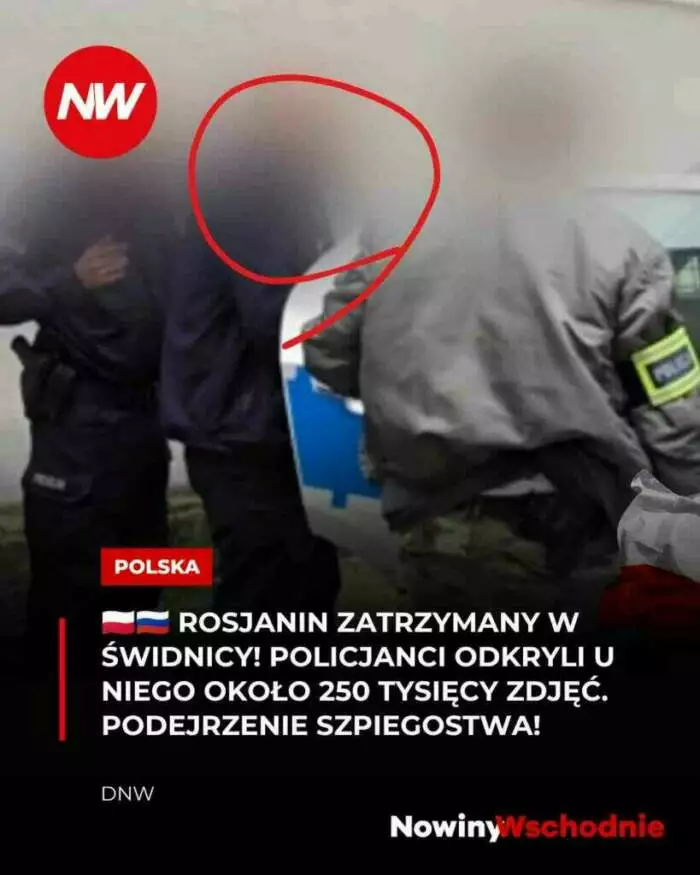
He drew officers’ attention at a railway crossing


The detention took place in Świdnica in Lower Silesia. Police officers who had earlier been providing security for the football match were patrolling the city in search of any groups of hooligan fans.
Near an unguarded railway crossing, they noticed a parked Volkswagen. When the driver saw the officers, he reversed the car and drove away.
Shortly afterwards, the patrol spotted the same vehicle again, this time near a railway viaduct. The man was outside the car, but when he saw the police officers, he tried to quickly get back into it.
The officers decided to carry out a check. It turned out that the 55-year-old had professional photographic equipment, which he used to document passing trains and elements of railway infrastructure.
A quarter of a million photos. Not only from Poland
The detained man was taken to the County Police Headquarters in Świdnica. It was established that he had come to Poland for work purposes.
While analyzing the secured devices, Świdnica police officers, working together with officers from the Central Bureau for Combating Cybercrime in Wrocław, came across hundreds of thousands of photographic files.
On October 30, the spokesperson for the Ministry of the Interior and Administration, Karolina Gałecka, reported that about 250,000 photos had been secured. Additional materials are located on further storage media.
The photographs showed, among other things, rail, transport, and production facilities, including elements of critical infrastructure located outside Poland.
Police also secured mobile phones, laptops, portable and external drives, as well as several identity documents.
Investigators are examining who the photographs were being made for
According to investigators’ findings, the 55-year-old was said to have photographed important sites with the intention of handing the documentation over to a foreign intelligence service.
The prosecutor’s office charged him under Article 130 § 1 of the Penal Code, concerning activity on behalf of a foreign intelligence service against the Republic of Poland.
The court decided to impose three months of pre-trial detention. The alleged crime carries a penalty of at least five years’ imprisonment.
Investigators will determine where the individual photographs were taken, on whose commission they were made, and whether the materials have already been passed abroad.
The case goes beyond Świdnica
The arrest comes at a time of heightened attention by Polish services to threats related to espionage and sabotage.
According to information provided by the spokesperson for the minister-coordinator of the special services, Jacek Dobrzyński, since the beginning of 2024, in proceedings conducted by the Internal Security Agency in espionage and sabotage cases, 90 people have obtained suspect status.
The Świdnica case shows how an ordinary police intervention can lead to the discovery of materials significant to state security.
At this stage, it has not been publicly determined which specific agency the photographs were intended for. Mere possession of photos of infrastructure does not in itself determine that a crime has been committed. The detainee’s liability will be the subject of further proceedings.
Sources: Lower Silesian Voivodeship Police Headquarters in Wrocław, statement of 30 October 2026; Ministry of the Interior and Administration, remarks by spokesperson Karolina Gałecka; PAP.
Information status: 31 October 2026.

Journalist and Editor-in-Chief of Nowiny Wschodnie, a news platform followed by more than 140,000 people on social media. A graduate in Journalism and Social Communication, he has been co-creating and developing Nowiny Wschodnie since 2017. He gained professional experience working with local and international media.
He specializes in fact-checking, countering disinformation and propaganda, and information security. His work focuses on Poland, Ukraine, Eastern Europe, and Polish-Ukrainian relations. He is also the founder of a non-profit organization working in the fields of integration and intercultural dialogue.
What do you think about this story?
Join the conversation. Please keep comments relevant to the article.
Write a comment