
Russian imperial policy has long relied on the peculiar ability to turn its own crimes into political arguments, and human suffering into a tool of propaganda. Oleshky have become another illustration of this technique.


The following text is an original opinion commentary. – ed.
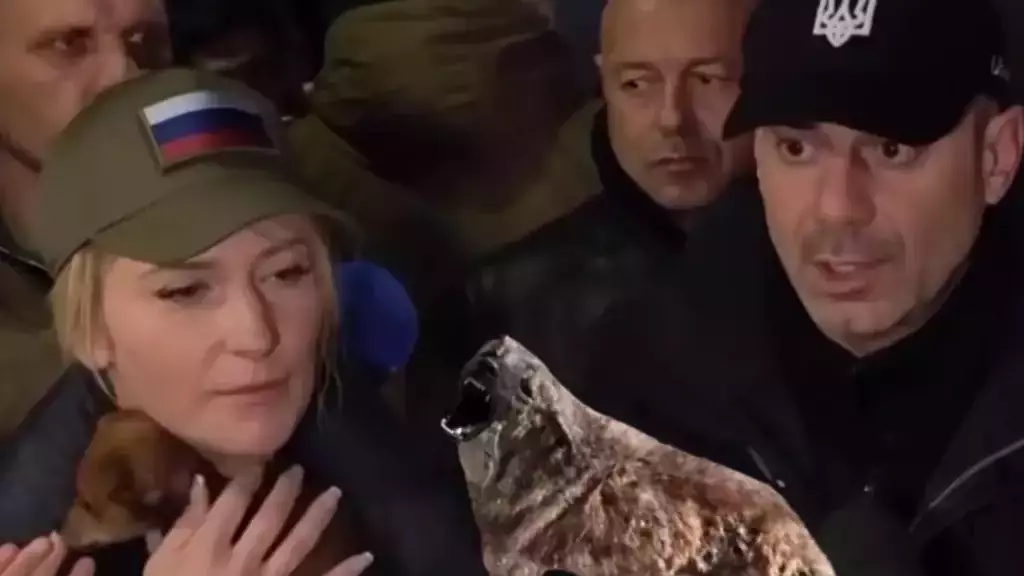
There is something particularly disgusting about the political technique that Russia is once again demonstrating in Oleshky. First, occupy a Ukrainian city, destroy the existing order of life, drive the residents into a humanitarian catastrophe, and then—when people are on the brink of biological survival—appear before the cameras with a shipment of aid and proclaim yourself their savior.
This is “russkij mir” in its practical implementation. Not an abstract geopolitical concept, not stories about a shared history, spirituality, or the protection of the Russian-speaking population. It is an entirely material reality: occupation, destruction, isolation, fear, shortages of food and medicine. And later—a televised image of mercy, aid, and care.
“Russkij mir” should be judged not by what it promises, but by what it leaves behind.
An ideology that saves you from the consequences of your own actions
Oleshky has been under Russian occupation since the first days of the full-scale invasion in February 2022. In June 2023, the city was among the localities that experienced the catastrophic effects of the destruction of the dam on the Dnipro River and the blowing up of the hydroelectric power plant in Kakhovka. Flooded homes, destroyed infrastructure, the loss of basic means of livelihood, and the deaths of people became another stage of the tragedy. The destruction of the dam occurred in territory controlled by Russia, which bears responsibility for the consequences of its aggression and the exercise of occupying authority [1; 2].
However, the water receded, and the humanitarian catastrophe did not disappear.
In the autumn of 2026, the situation became critical. According to the Ukrainian Ministry of Foreign Affairs and reports from international media, about 1,700–2,000 people remained in the city, including around 50 children. Residents struggled with severe shortages of food, drinking water, and medicines. The lack of regular supplies, destroyed infrastructure, mined roads, and the threat from Russian drones made it virtually impossible to leave the city safely [2; 3].
It is precisely here that the essence of the imperial project is revealed.
Russia supposedly comes to protect the Russian-speaking population, but it does not guarantee them the right to a safe life. It promises historical unity while at the same time destroying human bonds. It proclaims attachment to spiritual values, leaving people without the most basic material conditions for existence.
This is not a случай contradiction. It is a systemic feature of the “Russian world”: a person has value in it not in and of themselves, but only insofar as they can be used to validate an imperial idea.
Humanitarian aid as decoration
On 23 October 2026, an agreement was announced on a local ceasefire in the Oleshky area, negotiated with the participation of U.S. First Lady Melania Trump, with additional involvement from Pope Leo XIV. The truce began on 27 October. Its aim was to enable the delivery of humanitarian aid and the evacuation of civilians [4; 5].
On 29 October, the parties announced the completion of demining on the designated routes. The next day the humanitarian operation began: aid convoys were sent to the city, and residents who decided to leave began to be evacuated. The operation involved 25 buses and nine ambulances. Some residents were to be transported to territory controlled by Ukraine, some to Russia. Those heading to Ukraine faced a complicated route through southern Russia and Belarus [5; 6].
This is undoubtedly important. If even one person gets a chance to survive and leave the occupied city, the agreement will have been worthwhile. However, humanitarian necessity must not become an instrument of political amnesia.
Russian propaganda is already working to turn this operation into its own diplomatic success. Cameras, journalists, carefully selected testimonies from residents, demonstratively displayed Russian symbols on aid transports—everything is meant to create the right image: Russia helps, Russia saves, Russia cares [5; 7].
This is no longer just propaganda. It is an attempt at moral appropriation of someone else’s tragedy.
Let us imagine another situation: someone sets fire to another person’s house, locks the doors, and when the residents begin to suffocate, opens a window and demands gratitude for the rescue. This is exactly what the moral framework of Russian policy in Oleshky looks like.
The empire appropriates even human suffering
It is particularly dangerous that Russian propaganda is trying to use the city’s residents themselves as an instrument to legitimize the occupation.
A person who for many months fought to survive, lacking enough food, medicine, or any possibility of leaving, should not become a political witness on behalf of the state under whose occupation they found themselves. Gratitude for received bread is not a vote for Russia. Relief at the temporary cessation of shelling does not mean recognition of the occupation’s legality.
This is a fundamental distinction that Russian propaganda deliberately blurs.
Human gratitude does not mean political loyalty. Survival is not legitimation of the occupation. Evacuation is not an act of voluntary accession. No television footage can turn the forced dependence of the civilian population on the occupation authorities into proof of their humanitarianism.
Oleshky thus becomes, in this sense, a kind of laboratory of Russia’s information war: first, dependence is created; then, assistance is showcased; and finally, people are expected to show political gratitude.
It is telling that the Russian side brought journalists from the American network Newsmax to the city, spotlighting aid shipments marked with Russian symbols. At the same time, neither the UN nor the International Committee of the Red Cross participated directly in the operation, although they monitored its course and declared readiness to provide support [5].
So it is not solely about saving people. It is also about the struggle to control the interpretation of this event.
A ceasefire is not a victory
Moscow is, of course, interested in presenting the agreement as proof of its own constructiveness. But what exactly is Russia celebrating?
That it agreed to temporarily halt hostilities on territory it itself occupies? That it allowed aid to be delivered to people who had needed it for months? That it agreed to evacuate civilians who should have the right to leave a dangerous place without the need to conclude special political agreements?
This is not a victory. It is a humanitarian operation whose necessity arises from war and occupation.
Reuters points to the broader political context of the agreement: both Moscow and Kyiv are interested in demonstrating to Washington a readiness to cooperate as part of Donald Trump’s efforts toward a peaceful settlement of the conflict. At the same time, the Kremlin emphasizes that the operation in Oleshky is special and isolated in nature, not indicating broader progress in the peace process [5].
This is particularly telling. Russia wants to gain diplomatic benefits from a humanitarian operation while at the same time showing no readiness to bring the war to a systemic end.
The truce in Oleshky does not mean the city’s liberation. It does not restore the residents’ lost rights. It does not compensate for the losses incurred. It does not remove responsibility for the occupation and the consequences of the destruction of the Kakhovka hydroelectric power plant. Even less does it turn the aggressor into a mediator.
Russia is trying to sell the world its own pause in violence as proof of peaceful intentions. Meanwhile, ceasing shelling for a few days is not the same as ending the war. Delivering a convoy with humanitarian aid is not equivalent to restoring normal life to people.
“Russkiy Mir” as a technology for producing catastrophes
Oleshky is much more than a local humanitarian crisis. It is an illustration of how imperial ideology functions when it goes beyond television studios and political declarations.
Its logic is simple: first declare someone else’s territory part of one’s own historical space, then strip its inhabitants of political agency, destroy the existing social order, and when the consequences become catastrophic—use them for another propaganda offensive.
“Russkiy mir” not only destroys cities. It also tries to appropriate the right to explain why they were destroyed. It not only creates humanitarian crises. It seeks to monopolize the right to solve them. It not only takes people’s freedom away. It also wants them to thank the one who took that freedom away for the mere possibility of survival.
This is the fundamental danger of the concept of the “Russkiy mir”: it claims the right not only to other people’s territories, but also to define the moral coordinates of events. The aggressor wants to be, at once, the cause of the catastrophe, the party controlling access to aid, and the hero who supposedly rescues the victims.
This is no longer just political hypocrisy. It is a technology for erasing the very boundary between crime and merit.
That is why Oleshky cannot become yet another story about Russian mercy. It is a story about the cost of imperial occupation, the aggressor’s responsibility, and the danger of using humanitarian aid as an instrument of political rehabilitation.
One must not give in to diplomatic naivety here. Russian propaganda will operate not only with facts, but also with emotions. It will show grateful people, aid convoys, smiles and embraces. But behind every such frame, one question should remain: why did these people end up in a situation where receiving a food package becomes an event worthy of state propaganda at all?
“Russkiy mir” did not come to Oleshky with peace. It came with occupation. And now it wants the world to applaud it for the fact that, for a few days, it stopped being a source of danger.
This is not Russia’s victory. It is another attempt to present the consequences of its own policy as its own achievement.
If the international community allows Moscow to appropriate this story, it will not be humanitarianism that wins, but propaganda. It will mean that the “russkiy mir” has once again achieved what it does best: turning human tragedy into political capital.
Sources:
[1] United Nations Development Programme (UNDP), Kakhovka Dam Breach: Ukraine Assessment, 2023. Report on the environmental and humanitarian consequences of the disaster.
[2] Ministry of Foreign Affairs of Ukraine, 6.05.2026, Statement on the Critical Humanitarian Situation in Occupied Areas of the Kherson Region. Information about blocking evacuations, deliveries of food and medicines, and the situation in Oleshky.
[3] The Washington Post, 16.10.2026, With no food deliveries since May, starving residents flee Russian-occupied territory. Residents’ accounts of hunger, lack of medicines, the blockade, and living conditions.
[4] The White House, 23.10.2026, First Lady Melania Trump Secures Ceasefire Between Russia and Ukraine, Localized to Oleshky. Official statement regarding the agreement.
[5] Reuters, 30.10.2026, Key questions around the Russian and Ukrainian evacuation of Oleshky. The course of the operation, the role of the U.S. and the Vatican, the Russian propaganda narrative, and the political context of the agreement.
[6] Associated Press, 30.10.2026, Evacuated Oleshky residents begin the long journey out of the war-ravaged region. Details of the evacuation, transport, and the route through Russia and Belarus.
[7] Mezha, 30.10.2026, How Russia is turning the evacuation from Oleshky into propaganda. Analysis of Russian media messaging and the use of residents’ testimonies.
[8] Fourth Geneva Convention relative to the Protection of Civilian Persons in Time of War, 1949, arts. 55–60. Obligations of the occupying power regarding the provision of food and medical supplies to the population.
Literary scholar and researcher specialising in culture, identity, Polish-Ukrainian relations, and sociocultural processes in Central and Eastern Europe.
For many years, he has combined academic, educational, and civic activities in Poland and Ukraine. His research interests include cultural borderlands, collective memory, postcolonial processes, and intercultural interactions. He is the author and co-author of several monographs and more than 150 academic publications.
He has extensive academic and organisational experience. He has held senior positions at universities in Poland and Ukraine, led research teams, and implemented international research and educational projects.
He is actively involved in supporting the Polish community in Ukraine, particularly in Berdiansk and the southeastern part of the country. His work focuses on cultural heritage preservation, education, and documenting the experiences of communities affected by war and occupation.
In his publications and commentaries, he examines the Russo-Ukrainian war, Polish-Ukrainian relations, Polish diaspora communities in Central and Eastern Europe, politics of memory, and questions of national and cultural identity. He also addresses Russian propaganda and imperial narratives.
In recognition of his academic, cultural, and civic contributions, he has received several distinctions, including the Knight’s Cross of the Order of Merit of the Republic of Poland, the Medal for Merit to Culture – Gloria Artis, and the Honorary Badge “Meritorious for Polish Culture”.
What do you think about this story?
Join the conversation. Please keep comments relevant to the article.
Write a comment