
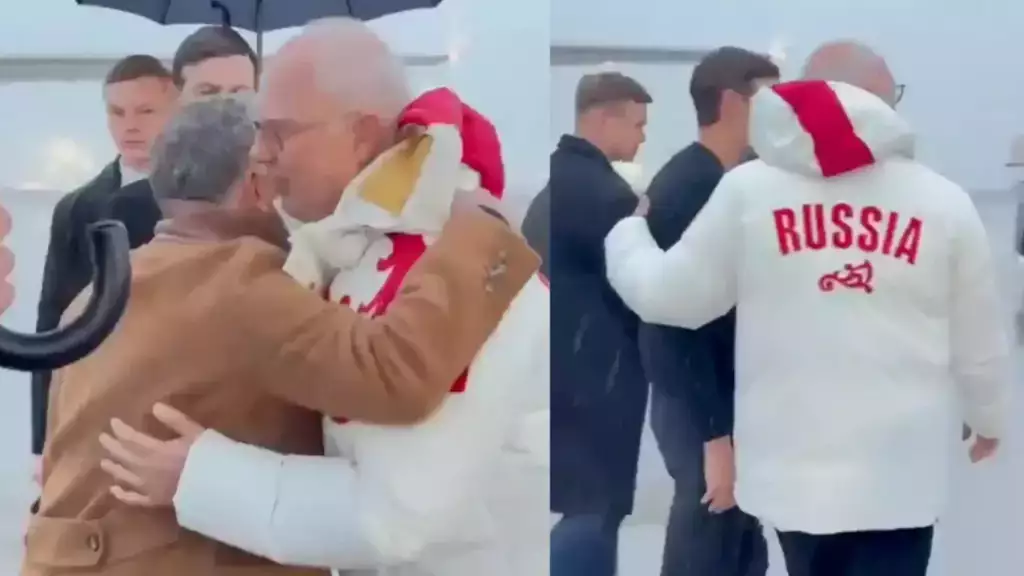
Not every gesture in diplomacy is innocent. Some matter not because they change the course of negotiations, but because they make it possible to impose a particular interpretation of them. Russia understands this relationship perfectly. That is why the story of the jackets bearing the word “RUSSIA” given to Donald Trump’s American envoys is more than an anecdote from a Moscow airport. It is a small scene revealing a much larger mechanism: the use of symbols, informal gestures and staged media events to build political influence.


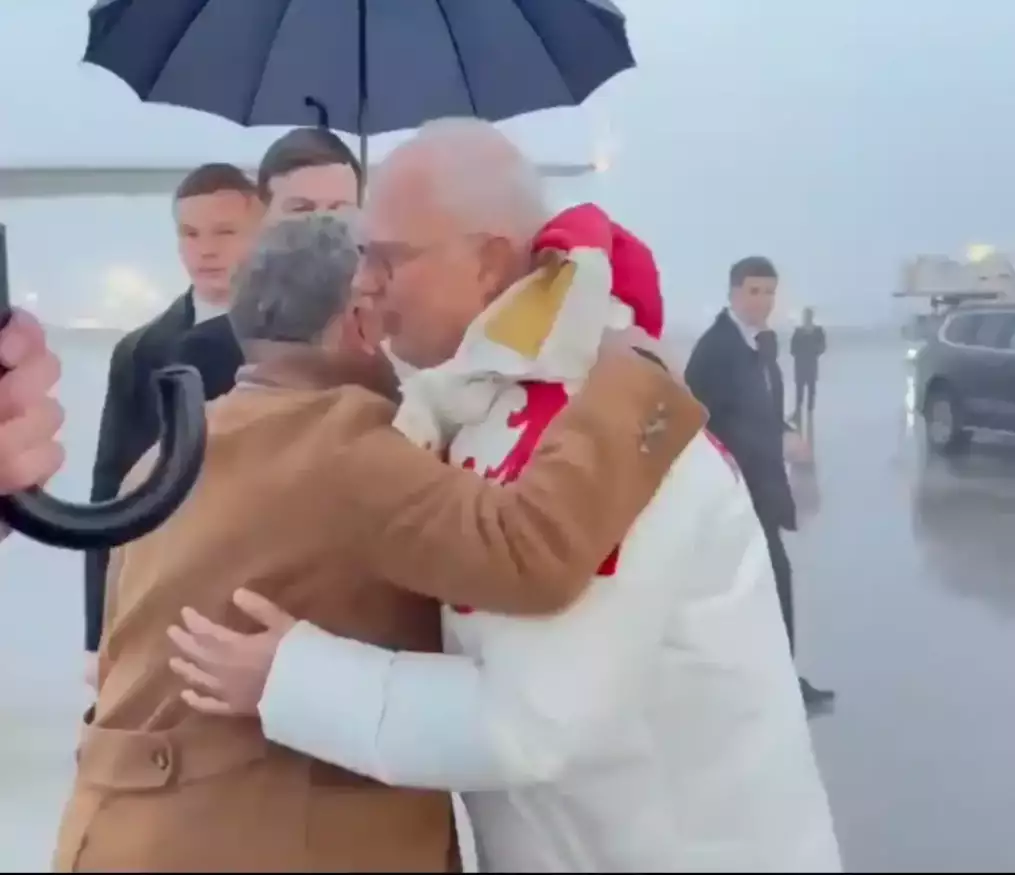
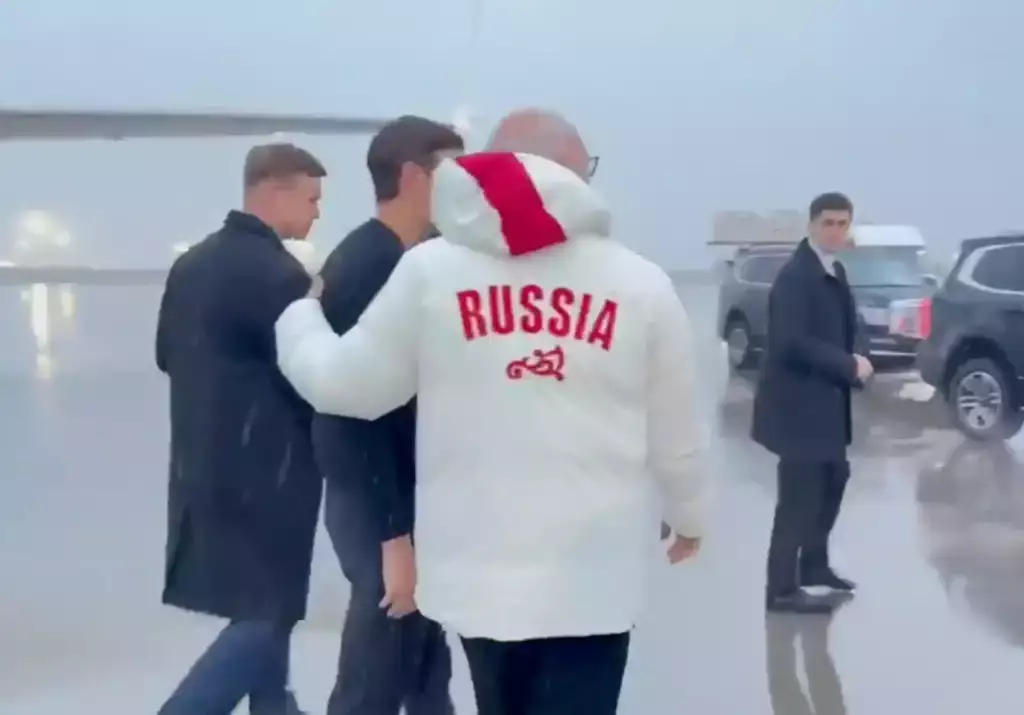
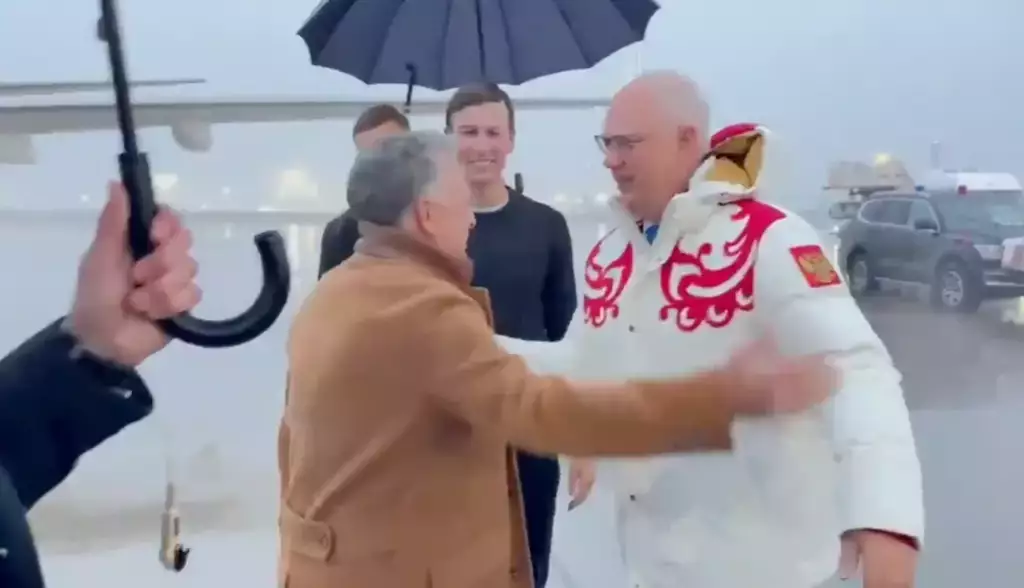
On November 12, 2026, Steve Witkoff, the US president’s special envoy, and Jared Kushner, Donald Trump’s son-in-law, arrived in Moscow to meet Vladimir Putin. They were welcomed at Vnukovo Airport by Kirill Dmitriev, the Russian president’s special representative for investment and economic cooperation. His white jacket bearing the word “RUSSIA”, styled after the Russian Olympic team’s outfits, attracted attention. Witkoff noticed it during the greeting. Later, the American guests receivedsimilar jackets, also bearing Russian symbols and the state coat of arms. Russian media reported the gifts, and photographs of the recipients quickly appeared online.
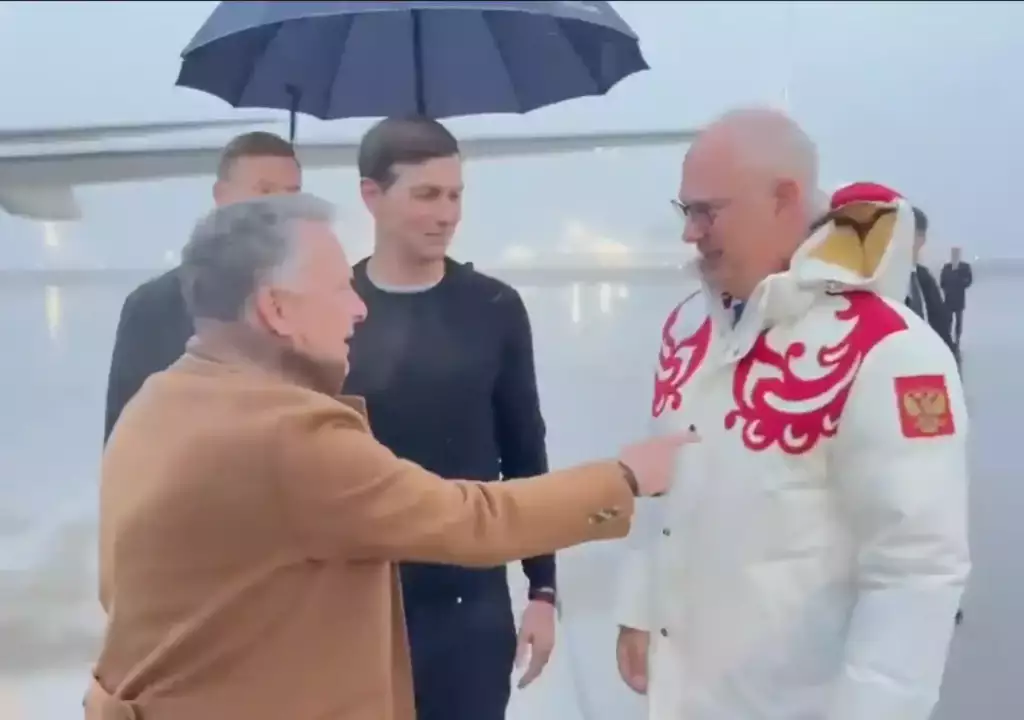
Of course, one could regard this as a friendly gesture by the hosts, part of the informal atmosphere of the talks, or simply a public-relations stunt. Yet in the politics pursued by the Kremlin, even such small details matter. Especially when they concern representatives of a country whose decisions may affect Ukraine’s future and the security of all Europe.
A jacket as a political message
Bosco is no ordinary clothing manufacturer. For years it dressed Russian athletes, and its distinctive outfits became one of the recognizable elements of the Russian national team’s visual identity. They made a particularly strong impression on collective memory during the 2014 Winter Olympics in Sochi. In this case, sport, national pride, state prestige and Russian symbolism were combined into a single coherent message.
That is why giving American envoys jackets bearing the word “Russia” is not simply a gesture of hospitality or a practical gift. It is an element of carefully selected symbolism through which the Kremlin presents its own vision of Russian statehood, prestige and international importance. This does not, of course, mean that Witkoff or Kushner sided with Russia by accepting the gifts. Such an inference would be unjustified. What matters is something else: Moscow gained an opportunity to create an image in which representatives of the United States become part of a Russian political stage set. Russia plays the host, chooses the symbols, defines the context and supplies the images that then circulate in media around the world.
Diplomacy of appearances: how Russia normalizes itself in the West
For years, Russian diplomacy has been refining a mechanism of political normalization. Its essence lies in gradually shifting the emphasis: from aggression to dialogue, from occupation to negotiations, from responsibility for the war to personal contacts, economic interests and informal gestures. In this way, aggression is reduced to one of many problems in relations between states, while the country waging the war begins to be treated as an ordinary partner with whom shared interests can be discussed. This is not an accidental consequence of diplomatic contacts, but part of a much broader political strategy.
A jacket solves no problem, changes nothing on the front line and brings Ukraine no closer to a just peace. It does, however, have another value: a symbolic one. It helps create an atmosphere of normality in which war, occupation and crimes cease to be the primary points of reference, replaced by courtesy, personal relationships and gestures of goodwill. This is precisely the shift in perspective the Kremlin seeks. Its aim is not merely to break diplomatic isolation, but gradually to restore Russia’s status as a country with which business can be conducted as though nothing fundamental had happened.
Nor is this a game directed solely at Donald Trump’s administration. Russia is trying to regain something far more important than a seat at the negotiating table: the right to co-determine the international order and to have its imperial ambitions recognized as a legitimate element of political reality. In this sense, the gift also has a domestic dimension. It sends a message to Russian society: despite the war, sanctions and international condemnation, representatives of the West’s most powerful country come to Moscow, meet Putin and accept Russian symbols. Isolation? What isolation? Kremlin propaganda seems to ask.
It is no coincidence that Russia’s propaganda machine so eagerly displays images of Western politicians in informal situations. In symbolic politics, it is not always necessary to formulate arguments or persuade people of a particular claim. Sometimes a carefully framed image, a smile, a photograph together or an accepted gift is enough. This creates the impression that relations are returning to normal, past conflicts can be set aside, and responsibility for aggression no longer stands in the way of doing business. Images begin to replace political judgment, gestures replace principles, and courtesy replaces accountability. This is precisely where the effectiveness of Russia’s strategy of normalizing the aggressor lies.
Negotiations about Ukraine, but also about Europe
The most important context of this story only becomes clear, however, when we look at the course of the November negotiations.
On November 10–11, talks involving representatives of Ukraine, Russia and the United States took place in Abu Dhabi. They brought no breakthrough on fundamental territorial and security issues, but preparations for a prisoner exchange and the continuation of talks were agreed. European security advisers took part in contacts on the sidelines of the meeting, but were not part of the maintrilateral format.
On November 12, Witkoff and Kushner met Putin in Moscow and then traveled to Dublin for talks with Ukrainian President Volodymyr Zelenskyy. One aim of the Moscow visit was to secure the Russian leader’s consent to the direct participation of European representatives in the next round of negotiations. The American envoys spoke of the need to include Europeans in the process because its subject is becoming not only the end of the war but also the broader security architecture of the continent.
Yet as early as November 13, Kremlin spokesman Dmitry Peskov cautioned that no final decision had been made about European participation. Moscow is making an expansion of the format conditional on whether European states demonstrate — in Russia’s assessment — a genuine willingness to contribute to the peace process. Kaja Kallas, the EU’s foreign policy chief, emphasized instead thatit should not be Russia that decideswho represents the European Union.
This exchange of positions shows that much more is at stake than organizing another meeting. The question is who will have a say in determining the borders, alliances and security principles of European states. Russia has long sought influence over Europe’s security order, and the current talks give those ambitions a new dimension. Moscow wants to talk to Washington not only about Ukraine but also about Russia’s broader relations with Europe.
In this context, it is particularly troubling that Europe’s presence in the negotiating process is becoming a matter for agreement between Washington and Moscow. Europe should not have to seek the right to participate in discussions about its own security as if it were an outside observer. Ukraine’s future cannot be decided without Ukraine, nor can Europe’s security architecture be determined without genuine European participation.
Not just jackets, not just history
Russia’s policy of influence also has a historical dimension. The exhibition “Ten Centuries of Polish Russophobia”, presented in Russia, is an example of an attempt to portray Polish distrust of Moscow as an irrational prejudice rather than a consequence of experiences of imperial domination, repression and loss of sovereignty. Its organization was attributed to the Russian Military Historical Society. It is worth seeing it, however, not as a separate subject but as another example of the struggle over how reality is interpreted.
In the first case, the aim is to build an image of Russia as a normal and attractive partner. In the second, it is to undermine the historical foundations of distrust toward its policies. In both cases, what is at stake is control over how Russia and its place in Europe are perceived.
We should not overestimate the significance of a single gift or attribute intentions to American negotiators that we do not know. Nor, however, should we underestimate the political context of this gesture. Russia is waging war not only on Ukrainian territory. It is also fighting over how that war is perceived, over its own image, and over the right to co-determine the future of countries whose sovereignty it undermines.
It is possible to accept a Russian gift without accepting the Russian narrative. It is possible to talk to the Kremlin without recognizing its claims to a special sphere of influence. The question, however, is whether the Trump administration and European leaders can separate diplomatic pragmatism from a political game aimed at gradually restoring Russia’s position as an arbiter of European security.
For this story is not about who puts on a Russian jacket. It is about who will set the terms of the conversation about Europe’s future. And a Europe that cannot participate independently in negotiations concerning its own security risks losing its agency, no matter how elegant the gifts its allies receive.
Literary scholar and researcher specialising in culture, identity, Polish-Ukrainian relations, and sociocultural processes in Central and Eastern Europe.
For many years, he has combined academic, educational, and civic activities in Poland and Ukraine. His research interests include cultural borderlands, collective memory, postcolonial processes, and intercultural interactions. He is the author and co-author of several monographs and more than 150 academic publications.
He has extensive academic and organisational experience. He has held senior positions at universities in Poland and Ukraine, led research teams, and implemented international research and educational projects.
He is actively involved in supporting the Polish community in Ukraine, particularly in Berdiansk and the southeastern part of the country. His work focuses on cultural heritage preservation, education, and documenting the experiences of communities affected by war and occupation.
In his publications and commentaries, he examines the Russo-Ukrainian war, Polish-Ukrainian relations, Polish diaspora communities in Central and Eastern Europe, politics of memory, and questions of national and cultural identity. He also addresses Russian propaganda and imperial narratives.
In recognition of his academic, cultural, and civic contributions, he has received several distinctions, including the Knight’s Cross of the Order of Merit of the Republic of Poland, the Medal for Merit to Culture – Gloria Artis, and the Honorary Badge “Meritorious for Polish Culture”.
What do you think about this story?
Join the conversation. Please keep comments relevant to the article.
Write a comment