

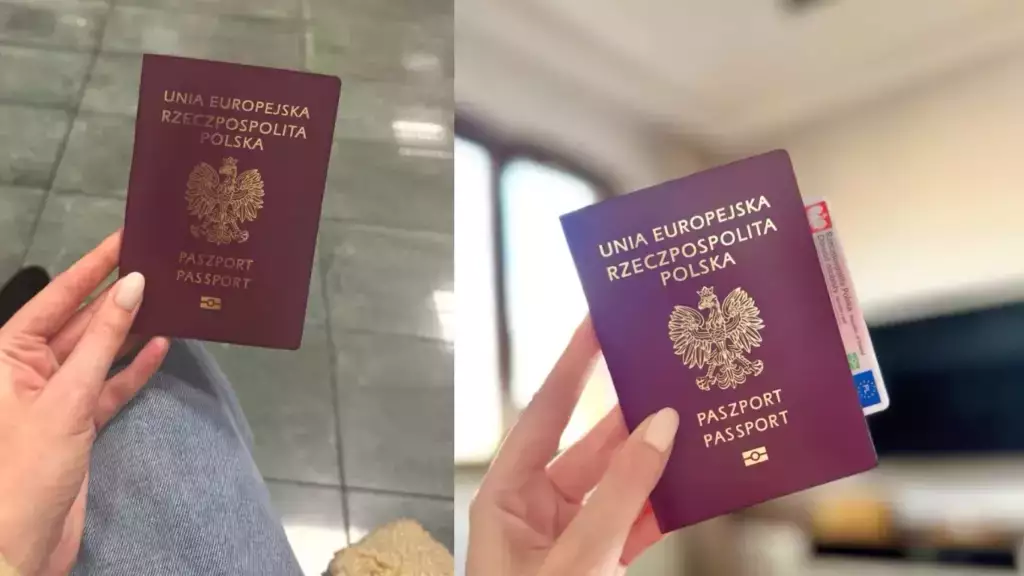
A woman published a personal social media post addressed to her late mother, telling her she had managed to obtain Polish citizenship. As she later recounted, alongside congratulations there were comments questioning her command of Polish and challenging the granting of citizenship. Her story raises a broader question: why is a Polish passport so desirable, and how difficult is it to obtain?
“Mom, I did it.” A personal message sparked a debate


A Threads user posting as @oxi_foksi shared news of receiving Polish citizenship. Her earlier post was particularly personal: it was addressed to her mother, who had passed away.
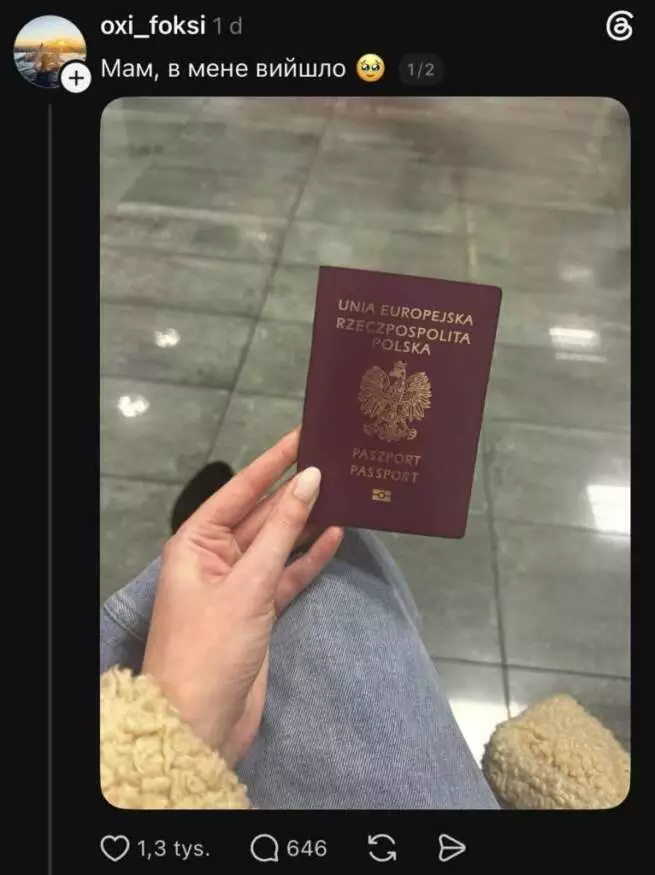
The woman wanted to symbolically share news of an important achievement in her life with someone close to her.
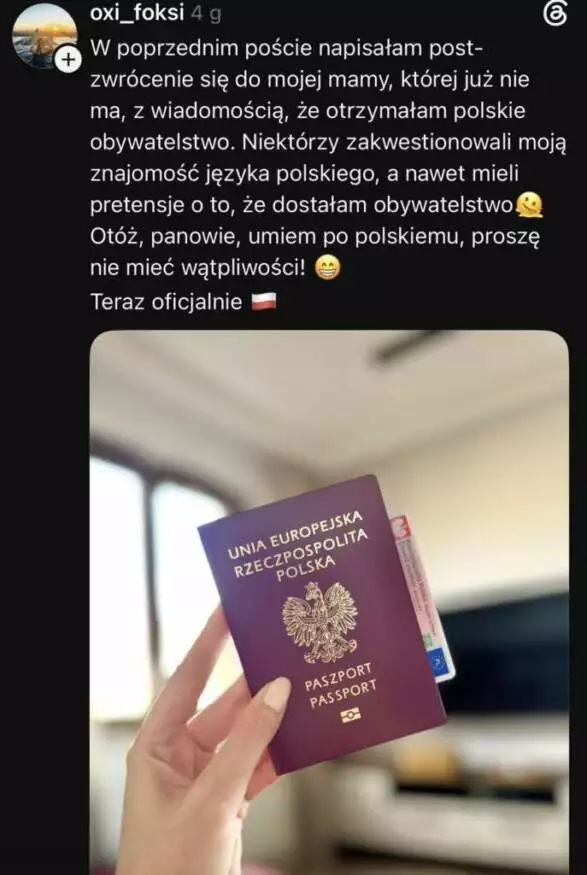
However, as she herself described in a subsequent post, some readers questioned her knowledge of Polish instead of congratulating her. There were also complaints about the fact that she had received citizenship.
The author decided to respond publicly. This time she wrote in Polish and posted a photo of her Polish passport.
“Well, gentlemen, I can speak Polish, have no doubts about that!” she wrote humorously.
She ended her post with the short statement “Now officially,” adding a Polish flag.
The available posts do not reveal which route she took to obtain citizenship or how long the procedure lasted. Nor is it known how many negative comments she received. Her account nevertheless shows that even a personal announcement about a major life event can become a target of online abuse.
Why is obtaining Polish citizenship not straightforward?
Obtaining a Polish passport is not simply a matter of living in Poland for a certain number of years. In most cases, foreigners must first regularize their residence status, collect documents and meet statutory requirements.
One route is recognition as a Polish citizen by a provincial governor (voivode).
Under the basic route, a foreigner must have resided continuously in Poland for at least three years on the basis of permanent residence, an EU long-term resident permit or a right of permanent residence. They must also have a stable source of income and a legal title to the dwelling they occupy.
This does not mean, however, that simply arriving in Poland and waiting three years is enough. The required period relates to a specific residence status, which may itself require earlier years of lawful residence.
Other routes also exist, including for spouses of Polish citizens, people of Polish descent, holders of the Polish Card and foreigners who have lived legally in Poland for at least ten years and meet additional conditions.
Knowledge of Polish is required. How must it be documented?
The procedure for recognition as a Polish citizen requires documented knowledge of Polish at a minimum B1 level, subject to statutory exceptions including those concerning minors.
Language proficiency may be demonstrated by an appropriate state certificate or a school completion certificate recognized under the regulations.
Simply using Polish in everyday conversations is not always enough. The authorities require a document confirming language proficiency in the prescribed form.
It is also worth remembering that not everyone who receives Polish citizenship follows the same procedure. Another route is the granting of citizenship by the President of Poland, who makes the decision under his constitutional powers.
Therefore, a social media post alone cannot establish whether someone did or did not meet the legal requirements.
How much does Polish citizenship cost, and how long is the wait?
According to the Ministry of the Interior and Administration, the fee for issuing a decision recognizing someone as a Polish citizen is PLN 1,000 in 2026.
Additional expenses may include sworn translations, obtaining documents, proving language proficiency and other steps involved in preparing an application.
As a rule, the provincial governor has six months to issue a decision, although proceedings may take longer in justified cases.
For many foreigners, however, the longest stage is not the citizenship application itself but obtaining the necessary residence permits beforehand and gathering documentation.
This means that the path to a Polish passport can take many years, even if the final administrative procedure is considerably shorter.
Polish or Ukrainian passport? The difference is 42 destinations
One reason for interest in Polish citizenship is the opportunity to travel.
According to the 2026 Henley Passport Index ranking a Polish passport provides access to 184 destinations without obtaining a traditional visa in advance. A Ukrainian passport provides such access to 142 destinations.
The difference is therefore 42 destinations.
| Passport | Access without a visa obtained in advance |
|---|---|
| Polish 🇵🇱 | 184 destinations |
| Ukrainian 🇺🇦 | 142 destinations |
The ranking includes not only completely visa-free travel but also certain cases of visas on arrival and electronic travel authorizations. The figures do not imply a right to live or work in every country listed.
For Ukrainian passport holders, the ability to make short visa-free trips to the Schengen Area under the rules for Ukrainian citizens with biometric passports remains an important convenience.
A Polish passport, however, offers more than greater freedom for tourism.
What does Polish citizenship offer that a Ukrainian passport does not?
The most important difference stems from Poland’s membership in the European Union.
A Polish citizen is also a citizen of the European Union. This entails, among other things, the right to move, reside and work in other member states under the conditions laid down in EU law.
For Ukrainian citizens living and working in Poland, obtaining Polish citizenship can mean greater legal stability and independence from residence permits.
Polish citizenship also grants the full political rights provided for citizens, including the right to vote in parliamentary and presidential elections.
This does not mean, however, that a Ukrainian citizen cannot legally live, work or run a business in Poland. Such opportunities also exist under relevant residence laws and special regulations.
In practice, Polish citizenship expands the range of rights and provides a more durable legal status.
Does a Polish passport also have disadvantages?
Obtaining citizenship is a serious decision whose consequences extend beyond travel opportunities.
Polish citizens are subject to obligations under Polish law, including provisions concerning national defense. Specific obligations depend, among other things, on age, sex, health and legal circumstances.
Acquiring Polish citizenship does not automatically create an obligation to pay tax on all worldwide income. The scope of taxation depends primarily on tax residence and the applicable rules.
Issues related to holding more than one citizenship are also important.
Polish law allows Polish and foreign citizenship to be held simultaneously. At the same time, a person holding Polish citizenship is treated as a Polish citizen by Polish authorities.
People who also hold Ukrainian citizenship should take Ukrainian law into account, including rules on multiple citizenship and civic duties. Obtaining a Polish passport does not automatically terminate all obligations toward Ukraine.
More and more stories about Polish citizenship on social media
Posts showing Polish passports, citizenship decisions or photographs from ceremonies are becoming a visible part of online discussions about migration and integration.
For some, Polish citizenship is primarily a document opening up new opportunities. For others, it symbolizes years of work, learning the language, building a life in Poland and a sense of belonging to society.
The Threads user’s story also illustrates another phenomenon: publicly sharing a success may lead to judgments about someone’s origins, language skills and right to belong to a community.
Yet citizenship is granted by the competent state authorities under the applicable procedures, not by online commenters.
A Polish passport is more than a document
For many people who have built their lives in Poland over the years, receiving citizenship marks the end of a long administrative process, but also an important personal moment.
For the author of the oxi_foksi post, the news had special significance. Rather than simply showing a new document, she decided to share her achievement symbolically with her late mother.
Her story reminds us that a passport photo posted on social media can represent much more than a change in legal status.
Behind it may lie years of waiting, effort, uncertainty and personal experiences that cannot be judged from a single online post.
Sources: Threads – @oxi_foksi, Ministry of the Interior and Administration, Polish Citizenship Act, Henley Passport Index 2026.

Journalist and Editor-in-Chief of Nowiny Wschodnie, a news platform followed by more than 140,000 people on social media. A graduate in Journalism and Social Communication, he has been co-creating and developing Nowiny Wschodnie since 2017. He gained professional experience working with local and international media.
He specializes in fact-checking, countering disinformation and propaganda, and information security. His work focuses on Poland, Ukraine, Eastern Europe, and Polish-Ukrainian relations. He is also the founder of a non-profit organization working in the fields of integration and intercultural dialogue.
What do you think about this story?
Join the conversation. Please keep comments relevant to the article.
Write a comment