

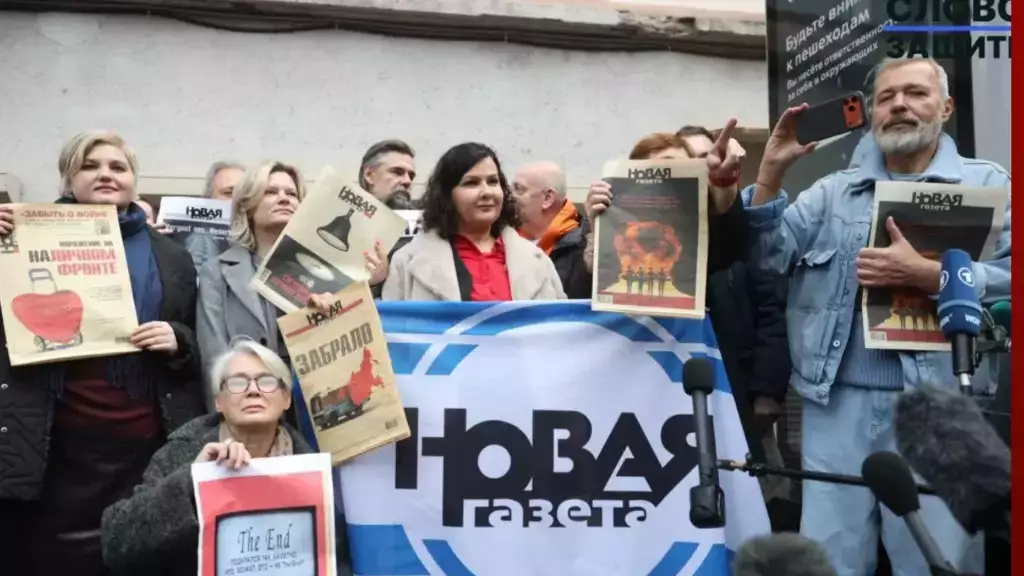
One of Russia’s most recognizable independent newsrooms is ceasing operations at its current headquarters in Moscow. According to reports from November 9, 2026, journalists from “Novaya Gazeta” left the editorial office, which for over three decades had symbolized the fight for freedom of speech, exposing abuses of power, and defending human rights. The newspaper’s history is also marked by repression, persecution, and murder of individuals associated with investigative journalism.
Over 30 years of independent journalism in Russia


Novaya Gazeta was founded in 1993, during the period of political and social transformation following the collapse of the Soviet Union. Over time, it became one of Russia’s leading investigative journalism outlets.
Its authors described corruption, the activities of the Russian security services, human rights violations, and Russian-led military operations. Coverage of Chechnya held a special place in the newspaper’s history.
In a country where the space for independent media was systematically shrinking, the editorial office remained one of the most recognizable voices critical of the authorities for years.
Six people associated with the editorial office lost their lives
The history of Novaya Gazeta is marked by tragedy. Among those murdered were journalists Igor Domnikov, Yuri Shchekochikhin, Anna Politkovskaya, and Anastasia Baburova, as well as lawyer Stanislav Markelov and human rights activist Natalia Estemirova.
One of the most famous figures was Anna Politkovskaya, who documented human rights violations during the war in Chechnya and openly criticized the Russian authorities.
She was shot dead in Moscow on October 7, 2006. Her death became one of the most recognizable symbols of the threats facing independent journalists in Russia.
Russian authorities have been restricting the newspaper’s activities for years.
Following the launch of the full-scale Russian invasion of Ukraine in February 2022, pressure on independent Russian media intensified further.
In 2022, a Russian court invalidated the registration of the print edition of Novaya Gazeta. This was one of the most serious blows to the editorial office, which had been operating for years in an increasingly difficult political and legal environment.
Despite these restrictions, journalists associated with the title continued their work, striving to maintain editorial independence.
According to information provided on November 9, 2026, another stage of this history has ended — the editorial office’s activities in its Moscow headquarters.
Dmitry Muratov appeals for the memory of political prisoners and help for Ukraine
Dmitry Muratov, winner of the 2021 Nobel Peace Prize, was associated with the editorial office for many years.
Muratov was honored for his work in support of freedom of expression, which is one of the basic conditions for the functioning of a democratic society.
According to reports about leaving the Moscow editorial office, the journalist appealed not to forget about political prisoners held in Russia.
He also drew attention to the need to create further humanitarian corridors in Ukraine, enabling the provision of assistance to people affected by the war.
The Kremlin is talking about a simple media rotation
The reaction of the Russian authorities to reports that the Moscow editorial office had ceased operations was particularly controversial.
According to the report, Kremlin spokesman Dmitry Peskov presented the newspaper’s closure as a natural phenomenon in the media market. He stated that, year after year, some media outlets cease to exist and are replaced by others.
However, this explanation ignores the long-standing context of political pressure, legal restrictions and repression against independent journalism in Russia.
In the case of Novaya Gazeta, it’s not just about economic problems or simple changes in the press market. The editorial history demonstrates how difficult it has become for media outlets to function independently of the Russian government.
What’s next for independent journalism in Russia?
The closure of the Moscow editorial office of Novaya Gazeta has significance that goes far beyond the fate of a single newspaper.
This is another symbol of the shrinking space for independent journalism in Russia, especially after the start of a full-scale war against Ukraine.
At the same time, it’s important to distinguish between the termination of a specific editorial office in Moscow and the definitive end of all journalistic initiatives associated with the “Novaya Gazeta” brand. Some Russian journalists continue their work abroad.
For over three decades, Novaya Gazeta published material that the Russian authorities often refused to see in the public sphere. Its history remains a testament to the price independent journalists pay for the right to inform the public.
The closure of the Moscow editorial office doesn’t mean that the questions posed by its authors have ceased to exist. However, it does mean that in today’s Russia, it is increasingly difficult to ask them publicly.

Journalist and Editor-in-Chief of Nowiny Wschodnie, a news platform followed by more than 140,000 people on social media. A graduate in Journalism and Social Communication, he has been co-creating and developing Nowiny Wschodnie since 2017. He gained professional experience working with local and international media.
He specializes in fact-checking, countering disinformation and propaganda, and information security. His work focuses on Poland, Ukraine, Eastern Europe, and Polish-Ukrainian relations. He is also the founder of a non-profit organization working in the fields of integration and intercultural dialogue.
What do you think about this story?
Join the conversation. Please keep comments relevant to the article.
Write a comment