
The Russian-Ukrainian war is being waged not only on the battlefield. From the first days of the full-scale aggression, alongside the actions of the Russian army, a second war has been unfolding—waged in the language of history, memory, religion, and civilization. Its goal is not to seize a particular hill or city, but to create a narrative in which the war ceases to be a political decision by the Kremlin and instead is presented as a historical necessity, a defense of one’s own civilization, and a struggle for the survival of a certain world.
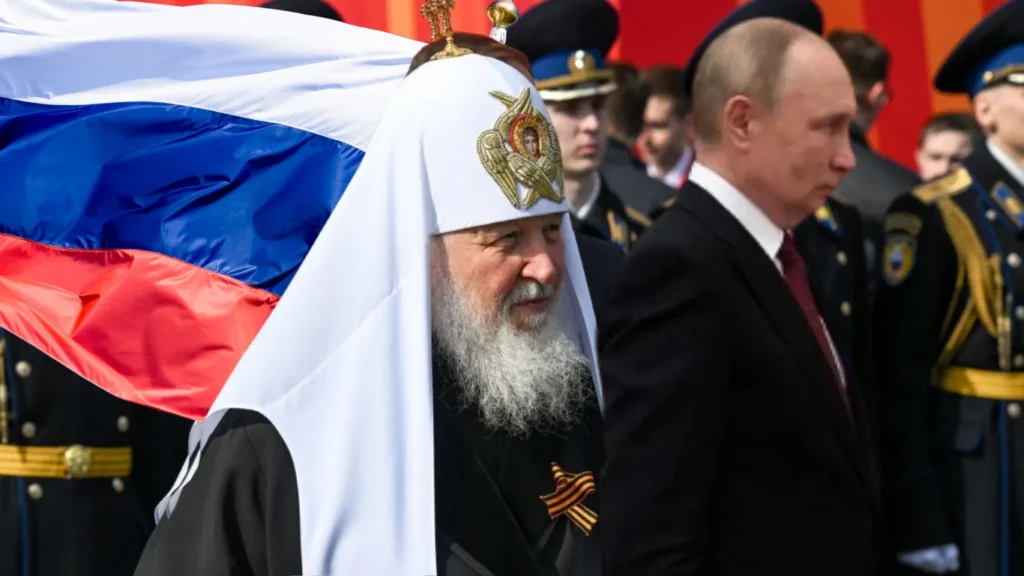


This does not mean, however, that the religious justification for Russia’s wartime policy was born with the full-scale aggression. Its roots reach much further back. Long before February 24, 2022, the Russian Orthodox Church became one of the important pillars of the idea of the “Russian world,” understood not only as a community of language, culture, and Orthodox tradition, but also as a special sphere of Russia’s historical, spiritual, and political influence. In this narrative, state borders increasingly gave way to the borders of an imagined community whose center was to be Moscow, and the religious bond became one of the arguments sustaining the belief in Russia’s special role vis-à-vis Ukraine and other nations perceived as part of the same world.
In this construction, a special place is occupied by the Russian Orthodox Church. This is not about Orthodoxy as a religion, nor about all Russian faithful or clergy. It is about the policy of the Church’s leadership, and above all about Patriarch Kirill, whose statements, decisions, and the documents of the institutions he leads show how religious language became ever more clearly intertwined with the state narrative about the war.
Most telling is that many examples do not need to be sought in Ukrainian media or in Western analyses. They can be found in the official materials of the Russian Orthodox Church itself. It is precisely there, in documents, sermons, and official declarations, that one can trace the path leading from the idea of the “Russkiy Mir,” through religious and civilizational justification of the conflict, all the way to calling Russia’s war against Ukraine a “holy war.”
September 2022: death is given a religious meaning
On 25 September 2022, a few days after Vladimir Putin announced partial mobilization, Patriarch Kirill celebrated the liturgy at the Alexander Nevsky Monastery near Moscow. During the service, he prayed for the Russian military and for those who had been killed during the war.
The prayer itself would not have been anything unusual. For centuries, the Church has prayed for soldiers, the wounded, and the fallen. However, the words used then were significant. Kirill spoke of “Holy Rus’,” against which enemies had risen who wanted to “divide and destroy” its single people, and for the fallen he prayed for the “forgiveness of sins.”
A few days earlier, Russia had begun a mobilization that meant that hundreds of thousands of citizens would have to go to the front. In this context, a religious interpretation of death took on particular significance. A person being sent to war received not only a state summons to fulfill a duty, but also a religious narrative in which his death could be presented as a sacrifice made in defense of the “holy homeland.”
This is an important difference. The state may tell a citizen that they have a duty to fight. A religious authority, on the other hand, may try to answer a much more difficult question: why it is worth dying for that fight.
“Not one nation,” but one political project
In the Russian Church narrative, Ukraine is not consistently presented as a separate political entity. In a speech at the World Russian People’s Council, Patriarch Kirill spoke of Russians and Ukrainians as “one nation,” united by a common spiritual code, culture, historical heritage, a shared fate and… religion.
On the surface, this is the language of history and culture; in reality, however, it conceals a specific political project: if two nations are presented as one, the distinctiveness of one of them begins to be treated not as a natural result of history, but as an artificial division that must be overcome.
This does not mean that the “Russian world” is an exclusively Orthodox project. Russia is a multiethnic and multifaith state, and its ideological construct also includes Muslims, Buddhists, Jews, and nonreligious people. Orthodoxy, however, occupies a special position in it: it constitutes the symbolic foundation of the historical community, while the remaining religious traditions are inscribed into a broader story about a multiethnic Russian civilization. In this way, the “Russian world” transcends confessional boundaries, but it does not abandon a symbolic hierarchy in which Moscow remains the spiritual, historical, and political center.
In this construction, a special place is occupied by the Russian Orthodox Church. This is not about Orthodoxy as a religion, nor about all Russian faithful or clergy. It is about the politics of the Church’s leadership, and above all about Patriarch Kirill…
That is precisely why the concept of the “Russian world” is something more than a sentimental story about a shared heritage. In the Russian interpretation, it becomes an ideologeme—a construct that makes it possible to connect religion, history, culture, and geopolitics.
March 2024: “Holy war”
The most striking moment came in March 2024. The 25th World Russian People’s Council, chaired by Patriarch Kirill, adopted a document entitled “The Present and Future of the Russian World.” This was not a private theological text or a sermon delivered during a service. The document was addressed to Russia’s legislative and executive authorities.
And it was precisely in this document that the statement appeared that the Russian “special military operation” (Newspeak!) is, from a spiritual and moral point of view, a “Holy War.” The authors of the document presented it as a stage of a “national liberation struggle” against the Ukrainian authorities and the “collective West.” However, they went even further: it was written that after the end of the war, the entire territory of contemporary Ukraine should find itself in “Russia’s sphere of exclusive influence,” and the possibility of a political system hostile to Russia existing in that area should be ruled out.
This is one of those documents that says more than dozens of commentaries.
In a single text, three elements come together: war, religion, and a political project concerning Ukraine’s future. The war is described as “holy,” Russia is given the role of defender of a special civilization, and Ukraine is placed within Russia’s sphere of influence.
It would be hard to find a more vivid example of the shift from the idea of the “Russian world” to a political theology of war.
600 clergy within the security structures
One more fact shows that this is not only about language.
The official website of the Moscow Patriarchate currently reports that in Russia 600 clergy are engaged in pastoral care for servicemen and officers of the security structures, including 181 in full-time positions. The Church also emphasizes that since the start of the acute phase of the war in February 2022, clergy have been ministering directly on the contact line and among soldiers taking part in combat operations.
There is nothing unusual about a soldier having the opportunity to talk with a chaplain. The problem arises when pastoral care is combined with a particular interpretation of the war, in which the soldier is not merely a person in need of support, but a participant in “defending the homeland,” “fighting evil,” or a “holy mission.”
Patriarch Kirill himself spoke plainly about the need to address soldiers with words concerning “God,” “sacrifice,” and “the Christian side of their wartime toil.”
This phrasing is more important than it might seem. It shows that it is not only about the presence of clergy with the military, but also about giving military actions a specific religious meaning.
The Church and the National Guard (Rosgvardia)
On March 14, 2024, an even more concrete event took place. Patriarch Kirill and General Viktor Zolotov, commander of the National Guard (Rosgvardia), signed an agreement on cooperation between the Russian Orthodox Church and the Federal Service of the National Guard Troops of the Russian Federation.
This is no longer the language of symbols. This is an institutional relationship. The National Guard (Rosgvardia) is not an ordinary social organization. It is a state formation responsible, among other things, for internal security, the protection of public order, and armed operations. Signing an official agreement between its leadership and the patriarch shows the scale of the institutional rapprochement between the Church and the state security apparatus.
At the same time, the Russian Orthodox Church increasingly strengthened its own presence within the army, in military hospitals, and among soldiers taking part in combat operations.
The Church therefore did not only talk about the war. Its structures were incorporated into a system that services this war also at the spiritual level.
The temple as a symbol of the state and the army
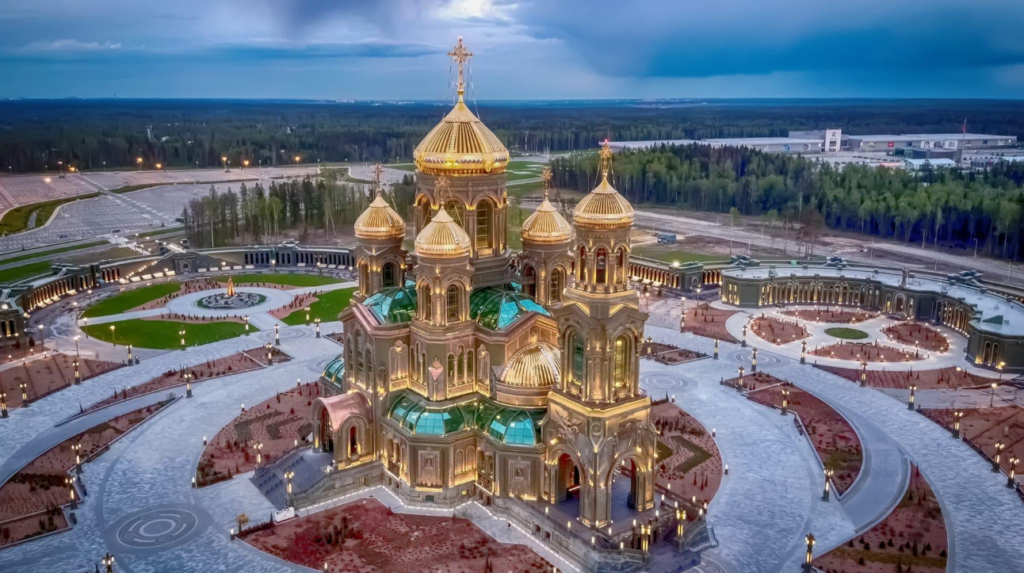
It is no coincidence that the central symbol of this process became the monumental Cathedral of the Resurrection of Christ, the main church of the Armed Forces of the Russian Federation. Patriarch Kirill is its superior, and the church was built as an element of the culture of remembrance of the Russian armed forces.
This also shows the character of the Russian religious construct. In one place, the symbols of Orthodoxy, the state, the army, and Russian military history come together.
This is no longer the traditional relationship between an individual believer and a religious community. It is a much broader symbolic project in which the state, the military, history, and religion are meant to mutually confirm each other’s legitimacy.
And what about those who say “no”?
However, this story would have too simple a structure if one were to present the Russian clergy as completely unanimous.
Also within Russian Orthodoxy, clergy emerged who opposed the war. One of the best-known examples was Father Ioann Burdin, who in 2022 publicly condemned the bloodshed and described the war as a situation in which “brother kills brother.” In 2023, a church court stripped him of the right to perform priestly ministry, citing, among other things, his pacifist stance and criticism of the Church leadership.
This case is important not because it represents all Russian clergy, but precisely because it shows the price of opposing the dominant line.
If one part of the clergy is granted the opportunity to serve with the army and at the front, while a clergyman who opposes the war is stripped of the right to perform ministry, it is hard to speak of a religion functioning completely outside state politics.
From language to system
Over the course of a few years, a system emerged whose individual elements are easy to identify.
First there was the “russkij mir” and the belief in a special spiritual unity of Russians and Ukrainians. Then came a narrative about the threat from the West and the need to defend “Holy Rus’”. After the full-scale war began, the deaths of Russian soldiers started to be interpreted in religious terms. At the same time, the presence of clergy within military structures was developing. In March 2024, the Church signed an agreement with Rosgvardiya. And a few weeks later, a document of the World Russian People’s Council gave Russia’s war against Ukraine the name “Holy War” and at the same time defined Ukraine as an area of Russia’s future exclusive influence.
This is no longer just a matter of language. It is a system. A system in which religion provides the state not only with symbols but also with arguments that make it possible to present war as the defense of values, territory as part of a historical community, and death as a sacrifice.
That is why the phrase “The Church blesses the war” can be used as a journalistic shorthand, but a much more accurate description is the statement that the leadership of the Russian Orthodox Church spent years building a religious narrative that gives Russian aggression a moral, civilizational, and sacred dimension.
Most telling, however, is the fact that the subsequent stages of this story can be reconstructed not on the basis of conjecture, but on the basis of the Church’s own documents: the Patriarch’s prayer from September 2022, his statements about “Holy Rus’,” data on hundreds of clergy serving within the security structures, the agreement with the Rosgvardiya, and the document of the World Russian People’s Council in which the war was called “holy.”
In this sense, the path from the “Russian mir” to “holy war” is not merely a journalistic figure of speech. It is a path that can be traced over time, document by document, statement by statement.
And that is precisely why it is worth looking not only at what Russia does with a weapon in its hand, but also at what words it uses to give meaning to this violence.
Literary scholar and researcher specialising in culture, identity, Polish-Ukrainian relations, and sociocultural processes in Central and Eastern Europe.
For many years, he has combined academic, educational, and civic activities in Poland and Ukraine. His research interests include cultural borderlands, collective memory, postcolonial processes, and intercultural interactions. He is the author and co-author of several monographs and more than 150 academic publications.
He has extensive academic and organisational experience. He has held senior positions at universities in Poland and Ukraine, led research teams, and implemented international research and educational projects.
He is actively involved in supporting the Polish community in Ukraine, particularly in Berdiansk and the southeastern part of the country. His work focuses on cultural heritage preservation, education, and documenting the experiences of communities affected by war and occupation.
In his publications and commentaries, he examines the Russo-Ukrainian war, Polish-Ukrainian relations, Polish diaspora communities in Central and Eastern Europe, politics of memory, and questions of national and cultural identity. He also addresses Russian propaganda and imperial narratives.
In recognition of his academic, cultural, and civic contributions, he has received several distinctions, including the Knight’s Cross of the Order of Merit of the Republic of Poland, the Medal for Merit to Culture – Gloria Artis, and the Honorary Badge “Meritorious for Polish Culture”.

What do you think about this story?
Join the conversation. Please keep comments relevant to the article.
Write a comment