
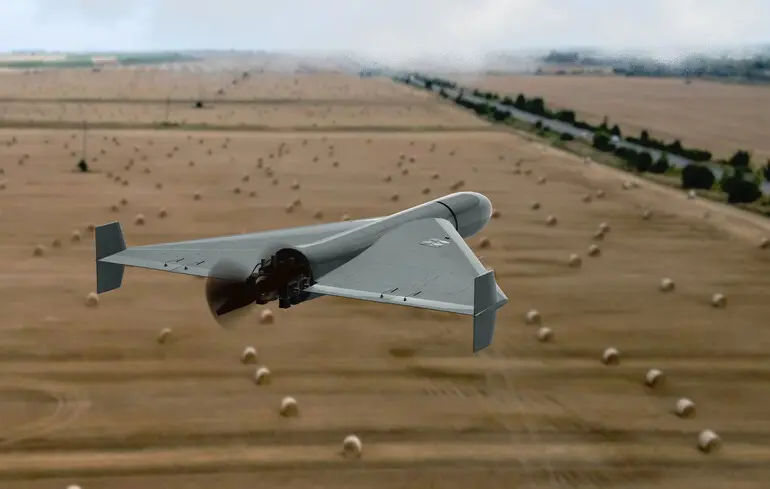
Source: social media, compiled by Nowiny Wschodnie


On 17 August, during a massive attack on Odesa Oblast, Russian “Bandierol” loitering munition veered off course toward Chornomorsk and Odesa, crossed the border and fell on Moldova’s territory, sparking a fire near the village of Talmaza. In the same week, the deputy head of Ukraine’s Main Intelligence Directorate (GUR) Vadym Skibitskyi told RBK-Ukraine that the main threat to NATO is not tanks or missiles, but precisely such — at first glance accidental — incidents. In his view, this is one of the indicators that usually precedes combat operations. The question is whether these two news items — about Moldova and about the intelligence assessment — can still be treated separately.
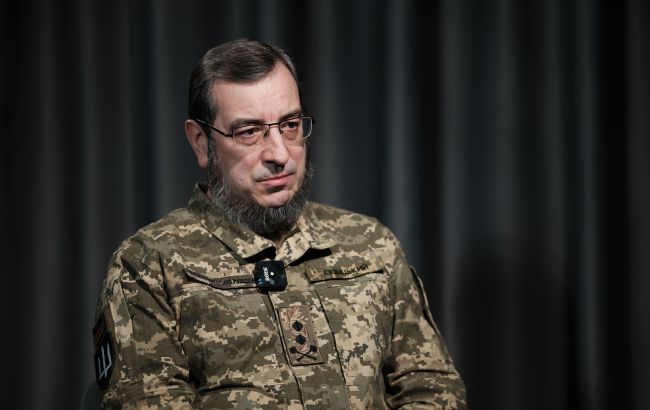
Vadym Skibitskyi, Major General, Deputy Head of the GUR of the Ministry of Defence of Ukraine.
Source: RBK-Ukraine / Vitalii Nosach, compiled by Nowiny Wschodnie
At 17:25 on 17 August, the Ukrainian Air Force reported the movement of several “Banderol”s—loitering munitions launched from “Orion” drones—toward Chornomorsk and Odesa. One of them then changed course to the northwest and at 17:37, according to Moldova’s Ministry of Defense, crossed the state border. The target disappeared from radar already over Moldovan territory; according to some monitoring channels it was later recorded in unrecognized Transnistria. The explosion occurred about 30 kilometers from the border, near the village of Talmaza in the Ștefan Vodă district, and caused a forest fire. Moldova’s Foreign Ministry described this as an “unacceptable” violation of the country’s sovereignty.
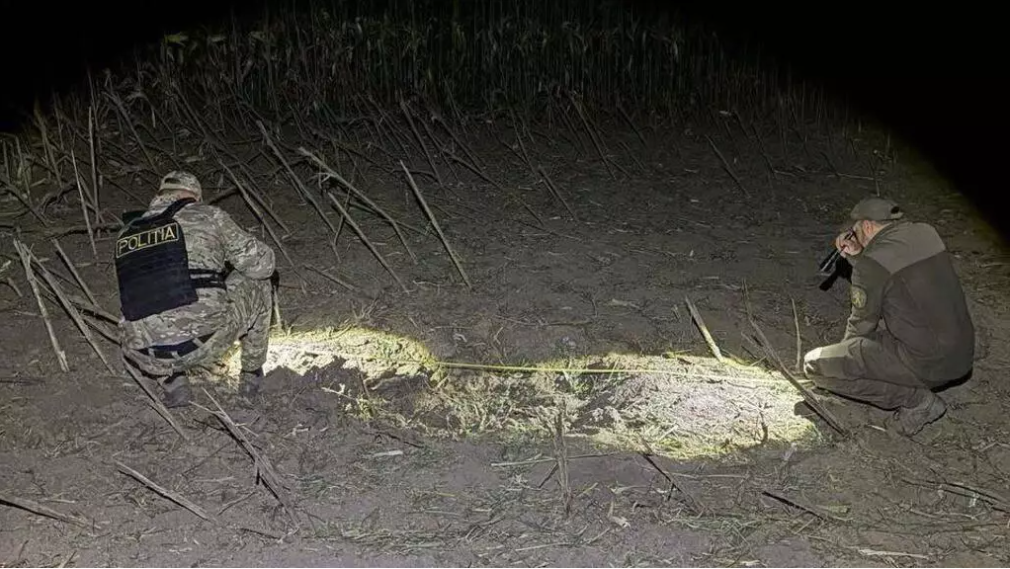
Drone wreckage near the town of Talmaza, Moldova, 17 August 2026.
Source: Police of the Republic of Moldova / Facebook, ed. Nowiny Wschodnie
This is already the second such case in two weeks: on 9 August an unmanned aerial vehicle fell and exploded near Ștefan Vodă, 10 kilometers from the Moldovan-Ukrainian border. Moldova’s President Maia Sandu had previously acknowledged that some Russian drones enter her country’s airspace accidentally—due to guidance failures or jamming—while others, she said, are sent there deliberately. This caveat is important: not every border violation is an intentional signal, and so far no official investigation has determined which category the 17 August incident falls into.
It is precisely against the backdrop of such “borderland” stories that Skibicki made his statement. The GUR currently considers the most realistic threat to NATO to be not a direct invasion, but Russia’s asymmetric, hybrid actions: unidentified drones over Alliance territory, information campaigns against Western weaponry, support for pro-Russian political movements in Europe. According to the intelligence assessment, in its plans Russia is preparing for a possible war with NATO countries by 2030 — and these data, Skibicki emphasized, are also confirmed by the intelligence services of Alliance states.
Why does intelligence interpret an “ordinary drone” as an indicator of preparations for war?
The logic Skibicki describes is fairly simple—and precisely for that reason alarming: hybrid operations are rarely an end in themselves. According to this argument, if we look at theory and history, they usually precede combat operations. In other words, a drone over someone else’s territory, even officially classified as a “course error,” in this logic is not an incident but a test: how quickly air defenses will react, how long political coordination of a response will take, whether the state will show disorientation.
The chronology of the past year confirms that this is not about isolated incidents. The real breakthrough came on the night of 9–10 September 2025, when during a mass raid of 19–21 drones, aircraft entered the airspace of eastern and central Poland — some from the territory of Belarus — and debris was found as far as 200 kilometers from the border. At that time, Polish F-16s and Dutch F-35s for the first time shot down at least three hostile unmanned aerial vehicles. Since then, tensions have not eased: at the end of July and at the beginning of August 2026, Polish fighters twice intercepted over the Baltic a Russian Il-20 reconnaissance aircraft, which was flying without a flight plan and with its transponder switched off. According to data cited by European Pravda, in July 2026 NATO fighters scrambled to intercept Russian aircraft near the Alliance’s borders 250 percent more often than a year earlier in the same month.
A similar picture can be seen in the Baltic states, where in spring 2026 a series of drone overflights were recorded that deviated from course as a result of Russian radio-communications jamming. Lithuanian special services directly linked this to the operation of electronic warfare assets, rather than to an intentional launch toward a specific target. Even so, the consequences proved very real: political disorientation, the resignation of Latvia’s government, a wave of mutual accusations — precisely the effect that the GUR warns about, regardless of whether a given overflight was deliberate.
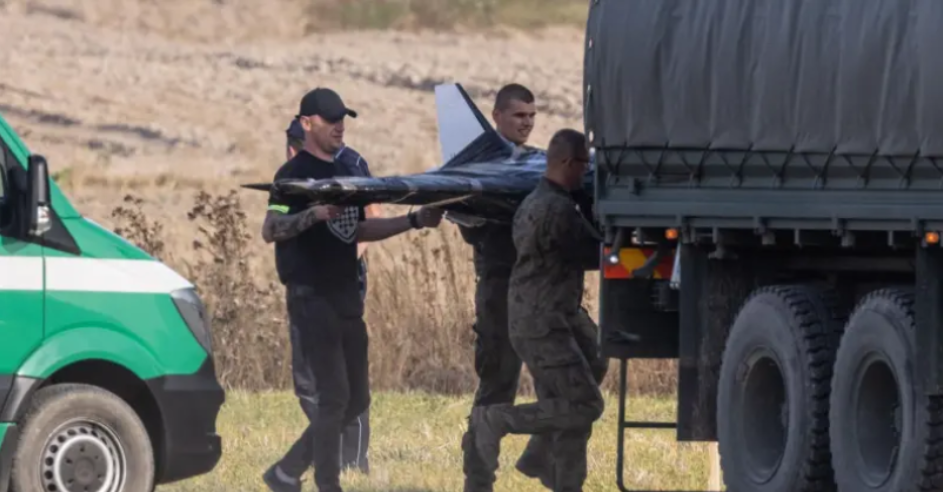
Source: social media, compiled by Nowiny Wschodnie
And herein lies the main difficulty for anyone trying to understand the situation: each individual incident can be explained away as a technical malfunction, but their sum — much harder. Moldova on 17 August is not the first and certainly not the last border violation in the region; it is rather another point on an upward-trending line that intelligence has been tracking at least since September 2025.
If you look at theory and history, they usually precede combat operations — Vadym Skibitskyi, deputy head of the GUR, in a conversation with RBK-Ukraine.
However, it is worth neither overestimating nor oversimplifying this picture. Hybrid activity is not the same as a declaration of war, and intelligence itself describes it as an “indicator,” not as proof of an inevitable attack. The date “by 2030” is an assessment of planning, not a forecast of a specific invasion date, and it aligns — as Skibitskyi noted — with the Alliance’s own public assessments, not only with Ukrainian data. At the same time, it is precisely this restraint in wording that makes the GUR statement more serious than yet another alarmist headline: intelligence is not saying “war tomorrow,” it is saying “look at the indicators” — and one of those indicators has just fallen near a Moldovan village.
A drone doesn’t choose where it will fall. But how long it takes to respond to each such crash is a question not for Russia, but for those who should be answering it.
Source: Nowiny Wschodnie / NV / ZAXID.NET / Gordon / Glavred / RBK-Ukraine / LIGA.net / 24 Kanal / Głos Karpat / European Pravda / Militarnyi / Slovo i Dilo
