
The following text is an original opinion commentary on Donald Trump’s policy toward Russia and Ukraine and its possible consequences for Europe’s security – ed.
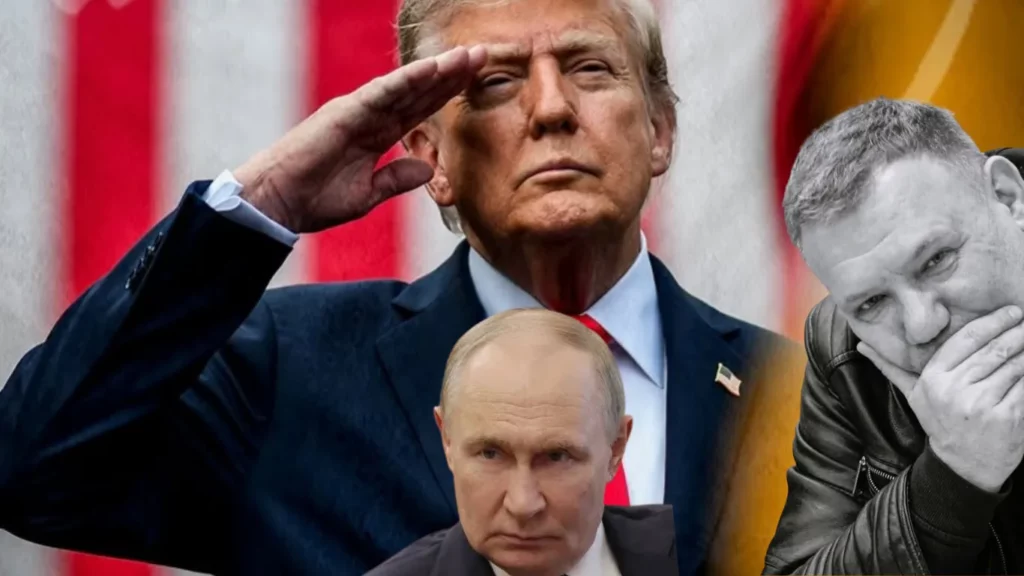


Donald Trump’s abrupt change in approach toward Russia and Ukraine raises questions about the American president’s motives. Is it an attempt to end the war quickly, an electoral calculation, or a strategy whose consequences may prove particularly beneficial for Vladimir Putin? Or perhaps not only for him, but also for the President of the United States? One thing is certain: what is at stake is not only political influence, but also the safety of millions of Ukrainians.
Timing that raises doubts
Donald Trump’s latest words and actions clearly indicate a greater willingness to make concessions to the Kremlin.
On October 19, Trump said about Zelensky: “I think it’s time for someone else to negotiate on behalf of Ukraine.” He also added that Zelensky should have ended the war long ago and that he is not helping to end it. At the same time, he said about Russia: “Russia, frankly, is doing quite well with Ukraine. They’re not doing much”. “
Why are the words of the President of the United States so important? Trump publicly undermines the position of the President of Ukraine as a negotiator, while at the same time speaking about Russia’s actions in a milder tone. He openly portrays the democratically elected leader of the country attacked by Russia as a more difficult partner than the leader of the state that launched a full-scale invasion. He also blames Ukrainian strikes on Russian refineries for the rise in diesel fuel prices, while simultaneously announcing an agreement on supplies of Russian diesel. The timing of these decisions is particularly questionable — in the period preceding the U.S. midterm elections.
From a political standpoint, this may be an extremely risky strategy. Trump exposes himself to criticism from part of his own camp, undermines the trust of allies, and gives his opponents arguments to challenge his foreign policy. A vast portion of American society, which declares support for Ukraine, also disagrees with him.
According to a YouGov poll from October 14, 2026, as many as 57% of Americans declare greater sympathy for Ukraine, while only 4% sympathize with Russia. This is an enormous advantage for Ukraine, showing that American society decidedly more often sides with it than with the aggressor state. These results contradict the belief that Americans widely support a pro-Russian direction in policy.
One possible explanation is Trump’s belief that a quick agreement with Vladimir Putin will allow him to announce a diplomatic success. Ending the war, lowering the costs borne by Americans, and presenting himself as a leader capable of resolving international conflicts could be significant political assets. The problem is that a quick agreement does not have to mean a just peace, and a diplomatic success proclaimed by a politician does not necessarily have to be a strategic success for his country.
Putin can benefit, even if Trump is not acting on his orders
For Russia, a weakening of American support for Ukraine would be a major gain. Military aid, deliveries of weapons and ammunition, intelligence cooperation, and the political unity of the West have a direct impact on Ukraine’s ability to defend itself against Russian aggression
Any disruption to this cooperation may improve the Kremlin’s negotiating position in the future. If, additionally, peace talks are conducted under pressure on Kyiv rather than on Moscow, Russia may obtain concessions it was unable to force through by military action alone. This is extremely worrying.
This does not automatically mean that Trump is acting on Putin’s orders or that there is some secret agreement between them. Such claims would require specific evidence. So far, there is none.
In international politics, you don’t have to control anyone to take advantage of their decisions. It is enough that two leaders are guided by their own interests, and at a certain moment their goals begin to overlap. Trump may seek a quick deal and political publicity, while Putin will try to use America’s haste to weaken Ukraine and cement Russia’s gains.
Behind political calculations lie human tragedies
It is understandable that in this discussion it is easiest to focus on polls, negotiations, economic interests, and great-power rivalry. Meanwhile, the most serious consequences of misguided policy are borne by people who have no influence over the decisions being made. Ukrainian civilians still live in the shadow of Russian attacks. People are dying, homes are being destroyed, and entire families are losing loved ones and their sense of security. Among the victims are innocent children, for whom the war means not only a direct threat to life, but also the loss of childhood, home, and prospects for a normal future.
It is not fair to claim that every decision made by Trump directly causes a specific death. Responsibility for Russia’s aggression and attacks on the Ukrainian civilian population lies with Russia. However, this does not absolve the U.S. administration of responsibility for the foreseeable consequences of its own policy.
If the United States limits support that helps Ukraine defend itself, it must take into account that this may affect the safety of its residents. If diplomatic pressure primarily leads to weakening the attacked state rather than stopping the aggressor, it is hard to present such actions as an indisputable contribution to peace.
Children dying in a war cannot be the price for a political success that someone wants to announce before the elections.
This is precisely where the abstract discussion about strategy ends and the moral dimension of decisions made in Washington begins. For the American president, the war may be a problem to be solved at the negotiating table. For a Ukrainian family living in a threatened city, it is a daily struggle for survival.
Peace—or just a break before the next war?
There is one more danger. An agreement reached at any cost may not end the conflict, but merely freeze it on terms favorable to Russia. If it does not include credible security guarantees for Ukraine and mechanisms to prevent further attacks, it may give the Kremlin time to rebuild its military potential and prepare for further confrontation. In other words, for another brutal war.
In such a scenario, Trump could declare success, and Russian propaganda could present the outcome of the negotiations as confirmation of the effectiveness of Putin’s policy. Ukraine would remain at risk, however, and Europe would have to bear the costs of ongoing instability.
True peace requires something more than declarations and photographs at the negotiating table. It must ensure security for the country that has been the victim of aggression, not reward the aggressor for persistence and readiness to continue using violence.
Questions Trump should answer
The most important question is not whether Trump is personally pro-Russian. What matters more is whether the American president can demonstrate that his policy brings real benefits to the United States, increases the chances of lasting peace, and does not weaken Ukraine’s security. Is he not putting his own need for quick success ahead of his country’s long-term interests and the security of European allies?
If Trump’s abrupt shift in policy weakens Ukraine’s ability to defend itself, increases the Kremlin’s room for maneuver, and exposes civilians to further danger, it should be met with serious criticism.
Because behind the political calculations there are people whose lives cannot be restored with another agreement. There are parents afraid for their children, children losing their parents, and families who, day by day, lose everything.
Trump may seek victory in negotiations, an improvement in his own image, and political gains before the election. However, it must not be forgotten that the true measure of success is not how impressively a leader announces that an agreement has been reached, but whether the people affected by the war will finally be able to live without fear.
If the price of a political triumph is that Ukraine is left in uncertainty and innocent children continue to die in Russian attacks, it is hard to call that a victory. It would be a failure not only of diplomacy, but also of moral responsibility.
Source: YouGov, survey of 14 October 2026; / Reuters, 19 October 2026.

Journalist, columnist, author of books about Ukraine, tour guide, and commentator on developments in Ukraine and Polish-Ukrainian relations.
A certified guide to Odesa, the Odesa catacombs, Ukrainian Bessarabia, and Kyiv. He is the author of numerous publications on Ukraine’s history, culture, and contemporary affairs, some of which have been translated into Ukrainian and published in Ukraine. In 2020, he received the honorary title of Ambassador of Odesa in Poland from the Mayor of Odesa.
On 24 February 2022, the day Russia launched its full-scale invasion of Ukraine, he was in Odesa. He remained there for several months, helping coordinate humanitarian aid and reporting on the war for Polish media outlets. He described his experiences during this period in his book Odessa 4.5.0.
At Nowiny Wschodnie, he publishes articles and commentary on the Russo-Ukrainian war, Russian propaganda and disinformation, Ukrainian history, particularly that of Odesa, as well as Polish-Ukrainian relations and changing public attitudes.
He collaborates with Ukrainian newsrooms and online news outlets and appears in Polish media as a commentator on Ukrainian affairs.

What do you think about this story?
Join the conversation. Please keep comments relevant to the article.
Write a comment