
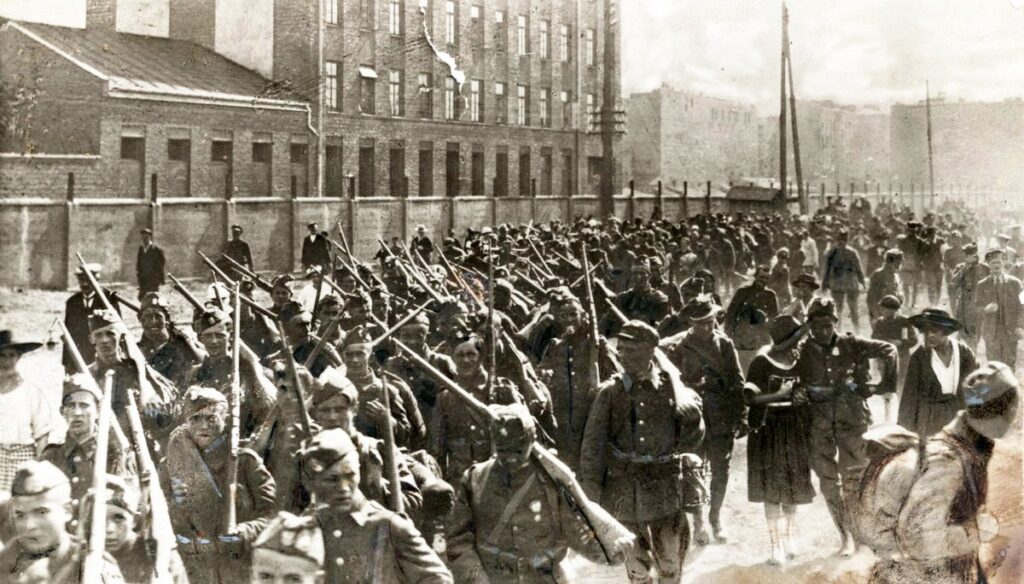


Photo: dzieje.pl / PAP / ed. Nowiny Wschodnie
On 15 August, Poland marks the 106th anniversary of the Battle of Warsaw — the day when a young, newly reborn state, building an army literally in the fire of war, stopped the Red Army at the very gates of the capital. Usually, people speak of it as a closed chapter in a textbook. And yet it is precisely from the experience of building statehood under pressure from Russia that Poland drew lessons which, over the last decade — quietly, without fanfare — it has shared with Ukraine. Not as a showy gesture of solidarity, but as a concrete transfer of knowledge: how to decentralise power, how to carry out a painful economic reform, and how to build from scratch a citizens’ army that defends its own land.

This reverses the well-worn narrative. Usually, people ask what Poland is learning today from a fighting Ukraine — about drones, about urban warfare, about societal resilience. Less often, the question is asked the other way around: what Ukraine has been learning from Poland over the last twelve years — long before 2022. The answer is not one thing. There are three, and each of them today quite literally determines whether the Ukrainian state will survive.
Why Poland specifically, and not the entire Western world all at once?
The first lesson began in offices, not on the front line. A month after Euromaidan, in March 2014, the then Deputy Prime Minister of Ukraine, Volodymyr Hroisman—previously the long-serving, popular mayor of Vinnytsia—came to Warsaw and asked the Polish government for help in carrying out local-government reform. Ukraine inherited from the USSR an inefficient, highly centralized administrative system: regions and districts were governed by officials appointed from Kyiv, and local governments did not have sufficient financial capacity to carry out public tasks. Poland had already gone through its own path—the local-government reform of the 1990s—built, as researchers of the subject note, by the best lawyers and scholars of the era of transformation.
Since that visit, Ukraine’s decentralization reform has been carried out in cooperation and with the direct use of Polish experience in building local self-government. The scale of the changes was not merely cosmetic: from around 12,000 fragmented communities, Ukraine consolidated them into 1,470 units, and reduced the number of districts from 490 to 136. The financial effect proved measurable: as a result of fiscal decentralization, the revenues of Ukrainian local governments increased by more than 30 percent. This reform and the decentralization of power associated with it is—as the Akademia Wschód portal summarizes when reporting on Ukraine’s local elections—modeled on Polish experience.
The second lesson was about the wallet, and it was far more painful. In 1990, GDP per capita in Poland was lower than in Ukraine — by nearly 800 dollars. A quarter of a century later, the roles reversed, and it is precisely Leszek Balcerowicz’s tough reforms of 1989 and 1990 — price liberalization, macroeconomic stabilization, and privatization of state-owned enterprises — that are regarded as one of the main reasons for this difference. In 2014, Balcerowicz himself, as co-chair of the advisory team to President Petro Poroshenko, came to Kyiv to say this outright.
«Strengthening the financial system, economic growth, fighting corruption and decentralization» — Leszek Balcerowicz, advisor to President Petro Poroshenko, on the reform priorities for Ukraine.
There he also pointed to a concrete thing that today sounds almost prophetic: giving up importing gas from Russia. Ukraine began moving away from direct gas purchases from Gazprom already after the annexation of Crimea in 2014, replacing them with supplies from Western countries, partly via the Polish LNG terminal in Świnoujście. Balcerowicz called it at the time a record in Europe. It was precisely this lesson — that energy sovereignty is a condition for political sovereignty — that turned out to be one of the few things that protected Ukraine from Russian gas blackmail already after 2022.
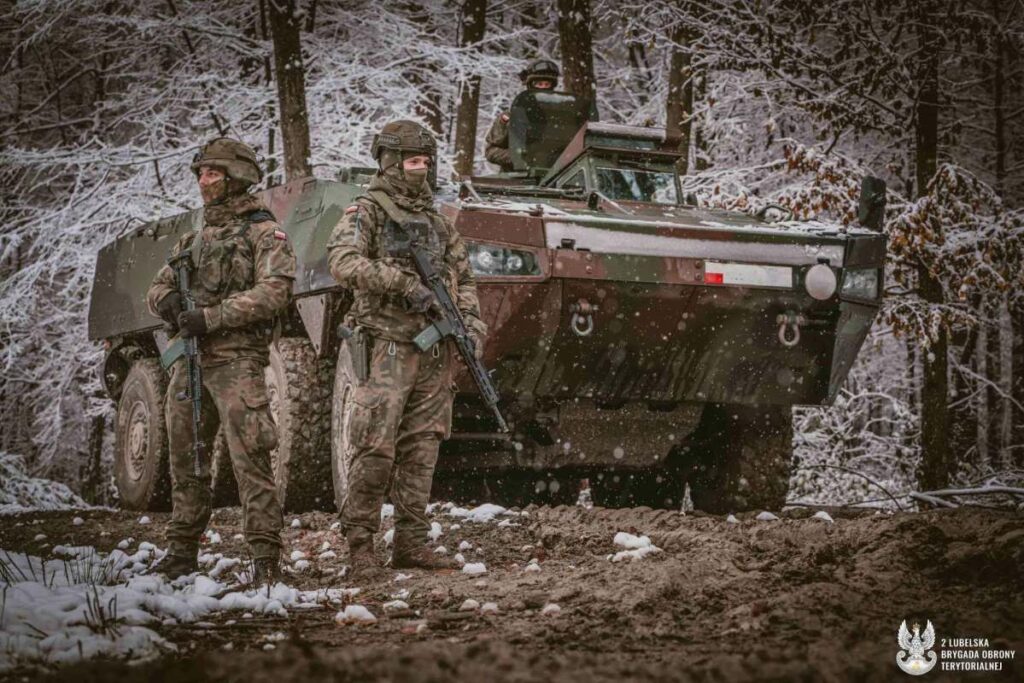
Photo: Wojsko-Polskie.pl / ed. Nowiny Wschodnie
The third lesson is the most recent and the most literal — because it concerns not theory, but rifles in civilians’ hands. The concept of Poland’s Territorial Defence Forces was signed by the then head of the Ministry of National Defence, Antoni Macierewicz, in April 2016, and the formation was formally established on 1 January 2017 as the fifth branch of the Armed Forces of the Republic of Poland. At the start, the plan was for 3,000 soldiers in the first year, ultimately 53,000 — a formation then mocked by some commentators as a political whim. When, however, Russia launched a full-scale attack in February 2022, it was the Commander-in-Chief of the Armed Forces of Ukraine, Gen. Valerii Zaluzhnyi who spoke of tens of thousands of territorial defence reservists — a formation that the Polish press expertly described as built with Poles as the model.
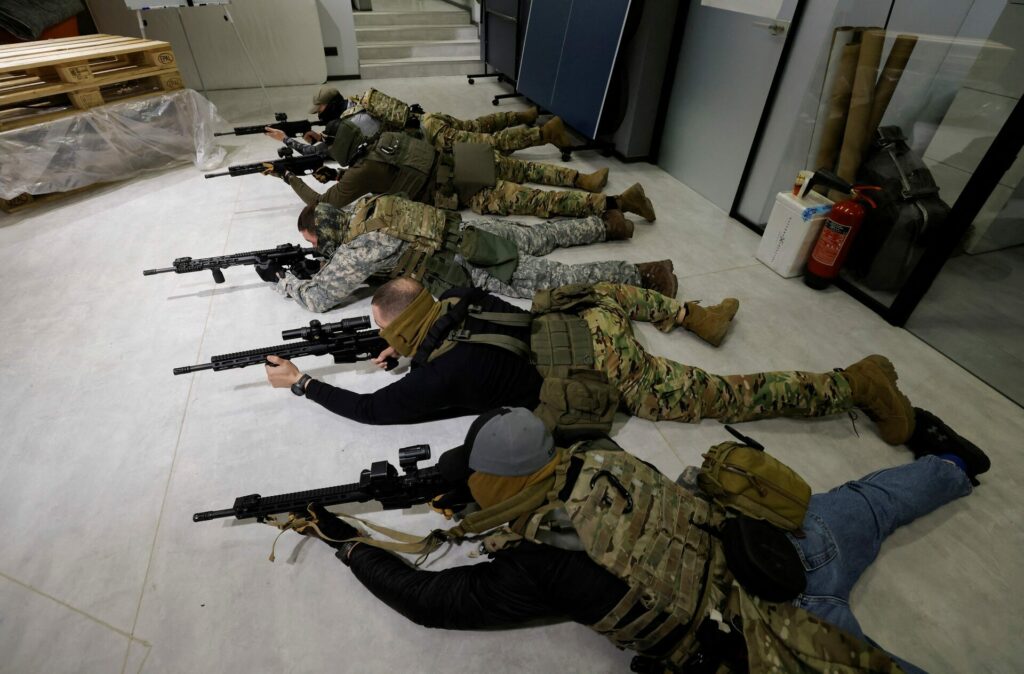
Zdjęcie: Lviv, Ukraine /REUTERS/Zohra Bensemra / opr. Nowiny WschodnieThe Ukrainian Territorial Defence Forces, formally established by law as early as 1 January 2022, a few weeks later became the backbone of the light infantry defending Kyiv and the towns on its outskirts — Bucha, Hostomel, Irpin, as well as Chernihiv, cited as hero cities of the defence of the capital — teaching civilians how to defend themselves before anyone had even managed to train them in operating complex weaponry.
Not every one of these lessons came easily, and none was a simple copy-and-paste. The Polish model of local government was adapted to the Ukrainian specifics of a three-tier administrative division. Balcerowicz’s reforms in Ukraine got bogged down in resistance from oligarchic interests in a way Poland did not face in 1990 — Balcerowicz himself later pointed in Ukraine to the elimination of oligarchs’ monopolies and privileges as a condition for further growth. The Ukrainian territorial defense model, built since 2014 in the shadow of the war in Donbas, differs structurally from the Polish one — as a comparative analysis of the two formations indicates, it is not a secondary formation alongside operational forces, but their direct combat support. Learning is never about copying one-to-one — it is about not having to learn the same thing twice.
Returning to August 15: one hundred and six years ago it was Poland that was a state only just being reborn, building an army from volunteers, peasants, and veterans of three different partitioning uniforms, with a century of nonexistence on the map of Europe behind it. Today it is Poland that has experience Ukraine lacked — and, as the facts show, has been sharing it consistently since 2014, long before it became a headline topic. A lesson does not end on the day someone completes it. It ends only when the student begins to pass it on further.
The Miracle on the Vistula was not a miracle — it was the result of someone learning in time to defend their own state. Ukraine is learning the same thing, only faster, because it has less time.
Source: Nowiny Wschodnie / Wikipedia (pl) / Liberté! / PISM / Akademia Wschód / Diplomacy.pl / Forum Dialogu / Money.pl / KoLiber / GazetaPrawna.pl / RP.PL / WAT / dzieje.pl

