
During the “Quo Vadis Polsko?” debate, organized by the Rozwój Plus association, former Prime Minister Mateusz Morawiecki presented a sober, illusion-free analysis of the state of the Polish economy. In fact, almost every one of the many panelists gathered that day spoke about the difficult geopolitical situation.
Morawiecki without illusions about Poland and Ukraine. “I can easily imagine Ukraine falling”
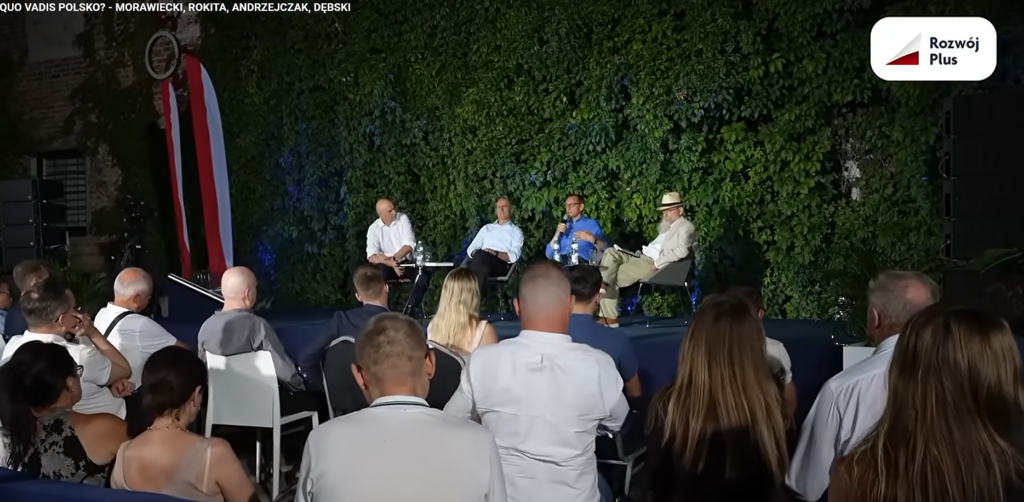


Video from Mateusz Morawiecki’s channel Rozwój + Wy | Main Stage | Mateusz Morawiecki and Guests
A week ago I described the speech by Jan Maria Rokita, who essentially set the tone for the entire discourse. Rokita met no resistance when he advanced the thesis about the urgent need to put political language in order and to move away from the “hystericization” that paralyzes the state. The other panelists—Mateusz Morawiecki and Gen. Rajmund Andrzejczak—fully agreed with him. Rokita even praised the former prime minister several times, pointing to him as a politician capable of rebuilding the demand for the “seriousness of politics.”
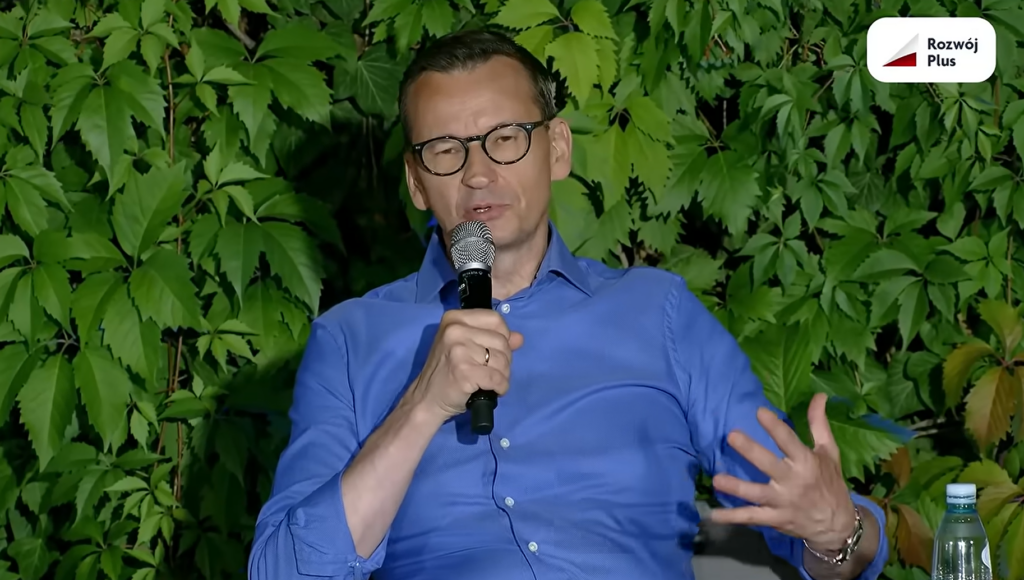
Morawiecki focused on economic goals, but did not avoid geopolitical threads. He challenged the widely repeated slogan about Poland as the “twentieth economic power in the world,” warned of the real risk of the front collapsing in Ukraine, and called for immediately linking massive defense spending with domestic industry.
We must drive armaments with our own economy
This last appeal is—paraphrasing a classic—an “obvious obviousness.” If only the current rulers would draw the proper conclusions from it.
Why is this so important? After the September defeat, Marshal Edward Rydz-Śmigły, in exile, explained the issue of Poland’s earlier exports of weapons. Before the war, Poland was a poor country— for every ten anti-aircraft guns sent for export, the Polish army received one for free. It was a hard economic necessity. The situation is similar with today’s funds and loans (e.g., the SAFE program): if we direct these resources to purchases from Polish defense companies, a significant part of the money will return to the budget in taxes on profit and labor. What’s more, companies will get a development impulse that will force investments in new production lines, technologies, and research and development.
Long-term state orders give the Polish defense sector stability and income certainty for a decade ahead. With such a time horizon, the business can be scaled safely. Thanks to the decisions of the Morawiecki government, many Polish designs underwent a practical test on the battlefields in Ukraine. This equipment proved itself, and manufacturers received something most valuable, something that cannot be obtained on any training ground—feedback abundantly sprinkled with blood and soldiers’ sweat. Battle-proven armaments are sought today by the whole world, and Polish companies have full order books.
The myth of the world’s 20th economy. “Intent according to strength”
In the Polish public debate, for years the phrase has been coming back like a mantra that Poland has become the world’s 20th economy. These words were spoken at the beginning of the panel by Gen. Rajmund Andrzejczak and Jan Rokita, as well as in earlier discussions. Morawiecki reacted to these declarations with clear skepticism:
– Let’s measure our strength by our intentions, but also our intentions by our strength. Let’s remember where we really are – said the former prime minister firmly.
Morawiecki reminded that a place in the top twenty in terms of total GDP results mainly from the size of the Polish population, not from real capital strength. Per capita indicators are far less spectacular: in terms of nominal GDP per capita, Poland ranks only around 44th in the world. In turn, in terms of accumulated wealth per citizen (wealth per capita), unique know-how and advanced technologies, the distance separating us from wealthy Western Europe still remains enormous.
Where did we start, and where are we now?
Although Morawiecki’s remarks were meant to bring the discussants down to earth, the historical context shows a gigantic civilizational leap. In 1990, nominal GDP per capita in Poland amounted to only about USD 1,730 (giving roughly 75th–80th place in the world). Today we are incomparably richer—this is visible, for example, in the scale of holiday trips or the need to build a new central airport.
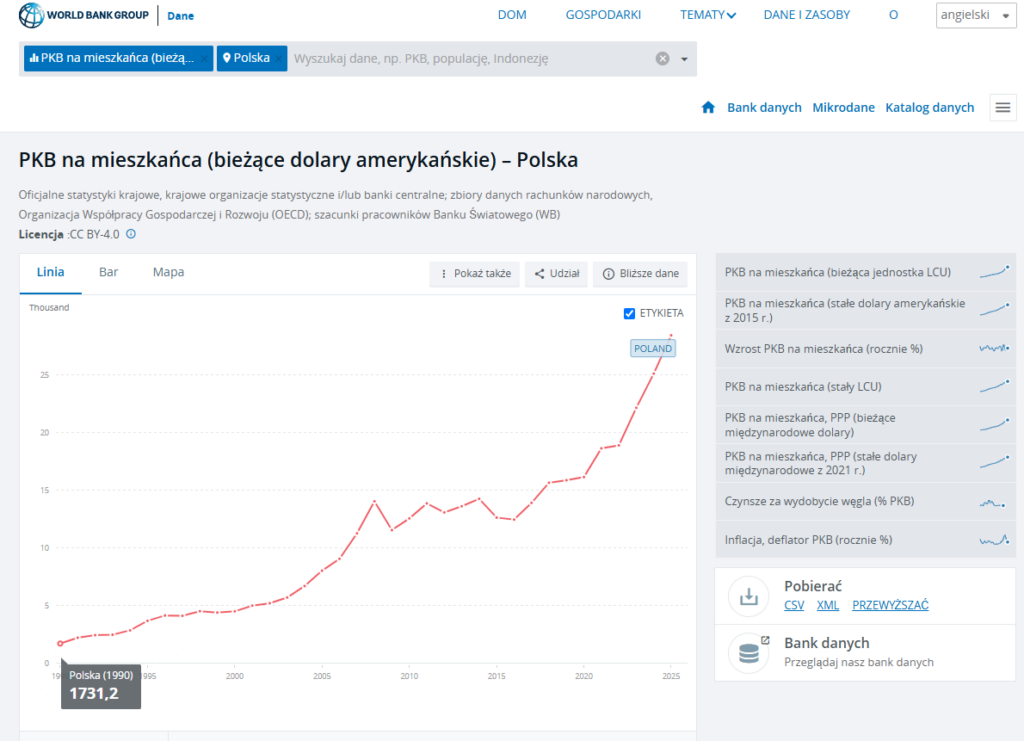
Source: World Bank – click here
Despite this, Morawiecki rightly pointed out that Poland is still stuck in the so-called dependent development model. Our economic sovereignty is continually limited by the lack of domestic capital and a strong dependence on foreign financial markets and decisions made in Western capitals.
Exhaustion of the trajectory and the drama of public finances
In addition to debunking the ranking myths, Morawiecki agreed with Rokita that the current development model has hit a wall. Both trajectories to date have been exhausted: both the liberal one (based on cheap labor) and the statist one (based on broad social spending and state investment, which has pushed the budget to the limits of what is possible).
Criticizing the growing budget gap and public debt under the governments of his successors, Morawiecki set a hard condition:
“You can’t invest 4 to 5% of GDP in foreign equipment for years on end. Either this capital will be harnessed for Polish industry and business, or it will be another dead end leading to a very difficult state of our public finances.”
Author’s comment: This declaration, however, grates on me enormously. After all, Morawiecki, together with the PiS parliamentary group, voted against the SAFE program, using rhetoric about “SAFE 0%”, which is easy to refute with a simple economic analysis. As you can see, a political point of view can change quickly. This vote is all the stranger because nearly 90% of the SAFE loan is to be spent in Polish companies.
Ukraine: A pragmatic raison d’état without illusions
The second pillar of the former prime minister’s remarks was a sober assessment of events in the East and a warning about the real risk of Ukraine collapsing:
– We’ve grown accustomed to this war. We think the situation is stable and that Russia is weak. Reality is different. I can easily imagine Ukraine falling. This can happen in any month – Morawiecki warned.
Democracy or survival?
Morawiecki shared Rokita’s brutal pragmatism: Poland’s raison d’état is for Ukraine to defend itself on its own territory at any cost—regardless of assessments of its political class or problems with corruption. He also revealed that in the first weeks of the war in 2022, the greatest fear of the Polish authorities was not a direct assault on Kyiv, but a scenario in which Russia takes control of Ukraine by political means, installing a puppet, pro-Russian government there under the guise of “democratic” procedures.
Morawiecki’s pragmatism also extended to Belarus. Despite condemning the Lukashenko regime, the former prime minister declared that Poland must “handle with kid gloves” any form of Minsk’s state distinctness, since the very existence of an independent Belarus constitutes a key buffer limiting Russia’s operational capabilities.
Conclusions: The Need for a New Grand Strategy
Mateusz Morawiecki’s speech can be summed up as a call to abandon political hysteria in favor of a language of seriousness (Rokita spoke about a language of seriousness). If you look at the direction taken by the part of the right gathered around conflict-driven rhetoric, it is no surprise that a group seeking a more substantive current is trying to break this pattern. The strategy the panelists talked about would not be possible under conditions of extreme polarization.
Recent months have brought enormous damage caused by the “hystericization” mentioned in the debate. Almost the entire political class allowed itself to be drawn into a vile race over “who helped Ukraine less.” Talking about handing over “scrap” to Kyiv is not only untrue, but also a blow to Poland’s raison d’état. We transferred functional equipment, thanks to which the Ukrainians, as military analyst Jarosław Wolski claims, equipped at least 8 full brigades. This built our position as a leader in Europe—a position that politicians themselves decided to dismantle. And they did so successfully. Russian propaganda loves this.
Poland delivered most of the equipment straight from training grounds – it was operational and could be put into combat much faster than Western weapons systems that were completely new to Ukrainians. Calling this equipment “scrap” strikes at our dignity as donors and gives fuel to foreign competitors to push Poland to the margins. Later on, equipment was supplied from factories. Of course it is true that older-model grenade launchers were also provided; some even fell into Russian hands in March 2022, where they recorded a not very clever propaganda video in which a Russian points to a grenade launcher saying that the inscriptions are in Ukrainian, but the letters are Latin… The language was Polish.
The debate initiated by the group around Morawiecki, however, gives hope. It shows that there is room for a concrete discussion—about real problems, not imagined ones. Such a strong departure from PiS by a sizeable group of MPs and members gives others something to think about. This group felt something was not right; they saw how Polish politics was heading toward the edge of a cliff. They were the first to show that it is possible. That it is necessary. May the rest of the political scene be able to join them.
I recommend everyone watch the debate, and for those who don’t have time I will soon provide a summary of Gen. Andrzejczak’s speech.
Source of the photographs and the debate itself: Mateusz Morawiecki’s YouTube channel: Link to the video
