



Photo: Getty Images / ed. Nowiny Wschodnie
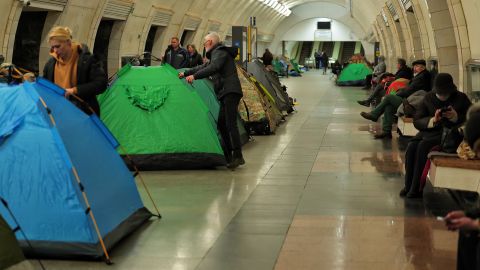
Some residents of Kyiv stopped waiting for the siren long ago – they simply go to the metro in advance, with their own sleeping mat, tent, and dog, to a place that for a long time has been almost “theirs”. In a village a hundred kilometres away, the siren sounds just as loud, but a significant portion of residents no longer even go down to the basement. These are not two different nations – it is one country that, over four and a half years of war, has developed two completely different ways of living with constant threat. And it is precisely this experience that countries are trying to learn from today – countries that themselves have never had to deal with mass air attacks on their own territory.
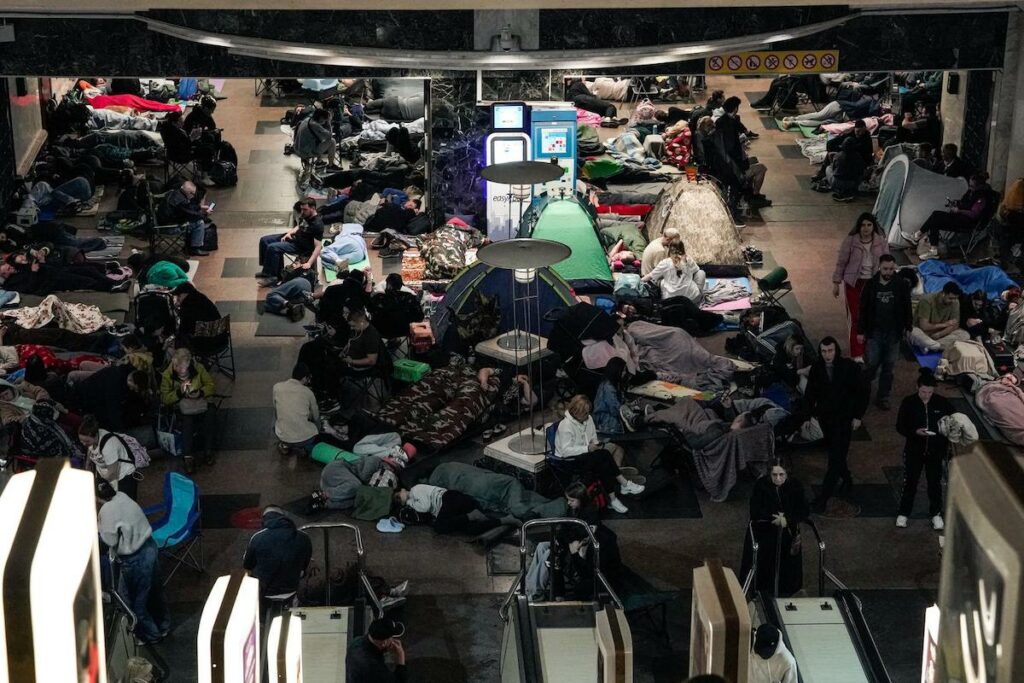
Photo: Andrij Chodkow / Apostrof / compiled by Nowiny Wschodnie
Let’s start with the capital. The Kyiv metro is officially a shelter – and that is precisely why, at night, when the metro is not operating as transport, it does not “close” to people but turns into a nighttime shelter. The problem is that there are physically not enough official shelters for the entire city, so the metro largely takes on this burden. The average depth of Kyiv metro stations ranges from a dozen to more than sixty meters, and the deepest station, “Arsenalna”, lies at a level of 105.5 meters – it is one of the deepest metro stations in the world, and it is this depth that makes it one of the safest shelters in the city. In recent months, a practice has taken hold in the capital that did not exist at the beginning of the war: some Kyiv residents no longer wait at home for the nighttime siren, but come to the stations in advance, with whole families, with sleeping mats, warm blankets, inflatable mattresses and camping tents – simply to get some sleep underground instead of running there in the middle of the night. In spring and summer 2026, a public dispute even broke out in Kyiv: there were so many tents on the platforms that people arriving only during the alarm itself began to run out of space, and the city authorities considered restricting their pitching – as a result, the metro updated its list of recommended items, recommending sleeping mats rather than full tents. People also come with cats and dogs – since February 2026, the rules officially allow entry to the shelter with any pet, and on the platforms you can see entire “encampments” consisting of a tent, a sleeping mat, and an animal beside it.
In the countryside, the picture looks completely different. In practically every private household there is a cellar or root cellar, and local authorities in civil defense instructions explicitly recommend using it as a shelter, equipping it in advance with chairs, a flashlight, and warm clothes. But unlike the Kyiv metro, where the problem became a lack of space, in villages the opposite problem is more acute: a significant share of people simply do not go down there. Local hromadas in Ivano-Frankivsk and Kharkiv oblasts openly admit in their appeals to residents that most people either ignore the signal altogether and continue what they are doing, or at least refuse to react—especially older people, who have to be persuaded separately that this is a serious matter.
Why doesn’t getting used to the alarm mean indifference toward one’s own life?
This question is not rhetorical from a scientific point of view. The most detailed study on this topic was published in 2023 by researchers from the University of Chicago and the University of Michigan together with Ipsos: they analyzed more than 3,000 air-raid alerts based on geolocation data from 17 million smartphones—about 60 percent of Ukraine’s population. The result is twofold. At the start of the war, people’s response to the siren saved lives: it was possible to prevent 35–45 percent of potential casualties precisely because people went to shelters. But over time the effect weakened: due to so-called “alert fatigue” (alert fatigue), another 8–15 percent of casualties that theoretically could have been prevented could no longer be prevented—people simply stopped responding.
Psychological science explains this not as a whim or recklessness. A study published in the journal Frontiers in Psychiatry – 307 participants, four weeks of smartphone-based monitoring in war zones – showed that habituation only slightly reduces the fear itself: it doesn’t go away anywhere; a person simply stops physically reacting to it every time.
“People are tired of acting, tired of reacting” – explains psychologist Olena Bortnikova, warning that constant fear without a response increases the risk of depression, and recommending the “two walls” rule as a minimal compromise for those who no longer go to a shelter.
Psychotherapist Maryna Usenko describes another effect: some people have become so accustomed to living to the rhythm of the siren that they feel relief not when the alarm ends, but when it finally sounds—because the waiting turns out to be harder than the alarm itself. In Kharkiv, as the head of the regional administration, Oleh Syniehubov, says, most residents simply ignore the signals, and the authorities deliberately do not lower the volume of the sirens—precisely because it remains the only universal signal for those who, despite everything, decide to respond. Researchers from the plandiy.com.ua project describe this phenomenon as “anxiety resilience”: people in shelters keep working, joking, and living on—and, as they emphasize, it is a sign not of indifference but of adaptation. Children who have been hearing the siren since their second year of life perceive it simply as part of normality.
For a Polish reader, this is not just a curiosity about a neighboring country. Poland—a state on NATO’s eastern flank—has repeatedly faced its own air alarms over the past year due to downed drones and debris on its territory. Ukraine is the only country in Europe with four and a half years of uninterrupted experience of what it is like for society to live—physically and psychologically—under a constant threat from the air. A sad experience, paid for at a high price—but precisely for that reason it has already become a subject of interest to foreign specialists.
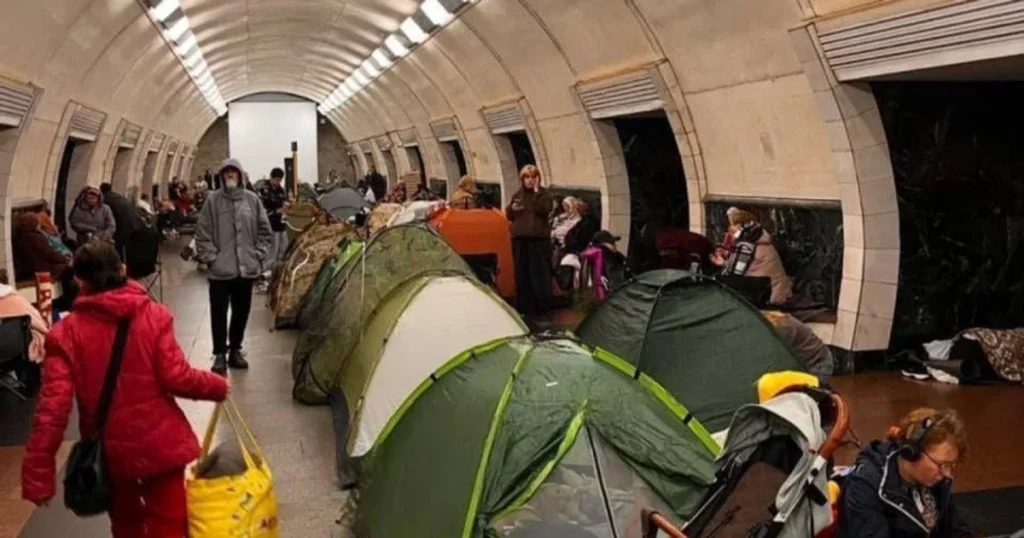
Photo: social media / edited by Nowiny Wschodnie
Norway is one of the most telling examples. The country’s government has officially acknowledged the possibility of an armed conflict on its own territory, activated a “total defence” regime, and plans to increase the size of the civil defence forces by 50 percent. The leadership of Norway’s civil defence says outright that it is adopting the experience of its Ukrainian colleagues in protection against drones and missile strikes, and that simply listening to how Ukrainians organize shelters during the war is invaluable. In the United Kingdom, the topic of civil defence—considered for decades a closed chapter of the Cold War era—has this year once again found itself at the center of public discussion among crisis-preparedness specialists—and the war in Ukraine is cited each time as the main reason why this needs to be discussed anew.
Norway and the United Kingdom have already managed to decide that it is worth learning this in advance, rather than when it is already too late. The question of whether Poland—a state geographically and politically even closer to this war—is ready to do the same remains open.
Source: Nowiny Wschodnie / RBK-Ukraine / 44.ua / Glavcom / 24tv.ua / Wikipedia / Harris School (University of Chicago) / Ipsos / Frontiers in Psychiatry / TSN.ua / Sestry.eu / UA.News / plandiy.com.ua / Kyiv Post / ICPEM

What do you think about this story?
Join the conversation. Please keep comments relevant to the article.
Write a comment