



A video documenting the debates held during the “Development + You” event appeared on former Prime Minister Morawiecki’s channel, and the media dubbed it “A Grill with Mateusz Morawiecki,” along with several other variants. The film is long—very long. More than nine hours. In this article I deal only with the last debate, or rather with the views expressed in it by the outstanding columnist Jan Maria Rokita. For those less familiar with what’s going on, a brief introduction.
The last few weeks have brought shocks on the political scene because of the right wing splitting. PiS is paying the price for a sharp turn toward the far right and for promoting politicians like Czarnek. Recently I had the impression that I was in some strange place. PiS—where, as in every party, there are better and worse people—were saying things as if they had plunged into an abyss of xenophobia and anti-Ukrainian hysteria. And we are talking about the party that in 2022, through its decisions, practically saved Ukraine from collapse. This participation in the witch-hunt lasted a very long time; it began before last year’s presidential election and recently reached its climax in the demand by PiS’s candidate for prime minister, Przemysław Czarnek, that no aid be given to Ukraine.
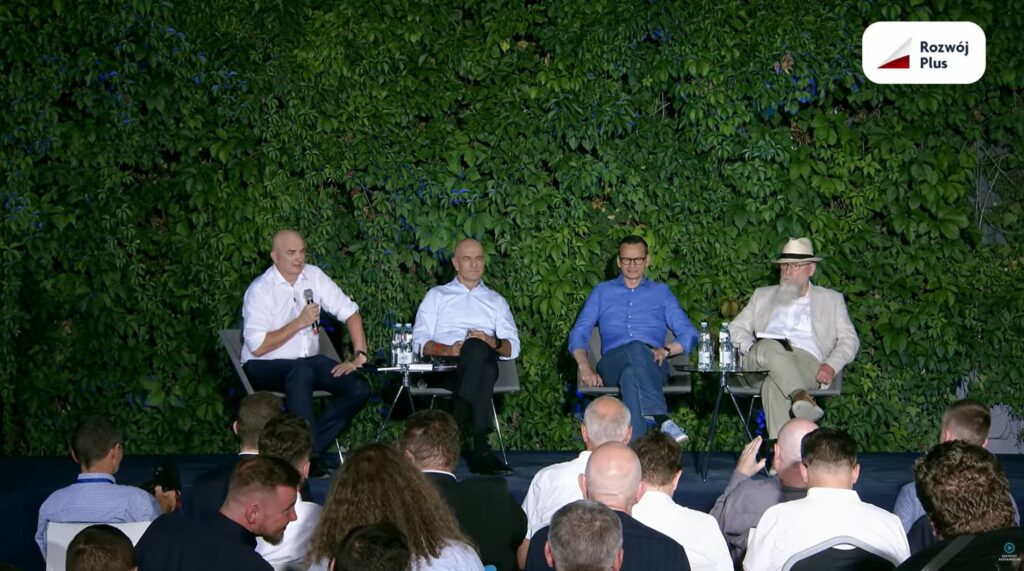
Source: Video from Mateusz Morawiecki’s channel Development + You | Main Stage | Mateusz Morawiecki and Guests
PiS from Kielce versus the “Decency” Raft
It was like an echo of the scandal from the city of Kielce, where PiS councillors adopted a resolution not to hand over the promised worn-out buses to the partner city of Vinnytsia in Ukraine because they might drive … along Bandera Street. If not for the intervention of wiser people, who take Christ’s Christian call to help more seriously, Kielce would have paid tens of thousands of zlotys to dispose of those buses. Fortunately, internet users raised several hundred thousand zlotys and are buying the buses to send to Ukraine. PiS councillors preferred to act in the spirit of the old saying: “What do I care that my cow died, if my disliked neighbour’s two cows died.”
And it cracked. I expected it, although I didn’t know when and in what lineup. Here we have an open conflict between the sectarians from PiS drifting toward chauvinism (Kowalski, Czarnek, etc.) and a lifeboat called “Decency”. I only gave it that name after watching the full 9 hours of debates, including the last one with Jan Maria Rokita, General Rajmund Andrzejczak, and former Prime Minister Mateusz Morawiecki three times. I wanted to understand whether I had missed something and therefore misunderstood it, hence the long staring at the debate and the notes.
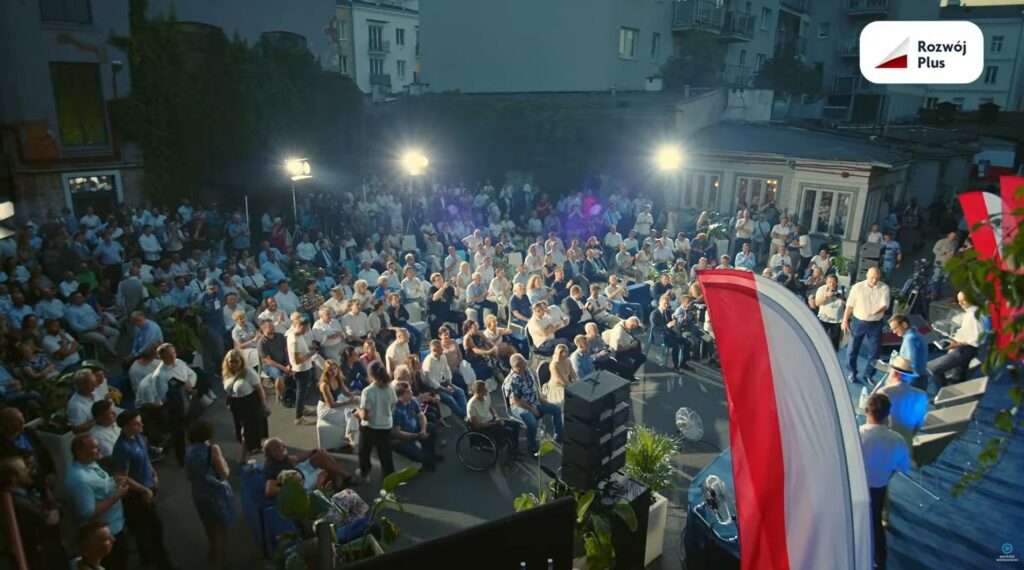
Source: A film from Mateusz Morawiecki’s channel Development + You | Main Stage | Mateusz Morawiecki and Guests
I reported here on Jan Maria Rokita’s speech; it’s worth reading if someone didn’t watch it. He wasn’t the only one supporting Ukraine. He put forward important theses, drew conclusions from politics that Kaczyński or Tusk would probably rather not hear. In the report I use Rokita’s original terminology. Without my own interjections and summaries, which are at the end. So, let’s begin.
1. Diagnosing the development deadlock and the exhaustion of the existing model
Jan Rokita began by referring to his experiences from 20 years ago working on the Civic Platform’s programme. He noted anecdotally that Donald Tusk considered publishing any election programmes to be a “mortal danger”, because someone would dislike every specific provision, which reduces electoral effectiveness.
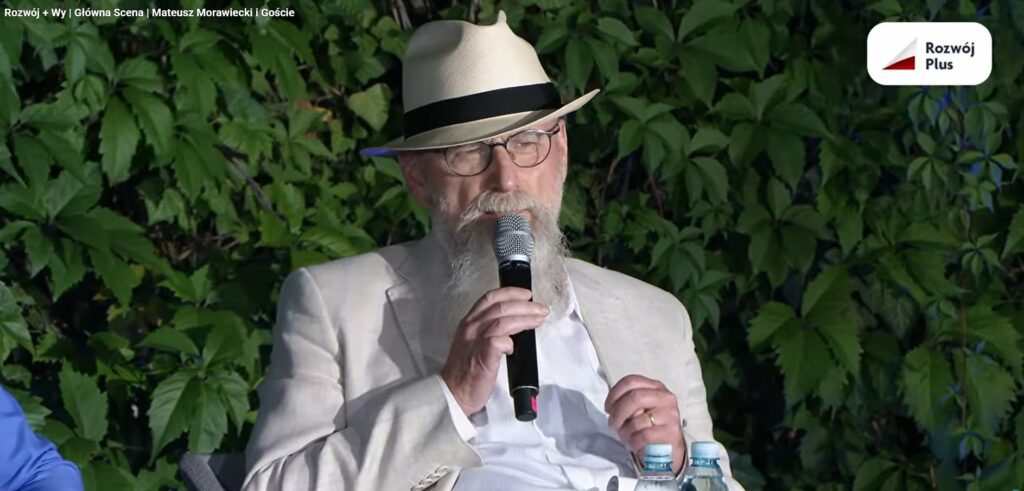
Source: Film from Mateusz Morawiecki’s channel Development + Us | Main Stage | Mateusz Morawiecki and Guests
Rokita’s main thesis was the claim that Poland has found itself in a developmental deadlock, resulting from the complete exhaustion of the two trajectories to date:
- The liberal-market trajectory (the 1990s): Based on individual entrepreneurship, the free market and cost competition. The maximum was extracted from it, but it ran out as a result of the European crisis in the early 2000s. Today, saturation with competition is so great that people do not see space for simple entrepreneurship.
- The state-statist trajectory (PiS / Morawiecki governments): Based on broad social programmes, raising wages and major state investments. This trajectory has pushed the state’s financial and intervention capacity to the wall. More is simply impossible.
Rokita stressed that the political epigones of both paths (Sławomir Mentzen for liberalism and Adrian Zandberg for statism) remain in the “coffins of old ideas” and are unable to offer a solution. He praised Mateusz Morawiecki as a politician constantly seeking ways to break the deadlock (as exemplified in the past by the fight against the middle-income trap, and today by the Development Plus initiative).
2. Ukraine, Russia and Poland’s stature in the East
Rokita presented one of the most categorical and radical positions on the issue of eastern policy:
- Fundamental national interest: Pushing Russia away from Poland’s borders is Poland’s absolute and indisputable objective. Consequently, Poland must pursue an unequivocal, 100-percent strategy of supporting any Ukraine.
- Approach to Ukraine’s system and ideology: Rokita is not bothered by corruption, Volhynia, or anti-democratic tendencies in Kyiv as long as Ukraine is fighting Russia. Responding to Dębski’s provocative question, he stated unequivocally: even a Ukraine that puts SS Galizien on its banners is a Polish ally if it is fighting Russia.
- The geopolitical truth about Poland: Poland’s historic greatness, strength, and great-power status since the 15th century have been decided exclusively in the East. Poland will never become an actual, equal partner shaping Western policy, because Western nations do not know and do not want to know Polish history. Poland’s authority in the West stems directly from its strength and influence in the East.
- Assessment of Morawiecki’s actions in 2022: Rokita said that Morawiecki earned his deep respect in 2022 when, after the outbreak of the war, he took the initiative in Europe, traveled to Berlin, mocked the German declarations about sending 5,000 helmets, and shifted Poland toward independence from Russian gas. Even German media were writing then about Poland as the one that was prepared and knew Russia better than Germany did.
- Pessimistic forecast regarding Russia and the war: Russia’s goal (regardless of who rules it) is not a direct war with Poland, but the rebuilding of the Soviet empire and the “gathering of Rus’ lands.” This war will not end quickly—next to Poland’s border a permanent flashpoint will emerge, because Russia will not rest until it occupies Ukraine.
- The need for a hard regime in Ukraine: Rokita put forward a pessimistic thesis that a romantic, law-abiding and fully democratic Ukraine will not be able to defend itself against Russia. Poland needs a tough authority in Ukraine, a military regime and a strong hand, because only such a structure will withstand Moscow’s pressure.
3. Right-wing decadence and the hystericization of politics
In response to Morawiecki’s proposals on building social cohesion, Rokita accused the former prime minister of lacking political realism. He pointed out that Polish politics is in a state of permanent hystericization, in which party struggle has become the main vehicle of power.
At the same time, Rokita formulated a sharp criticism of the phenomenon he called “decadence on the right”:
- While left-wing decadence (aversion to religion and the nation) is a known phenomenon, a dangerous anti-Americanism has appeared on the Polish right, along with reluctance to support Ukraine and sympathy for the enemies of Western civilization (e.g., Iranian mullahs or Russia).
- He criticized these attitudes (pointing, among other things, to statements by Przemysław Czarnek that suggest abandoning Ukraine). He called it “harmful subversion” and “treason against Western civilization.” He mentioned that he spoke about this directly after Czarnek’s statements.
- He emphasized that the pillars of Poland’s national interest must be: Poland’s greatness and the power of a united West under U.S. leadership.
My remarks:
Although Rokita invoked decency in politics—saying he expects us to bring it into the public debate instead of what he called “hystericization”—he would like a military government to be installed on the Dnieper. A strong-hand government. In doing so, he overlooks one fact. Ukraine as an authoritarian country will remain Europe’s dependent, unable to finance its own existence independently. Only democracy can provide Ukraine with an economy that flourishes and funds its defense. It is not true that democracy works poorly in wartime conditions. It is enough to develop procedures, which he himself mentioned, and we can end up with the Israel of Eastern Europe. No one will deny that Israel is a democratic state.
I watched Jan Maria Rokita’s appearance with great pleasure, and I believe his presence will influence the emerging new force, which will move toward conservatism, not chauvinism. In Poland, what is lacking is not only decency in politics, but also a strictly conservative party that, on these foundations, would oppose the further degradation of politics through pandering to the basest instincts of the most vile part of the electorate. What matters here is not how much I agree with Rokita. What matters is that he is saying what should be said now. We must stop buying votes through the worst kind of populism that feeds on hatred. The first polls sound optimistic. Morawiecki would be supported by between 5% and 7% of voters, and this is only the beginning. Morawiecki has not yet started a campaign to build party structures; that will only get underway in the autumn. Is this a good time? I don’t know. I hope that Czarnek and Kowalski’s chauvinistic PiS will collapse, making room for Morawiecki’s “Decency” raft.
I recommend everyone watch the debate, and for those who don’t have time, I will soon provide a summary of Morawiecki’s and Gen. Andrzejczak’s remarks.
Source: Mateusz Morawiecki’s YouTube channel: Link to the video

What do you think about this story?
Join the conversation. Please keep comments relevant to the article.
Write a comment