
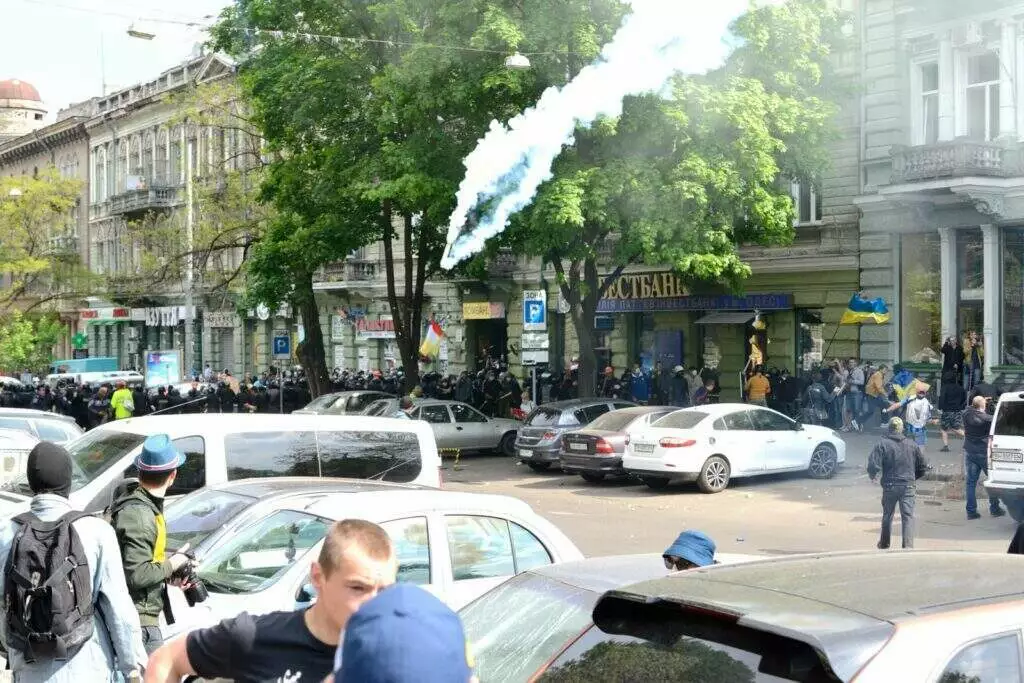
Odessa, 2 May 2014. The beginning of the clashes on Hretska Street (photo: Strakhov Ivan).


The judgment of the European Court of Human Rights of March 2025 was meant to help hold those responsible accountable for the tragic events in Odessa. For some commentators in Poland, however, it has become yet another pretext for repeating Russian propaganda. From a ruling that points both to serious negligence by the Ukrainian authorities and to the role of Russian propaganda in inflaming tensions, they select only those fragments that make it possible to portray Ukraine as a state responsible for deliberately murdering its own citizens. In doing so, they ignore the context of the events, the victims on both sides of the conflict, and the fact that Russia was already conducting actions in 2014 aimed at destabilizing southern Ukraine.
Twelve years after the tragedy that unfolded on 2 May 2014 in Odesa, those events are still being used in the information war. At first, the discussion concerned the need to establish the truth, clarify the circumstances of the deaths of several dozen people, and identify those responsible for negligence. Over time, however, part of that discussion turned into dishonest manipulation, in which facts give way to emotional slogans, and questions about the responsibility of specific individuals are replaced by accusations against all of Ukraine. It is enough to read the comments under publications about Odesa to see how often the judgment of the European Court of Human Rights (ECHR) is presented in a way that is inconsistent with its actual meaning.
The problem is not that someone is reminding others about the responsibility of Ukrainian institutions. On the contrary, the state’s negligence, the services’ mistakes, and the ineffectiveness of the investigation should be the subject of an honest discussion. The problem begins when findings about a failure to fulfil the duty to protect life are used to draw conclusions about a planned crime, the deliberate burning of people, or an alleged genocide of ethnic Russians. Such claims require evidence. They cannot be replaced with emotional interpretations of the judgment.
What did the Court actually rule?
On 13 March 2025, the ECHR issued a judgment concerning the events of 2 May 2014 in Odesa. The Court found that Ukraine had violated Article 2 of the European Convention on Human Rights, which guarantees the right to life. It pointed to serious shortcomings by the authorities, including insufficient measures to prevent an escalation of violence, an inadequate response by emergency services, and the ineffectiveness of the subsequent investigation.
Forty-six people were killed at the time, and two more later died in hospital. The tragedy unfolded during violent clashes between supporters of Euromaidan and Antimaidan. Some of the victims died during street fighting, and 42 people died in the Trade Unions Building, where a fire broke out.
The Tribunal noted that a sufficiently swift and effective response by the Ukrainian services could have prevented some of the victims or reduced their number. It also highlighted irregularities in the actions of the police and fire service, as well as shortcomings in the proceedings aimed at clarifying the circumstances of the tragedy.
Ukraine was ordered to pay 15,000 euros to the families of each of the victims and 12,000 euros to three people who survived the fire but suffered severe burns. The compensation is linked to the state’s responsibility for failing to meet obligations arising from the right to life. It does not mean, however, that the Tribunal recognized the Ukrainian authorities as the organizers of the fire or found that an order to kill people had been issued.
This distinction is fundamental. A state may bear responsibility for people’s deaths because it did not provide them with adequate protection, did not respond in time, or did not conduct an effective investigation. However, this is not equivalent to proving that it planned the crime itself. The ECHR also did not find that the Ukrainian authorities deliberately destroyed evidence to conceal their own involvement in the tragedy. The indicated irregularities and the ineffectiveness of the investigation do not justify adding to the judgment findings that are not there.
Equally important, the Tribunal drew attention to the role of Russian propaganda in stoking tensions and destabilizing the situation in Odesa. This element of the ruling is particularly inconvenient for those who would like to use the judgment solely to accuse Ukraine. In their interpretations, it often disappears, as if it did not exist at all.
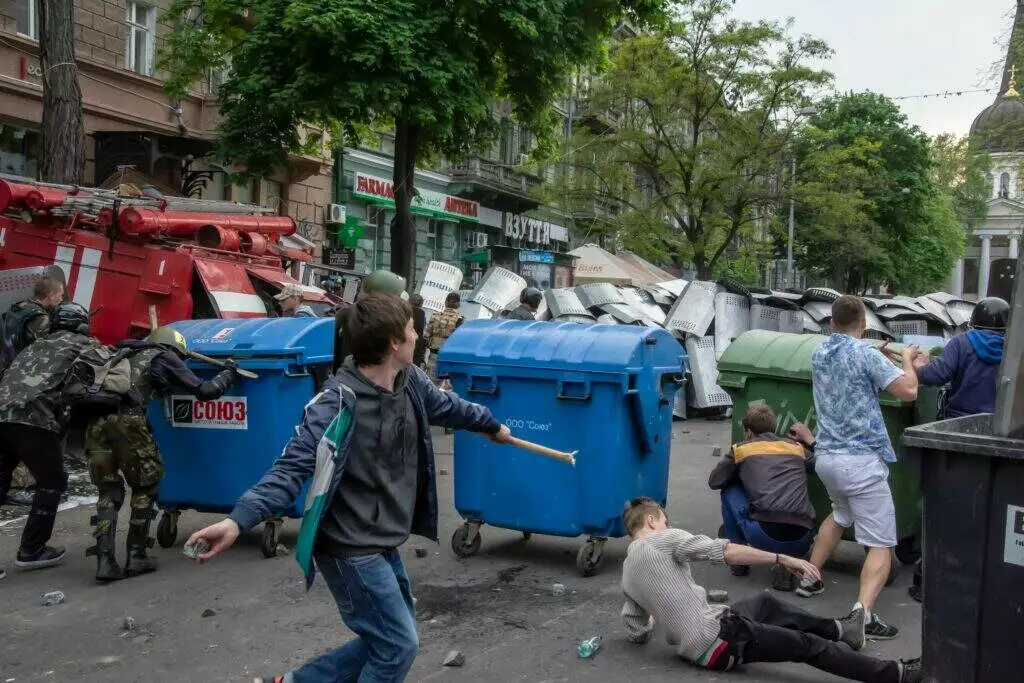
Odesa, 2 May 2014. Clashes on Hretska Street (photo: Kutskiy Oleg).
“48 ethnic Russians burned by Ukrainian nationalists”
This is one of the most widely circulated and, at the same time, most manipulative narratives concerning the events in Odesa. It is meant to evoke an association with persecution of Russians because of their origin, and then to portray Russian aggression as an action undertaken in defense of an endangered population.
It is also not the case that the ECHR found that all the victims were ethnic Russians murdered by Ukrainian nationalists. Participants in the events represented opposing political camps, and the victims came from both sides of the conflict. Those killed included Ukrainian citizens, including Russian-speaking people. Speaking Russian does not automatically mean Russian nationality, just as supporting a particular political option does not determine a person’s ethnic identity. The ECHR explicitly denies this thesis, and repeating it means knowingly misleading people.
Equally manipulative is the claim that 48 people were burned alive. The events of 2 May ended with the deaths of 48 people, but not all of them died in the fire. Forty-six people died that day, and two more died later in hospital. In the Trade Unions building, 42 people were killed. Replacing these findings with one dramatic slogan does not serve the pursuit of truth, but rather the intensification and escalation of emotions.
The claims that the ECHR confirmed deliberate action by the Ukrainian authorities, a conscious arson of the building, or intentional destruction of evidence should be assessed in the same way. This is an obvious lie. The Court found state negligence and irregularities in the actions of the services. This is not equivalent to a finding that the fire was planned by the Ukrainian authorities or that there was an order to burn people. Nor did it find that local authorities knowingly destroyed evidence. This is precisely what manipulation consists in: real findings concerning negligence are combined with unproven accusations of criminal intent. The Court pointed to irregularities in the investigation, chaos, and lack of professionalism. There was no statement about intentional destruction of evidence.
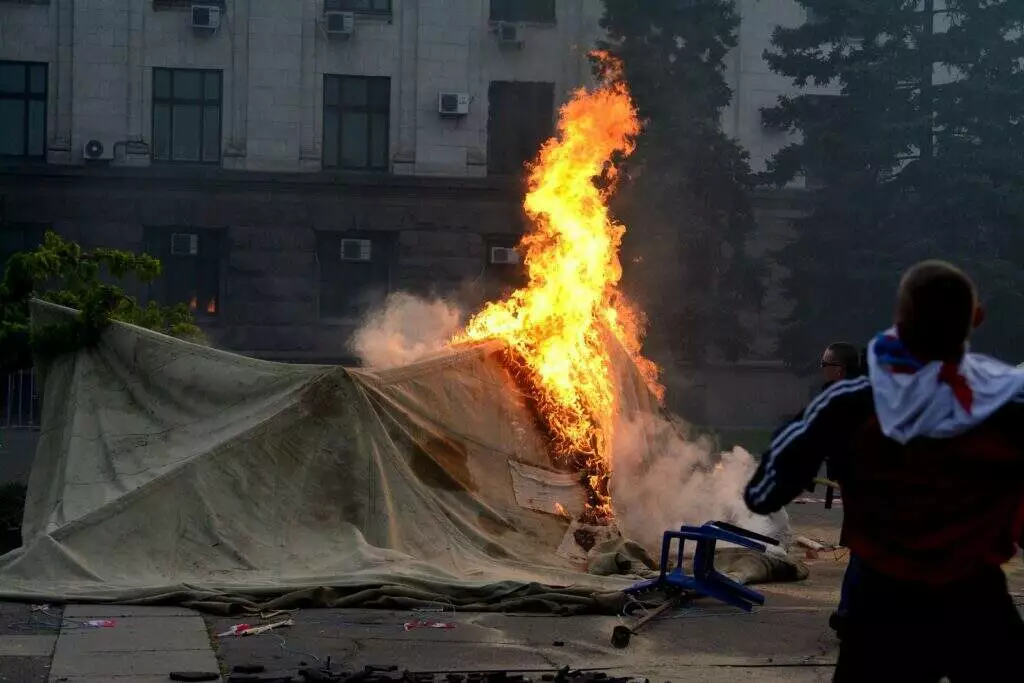
Odesa, 2 May 2014. Kulikove Pole (photo: Strakhov Ivan).
Odesa before the tragedy: an attempt to destabilize the city
To understand the events of May 2, 2014, one cannot limit oneself to the few hours spent on Kulikove Field. It is necessary to take into account the political situation in Ukraine and earlier events in Odesa itself.
It was a period when Russia had already launched a military operation leading to the seizure of Crimea and its illegal annexation. In various parts of Ukraine, attempts were made to create separatist structures that were meant to lead to the detachment of further regions from the state. Odesa, a strategic port and one of the most important cities of southern Ukraine, also found itself at the center of these actions.
For several months, a tent camp of Anti-Maidan supporters operated on Kulikove Field. Russian flags and St. George ribbons appeared there, and during gatherings slogans were raised calling on Russia to intervene, including “Russia, come!” and “Putin, bring in the troops!”. The activities of some pro-Russian activists were part of a broader attempt to destabilize Ukraine and transform the region into another separatist pseudo-republic.
This does not mean that every Anti-Maidan participant was a Russian agent, nor that all the people gathered on Kulikove Field had identical motivations. It does mean, however, that these events must not be torn out of the context of Russia’s policy toward Ukraine at the time.
On May 2, clashes took place already in the city center. Among the pro-Russian activists, a particularly important role was played by Serhii Dolzhenkov, also known as “Captain Cocoa,” who led this group. According to the presented account of events, it was precisely the pro-Russian activists who attacked the pro-Ukrainian march. The first fatalities appeared in central Odesa before the fire at the Trade Unions Building.
This fact is of fundamental importance. The violence did not begin with the fire at Kulikove Field. Earlier, there were violent clashes in which participants from both camps used violence, and fatalities occurred on both sides of the conflict. Omitting this stage creates a false picture of events in which one group appears solely as a defenseless victim and the other as a perpetrator devoid of any motives.
After the clashes in the city center, the crowd went to Kulikove Field, where the Anti-Maidan camp was located. Further violent incidents took place there, including gunfire, throwing Molotov cocktails, and an assault on the Trade Unions building. Both sides used incendiary materials. It is therefore not true that we were dealing with a peaceful gathering that, without any prior context, was attacked by Ukrainian nationalists.
Also untrue is the story circulated in Russian propaganda that Anti-Maidan activists were forcibly driven into the building and locked inside in order to burn them alive. According to the presented course of events, they entered the building about half an hour before the crowd arrived at Kulikove Field. A decision was also made to defend the camp. Someone was even said to have declared: “This will be our Brest Fortress, we will not leave it until death!” They therefore had time to leave the square, but decided to stay and defend the camp. This does not mean that the later deaths of these people were any less tragic, or that anyone lost the right to be rescued. It does mean, however, that the story about people being forced into the building does not correspond to the described course of events.
How did the fire start?
According to experts’ findings, the main seat of the fire was located two meters behind the left door of the central entrance to the Trade Unions building. It most likely started as a result of the parties to the conflict throwing bottles containing flammable substances, or preparing incendiary mixtures such as Molotov cocktails inside the building and in its immediate vicinity. Based on the obtained video fragments and eyewitness accounts, experts determined that one of the Molotov cocktails was thrown by one of the Anti-Maidan supporters inside the building. However, on the basis of the collected materials it is not possible to state definitively who exactly was responsible for the outbreak of the fire.
This does not change the fact that after the fire broke out, the people inside found themselves in mortal danger and needed immediate help. Some people tried to extinguish the fire using fire extinguishers. If the standard fire protection system, including water hydrants, had been functioning, it might have been possible to bring the fire under control at an early stage. However, there was no water in the hydrants.
The critical phase of the fire, during which people jumped out of windows, was said to have begun suddenly and to have lasted only two to three minutes. People gathered in the square attempted to rescue others, putting their own lives at risk. However, stones, bottles, and other dangerous objects were still allegedly falling from the building’s windows and roof, creating a threat to those carrying out the rescue.
According to the materials cited in the analysis of the events, video recordings, witness testimony, and the interview records of fire engine drivers and rescue workers do not confirm that the crowd in the square prevented firefighters from conducting the operation. This is important because claims also circulated that the services could not intervene because of the actions of those gathered at Kulikovo Field. The most serious questions, however, concern the time it took the fire brigade to arrive.
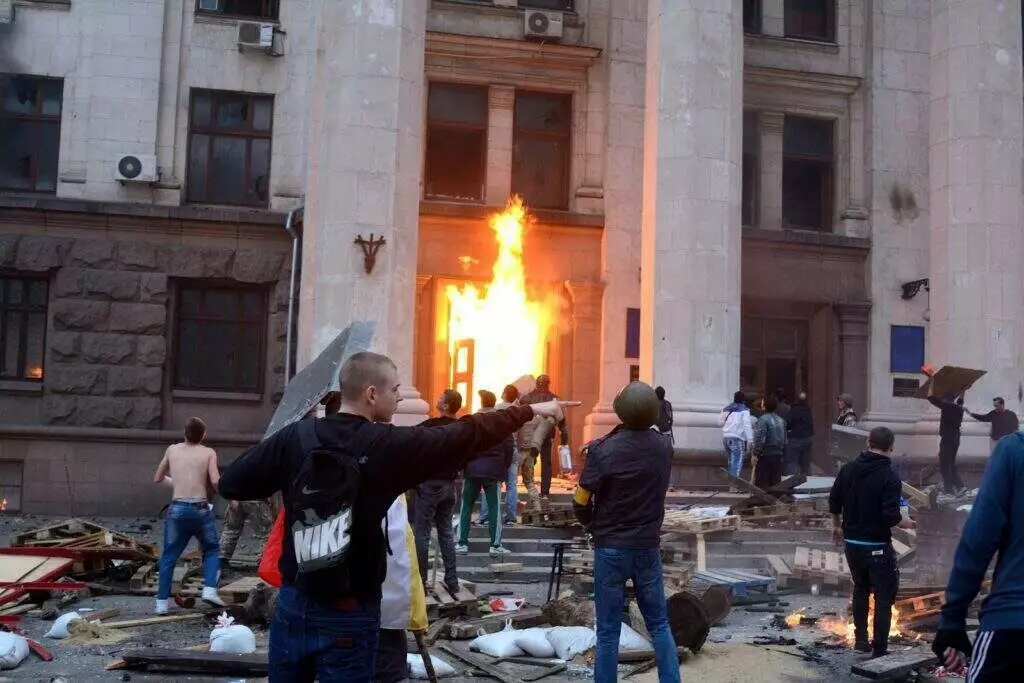
Odessa, May 2, 2014. Kulikove Field (photo: Strakhov Ivan).
Forty minutes of waiting for help
A fire brigade unit was located about 500 meters from the Trade Unions House, yet the rescue and firefighting vehicles arrived only after about forty minutes. From the outset, these events raised serious doubts about the way the services operated and the decisions made by their command.
According to the findings of the investigation, Vladimir Bodelan, then head of the regional directorate of the State Emergency Service, had been at Kulikove Field since about 19:30 and was a direct witness to the spread of the fire. Around 19:50, people trying to rescue those in danger began to threaten him, seeing his inaction. Around 19:55, Bodelan was reportedly to have given a telephone order to send only one unit to extinguish the fire, which, according to investigators, was another violation of the applicable rules.
In the investigators’ assessment, the delayed dispatch and arrival of rescue and firefighting units made it impossible to quickly extinguish the fire and evacuate people in immediate danger of losing their lives. If firefighters had taken action immediately, some of those who died in the building might have survived. Those who died from carbon monoxide poisoning would also have had a chance of being saved if the rescue operation and resuscitation had begun quickly enough.
It is precisely in such negligence that one of the most important dimensions of the state’s responsibility for the tragedy should be sought. There is no need for theories about a secret order to burn people alive in order to recognize that the services’ omissions could have had tragic consequences. It is enough to reliably analyze the decisions made at a time when human life could still have been saved.
It is also worth noting that a few years after the events, Vladimir Bodelan received Russian citizenship and worked in Crimea occupied by Russia. This fact alone does not replace evidence regarding his responsibility for delaying the rescue operation, but it is an important element of his later biography that is worth keeping in mind when analyzing the whole case.
The militia that did not ensure security
Responsibility for the tragedy is not limited to the actions of the fire brigade. Serious reservations also concern the police, the then militia, and soldiers of the Internal Troops.
The militia did not provide adequate safety conditions during the march of two opposing demonstrations through the city. It failed to effectively prevent an escalation of violence, even though earlier events indicated that a confrontation between Euromaidan and Antimaidan supporters was a real threat. Mutual hatred and the radicalization of the participants in the clashes do not justify the passivity of the services that had a duty to protect people’s life and health.
To properly assess these failures, it is necessary to remember the state of the Ukrainian militia in 2014. It was a corrupt and demoralized institution, and after the events in Kyiv in January and February, society—including officers as well—was deeply divided. Many militiamen reacted negatively to the change of power and did not sympathize with Euromaidan. This context does not absolve officers of responsibility, but it helps explain why the state’s response was so ineffective.
The ECHR rightly drew attention to the failings of Ukrainian institutions. There is no reason to justify them simply because Ukraine became a victim of Russian aggression. A fair assessment of history, however, requires simultaneously taking into account the state’s responsibility to protect life and the actions of those who led to the escalation of the conflict. One does not exclude the other.
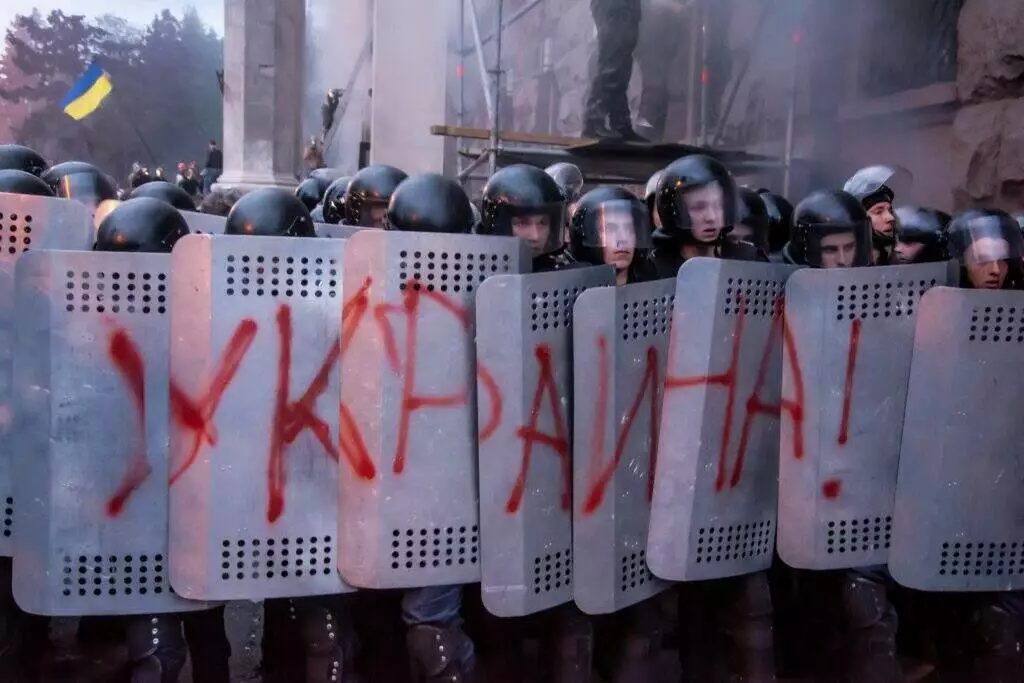
Odesa, 2 May 2014. Kulikove Field (photo: Kutskiy Oleg).
Russia, which did not want the tragedy clarified
It is particularly telling how little space Russia itself occupies in Russian narratives about Odesa. In accounts focused on accusing Ukraine, the actions of pro-Russian separatists, earlier clashes, the situation in Crimea, and the role of Russian propaganda in stoking tensions are almost completely omitted.
Meanwhile, Moscow did not limit itself to commenting on events. One of the key figures covered by the investigation was Dmitry Fuchedzhi, former deputy head of the Main Directorate of the Ministry of Internal Affairs of Odesa Oblast. Russia granted him shelter, gave him citizenship, and refused to extradite him to Ukraine, citing his Russian citizenship. As a result, Ukrainian law enforcement authorities could not bring him to account before their own justice system.
This is not conduct that allows Russia to be portrayed as a state impartially interested in learning the truth about the events in Odesa. If Moscow truly wanted a full clarification of the responsibility of all persons involved in the tragedy, obstructing proceedings against one of the main suspects should raise serious doubts.
In this context, the ECHR’s indication of the role of Russian propaganda in stoking tensions and destabilizing the city takes on particular significance. The point is not to use Russia’s responsibility to invalidate the responsibility of Ukrainian institutions. The point is not to remove from the picture of events an element that is necessary to understand them.
From Odesa to the full-scale invasion
The events of 2 May 2014 should be considered as part of a broader crisis of Ukrainian statehood. A few months earlier, Russia had seized Crimea and then began actions aimed at destabilizing eastern Ukraine. In various regions, attempts were made to create separatist structures whose aim was to detach further territories from Ukraine.
Odesa had special significance in this plan. Losing control of the city could have led to a further weakening of the state, the cutting off of an important port, and a serious threat to the south of the country. From Kyiv’s perspective, it was a fight not only for the safety of the residents of one city, but also for preserving Ukraine’s territorial integrity.
These events also revealed that Ukrainian patriots were not exclusively Ukrainian-speaking people. Russian-speaking citizens of the country also stood up in defense of Ukrainian statehood. This is an important counterargument to the ideology of the “Russian World,” according to which the Russian-speaking population of Ukraine would supposedly naturally and en masse favor subordination to Russia.
Odesa showed that language does not determine political loyalty, and that a Russian-speaking resident of Ukraine does not have to regard Russia as their homeland or accept its imperial ambitions.
In February 2022, Vladimir Putin launched a full-scale invasion of Ukraine, drawing in part on false stories about the persecution of the Russian-speaking population and alleged crimes by Ukrainian nationalists. The events of the Odesa tragedy became one element of that propaganda image. Therefore, manipulating them is not an innocent dispute over the interpretation of history. It fits into a narrative that helped justify the aggression and portray Ukraine as a state requiring Russian intervention.

Odesa, 2 May 2014. Kulikove Pole (photo: Kutskiy Oleg).
Emotions instead of facts
In Odesa, there were violent street clashes, deaths on both sides of the conflict, a fire, and serious negligence on the part of the state. These are facts tragic enough that there is no need to amplify them through unproven accusations of genocide.
Similar is the way phrases about “Ukrainian nationalists” supposedly burning 48 ethnic Russians work. This is not a neutral description of events, but a ready-made propaganda template that has been operating for years in Russia’s information war. It is meant to evoke an image of ethnic violence, portray Ukraine as a criminal state, and justify Russia’s claims to act as the defender of Russians outside the borders of the Russian Federation.
Selective quoting of the ECHR judgment fits perfectly into this mechanism. From the ruling, the negligence of the Ukrainian authorities is selected, while Russian propaganda is omitted. The victims of the fire are recalled, but the earlier fatalities in the city center are kept quiet. Ukraine’s responsibility is discussed, but the actions of pro-Russian activists and the geopolitical situation in which the tragedy occurred are removed from the picture.
In this way, the roles are reversed: Russia, which was pursuing actions aimed at destabilizing Ukraine, disappears from the story, and the state defending its territorial integrity is presented as the sole perpetrator and oppressor.
The judgment is not a justification for propaganda
The judgment of the European Court of Human Rights should be an opportunity for a renewed, reliable analysis of the events of May 2, 2014. It should prompt questions about the responsibility of the police, the decisions of the fire service command, the ineffectiveness of the investigation, and why the state failed to protect people’s lives. It should not, however, be used to spread claims that the Court did not confirm.
There is no contradiction between recognizing the responsibility of the Ukrainian services and pointing to Russia’s role in destabilizing the situation. One can and should condemn the negligence of Ukrainian institutions without at the same time accepting the Russian version of history. One can remember all the victims without collectively assigning them a single nationality or falsifying the circumstances of their deaths.
Most important, however, is not to allow the tragedy to be used again for political purposes. In 2014, propaganda accompanied efforts to destabilize Ukraine. In 2022, similar narratives served to justify a full-scale invasion. Today, the same patterns are returning in Polish social media, often repeated without checking sources, without reading the entire judgment, and without the slightest attempt to understand the context.
Not everyone who unthinkingly repeats Russian arguments must be consciously acting on behalf of the Kremlin. The effect, however, remains similar: it amplifies a message whose aim is to discredit Ukraine, fuel hostility toward Ukrainians, and justify Russian aggression. That is why responsibility for one’s words does not end with sharing a sensational post. It begins with checking whether the cited ruling really says what its author claims it does.
The truth about Odesa requires neither whitewashing the Ukrainian authorities nor repeating Russian propaganda. It requires taking into account all relevant facts, acknowledging the suffering of the victims, and pointing to those responsible for specific negligence and actions. It also requires remembering that Russia’s war against Ukraine did not begin in February 2022, and that the Odesa tragedy was one of the dramatic episodes of a crisis that Russia actively deepened.
Twelve years after 2 May 2014, we still have a duty to separate facts from manipulation. The ECHR judgment should serve the search for truth and accountability. When someone uses it to spread claims that the Court did not formulate, they are not defending the victims. They are using their tragedy to wage yet another chapter of the information war.
Sources: The chronology of events that occurred on 2 May 2014 in Odesa – part 1 / The chronology of events that occurred on 2 May 2014 in Odesa – part 2 / Radio Svoboda / DBR.GOV.UA / Judgment of the European Court of Human Rights / Borys Tynka, Odesa, 2 May 2014. The bloody trail of the “Russian Spring”, e-bookowo Publishing, 2024.
Journalist, columnist, author of books about Ukraine, tour guide, and commentator on developments in Ukraine and Polish-Ukrainian relations.
A certified guide to Odesa, the Odesa catacombs, Ukrainian Bessarabia, and Kyiv. He is the author of numerous publications on Ukraine’s history, culture, and contemporary affairs, some of which have been translated into Ukrainian and published in Ukraine. In 2020, he received the honorary title of Ambassador of Odesa in Poland from the Mayor of Odesa.
On 24 February 2022, the day Russia launched its full-scale invasion of Ukraine, he was in Odesa. He remained there for several months, helping coordinate humanitarian aid and reporting on the war for Polish media outlets. He described his experiences during this period in his book Odessa 4.5.0.
At Nowiny Wschodnie, he publishes articles and commentary on the Russo-Ukrainian war, Russian propaganda and disinformation, Ukrainian history, particularly that of Odesa, as well as Polish-Ukrainian relations and changing public attitudes.
He collaborates with Ukrainian newsrooms and online news outlets and appears in Polish media as a commentator on Ukrainian affairs.
What do you think about this story?
Join the conversation. Please keep comments relevant to the article.
Write a comment