
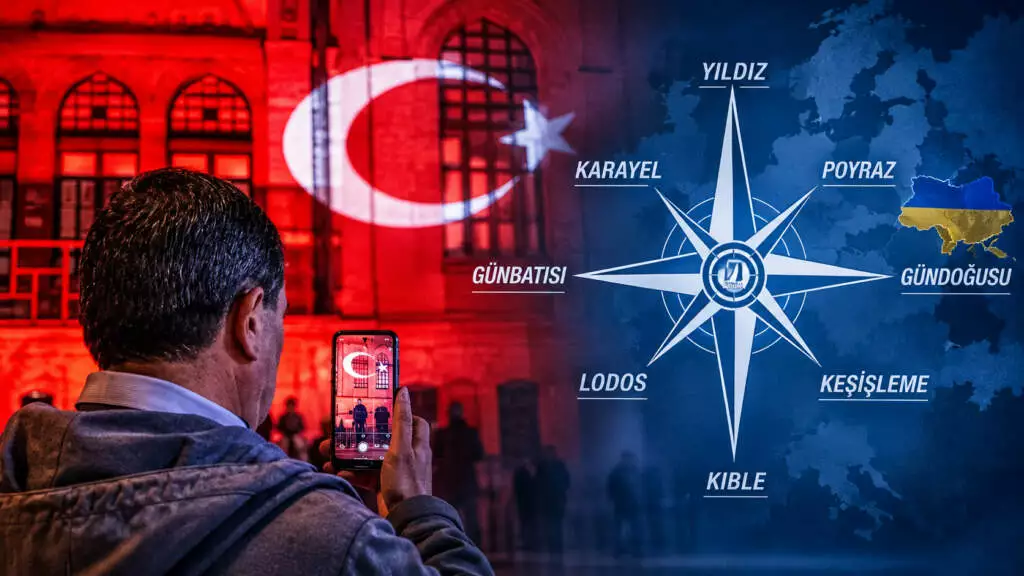
Recep Tayyip Erdoğan is trying to keep Turkey on a course set by the changing winds of geopolitics, blowing from various directions: from the West, through Russia, to the Middle East. Skillfully exploiting tensions and rivalry among major powers, Ankara seeks to strengthen its position as an independent center of power, trying not to become dependent on any of the main actors on the international stage. However, while Turkish diplomacy deftly adjusts its sails to the changing directions of political winds, the country’s internal situation is becoming increasingly worrying. International flexibility is accompanied by a growing crisis of democracy, the weakening of rule-of-law institutions, and an ever-stronger concentration of power in the president’s hands.


The impetus for writing this text was the European Commission’s report on Turkey, published on 4 November 2026. In it, Brussels drew attention to the widening gap between Ankara’s declared goal of European integration and the state of democracy, the rule of law, and civil liberties. It pointed, among other things, to intensifying legal actions against selected representatives of local authorities, the opposition, and civil society organisations. Ankara rejected this assessment as biased and unfair. This dispute once again raised the question of the true direction of Turkish policy.
Marcelina Szumer-Brysz, a Polish journalist and reporter specializing in Turkish affairs, in her book Fortune-Telling from Coffee Grounds suggests looking at Recep Tayyip Erdoğan’s politics through the prism of a football game—with its variability, tactical twists, and the unpredictability of subsequent outcomes. Let us, however, try to adopt a slightly different perspective and read Turkish politics through the meteorology of the Bosphorus. In Istanbul, it is not enough to check the temperature or the weather forecast. You need to know where the wind is blowing from. Each one here has its own name, direction, and character. Yıldız blows from the north and brings cold; Poyraz—from the northeast, cold and sometimes violent; Lodos—from the southwest, warm but capable of bringing stormy weather; and Karayel—from the northwest, often heralding a cool-down. Kıble carries warm, humid air from the south; Keşişleme—warm and dry from the southeast. Gündoğusu blows from the east, bringing cooler and dry air; Günbatısı—from the west, usually warmer and more humid, while Meltem is a characteristic seasonal northwesterly wind in the eastern part of the Mediterranean Sea. The winds change the face of the sea, affect shipping, and the city’s daily rhythm. The Bosphorus lives under their constant pressure, and none of them has a monopoly on the weather.
It is similar with contemporary Turkey. This is a state functioning at the intersection of divergent interests: between East and West, between obligations stemming from NATO membership and pragmatic relations with Russia, between European aspirations and Middle Eastern reality. Added to this are ambitions of regional leadership, political and economic tensions, and an increasingly pronounced contradiction between Ankara’s international position and the state of its democratic institutions.
Lodos – the wind of strong power
In Turkish politics, the counterpart of Lodos is Recep Tayyip Erdoğan – strong, unpredictable, and capable of abrupt turns. For more than two decades he has remained the central figure in the country’s political life. Under his rule, Turkey has developed great-power ambitions, strengthened its defense industry, and increased its activity on the international stage.
However, this political strength comes at a price. The concentration of power in the president’s hands, the weakening of independent institutions, and pressure exerted on political opponents have become lasting elements of the Turkish system. Erdoğan wants to be not only the leader of the state, but also the architect of its new international position. The question is whether a system based on such strong personalization of power will be resilient to a change in the political wind.
Poyraz – the cool wind of the opposition
Poyraz blows from the northeast. It is cold, gusty, and can change the state of the sea in a short time. In Turkish politics its counterpart is the opposition, which during the 2024 local elections showed that the dominance of Erdoğan’s camp is not unassailable. The Republican People’s Party (CHP) then won 37.8% of the vote nationwide, overtaking the ruling AKP, which received 35.5%.
Istanbul is of particular importance—not only as the country’s economic heart, but also as a symbolic arena of the struggle over its political future. Ekrem İmamoğlu, the city’s mayor and one of the opposition’s most important politicians, has become a serious rival to the president. He was detained on 19 March 2025, a few days before the CHP was set to name him as its candidate in the upcoming presidential election. Human Rights Watch described the detention as a politically motivated attack on the opposition.
İmamoğlu’s case is no longer just a conflict between two politicians. It has become a symbol of the question of whether Turkish voters still have a real possibility of choosing a political alternative. In November 2026, European representatives of institutions monitoring local democracy continued to point to the problem of the prolonged pre-trial detention of elected local officials, including the mayor of Istanbul [5].
Karayel – the cool front of democracy
Karayel signals a cooling. In Turkey’s political landscape, it symbolizes problems with the rule of law, the independence of the judiciary, and media freedom.
It is precisely in this context that the European Commission’s latest assessment should be read. Brussels points to Turkey moving away from democratic standards that should form the basis of its European aspirations. The report of 4 November emphasized that legal actions against selected representatives of local authorities, the opposition, and civil society are intensifying, and that the gap between the declared goal of EU membership and the actual state of the political criteria has widened further.
A fundamental contradiction emerges: Turkey wants to remain Europe’s strategic partner, benefit from its markets, and cooperate on security, while at the same time moving ever further away from the values that are the foundation of the European project. NATO membership and candidate status for the Union do not replace democratic institutions, nor do they exempt a country from the obligation to uphold the rule of law.
Gündoğusu – the eastern wind and the Russian direction
Gündoğusu is an east wind. In Turkey’s foreign policy, it is a reminder of the particularly complex relationship with Russia.
Ankara remains a member of NATO, recognizes Ukraine’s sovereignty and territorial integrity, develops defense cooperation with it, and applies the provisions of the Montreux Convention regarding navigation through the Turkish Straits. At the same time, it has not joined EU sanctions against Moscow, maintains extensive economic ties with Russia, and seeks to preserve its position as an intermediary in talks concerning the war. The European Commission notes both Turkey’s lack of alignment with EU sanctions and its actions aimed at limiting the circumvention of restrictions via Turkish territory.
This is not an accidental inconsistency, but a deliberate strategy. Turkey wants to maximize its own benefits, maintaining freedom of maneuver and avoiding full dependence on any of the geopolitical centers. For Ukraine, this stance remains ambiguous: Turkey is an important partner in the Black Sea region, but its pragmatic relations with the Kremlin set the limits of that partnership.
Kıble – a wind from the Middle East
Kıble, blowing from the south, brings warm and humid air. In Ankara’s policy, it symbolizes the ambition to strengthen Turkey’s position as one of the most important centers of influence in the Middle East and the Muslim world.
Ankara is actively developing diplomatic, economic, and military contacts in the region, seeking not only to respond to events but also to help shape their course. Its ambitions go beyond traditionally understood regional leadership. Turkey wants to take part in creating new security arrangements and to increase its own strategic autonomy.
In this sense, Erdoğan does not intend to limit the country’s role to that of an important NATO member. He seeks for Turkey to be a separate center of power, capable of pursuing its own policy toward Washington, Moscow, Brussels, and the states of the region.
Meltem – a European wind with no prospect of membership
Meltem is a seasonal wind characteristic of the eastern part of the Mediterranean Sea. However, its regularity does not mean unchanging conditions. This is similar to how Turkey’s relations with the European Union look today.
Both sides still need each other. Europe values Turkey’s geostrategic location, military potential, and Ankara’s importance in the Black Sea region and the Middle East. Turkey, in turn, needs European markets, capital, technology, and investment. However, the prospect of membership remains in practice frozen. Turkey received candidate status in 1999, accession negotiations began in 2005, and since June 2018 they have remained at an impasse.
Economic and strategic cooperation does not remove political contradictions. Brussels expects democratic standards to be upheld, while Ankara does not intend to abandon a model of governance that gives it broad freedom of action. As a result, both sides remain dependent on each other, but trust each other less and less.
High temperature – the economy as a political barometer
No wind can obscure economic problems. Turkey has a developed industrial base, a strong tourism sector, growing defense potential, and a favorable geographic location. This does not mean, however, that it has dealt with inflation and the problems of society’s purchasing power. According to the Turkish statistical office TÜİK, in October 2026 annual inflation was 29.77%, and the monthly increase in prices was 2.58%. [8].
The economy is a barometer that cannot be persuaded by political rhetoric. You can talk about Turkey’s greatness, its historical mission, and geopolitical independence, but citizens judge the authorities above all through the prism of prices, wages, housing costs, and the ability to plan for the future.
It is precisely the everyday experience of society that may prove to be a more serious challenge for the Turkish authorities than criticism coming from European institutions.
The Bosporus does not have just one wind
Contemporary Turkey wants to be at the same time a European, Asian, and Middle Eastern state, and above all—a self-reliant center of power. It does not want to choose between Washington and Moscow, between alliance commitments and its own ambitions, between European markets and regional aspirations.
There is geopolitical logic in this strategy. Turkey’s location gives it unique opportunities to exert influence—from the Black Sea to the Mediterranean, from the Caucasus to the Middle East. It will not, however, replace stable institutions, the rule of law, or citizens’ trust.
The greatest paradox of Turkish politics today is that its flexibility on the international stage increasingly stands in stark contrast to the curtailing of pluralism inside the country. Erdoğan wants to maneuver freely between global centers of power, but at the same time he narrows the space for political competition in his own state.
The Bosporus teaches that no wind blows forever from the same direction. You can harness its strength, adjust the sails, and change course. But you cannot order the sea to submit to the captain’s political ambitions.
And perhaps this is where the most important question about Turkey’s future lies: can Erdoğan make use of geopolitical winds without losing sight of his own society? Because ultimately a ship’s fate is not decided solely by the direction of the wind. Equally important are its construction, the condition of the crew, and the helmsman’s skills.
Literary scholar and researcher specialising in culture, identity, Polish-Ukrainian relations, and sociocultural processes in Central and Eastern Europe.
For many years, he has combined academic, educational, and civic activities in Poland and Ukraine. His research interests include cultural borderlands, collective memory, postcolonial processes, and intercultural interactions. He is the author and co-author of several monographs and more than 150 academic publications.
He has extensive academic and organisational experience. He has held senior positions at universities in Poland and Ukraine, led research teams, and implemented international research and educational projects.
He is actively involved in supporting the Polish community in Ukraine, particularly in Berdiansk and the southeastern part of the country. His work focuses on cultural heritage preservation, education, and documenting the experiences of communities affected by war and occupation.
In his publications and commentaries, he examines the Russo-Ukrainian war, Polish-Ukrainian relations, Polish diaspora communities in Central and Eastern Europe, politics of memory, and questions of national and cultural identity. He also addresses Russian propaganda and imperial narratives.
In recognition of his academic, cultural, and civic contributions, he has received several distinctions, including the Knight’s Cross of the Order of Merit of the Republic of Poland, the Medal for Merit to Culture – Gloria Artis, and the Honorary Badge “Meritorious for Polish Culture”.
What do you think about this story?
Join the conversation. Please keep comments relevant to the article.
Write a comment