
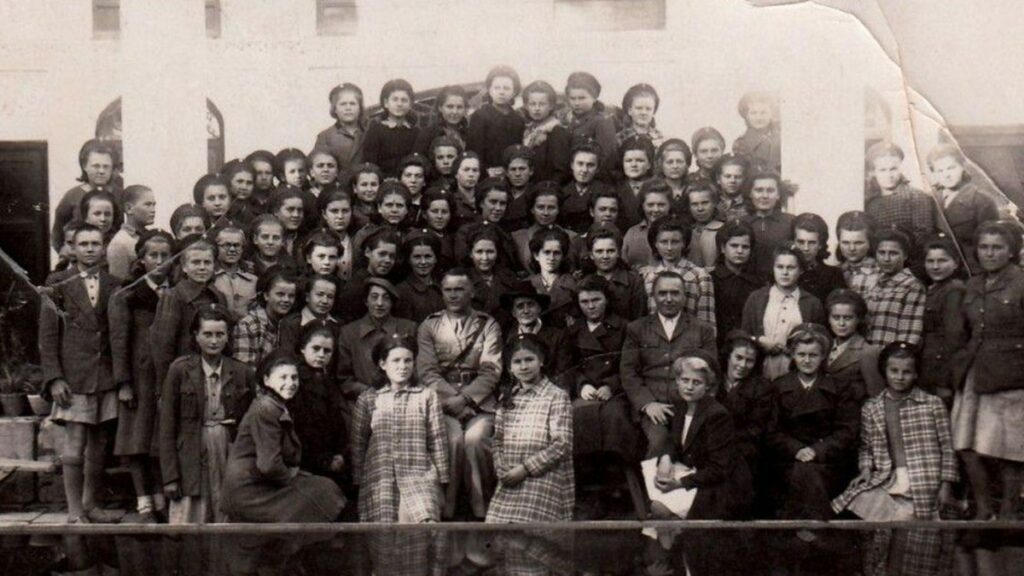
In 1942–1945, Isfahan became one of the most important centers of care for Polish children evacuated from the Soviet Union. Schools, orphanages, and educational institutions were established there, helping young refugees regain a sense of security after the experience of deportation. This history shows not only the scale of Polish refugeehood during World War II, but also the encounter between Poles and Iranians in the difficult conditions of wartime.
From deportation to Iran


After Germany’s invasion of Poland in 1939, the Soviet Union occupied the country’s eastern territories. In 1940–1941, hundreds of thousands of Polish citizens were deported deep into the USSR; many experienced hunger, disease, and forced labor.
The Sikorski–Mayski Agreement of 30 July 1941 made it possible to release some prisoners and exiles and to form General Władysław Anders’s army. In 1942, the evacuation to Iran began. The context and scale of the migration are described by the United States Holocaust Memorial Museum (USHMM).
According to Poland’s Ministry of Foreign Affairs, more than 114,000 Poles arrived in Iran between March and September 1942, including soldiers and civilians; among the civilians were thousands of children (Ministry of Foreign Affairs of the Republic of Poland — Polish-Iranian relations). Many of those who arrived were extremely exhausted and required medical treatment, food, and accommodation. Iran itself was under British and Soviet occupation, and the war caused shortages and pressure on the local economy. Helping the refugees therefore did not take place in conditions of unlimited resources.
Why Isfahan in particular?
Isfahan became a special center for the care of children. According to the Institute of National Remembrance, 21 care facilities were established there, located, among other places, along the Chahar Bagh avenue and south of the Zayandeh Rud River, in the Julfa district. The children found shelter, among other places, in institutions run by the Sisters of Charity and the Salesians (IPN — “Children on the Trail of Hope”). These are specific places on the city map, not just a general name for a humanitarian operation.
Sources give different numbers because they do not always describe the same category. The USHMM estimates that about 2,000 children passed through Isfahan. In turn, an archival list published on the website Polish Exiles of World War II, based on a report by the Polish delegation from June 1945, contains 2,428 names of children connected with Isfahan in the years 1942–1945.
The list covers several years and does not mean that all of these children were in the city at the same time. The difference does not diminish the significance of either figure: they show the scale of the undertaking and the need to read statistics cautiously.
Polish children in Isfahan: school and everyday life
In Isfahan there were kindergartens, primary and secondary schools, orphanages, and vocational courses. Children learned school subjects, and some institutions also offered Persian-language instruction. Scouting was developed, as were community rooms, libraries, amateur theatre, folklore groups, and sports.
The Institute of National Remembrance (IPN) lists such forms of activity in the description of an exhibition devoted to Isfahan; there is also evidence of a press created by young people — “Journal of School Youth – Us,” published from 1943.
From an analytical perspective, school was something more than a place of learning: it could restore a predictable daily rhythm, contact with peers, and continuity of language and culture after the experience of deportation. This is the author’s interpretation, not a direct conclusion that can be attributed to every child. Not everyone experienced exile in the same way, and institutions could not undo the loss of home, loved ones, or the years spent in the Soviet Union.
Help and difficulties in mutual contacts
Polish-Iranian relations should not be presented as a story devoid of tensions. A study by Masoume Goodarzi Borujerdi, Morteza Nouraei, and Abolhassan Fayaz Anush on socio-cultural contacts in Isfahan in 1942–1945 describes both the health and living difficulties caused by the sudden influx of refugees and the development of contacts and cultural exchange (publication description in DOAJ).
The authors analyze, among other things, everyday practices, clothing, and ways of spending free time. This is an important complement to a narrative focused exclusively on Polish institutions: the refugees lived in a city that had its own residents, needs, and limitations.
The available discussion of the study does not justify attributing a specific conflict to a particular district or group of residents. It is safer to speak of a process of mutual adaptation under wartime conditions. In my view, it is precisely this duality — real help and real difficulties — that best captures the complexity of the Isfahan experience.
Individual accounts of kindness do not describe all Iranians, just as the reported tensions do not invalidate the support that was provided.
A broader Polish-Iranian memory
The story of Polish refugees in Iran also has a personal dimension for me. I remain in contact with Reza Nikpoor, the son of Helena Stelmach-Nikpour, who as a child was deported to the USSR and in 1942 arrived in Iran with her mother via Bandar-e Pahlawi and then went on to Tehran.
Her memoirs, published in Persian as “Az Warszo ta Teheran,” recall the human dimension of exile and the Polish-Iranian ties that have endured for generations. Although Helena’s fate is connected primarily with Tehran, her story forms part of the broader context of the Polish presence in Iran. See Al Jazeera and Aasoo.
It is also necessary to distinguish the Children of Isfahan from the “Tehran Children”—a name referring to a separate group of about one thousand Polish Jewish children, mostly orphans, who reached Iran after staying in the territories of the USSR. In 1943 most of them were transported to Palestine; USHMM states that about 870 children ultimately arrived there (USHMM — “Tehran Children”). This is part of the broader history of refugee flight through Iran, but this group should not be conflated with the children who lived in Isfahan.https://www.aljazeera.com/features/2017/6/3/the-complex-story-of-polish-refugees-in-iran
Departures and subsequent fates
Isfahan was a stopover, not the end of the road. According to an IPN study, the first group of children together with their caregivers left the city on 11 February 1943, heading for Oudtshoorn in South Africa.
In subsequent stages, the children were also sent to Palestine, India, New Zealand, and Lebanon; the last group left Isfahan in October 1945 (IPN — “Little Poland in the Antipodes”). This dispersal is a reminder that the care provided in the city was part of a larger, international refugee system, and that the children’s lives after leaving Iran followed different paths.
The city’s legacy
The history of Isfahan cannot be reduced to statistics or to an image of selfless aid. Establishing schools, care homes, and cultural activities required the work of teachers, caregivers, clergy, and staff, as well as coexistence with the Iranian surroundings.
Photographs and archival letters make it possible to recover tangible traces of this everyday life; research, in turn, reminds us that this daily life unfolded amid hardship and social challenges.
Therefore, the phrase “the city of Polish children” is worth understanding not as a complete, trouble-free idyll, but as the name of a place where, after the experience of deportation, it was possible for a time to recreate education, community, and a part of the children’s world. It is precisely in this—in specific schools, facilities on Chahar Bagh and in Julfa, and in preserved photographs—that the historical significance of Isfahan lies.
Iranian researcher and analyst specialising in Middle Eastern geopolitics, Iranian politics, and international security. He has published articles on Iran’s nuclear programme and Iranian-Russian cooperation, including on the BiznesAlert news portal.
He holds a Master of Business Administration (MBA) degree. He pursued doctoral studies in economics, finance, and management for five years at the Krakow University of Economics.
At Eastern News, he analyses international political and economic developments, armed conflicts, and great-power competition, with particular emphasis on their impact on the security of Poland, Ukraine, and Europe. In his publications, he combines his knowledge of Middle Eastern affairs with an economic and strategic perspective.

What do you think about this story?
Join the conversation. Please keep comments relevant to the article.
Write a comment