
Source: open sources / compiled by Eastern News
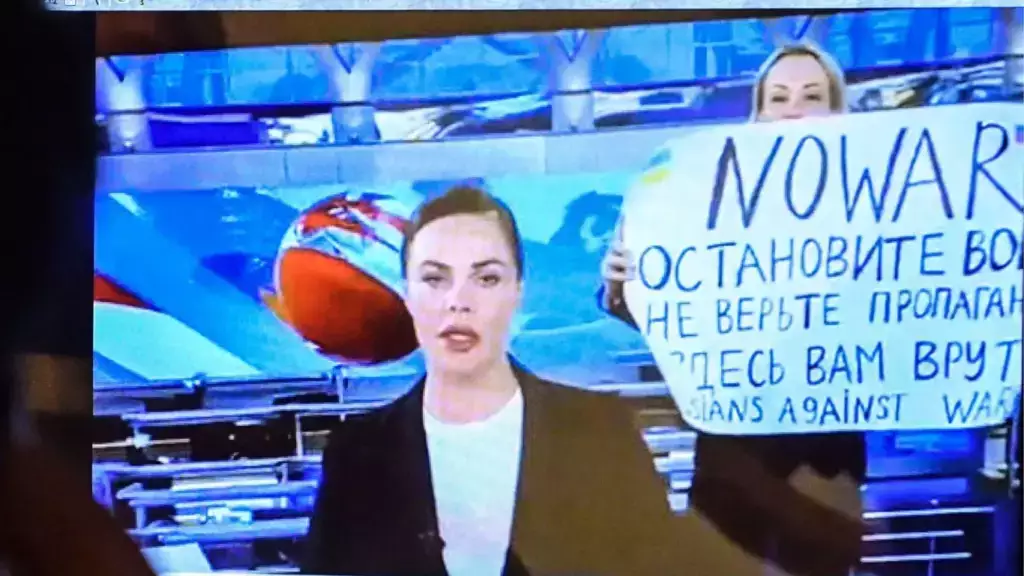
From defending ‘traditional values’ to censoring the human body – the Russian authorities are increasingly consistently pursuing the ambition to control not only social behaviors but also the boundaries of what can be seen, named, and presented.


In Russia, another cultural operation is underway – a fight for moral purity with the help of editing tools. Naked bodies are being obscured, erotic scenes cut out, undesirable dialogues rewritten, and plot threads that do not fit the official image of the proper moral order simply disappear. This is no longer about individual cases of television censorship, but about a systematic interference with artistic works. The scale of the phenomenon is illustrated by an investigation published on October 12, 2026, by the Russian editorial team of Mediazona, titled ’75 Hours of Censorship’. Journalists compared the original versions of foreign series with their Russian counterparts available on the Amediateka platform. In 200 productions, they confirmed instances of censorship, totaling about 75 hours of removed material. Of this, 44 hours pertained to LGBT themes, and 12 hours involved political content. The study covered 462 series, and signs of editing interference were found in 368 of them. Importantly, the censors did not limit themselves to the imagery: they also interfered with dialogues, translations, and entire plot threads.
‘Russkij mir’: from cultural community to ideology of control
The concept of ‘russkij mir’ does not have a single, immutable definition. It once signified a linguistic, cultural, or historical community, yet in the Russian political discourse of recent decades, it has transformed into an ideological construct of civilizational identity. A construct that not only defines the boundaries of the Russian community but also claims the right to set cultural and political orientations beyond the borders of the Russian Federation.
In this way, voluntary cultural affiliation gives way to political loyalty. The Russian language, historical memory, Orthodoxy, and the myth of a common civilizational fate become elements of a system that determines who belongs to this community and who is symbolically excluded from it.
Anastassiya Starodubtseva in the article Axiological Functionalities of the Concept of the “Russian World” (Russkiy mir) analyzes this concept in three dimensions: mythological, cultural, and ideological. The last one is particularly important – the “russkij mir” becomes a tool for regulating Russia’s domestic and foreign policy. It is no longer a neutral description of a cultural community, but a political claim to define its boundaries and principles of existence.
“Traditional Values” as a Technology of Power
One of the pillars of this ideology is the opposition of Russia to the supposedly morally degenerated West. Russia presents itself as a defender of tradition, spirituality, and family, while the West is portrayed as a space of moral decay and loss of values. This propaganda division has a direct impact on state policy: limiting the rights of LGBT individuals, prohibiting the dissemination of certain content, and controlling cultural production serve to impose a single normative model.
Censorship of culture becomes a tool of social engineering in this system. It does not limit itself to removing inconvenient content, but shapes the perception of who a “normal” person is, what kind of family deserves recognition, and which relationships can be present in public space.
The question remains: does a state that must constantly conceal alternative forms of human existence truly defend a strong system of values, or does it rather reveal its ideological fragility?
“Traditional Values” as a Technology of Power
“Traditional Values” as a Technology of Power
Russia presents itself as a defender of tradition, spirituality, family, and historical continuity, while the West is portrayed as a space of moral decay, individualism, and loss of values.
However, this is not exclusively a propaganda measure, but rather an increasingly evident state policy. The restriction of rights for LGBT people, censorship of content, and repression of independent social initiatives serve to impose a single, top-down defined normative model. This is confirmed by the evolution of Russian law: from the ban on “propaganda of non-traditional sexual relations” among minors (2013), through its extension to all age groups (2022), to the recognition of the so-called international LGBT movement as an extremist organization (2023). These changes are discussed in a British analytical note by the UK Home Office from June 2025.
Censorship of culture becomes in this system a tool not only for controlling speech but also for imposing a model of a ‘normal’ person, family, and socially accepted behaviors. However, the question remains: does a state that must repress alternative forms of human existence not reveal the fragility of the values it supposedly defends so zealously?
When censorship rewrites not only the frame but also the plot
The most interesting aspect of Russian practice is the extent of interference in the internal logic of the artistic work. It’s not just about blurring naked bodies or removing erotic scenes. Dialogues are censored, translations are altered, characters disappear, and with them entire plot threads.
A notable example is Game of Thrones. In the Russian versions, the removal of scenes related to incest and homosexual relationships leads to a disruption of the cause-and-effect structure of the story. A viewer may not understand why Jaime Lannister pushes Bran Stark out of the tower because the context of the family secret that motivated his actions has been removed.
Similarly, in the series The Sopranos, the interventions in the plot regarding the homosexual identity of one of the characters change the interpretation of his fate and the motivations of the other characters. As a result, the audience no longer receives the original work but its ideologically adjusted version. These examples are documented by the aforementioned Mediazone investigation (12.10.2026). Especially notable is the fact that censorship does not spare Russian productions either. In Nikita Mikhalkov’s film Burnt by the Sun (Утомлённые солнцем), Russian platforms Ivi and Viju removed nearly three minutes of material. Among other things, the scene in the bathtub, an intimate scene, and a fragment of the dialogue regarding one of the characters’ suicide attempts disappeared. This was reported by Meduza on December 24, 2025, citing findings from the project ‘Can Explain’.
A nearly grotesque situation is emerging: a state that acts as a defender of great Russian culture intervenes in its works, adapting them to current political and moral demands. Even the creativity of politically loyal authors is not automatically free from censorship.
This is not coincidental. For an ideology striving for a monopoly on the interpretation of history and contemporary matters, art cannot remain an autonomous space. It should affirm the official image of the world or at least not question it.
An empire that fears diversity
In the context of the ‘Russian world,’ censorship reveals yet another, deeper dimension. It shows the characteristic tendency of imperial consciousness toward unification. The empire does not tolerate diversity unless it is subordinate to its own hierarchy. It seeks to define not only political borders but also symbolic limits of what can be considered as its own, permissible, and legitimate.
This applies not only to sexuality or family models. A similar logic reveals itself regarding historical memory, national identities, linguistic diversity, and the rights of societies to independently determine their cultural development.
Therefore, Russian policy towards Ukraine cannot be analyzed in isolation from the ideology of the ‘Russian world.’ Its imperial logic undermines the independence of Ukrainian historical and cultural subjectivity, trying to present Ukraine as part of a broader Russian civilizational space. Full-scale aggression has become the most brutal form of executing this claim – attempting to impose political and cultural dependency where there is no voluntary consent.
One can observe a significant analogy here. Within Russia, the authorities try to edit cultural reality according to their own normative model. Outside its borders, it seeks to impose on other nations Russia’s right to define their historical and civilizational belonging. In both cases, it is about undermining autonomy – personal or national.
Of course, the censored erotic scene and the denial of Ukrainian subjectivity are not phenomena of the same scale, nor do they have comparable consequences. They should not be equated. However, one can discern a common ideological mechanism: the inability to accept a reality that does not fit into a previously established worldview.
Who has the right to edit reality?
In this entire narrative, the paradox is particularly eloquent. The Russian authorities constantly talk about protecting tradition but increasingly resemble an editor who fears leaving anything in the frame that contradicts his vision of the proper world. They not only prohibit but also cut out, replace, hide, and rewrite. They sometimes do it in such a way that the viewer does not even realize they are watching a manipulated version.
However, culture is not a montage version of state ideology. Human life cannot be confined to one moral instruction, and society does not become stronger by removing from its cultural space everything that is uncomfortable.
That is precisely why the contemporary “russkij mir” speaks so much about spirituality, tradition, and moral purity. Behind these declarations lies not so much confidence in one’s culture, but fear of its uncontrolled diversity. An ideology that cannot accept the multiplicity of human experiences must constantly define the boundaries of acceptable existence.
In this sense, the blurred fragment of a film becomes something more than just evidence of censorial intervention. It is a sign of a political imagination that does not allow for the possibility that the world could be different than what the official doctrine predicts.
In Polish literature, different variants of this term are encountered: “russkij mir”, “ruski mir”, and “rosyjski świat”. In this text, I consistently use the form “russkij mir”, in accordance with the rules of transliteration of the Russian language, and I treat it as the proper name of the analyzed concept.
Literary scholar and researcher specialising in culture, identity, Polish-Ukrainian relations, and sociocultural processes in Central and Eastern Europe.
For many years, he has combined academic, educational, and civic activities in Poland and Ukraine. His research interests include cultural borderlands, collective memory, postcolonial processes, and intercultural interactions. He is the author and co-author of several monographs and more than 150 academic publications.
He has extensive academic and organisational experience. He has held senior positions at universities in Poland and Ukraine, led research teams, and implemented international research and educational projects.
He is actively involved in supporting the Polish community in Ukraine, particularly in Berdiansk and the southeastern part of the country. His work focuses on cultural heritage preservation, education, and documenting the experiences of communities affected by war and occupation.
In his publications and commentaries, he examines the Russo-Ukrainian war, Polish-Ukrainian relations, Polish diaspora communities in Central and Eastern Europe, politics of memory, and questions of national and cultural identity. He also addresses Russian propaganda and imperial narratives.
In recognition of his academic, cultural, and civic contributions, he has received several distinctions, including the Knight’s Cross of the Order of Merit of the Republic of Poland, the Medal for Merit to Culture – Gloria Artis, and the Honorary Badge “Meritorious for Polish Culture”.
What do you think about this story?
Join the conversation. Please keep comments relevant to the article.
Write a comment