
Authors: Jarosław Kit, Nadija Hałuszka


When on October 20, 2026, the Lviv Regional Council declared 2027 the year of the UPA, Romana Szuchewycz, and Ołeh Olzycz, Warsaw responded with protests, and the initiator of the resolution ended up on the list of undesirable persons in Poland. Jacek Kluczkowski, ambassador of the Republic of Poland in Ukraine from 2005 to 2010, recalls that after 1989 Poland had a plan precisely for such moments. Its essence was the creation of new, positive facts that are stronger than the difficult history. He talked about how Polish-Ukrainian relations were built this way and why today “everything starts from scratch,” during his talks with students in Lublin and on the air of Radio Lublin.
Ambassador Kluczkowski is by training a historian, and in the 1990s he worked as a journalist, later becoming an advisor to President Aleksander Kwaśniewski. In 2004, he led a team of Polish and international diplomats and experts who prepared for negotiations at the round table in Kyiv during the Orange Revolution. After five years in Kyiv, he served as ambassador to Kazakhstan and Kyrgyzstan. He detailed his memories in the book ‘Diplomat’s Cases and Mistakes,’ which was published in Polish and has already been translated into Ukrainian.
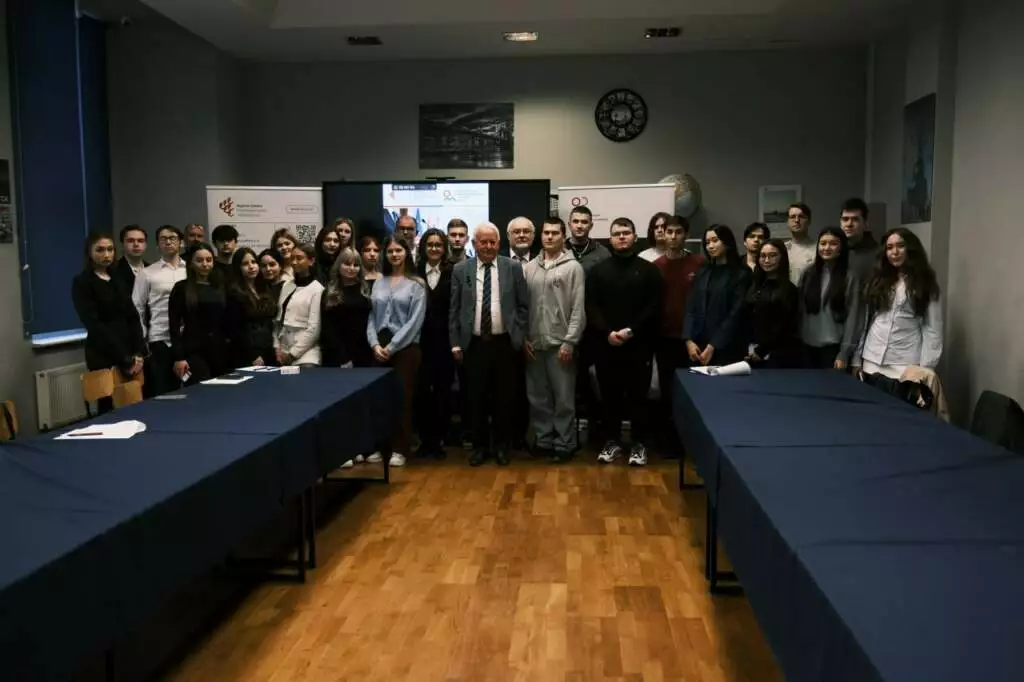
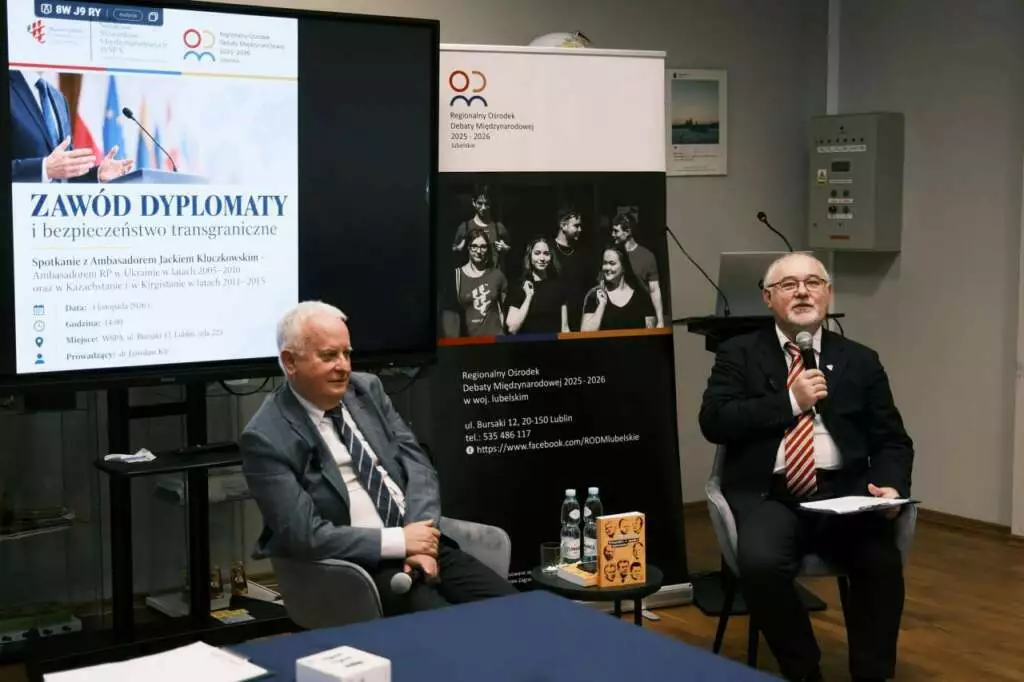
At the beginning of November, Kluczkowski came to Lublin at the invitation of the Regional Center for International Debate and the Higher School of Entrepreneurship and Administration (WSPA). The discussion with international relations students was conducted by Dr. Jarosław Kita.
35 years against a thousand
Kluczkowski formulates the main thought simply. Polish diplomats and first-generation politicians, as he says, knew the history of World War II better than the elites of Kyiv or Kharkiv, and that’s precisely why they wanted to ‘escape a bit from history by creating new, positive facts’.
‘Even if we had a thousand years of continuous conflicts behind us, we still have these 35 years of positive things’ – he says in an interview with Radio Lublin. He lists: in the autumn of 1989, the Solidarity delegation was the only foreign presence at the Movement conference in Kyiv, and on December 2, 1991, Poland recognized Ukraine’s independence as the first country in the world. ‘All of this was planned and executed with the thought that regardless of this difficult, tragic history, we must create positive facts.’ – sums up the diplomat.
The following facts included the Lviv Eaglets Cemetery, the joint Euro 2012, and the Eastern Partnership. The latter is considered by Kluczkowski to be the most tangible success of his time. The idea was Polish, but Minister Radosław Sikorski first convinced the Swedes, because – as the diplomat suspects – a purely Polish initiative might not have gained support in Brussels. It was the Eastern Partnership that helped prepare the association agreement between Ukraine and the EU and the free trade area.
Euro 2012 also had a human dimension. Every two to three weeks, the ambassador flew to matches of Shakhtar Donetsk and Metalist Kharkiv to show that Poland takes the joint tournament seriously. This unexpectedly came in handy: Prime Minister Donald Tusk, while waiting in Kyiv for a meeting with Viktor Yushchenko, particularly asked him about the Ukrainian football league.
The road to such facts led through compromise. Kluczkowski began the talks about the Lviv Eaglets Cemetery by giving up the demand to revert to the state prior to September 17, 1939. Such a demand would, in his opinion, be “unrealistic” and “impolite.” Instead, he spoke about respect for the deceased and the shared Christian values of Poles and Ukrainians, and the new boundaries of the cemetery were simply accepted as a fact. The cemetery was opened in 2005 by Presidents Kwaśniewski and Yushchenko.
He adhered to the same principle in November 2004 when Polish mediators persuaded the parties that the elections should not be “a fight for everything.” “Let the voter decide, as long as the elections are fair” – this is how the diplomat explained to the students the meaning of that mediation. The most important lesson he learned from it: to talk to everyone and to take everyone seriously, including those who are hostile toward you and your country.
The diplomatic craft, according to Kluczkowski, consists of matters far removed from notions of balls and etiquette. Above all, a lot of writing is required. An ambassador is expected not only to provide a reliable account of a conversation with a minister but also to draw a conclusion: what Poland should do about it. Based on this, as he says, ambassadors are evaluated. Protocol should also serve people, not the other way around. He recalls his first days in Kyiv with a smile: according to the rules, a new ambassador must visit colleagues in the order of their tenure. The third in line was the Russian ambassador, Viktor Chernomyrdin, but the security of the Russian embassy simply did not let the Polish diplomat in. The next day, it turned out that the secretaries had mixed something up, and apologies were made. Out of a sense of guilt, Chernomyrdin later invited Kluczkowski to concerts, and relations developed well.
Separately, the diplomat emphasizes trust in the country. His, candidate of Kwaśniewski, was accepted without dispute by the next president, Lech Kaczyński, with whom he worked almost the entire term. This provided assurance that no one in Warsaw “is lurking for your mistake.” When asked about the current dispute between the president and the Ministry of Foreign Affairs regarding ambassadorial nominations, Kluczkowski responds briefly: “This mutual hostility and dislike is, in general, a fatal matter both for Poland and for foreign policy in particular.”
Why positive facts have been possible to build precisely with Ukraine can best be seen in the example of Kazakhstan. There, as Kluczkowski says, it was necessary to concentrate primarily on representing “hard Polish interests”: economy, care for the Polish diaspora, and political dialogue with a country navigating between Russia, the West, and China. In Ukraine, however, the dream of Europe, which inspired both the Orange Revolution and the Revolution of Dignity, was alive. Without common ground, such facts do not emerge.
The endurance test became a reality in February 2022. Kluczkowski admits that several weeks before the invasion, he expected only a ‘demonstration of force’ from Russia. Americans, having intelligence data, evacuated their mission from Ukraine, while the Polish embassy remained in Kyiv. Polish diplomacy, Kluczkowski believes, passed the test of courage at that time. In autumn 2026, he was again in Kyiv, where people told him that the memory of the previous winter is more terrifying than daily bombardments. ‘But I don’t think that it will be possible to psychologically break these people,’ says the diplomat.
Why does everything start over?
It is all the more painful, as Kluczkowski says, to see how what has been built is undermining memory. In the early 90s in Poland, it was believed that an independent Ukraine would not seek its founders among the extreme nationalist movement. In the background is the Polish-Ukrainian context – the crime against Poles in Volhynia and Galicia in 1943–1944.
Poland’s reckoning with the past, the diplomat reminds, began with itself. In August 1990, the Senate unanimously condemned the operation ‘Vistula,’ later condemning the camp in Jaworzno and the destruction of the church in Chełmszczyzna in 1938. President Lech Kaczyński first went to Pawłokoma in Podkarpacie, where Polish partisans murdered Ukrainian civilians, and only then did he demand Polish graves in Volhynia. Such reflection from the Ukrainian side, Kluczkowski says, ‘has not come’ or has only come in very limited form. However, he still hears how Polish sins are used as justification for the massacre. ‘It doesn’t work that way. We have an obligation to first hit our own chests,’ he says.
The diplomat clearly indicates that one can lament the battles with armed formations as a political tragedy, but if innocent civilians are dying, “that is a different category.” At the same time, he acknowledges the heroism of many Ukrainians fighting against Soviet occupation after 1945 and reminds us that as a result of Soviet terror, well over 100,000 Ukrainians perished back then, and entire villages were deported. He encountered descendants of those deported in Kazakhstan. Therefore, Kluczkowski believes it is so difficult for Ukrainians to separate one from the other.
The decision of the Lviv councilors is explained by the diplomat as the pressure from veteran and military communities who need “some rooting.” He emphasizes that the contemporary Ukrainian state defends parliamentary democracy and freedom of speech, everything that the OUN-UPA ideology deemed hostile. Thus, in his opinion, such steps should have been prevented at the political level and “other heroes” should have been sought. The Ukrainian Foreign Ministry deemed the decision of the councilors harmful to relations with Poland and stressed that no one consulted it with the central authorities, and according to the Deputy Head of the Polish Foreign Ministry, the associates of the Ukrainian president assured Warsaw that the Lviv resolution would not come into effect. Kluczkowski fears that this issue will resonate in Polish-Ukrainian relations for a long time: “Every new generation, every new batch brings its new grievances, and sometimes I have the impression that everything starts anew.”
The solution proposed by the diplomat is the same as twenty years ago in Lviv: to not count grievances, but to seek common values. When asked by students about artificial intelligence, he replies that no program can replace the conversation of “a human with a human.” Today, when it benefits politicians to differentiate as much as possible from their opponents, diplomacy is, according to him, “in a certain sense a denial of such polarization.”
“The diplomat should seek dialogue until the last moment.”
– Jacek Kluczkowski, ambassador of Poland in Ukraine from 2005 to 2010
Positive facts are not created once and for all – they need to be built anew with each successive generation.
Source: WSPA in Lublin, Radio Lublin, PAP

Historian, ethnographer, and social media specialist. She has many years of experience developing YouTube channels, helping experts and businesses build their online presence. She has conducted academic research in ethnopsychology and ethnopedagogy in Galicia and the Northern Black Sea region. Her interests include the history of Ukraine and Europe, Polish-Ukrainian relations, and ethno-national and intercultural issues.
What do you think about this story?
Join the conversation. Please keep comments relevant to the article.
Write a comment