

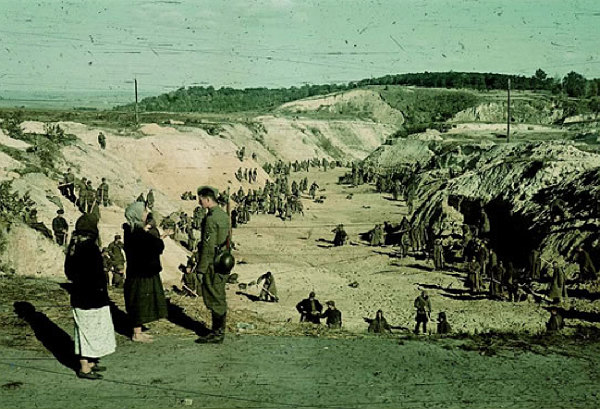
Babyn Yar is a ravine on what were then the northwestern outskirts of Kyiv, today within the city limits. On 29 and 30 September 1941, the Germans shot 33,771 Kyiv Jews here—such a figure was given in their reports by the perpetrators themselves. Today Ukraine marks the 85th anniversary of this crime. However, the history of Babyn Yar did not end with the war: the Soviet authorities kept silent about this crime for decades, and later tried to fill in the ravine itself.


The order was posted around the city on 27 and 28 September: all Jews of Kyiv and the surrounding area were to report on the morning of 29 September at the intersection of Melnykova and Diehtiariwska streets, with documents, money, valuables, and warm clothing. Failure to comply was punishable by death. Thousands of people came. Their documents and belongings were taken, they were ordered to undress, and then led in groups to the ravine. By evening, nearly 22,000 people had been killed. Those who could not be shot in time were locked overnight in garages on Tabirna Street and murdered the next day. The youngest victim was three days old, the oldest—103.
Among those walking that morning was Dina Pronicheva, an actress at Kyiv’s puppet theater. She jumped into the ravine before the shots were fired and lay among the bodies, pretending to be dead, and at night she got out to the top. After the war, she testified in court. Only about 29 people survived the executions of 29 and 30 September.
The executions did not end there. In October 1941, another approximately 17,000 people were murdered in Babyn Yar, and the shootings continued until Kyiv was liberated in November 1943. Roma people, prisoners of war, members of the underground, patients of a psychiatric hospital, and members of the OUN died here. According to the Ukrainian Institute of National Memory, a total of about 100,000 victims are buried in the ravine. Their names and photographs are still being collected, among others, by the Jerusalem-based institute Yad Vashem.
On the other side of the Dnipro, in the forest on the eastern outskirts of Kyiv, there is a place well known in Poland. Bykivnia is one of the four Katyn cemeteries. Buried here are Polish citizens from the so-called Ukrainian Katyn List—3,435 people arrested after September 17, 1939 and murdered by the NKVD in 1940. Next to them lie tens of thousands of Ukrainians, victims of the Great Terror.
The Soviet authorities treated both places similarly. In Bykivnia, the graves were dug up several times to remove items that would have made it possible to determine the nationality of the murdered. The NKVD’s victims were officially acknowledged there only in 1989, and the list of 3,435 Poles was handed over to Poland by the Security Service of the now independent Ukraine in 1994. Today, the National Historical and Memorial Preserve “Babyn Yar” tells the story of Bykivnia and Babyn Yar in a joint project—as crimes of two totalitarian regimes.
Why was it impossible to speak openly about Babyn Yar for half a century?
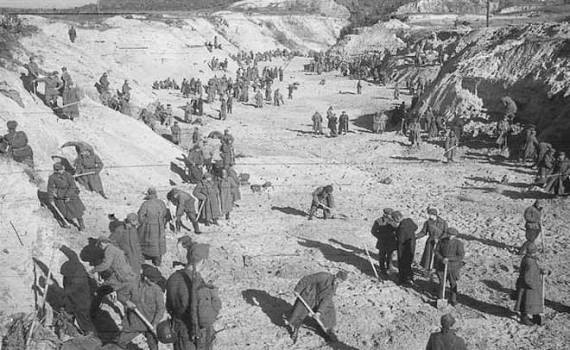
The Soviet version of events did not single out any nationalities: the victims were called “peaceful Soviet citizens.” In this way, the fact disappeared from memory that the victims of the largest executions died precisely because they were Jews. When, in 1976, the first official monument was unveiled at Babyn Yar, the word “Jews” did not appear in its inscription. The Menorah, today a symbol of this place, was erected only on 29 September 1991, on the 50th anniversary of the crime.
Earlier, in 1950, the Kyiv authorities decided to fill the ravine with waste from nearby brickworks—a liquid mixture of clay, sand, and water. For years it was pumped into the site of the mass grave, behind an earthen dam. On the morning of 13 March 1961, the dam burst, and a wave of liquid clay and mud flooded the Kureniivka district. Officially, 145 people died; according to researchers’ estimates—several hundred. The details of the disaster were concealed, and a year later the ravine was leveled and turned into a park.
For a Polish reader, this mechanism is familiar from the history of Katyn: the crime is hushed up, distorted, or described in a way that hides who was killed and why. Moscow admitted the truth about Katyn in 1990. Babyn Yar and Bykivnia also began to be spoken about openly around the same time—at the end of the USSR’s existence.
Ukrainian President Volodymyr Zelensky, paying tribute to the victims today, wrote:
This tragedy reminds us how important it is to defend ourselves against evil, against terrible regimes for which human life is worth nothing. It reminds us why we must not turn a blind eye to terror and atrocities against people and why it is always worth supporting the true defenders of life – Volodymyr Zelensky,
Today, on the site that the Soviet authorities wanted to turn into a park, there is a memorial.
The ravine was managed to be filled in. Memory—no.
Source: Nowiny Wschodnie / Ukrainian Institute of National Remembrance / National Historical and Memorial Reserve “Babyn Yar” / Yad Vashem

What do you think about this story?
Join the conversation. Please keep comments relevant to the article.
Write a comment