

From this example, we can learn that good relations with Russia mean nothing. Russia ruthlessly pursues its goals, regardless of the fact that it does so in countries traditionally sympathetic to it. Czechoslovakia is a prime example. Between February 20-25, 1948, a drama unfolded that changed the fate of this most democratic and wealthy country for four decades. The events communist propaganda dubbed “Vítězný únor” – “Victorious February” – were in reality a precisely executed seizure of power. Not a single shot was fired. Not a single tank was deployed. Yet, democracy in Czechoslovakia ceased to exist.


As I mentioned, Czechoslovakia traditionally had good relations with Russia and its successor, the Soviet Union. Before gaining independence, Czechoslovak leaders were frequent guests in Russia, hoping for its assistance, and Russian pan-Slavic propaganda was unhindered in Czechoslovakia. During World War I, legions were formed from Czechoslovak prisoners of war to fight against Germany and Austria-Hungary. After the establishment of independent Czechoslovakia in 1918, it felt closer to Bolshevik Russia than to the West. One example is the strikes of Czechoslovak railway workers who blocked trains carrying weapons and ammunition for Poland and Ukraine fighting Russia. These supplies were crucial. The trains only passed through after many days following the intervention of the Entente powers.
Czechoslovakia inherited a fairly good industry from the Austro-Hungarian period. Its proximity to Vienna meant it wasn’t underinvested like Galicia or the Balkan countries. Before surrendering to the German occupation in March 1939, the Czechs and Slovaks had built a country with one of the strongest economies in the world. In Europe, it was one of the most technologically and economically advanced countries, second only to France, Great Britain, and Germany. Comparing Poland at that time to Czechoslovakia, we were a very, very poor and backward country.
A Republic Between East and West
After World War II, Czechoslovakia found itself in a unique situation. Although liberated primarily by the Red Army, it formally retained a pluralistic system. The head of state was President Edvard Beneš, a symbol of the continuity of the pre-war republic. Beneš cultivated good relations with Russia during World War II, which allowed him to temporarily return to power.
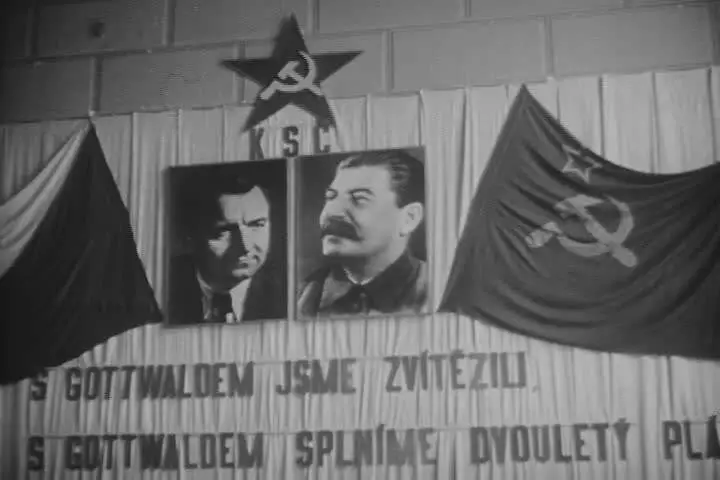
Communist propaganda supporting Klement Gottwald. Source: Wikimedia Commons
Free parliamentary elections were held in 1946. The Communist Party of Czechoslovakia won the most votes (approximately 38%). Its leader, Klement Gottwald, became prime minister. The government was a coalition—operating within the so-called National Front—but the communists took over key ministries, including the Ministry of the Interior, meaning control of the police.
This is where the real power game began.
State takeover plan
The years 1946–1947 were a period of systematic strengthening of the communists’ position. They seized influence in the administration, media, trade unions, and—most importantly—the security apparatus.
At the same time, international tensions were rising. The Cold War was beginning. In 1947, Czechoslovakia, like Poland, initially expressed interest in the American Marshall Plan. However, after Moscow’s opposition, both countries withdrew their decision. This sent a clear signal to Czechoslovakia that the country’s real sovereignty was limited by the influence of the Soviet Union. In Poland, no one harbored such doubts. In Poland, rebellious Poles who held different views were openly murdered and deported to Russia.
The Kremlin believed that the Central European states must be unequivocally subordinated to Moscow. Communist Russia’s authorities distrusted “mixed” models—coalition governments with the participation of non-communist parties. Czechoslovakia was to be completely “safe.”
The crisis that changed everything
The spark was sparked by a dispute over purges within the police force. The Communist Minister of the Interior, Václav Nosek, removed officers deemed disloyal to the party. Democratic parties demanded the decision be reversed.
When Nosek refused, on February 20, 1948, 12 non-communist ministers resigned. They hoped that President Edvard Beneš would reject their resignations and call early elections. I have never known greater naivety. They truly believed in democratic procedures, with Russia as the key player. They thought that the Russian people could be fought within the framework of a democratic system by resorting to elections.
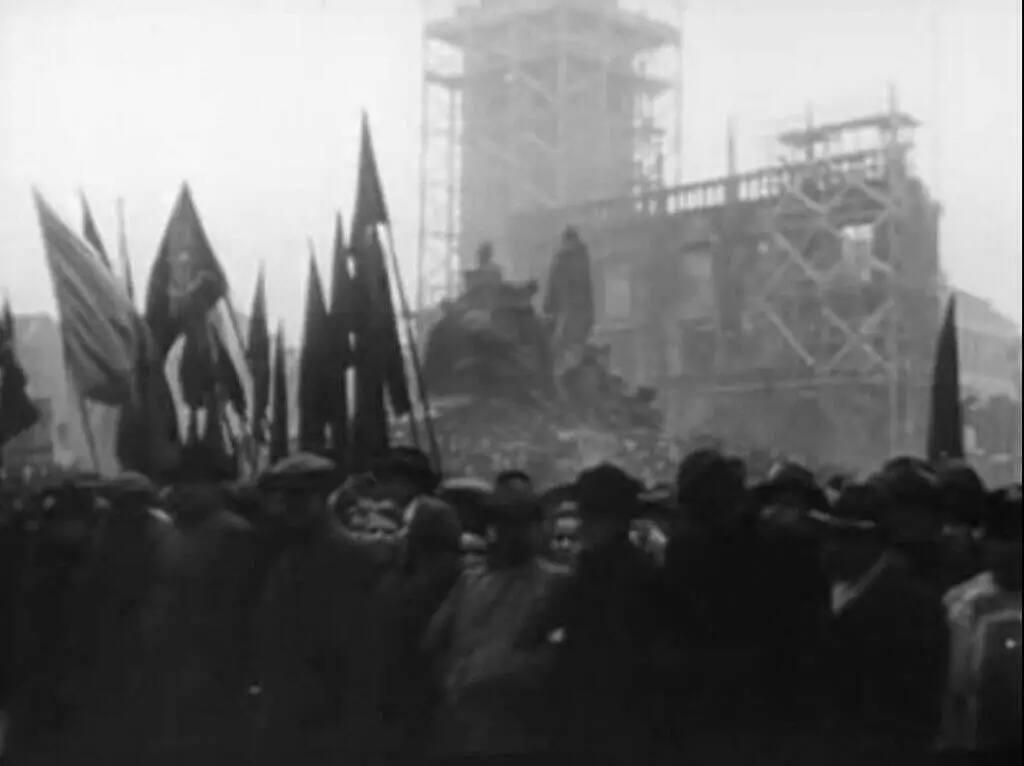
Workers’ demonstration in Prague in February 1948. Source: Wikimedia Commons
The communists were prepared for this; they were well aware of the non-communist ministers’ intentions thanks to their extensive intelligence network. Mass demonstrations began in Prague, organized by trade unions and party-controlled workers’ militias. The streets were filled with banners in support of Gottwald. It was a show of force—political blackmail against the president.
On February 25, Beneš resigned. He accepted the resignations of his ministers and agreed to a new government in which the communists and their loyal allies took key positions. Gottwald proclaimed the “victory of the working people” from the balcony of the Kinský Palace in Prague, which is considered the end of democracy in Czechoslovakia.
Moscow’s shadow and the role of the secret services
Although the coup was formally internal in nature, it was not isolated from Moscow’s influence. Czechoslovak communists were in constant contact with the Soviet authorities.
Soviet security services, primarily the NKVD (and later the KGB), collaborated in the reorganization of the security apparatus. Staff were trained and experience in social control, surveillance, and the elimination of political opponents was shared.
There’s no evidence of direct military intervention in February 1948, but the pressure was obvious. The Red Army wasn’t stationed in Czechoslovakia; it was the only unoccupied country in the region. Nevertheless, thanks to the work of the secret services, the country was completely subjugated to Russia, making Czechoslovakia a piece of the Russian puzzle.
Mysterious death
Two weeks after the coup, on March 10, 1948, the body of Foreign Minister Jan Masaryk, son of Czechoslovak state founder Tomáš Masaryk, was found outside the windows of the Ministry of Foreign Affairs. Officially, it was ruled a suicide. However, many historians still believe it was a staged assassination by the security services—perhaps with Soviet inspiration. His death symbolically marked the end of the pre-war republic.
The effects of “Victorious February”
In the following months:
- the political opposition was liquidated,
- the economy was nationalized,
- repression and show trials began,
- foreign policy was subordinated to Moscow.
In May 1948, a new constitution was adopted. President Edvard Beneš refused to sign it and soon resigned. Gottwald took his place. Czechoslovakia entered a period of forty years of communist rule, ending only in 1989 with the Velvet Revolution.
Why is this important?
“The Vítězný únor” shows that democracy doesn’t always collapse under the onslaught of tanks. Sometimes, all it takes is control of the services, the deft exploitation of a political crisis, and the support of a powerful neighbor. It’s a story of how a state with strong democratic traditions can be taken over from within—through legal decisions that were, in reality, the result of pressure and political maneuvering. For those curious about the world, it’s a lesson in the fragility of institutions, the importance of security apparatuses, and the role of geopolitics in the fate of nations.
It’s also a lesson in economic consequences. As a result of succumbing to Russian domination, the Czechoslovak economy collapsed. In a short time, the country plummeted from one of the richest in Europe to one of the poorest. Emerging from communism in 1990, they were indeed wealthier than war-ravaged Poland, but this was nowhere near the advantage they enjoyed in 1938, when they were hot on the heels of Europe’s most powerful economies.

What do you think about this story?
Join the conversation. Please keep comments relevant to the article.
Write a comment