

Ukrainians today, like Poles 45 years ago, have every right to ask for solidarity. They have every right to express their pain. They have every right to do so in my country – Poland. Especially in Poland. A country so deeply afflicted, a country that for two centuries has provided millions of emigrants. A country occupied by Russia for approximately 200 years. Below are a few words explaining why on February 24th, at the request of Ukrainians, I will be present in Legnica, where I can express my feelings as their country is being destroyed and murdered by Russian bandits. This will be the Legnica market square.
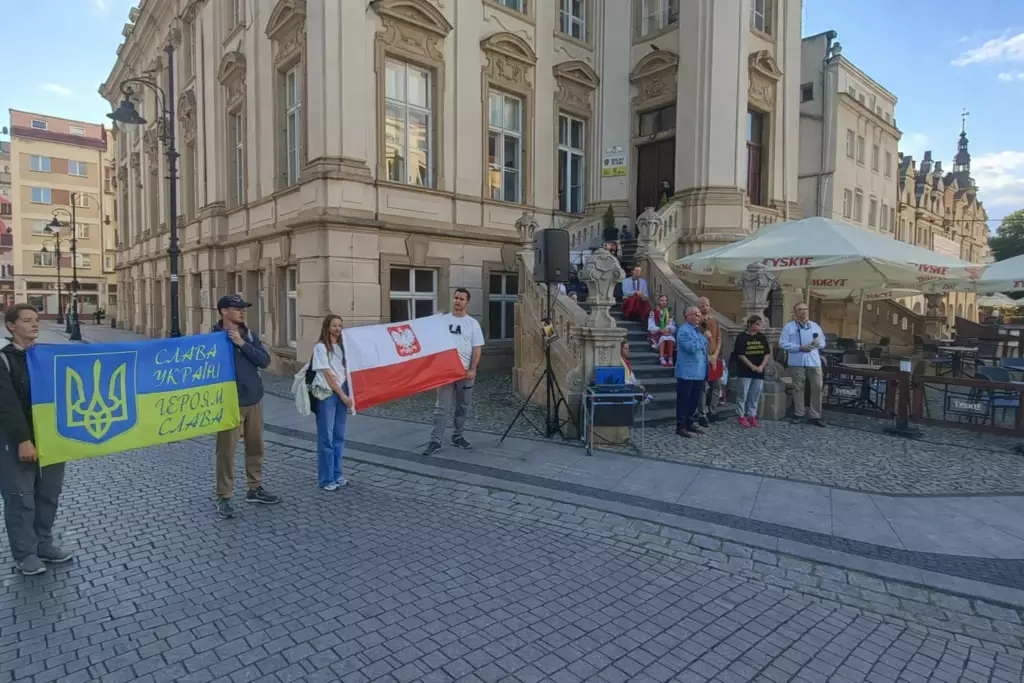


Legnica, 2025. Author: Grzegorz Majewski
The Polish experience of refuge and war wandering
I finished scanning. It took dozens of hours, and they were in poor condition. I’m looking at the small, yellowed photos. They’re from 1937-1945. The photographer is a Polish soldier who didn’t surrender after the defeat in September 1939 and went “to fight.” He found himself in Palestine, and most of the photos are from that period. There are even photos with the local population, who are clearly friendly. One of the photos shows several Arabs participating in a Polish holiday. A Polish holiday and a Polish military parade in Palestine. Without hostility. With compassion and sympathy. This must have made me reflect on how similar the fate of Ukrainians today is. Fortunately, their army is fighting in the country and hasn’t surrendered. However, just as Polish civilians fled the German and Russian occupation, Ukrainians fled the war to us and to many other European countries.
Martial law – a time of humiliation, repression and emigration
And another thought immediately arose, for how could it be otherwise for a member of a nation that had sought help in other countries for two centuries? The period I clearly encompass was martial law in Poland. Over a million Poles fled the communist regime at that time. They were not persecuted, yet they chose to live in refugee camps, because life in a country without prospects was not only depressing but, as martial law turned out, also dangerous. Thousands of political prisoners, tens of thousands of beatings. The brutality of the militia and the Security Service. In just a few years, approximately 100 unexplained deaths of regime opponents. Brutal murders and a remarkable failure to identify the perpetrators—always dismissed because the perpetrators were not identified. And as if that weren’t enough, the mundane reality: power outages, freezing temperatures, days-long queues for shoes, duvets, or even simple underwear. Hours-long queues for rationed meat, butter, and sweets. I remember standing in them. It was not only difficult but also humiliating. At that time, I had one, sometimes two pairs of shoes. I ate meat only on special occasions, and I never saw butter. Sweets were out of reach. The main staples of my diet were bread and yellow cheese. Unripe.
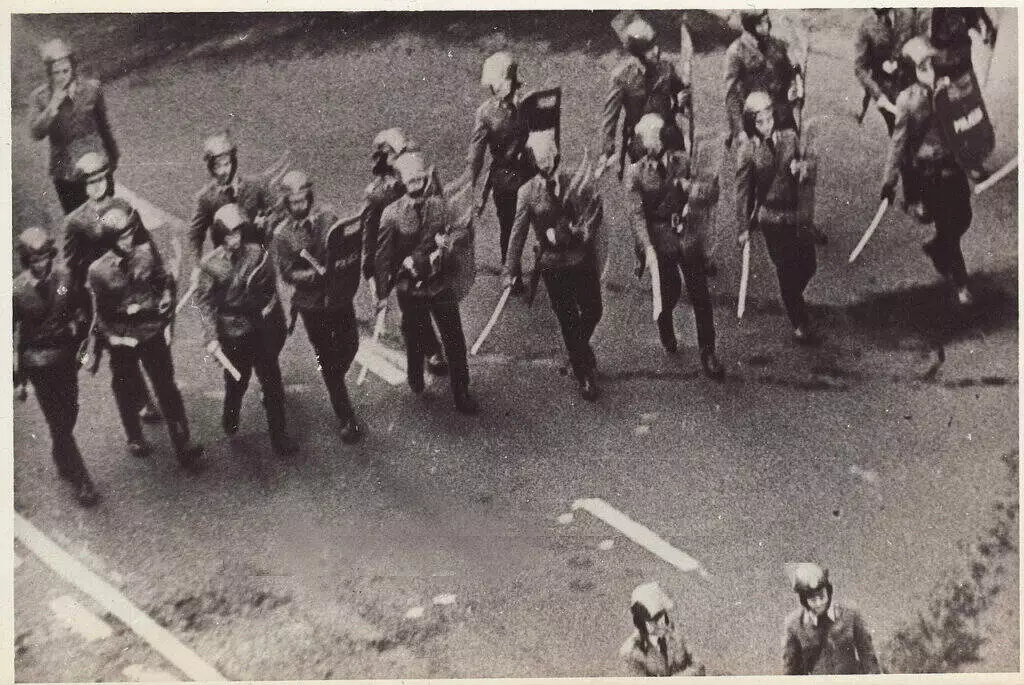
Martial law, fighting in the streets of Polish cities. Source Wikimedia Commons
Western Solidarity – the help that allowed us to survive
In the underground press, which appeared almost from the beginning, one could read about strikes and their brutal suppression. Of arrests, of being forced to leave the country in exchange for release from prison. And one could read that those forced to leave did not stand idly by. They organized the Polish diaspora into action. Together with residents of Germany, the Netherlands, France, Austria, Italy, Sweden, Great Britain, Canada, the USA, and many other European countries, they held collections and used the money they collected to send aid to the struggling Poles. Western societies showed us generosity and solidarity. Printing machines, paints, paper, and even money for living in the underground were smuggled in through various channels. Yes, many activists of the anti-communist underground survived thanks to this aid. My friend Krysia is smiling before me on her computer screen. Krysia and her husband Leszek were, more or less consciously, benefiting from this aid. They were pursued by the political police with arrest warrants. They were never caught – also thanks to help from the Germans and the French.
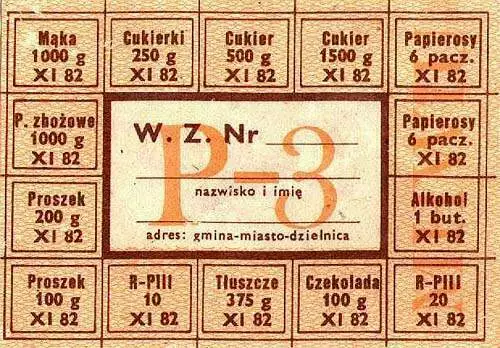
A ration card from the early 1980s in Poland. Source Wikipedia, author Niki K.
Without help from the West, those harboring our conspirators would have been financially and logistically helpless. A meat ration was 2.5 or 4 kg a month. How could they survive with two people in hiding, wanted by the political police? The rationing wasn’t the only problem. Low wages were too. We earned $15-25 a month. We owe the West a lot. A great deal.
And we owe them an extraordinary solidarity that is sorely lacking in Poland today. European cities were flooded not only with a wave of people raising money to help Poland, but also with another wave – demonstrations. Demonstrations were held in front of every communist consulate or embassy, on December 13th, May 3rd, November 11th, and August 15th. None of these days were considered a holiday in communist Poland at that time. Russian vassals sat behind curtains in their embassies, gnawing their fingers in anger as they watched the thousands gather outside their embassies. Yes, Germans, French, Americans, and others flocked there to express solidarity with Poles fighting for their freedom. Of course, the large crowds didn’t last forever. Two years, and then a natural fatigue set in. Russian disinformation also took its toll. Along with the emigrants, collaborators smuggled their spies to the West. They committed plunder and murder – as, for example, in 1987, the murder of Father Franciszek Blachnicki in Germany.
Russian propaganda yesterday and today – the same mechanism, different victims
Russian information warfare has always been at a high level. Just remember their explanations for why they had to kill Poles during the partitions. They told the West that we were disobedient, savages. And why should we be obedient and not want our own country? Why wouldn’t we want an independent country? We had a sacred right to do so. Russian intelligence tried to explain that we didn’t have that right. That we were incapable of independent living, that we were criminals because we were Russophobes. Yes, this is a particularly vile tactic. The occupiers accused us of Russophobia. Exceptional perfidy.
The Debt of Humanism
In the last paragraph, where Poland or Poles are mentioned, simply replace them with Ukraine and Ukrainians. It turns out that Russia’s modus operandi is the same and hasn’t changed for over two centuries. They conduct their operations against Ukraine in the same way. They conduct their destructive activities in the same way. They send agents, murderers. They recruit Ukrainians just as they once did Poles. Besides, they recruit Poles too. Nothing has changed. And there are still many among us willing to betray, whether for money or out of hatred. Many Poles have succumbed to Russian propaganda. The Russians have well-mapped the possibilities of where to strike, what to publicize to stir up animosity toward those in need of help. And Ukrainians do nothing but want to live. They want to live in a free country. And we, today sated with freedom, should help them in this. Because we owe them a simple human debt. A debt of humanism.
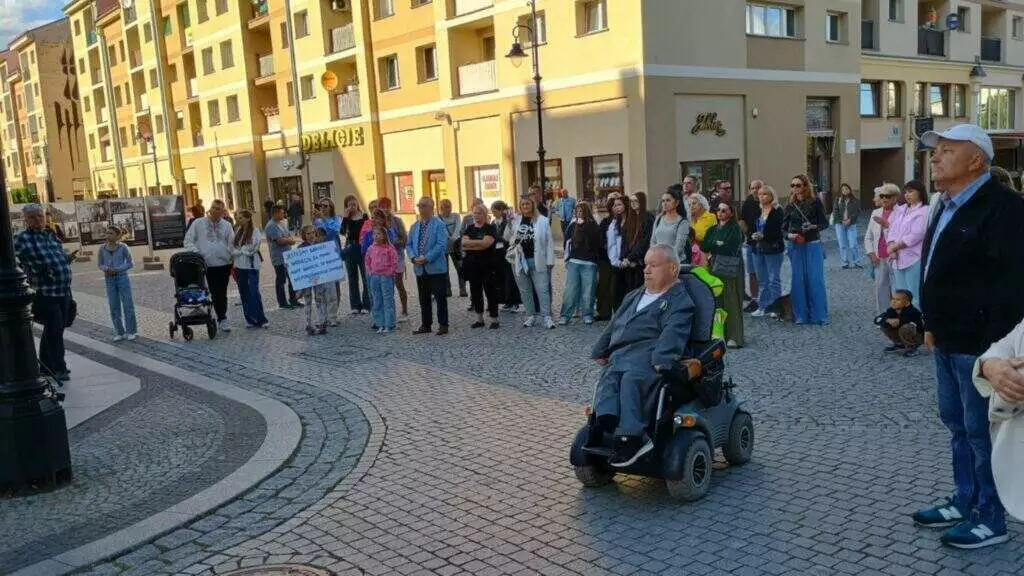
Legnica, 2025. Author: Grzegorz Majewski

What do you think about this story?
Join the conversation. Please keep comments relevant to the article.
Write a comment