

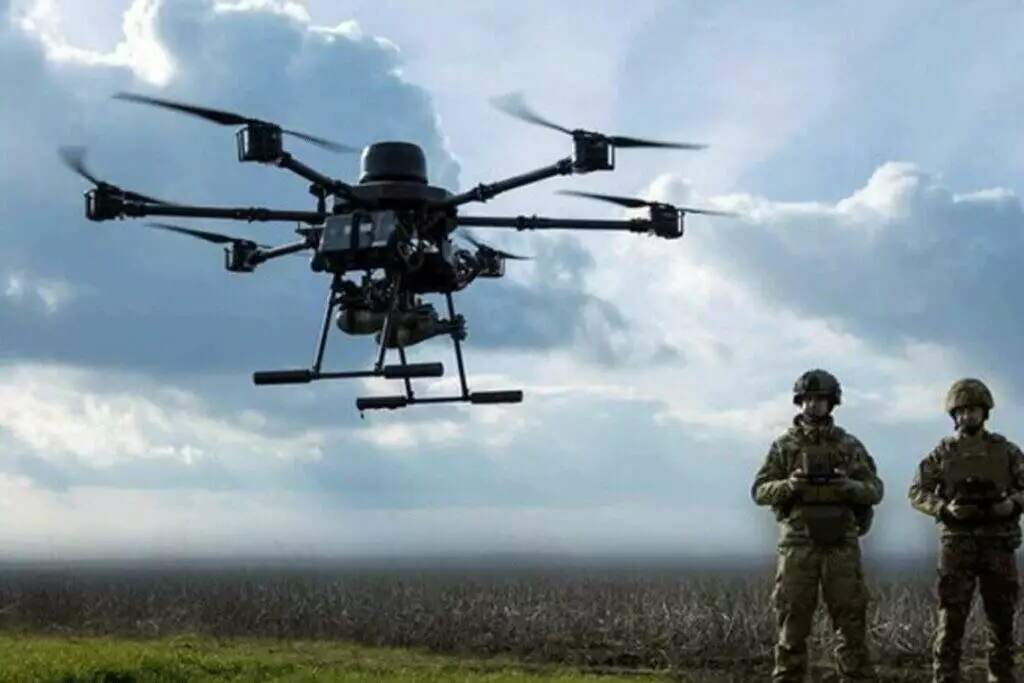
Source: General Staff of the Armed Forces of Ukraine


On July 21, 2026, the Polish Minister of National Defense, Władysław Kosiniak-Kamysz, announced that Russia had seized a significant number of Ukrainian drones and can use them – after repainting the markings – for operations “under a foreign flag” against Poland, the Baltic countries, Finland and Romania. If this happens, it won’t be anything new. We’ve seen it before. Eighty years ago.
The formula is simple, and precisely for this reason, so terrifying: we take someone else’s symbol, someone else’s uniform, someone else’s markings—and we kill, attack, and provoke in someone else’s name. The goal hasn’t changed one iota: to divide two neighbors who have been trying, for too long and too stubbornly, to stand shoulder to shoulder against the same enemy from the east.
The Council of Ministers’ Committee on National Security considered a hypothetical scenario on Tuesday: a swarm of drones appears over Poland or another country on NATO’s eastern flank, bearing the markings of the Ukrainian Armed Forces. Formally, it’s a Ukrainian attack. In reality, it’s a Russian provocation. Kosiniak-Kamysz stated bluntly that this is a proven tactic: “we’ve had provocations using drones, so we’ve seen what they’re capable of.” Russian Federation” According to him, not only Poland is at risk, but also the Baltic states, Finland and Romania – the entire eastern flank of the Alliance.
Why does the Kremlin always fight with other people’s hands — and in other people’s uniforms?
The answer is simple: because it works. It operated in some form in Volhynia in 1943. It became a systematic tactic between 1944 and 1953. It operates today on the Baltic Sea.
First, an important caveat. In 1943, when the Volhynia tragedy unfolded, this area was under German occupation, not under NKVD control—the Soviet authorities had no physical control over Volhynia at that time. These were years in which both German and Soviet agents, as well as Ukrainian and Polish underground forces, were active, so the events of that time cannot be equated with the subsequent systematic work of the NKVD. However, some historians believe that some attacks on Polish villages during this period may also have been carried out by NKVD special forces dressed in UPA uniforms — that is, Soviet agents were already trying to influence the course of the Ukrainian-Polish conflict, although not on such a scale as later.
It became a real, system-developed tactic of “someone else’s uniform” only after the return of Soviet power — in the years 1944–1953. When the UPA’s activity as a large, regular force began to wane, the NKVD, and later the MGB, did not cease fighting—they changed its form. They created so-called legendary groups—special units that donned UPA uniforms, used UPA slogans, and operated, in accordance with official missions,under the guise of insurgents in order to discredit the movement“One of these managements had a telling the name “East”. According to researcher Mykola Rutsky, who worked with declassified KGB archives, under this leadership operated 47 groups dressed in UPA uniforms.
These units served a dual function. Firstly, they robbed and killed civilians—both Ukrainian and Polish—precisely to blame the insurgents. Secondly, by posing as a UPA unit, a commander with his entourage, or even a militia of the OUN Security Service, they established contact with real UPA formations—in order to detect and destroy.
It’s not just about accusing the enemy. It’s about doing it in such a way that the victim accuses not the occupier, but their neighbor.
Researchers point out that the activities of special groups NKVD could influence the course some episodes of the Ukrainian-Polish conflict In 1944–1953. The goal remained constant throughout this period: to prevent two nations, each with its own vendettas with totalitarian regimes, from uniting against a common enemy. Divide and conquer.
Volhynia 2026 – no longer an archive, but an up-to-date FSB manual
The worst thing is that it’s not just history. This is the prevailing methodology. A few weeks before Kosiniak-Kamysz’s statement, Polish and Ukrainian sources noted: On July 5, 2026, pro-Russian media (including RT and TASS) published allegedly “declassified” FSB documents regarding the Volhynia tragedy—a falsified “report” on the murder of 11 Catholic priests and nearly 2,000 Poles in Volodymyr-Volynskyi. Just a day earlier Ukrainian Center for Counteracting Disinformation warned against the upcoming publication, which aims to undermine the strategic partnership between Poland and Ukraine. Polish historians — including Dr. Joanna Karbarz-Wilińska from the Institute of National Remembrance and Prof. Mirosław Szumiło from the Maria Curie-Skłodowska University confirmed to PAP that this is a known fake that the FSB had published earlier, in 2024, and which circulates in Poland since 2008.
The decades have changed. Technologies have changed. Instead of disguised “fighters,” we now have repainted drones, and instead of falsified field intelligence reports, we have falsified archival documents. Only one thing has remained unchanged: the enemy’s logic. Back then, a UPA uniform on the shoulders of an NKVD agent. Today, the insignia of the Ukrainian Armed Forces on the fuselage of a drone launched from Kaliningrad or Belarus.
Then and now, the calculus is the same: force the victim to suspect not the empire but the neighbor.
“There are many of our people here – my late mother counted 47 people from our village and the surrounding area,” she recalled. a resident of one of the Volhynian villages, telling about trials carried out under someone else’s name.
These aren’t lines from a textbook. This is a living witness to the consequences of a provocation that wasn’t recognized in time.
The difference is that today Warsaw and Kyiv seem to have learned this lesson. The Polish defense minister is not keeping silent and accusing Ukraine in advance—he is publicly warning about the very mechanism of provocation, even before it could happen. And this is precisely the best defense: when all sides know the rules of the aggressor’s game, the game stops working.
There were breaches of trust, tragic mistakes, and real Ukrainian-Polish bloodshed in the Volhynian lands—there’s no point in denying this or minimizing it for the sake of a convenient metaphor. But at the same time, we can’t close our eyes to the third party in the conflict, which for decades—and today again—has had a direct incentive to ensure this blood continues to be shed, and blame falls where it shouldn’t.
The Kremlin hasn’t invented anything new in eighty years. It simply updated its wardrobe.
Source: Nowiny Wschodnie / RMF24 / RP.PL / Ukrslovo.org.ua / Wikipedia / Radio Svoboda / dzieje.pl

Historian, ethnographer, and social media specialist. She has many years of experience developing YouTube channels, helping experts and businesses build their online presence. She has conducted academic research in ethnopsychology and ethnopedagogy in Galicia and the Northern Black Sea region. Her interests include the history of Ukraine and Europe, Polish-Ukrainian relations, and ethno-national and intercultural issues.
What do you think about this story?
Join the conversation. Please keep comments relevant to the article.
Write a comment