

Despite the war, Ukraine’s potential is recognized by Polish companies. Polish firms have excellent experience operating in a market similar to Poland’s in the 1990s. This experience included economic instability and collapse, as well as high inflation. This unique experience gives Poles a natural advantage over companies that didn’t dare enter Poland at that time, awaiting our accession to the European Union.


The following text is the author’s journalistic commentary.
• Estimated reading time: 9 minutes
The Ukrainian market is currently five times smaller than Poland’s, with a GDP of approximately $212 billion, while ours is over $1 trillion. This creates a natural basis for investment by many entrepreneurs, i.e., operating surpluses. Entrepreneurs are looking for opportunities to allocate their profits to generate the highest possible dividend. Yes, the market is poor. However, this reminds us of an anecdote. The owner of a shoe manufacturing company sent two managers to Africa to research the market. The first wrote that it was a market without prospects; no one wore shoes. Everyone walked barefoot. The second replied that it had enormous prospects—no one had shoes. Polish companies that have entered/are entering Ukraine today are following the second manager’s lead.
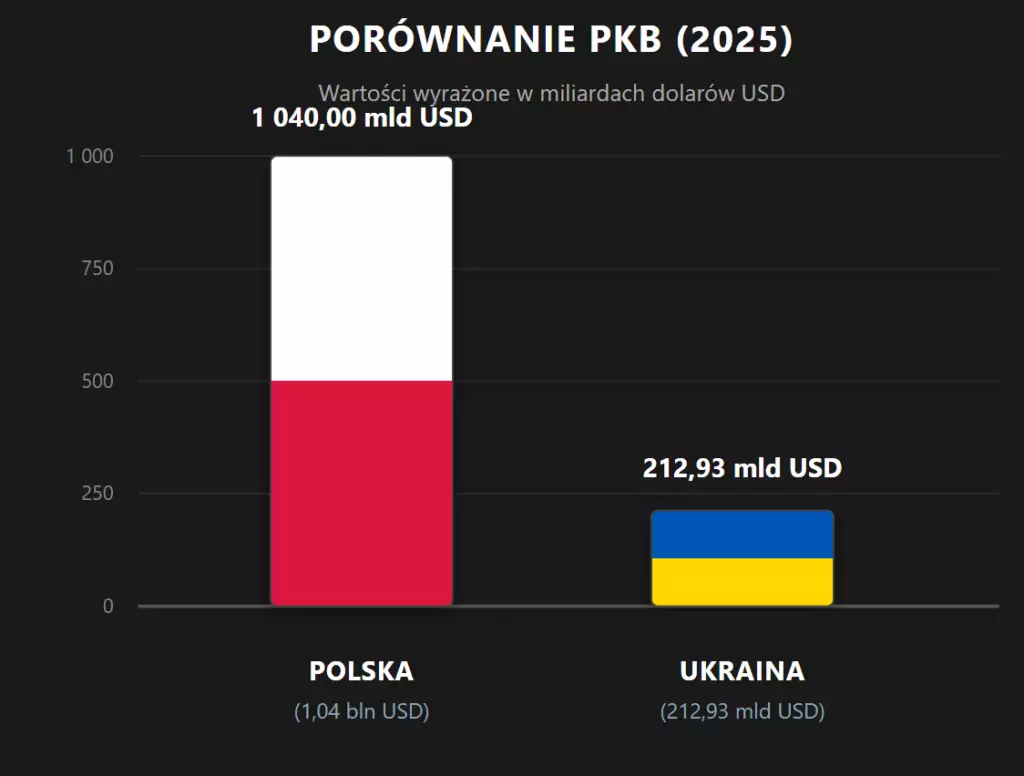
Comparison of nominal GDP of Poland and Ukraine at the end of 2025. Own study
News outlets and social media are abuzz with political disputes, gestures, and diplomatic friction, and where little is visible, something is happening that could define the economic architecture of Eastern Europe for decades to come. Polish businesses have stopped waiting for the war to end. They’ve sensed the right moment (it’s cheap) and are laying the foundations for economic success, which, if peace is reached, will have an economic turbocharger effect.
Strategic Bridgeheads: From Banks to Factories
The current sectoral distribution of Polish capital in the Ukrainian market is beginning to resemble a strategy for securing key economic sectors. Investments no longer focus solely on cross-border trade, but also on critical infrastructure, logistics, and modern technologies, as well as security.
Acquisition PINbank by fintech ZEN.COM This provides Polish companies with a safe haven to handle their transactions, protected by EU banking regulations. To bypass the lengthy process of obtaining a banking license, ZEN.COM decided to purchase a failing Ukrainian bank. This is an expansion of the activities of this fintech, which until now was known primarily for online financial services (e.g., currency exchange).
PZU has been present in Ukraine for a long time, has very good knowledge of this market, and can assess risk. Hence the decision to expand the scale of this activity. The acquisition of “MetLife Ukraine“The acquisition of PZU, a leader in life insurance, offers broader opportunities for scaling the business. The company is becoming a major player in the market. PZU itself provides services that can help Polish investors. You can insure transactions and deliveries with an insurer you trust. This insurer won’t disappear overnight with clients’ money.
Entry Maspex Group in the food market (80% stake in Karpackie Mineralnye Vody) is accustoming Ukrainian consumers to the idea that they can also obtain Polish quality products from a Polish company. People working for Maspex in Ukraine are pleased that it has invested in their region. The Polish company has long been perceived there as a symbol of success and quality.
In addition, there is the start by Allegro Deliveries to Ukraine, which opens up sales opportunities for thousands of Polish small businesses. It’s worth remembering that hundreds of thousands of Ukrainians have returned to Ukraine from Poland. Nearly a million work in Poland. They all use Allegro for shopping, which creates certain habits. Ukrainians in Poland can now order something on Allegro and send it directly to their family: a husband on the front line, a granddaughter, a sister, a brother in the army. And they send a lot. Those who returned also remember Polish products and the way of shopping online. Allegro plans to utilize the dense network of Ukrainian delivery company Nova Poszta for deliveries to Ukraine. All this together provides a natural base for our champion, which has broken into the WiG 20 index and become one of the largest Polish companies on the Polish stock exchange.
The opening of the chain’s first store has been announced for the fall. Pepco. While it’s not a purely Polish company, it’s listed on the Polish Stock Exchange and has “shared” part of its business with Polish investors, meaning the income generated in Ukraine will return to Polish investors. Knowing how this chain operates, it will soon be possible to buy the same products in Ukrainian cities as in Poland and other countries. I don’t know if this is good for fashion, but it is good for business.
The clothing industry is also a company LPP, which has been consistently investing in Ukraine for several years. In 2021, before the full-blown war, they had 33 showrooms open there under the brand Sinsay. By the end of 2025, there were 330 such stores. LPP is also listed on the Warsaw Stock Exchange and is highly valued by investors. Suffice it to say, the current share price is well over 19,000 złoty. I remember passing on buying LPP shares when I saw the price at 2,000 złoty per share… Wrong.
In turn, Polish production plants – such as factories Cersanit, Fakro Whether Barlinek – not only did they maintain continuity of work during wartime conditions, but they also consistently modernized their machinery and secured local raw material deposits. Thanks to their presence, they have a significant opportunity to participate in Ukraine’s post-war reconstruction. While other companies are waiting in the starting blocks in their home countries, they are already there. They understand the market, the law, and the realities. They know how to navigate the complex wartime situation in Ukraine. This is a unique experience.
Our flagship supplier of fuels and petroleum products PKN Orlen It has been present in Ukraine for many years. It has extensive experience in this market. It is one of the main suppliers of oil and gas to the Ukrainian market. Due to the shift away from Russian supplies, our giant faces virtually no competition there. However, there is a temptation to become more than just a pipeline supplying products to Ukraine. Orlen wants to buy part of Ukrnafta, a company that controls approximately 20% of the retail market and approximately 65% of the mining market. This is widely and positively reported in the Ukrainian press.
All these entities have one thing in common: they’re buying assets and building structures now, when valuations are burdened with war risk and the associated discount when peace is declared. It’s a somewhat risky strategy, but if successful, these companies will earn a significant amount of money. Most importantly, the climate they encounter is very favorable. I haven’t found any criticism of Polish companies investing there in the Ukrainian media. And there’s plenty of it. Polish companies are approaching a billion dollars in investments. And we’re among the top ten investors. This offers a lesson. Polish companies aren’t the only ones; they need to compete with the competition. Those who are, however, can be sure of a better starting position after a truce, or even peace, is reached. Hopefully.
Peace as a Catalyst: What Lies Ahead for Ukraine’s Economy?
A permanent ceasefire or peace agreement would fundamentally change the rules of the game. Current forecasts from the European Bank for Reconstruction and Development (EBRD) and the International Monetary Fund (IMF), hampered by the ongoing conflict, assume cautious growth for Ukraine at 1.3–2.5% of GDP. However, these same institutions indicate that The launch of post-war reconstruction will unleash a growth potential of 5–6% per year in the long term.
The conclusion of peace will remove the biggest development brakes in Ukraine so far:
- Return of human capital: Peace will create the conditions for the return of millions of refugees (often highly skilled professionals). Without workers, no economy can sustain sustainable growth.
- Reconstruction of infrastructure and energy: The reconstruction cost, estimated by the World Bank at over $580 billion, will transform Ukraine into the world’s largest construction site. Decentralization and modernization of the energy grid (where Polish renewable energy companies like Unimot and the ELQ Group are already making a significant contribution) will fuel heavy industry (steel), construction, and small subcontractors from all sectors providing services and goods for ongoing construction projects.
- Drastic drop in capital costs: Ukrainian entrepreneurs are currently facing a gigantic financial crunch. Peace and international guarantees will allow for an influx of cheap loans and investment insurance, leveling the playing field against Western competition. Inflation will fall almost overnight as large amounts of foreign money arrive.
It’s enough to trace Poland’s path to success, drawing support from other countries undergoing transformation like Poland, to predict what will happen after, for example, a ceasefire in Ukraine. The popular belief is that the country is corrupt and ruled by oligarchs. But are private companies run by fools incapable of risk management? How on earth did they amass such vast fortunes? Polish businessmen and managers are closely monitoring the changes taking place in the Ukrainian market and their needs. They do the math, and looking at Poland’s development path, they conclude that there’s plenty of room in the Ukrainian market.
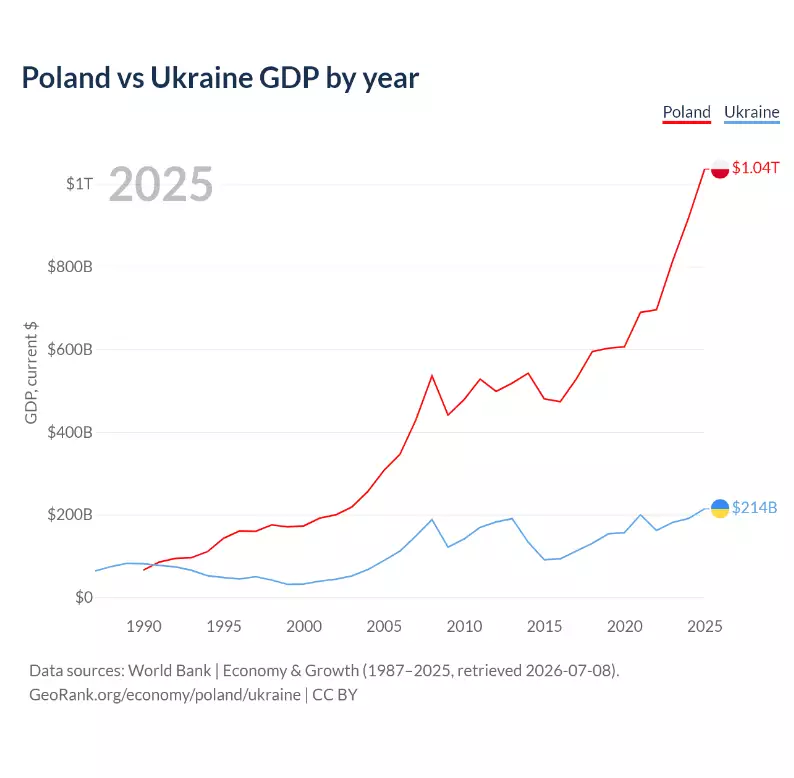
Nominal GDP growth in Poland and Ukraine from 1990 to 2025. Source: World Bank
Lesson from Prus: Who Really Makes Money from War?
So what’s the deal with these oligarchs? Their power is waning. Those who studied personal development and read books in school remember The Doll. In this book, Prus placed a merchant who made his fortune in war as the main character. It’s worth reading, knowing the literature, and history. What does this have to do with Ukraine? Well, a lot. The Ukrainian economy is undergoing significant changes, and the oligarchs are unable to exit their old businesses. Thousands of small companies have emerged dealing with military supplies. Among them, hundreds are engaged in research and development of military technology. Why are the oligarchs giving up this field? Because their structures are burdened with inefficiency. They have never been able to compete, and their fortunes were built on monopolies, either industry-specific or geographical. A long time can pass from discussion to decision—even a year or two. In the case of these small companies, it sometimes takes two or three weeks to produce a product (!).
I once dealt with a company like this. We bought night vision goggles for cars for Ukrainian medics. In Poland, they cost around 2,000-3,000 złoty each, and they were of poor quality. For that price, we bought two with much better performance from a Ukrainian company. After installing them on the car, the medics could start visiting the injured even at night, which was much safer. The contact with the owner was fantastic. He didn’t know us, and even though we hadn’t sent him the money yet, he sent the cameras to our guys. That’s how young Ukrainian businesses work. Dynamic, efficient, and innovative. And it’s taking up an increasingly larger share of the market. That’s why you have to be in Ukraine, and Polish entrepreneurs understand this. Our giants – PZU, PKN Orlen, LPP, and Allegro – understand this too. And they’re there. I wish them success.
Sources:
- UA.NEWS – Polish energy giant may join Ukrnafta
- UNN – Orlen plans to take over shares in Ukrnafta
- World Bank – Ukraine Recovery and Reconstruction Needs Assessment 2026
- International Monetary Fund (IMF) – Ukraine
- Bankier.pl – LPP SA Quotes
- Interia Biznes – a Polish chain dynamically developing its operations in Ukraine
- Money.pl – Cersanit invests in Ukraine
- PAP Biznes – Allegro is preparing deliveries to Ukraine
- Minfin.ua – Information about the Ukrainian market
Featured photo: Wikimedia Commons, author: Wistula.

What do you think about this story?
Join the conversation. Please keep comments relevant to the article.
Write a comment