
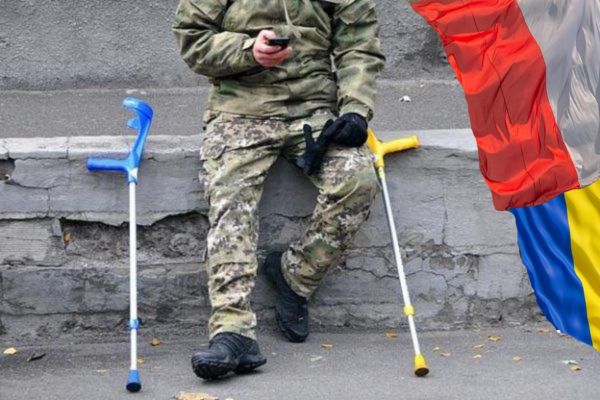
The only “weapons” of the thirty participants in the pilot rehabilitation program in Górowo Iławeckie are orthopedic crutches and a three-week physiotherapy schedule. The program is funded privately, without a single zloty from the state budget, and uses the infrastructure of an already existing hospital. Even so, a version about a “security threat” and “resettlement” has already managed to grow around it on the Polish internet — a version that Polish sources make easy to verify and debunk.


This concerns a project that launched in August 2026 on the initiative of the Polish sociologist Jakub Wygnański, president of the Stocznia Foundation, in cooperation with the Association of Ukrainians in Poland. Thirty demobilized veterans, divided into three groups of ten, will use the facilities of the already operating Provincial Rehabilitation Hospital in Górowo Iławeckie as well as the local spa infrastructure. No new center for visitors is being created from scratch — the organizers deliberately chose a model in which, for three weeks, the veterans become patients of an existing facility rather than residents of a separate “Ukrainian” site.
The project is funded by the PRB Foundation, affiliated with the Polish Business Roundtable—an association of entrepreneurs—through individual contributions from its members, both men and women. No funds from the Polish state budget are involved. In an interview with the Polish portal Sestry.eu, Wygnański emphasized that this is a pilot for thirty people, which will still be modified based on experiences from the first group, rather than a ready, scalable model.
The choice of Górowo Iławeckie is not solely due to suitable medical facilities. More than 10 percent of the town’s residents are descendants of Ukrainians resettled there as part of the post-war “Vistula” operation; there are two Eastern Orthodox churches there, and in Wygnański’s view this was meant to help create an environment friendly to the program participants. Three weeks of stay, as he himself assesses, do not change a person’s life—but they can become an impulse and motivation for further rehabilitation.
Why did a rehabilitation hospital for thirty people become a “security threat” on the Polish internet?
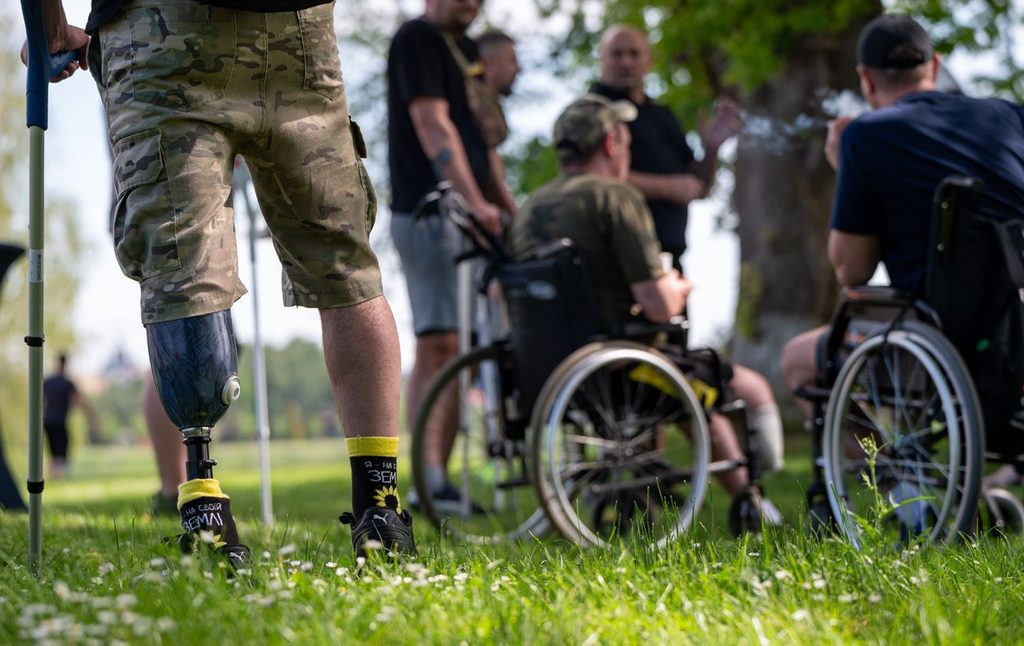
Who is paying, where the treatment takes place, how many people are involved – these are precisely the details that disappeared from the version picked up by some Polish portals. Even before analysts officially noted the campaign, one of the right-wing Polish services used the word “bringing in” veterans to Poland in the title of its text, calling the three-week rehabilitation a “social engineering” project – “pushing” Ukrainian veterans with PTSD into Poland in order to check what the effects would be. The same text, reprinted verbatim on another similar portal, spread further online. “Familiar with using weapons,” “a tempting target for criminal organizations” – none of these phrases appears in the Sestry.eu material, in the PRB statement, or on the hospital’s own website. They simply do not exist in reality, which can be verified.
We’ve seen this before. In autumn 2025, a recording circulated online of a group of Ukrainian soldiers standing outside the county hospital in Stalowa Wola, accompanied by the claim that they were being treated out of turn at the expense of Polish patients. The county office, the hospital management, and the Ministry of National Defence, as determined by TVN24 Konkret24, explained that it concerned only routine periodic check-ups as part of the “Hospital friendly to the military” program, financed by the Ministry of National Defence on standard terms, and that the soldiers were served the same as any other patient. These facts were also independently confirmed by the Polish fact-checking portal Demagog, which belongs to the international IFCN and EFCSN networks. The recording, however, still managed to trigger a wave of hostile comments directed at Ukrainians in Poland.
A few weeks before the Górowo Iławeckie case, in July 2026, recordings of alleged Polish soldiers criticizing Ukraine and the authorities in Warsaw appeared online. An analysis by the Polish state institute NASK showed that the figures in the recordings were generated by artificial intelligence, and that the trail led to Russian sources. The pattern is the same every time: a real fact related to the presence of Ukrainian soldiers in Poland is taken, the context is cut away – and it is presented in such a way that the Polish audience develops a sense of threat or injustice.
The Ukrainian Center for Countering Disinformation also reported on the same campaign around Górowo Iławeckie, assessing it as consistent with the Russian narrative aimed at stoking anti-Ukrainian sentiment in Poland. However, there is no need to take anyone’s word for it – the “threat” version can be verified directly: on the official website of the provincial hospital, in the Polish Business Roundtable’s statement on the financing, and in an interview with the program’s organizer for the Polish edition.
The program in Górowo Iławeckie remains what it has been from the start: a pilot covering thirty demobilized people, financed privately by Polish entrepreneurs, without involvement of the state budget and without creating new infrastructure. If it proves effective, the organizers want to develop this model in other towns – but that is an entirely different story from the one described by the version circulating online.
An injured veteran waiting for physiotherapy in a state hospital is not a threat. He is convenient material for someone else’s story – until someone checks it at the source.
Source: Sestry.eu / Polish Business Roundtable / Provincial Rehabilitation Hospital in Górowo Iławeckie / TVN24 Konkret24 / Demagog / NASK / PolsatNews
