
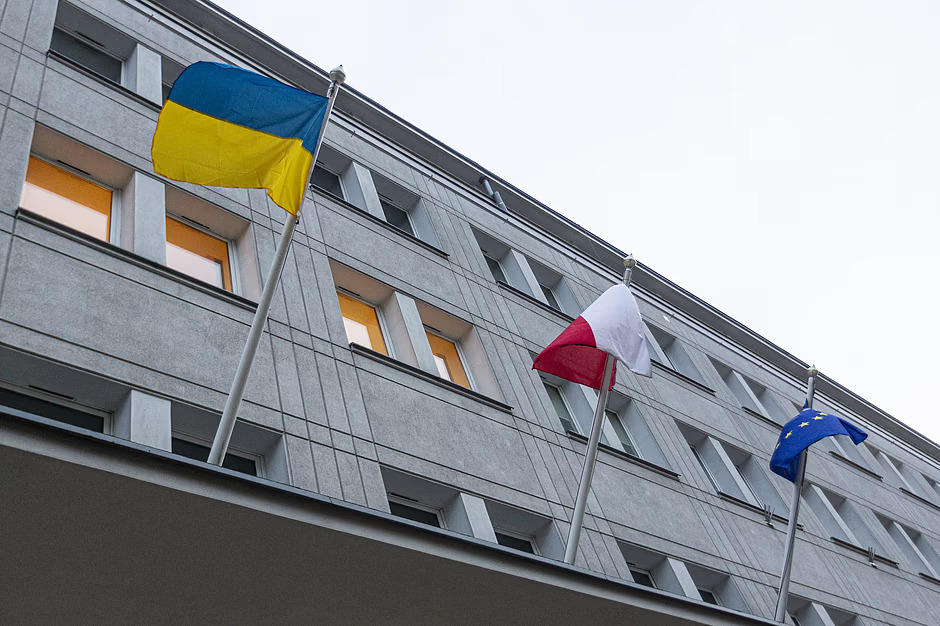
On the facade of Gdańsk City Hall at Nowe Ogrody, the Ukrainian flag has been hanging for almost four years now—next to the Polish and EU flags. It was hung there on 24 February 2022, the day of the Russian invasion, as a gesture of solidarity with a country that found itself at war that same day. It was meant to be something temporary. Four years later, the flag is still there, and one of the sharper local rows of recent months has grown up around it.
Currently from the session of the Gdańsk City Council


Given that at the time of making the material available it is 27 August, we are providing ongoing updates on the events from the 29th session of the Gdańsk City Council.
This is what the chair of the Law and Justice club said about the appeal during the club’s statement:
As the Law and Justice club, we will not support this appeal. Not because we have doubts about violence and hatred—we are against them, toward every person. Without exception. And that is obvious. […] But this appeal should be symmetrical. […]
On behalf of the applicant, i.e. the All for Gdańsk club, the appeal was presented by Councillor Marcin Makowski.
During the vote on print no. 820, the council adopted an appeal on counteracting hatred and discrimination on the grounds of nationality or origin, and on strengthening security and mutual respect in the Gdańsk community (24 votes in favor, 6 against). Councillors from Law and Justice voted against this resolution.
Right after the vote, Councillor Jolanta Banach presented a letter of thanks from Ms Svitlana Krysa, the Consul General of Ukraine in Gdańsk, for the support and assistance provided to Ukraine and to Ukrainian men and women, for, as she put it, “the entire city council, for all councillors, without exception”.
Flashpoint: Zelensky’s decision
The renewed flare-up of the dispute was triggered by a decision taken in Kyiv. On 27 May 2026, the President of Ukraine, Volodymyr Zelensky, gave the Independent Special Operations Centre “North” of the Armed Forces of Ukraine the name “Heroes of the UPA”. The Ukrainian side explained this as a need to restore the army’s national tradition. In Poland it was received very differently—as a tribute to a formation responsible for the massacres in Volhynia and Eastern Galicia, in which, depending on estimates, from one hundred to several hundred thousand Poles were killed. Criticism came not only from the right—the decision was also condemned by Donald Tusk’s government, the Ministry of Foreign Affairs, the Ministry of National Defence, and President Karol Nawrocki called it unacceptable.
It was this decision that triggered a wave of councillors’ questions, street protests and, finally, a petition demanding that the flag be taken down from Gdańsk City Hall. The region had seen similar disputes before—in Starogard Gdański, calls to remove the flag from in front of the county office were made both by a local councillor and by Oliwia Chyła, the leader of the local New Hope structures.
Gdańsk PiS councillors enter the fray
On 2 June 2026, four councillors from the PiS group in the Gdańsk City Council — Aleksander Jankowski, Piotr Gierszewski, Tomasz Rakowski and Kazimierz Koralewski — submitted an interpellation to Mayor Aleksandra Dulkiewicz demanding the removal of Ukrainian flags and state symbols from all facilities belonging to the city. In their justification, they called Zelensky’s decision “shameful” and demanded that Ukrainian symbols disappear from Gdańsk’s public space until it is withdrawn. A few days earlier, another trio of PiS councillors — Andrzej Skiba, Barbara Imianowska and Przemysław Majewski — had announced a similar step, asking outright whether Gdańsk, like Lublin, would take down Ukrainian flags from offices. “Everything has its limits,” Skiba wrote at the time on social media.
City Hall’s response was unequivocal: the flags will stay where they are. In official statements, the office emphasized that they are a symbol of support for a nation defending itself against Russian aggression, and that nothing will change in this matter.
Crown supporters with a ladder
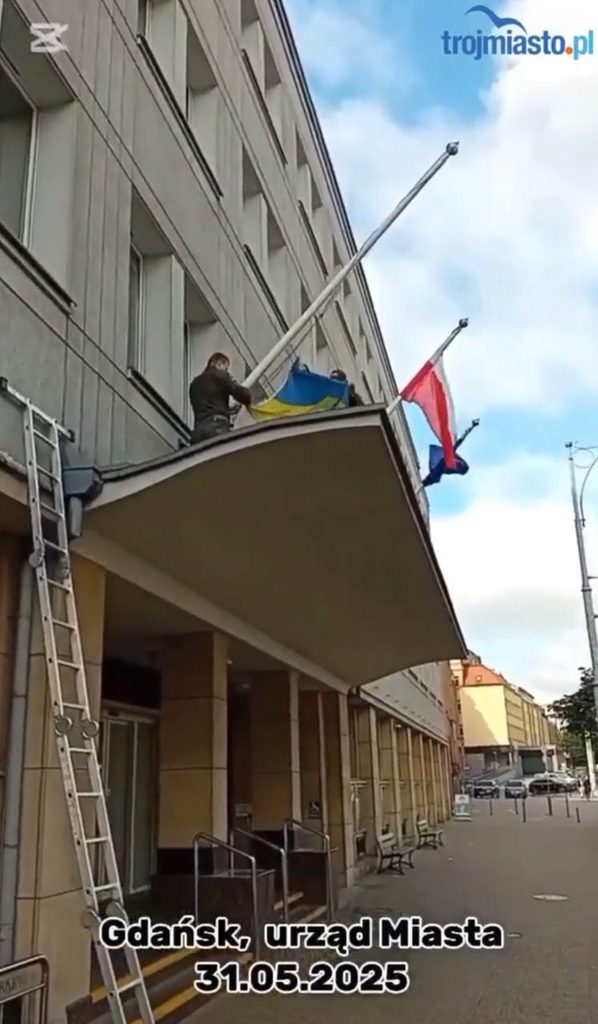
The Ukrainian flag taken down from the Gdańsk City Hall. And hung up again. Footage from trojmiasto.pl.
It was not the interpellations, however, but an event from a year earlier that truly gave the matter momentum. Early in the morning of 31 May 2025, four men associated with the Confederation of the Polish Crown appeared outside City Hall on Nowe Ogrody. Two of them set an aluminum ladder in place, climbed onto the canopy above the building entrance, and pulled down the Ukrainian flag from there. Folded into a neat square, they handed it to a City Hall employee standing nearby, who — as local media reported — watched the whole time what was happening; someone recorded the entire incident, in fact. “We do not agree for the flag of a foreign state to hang on a Polish office,” they explained to witnesses. Later that same day, officials hung the flag back up and reported the matter to the police.
Konrad Niżnik, head of the Gdynia–Słupsk district of KKP and a member of the party’s national council, told Trojmiasto.pl at the time that his milieu has been repeating the same thing for three years: hanging Ukrainian flags on Polish public offices has no legal basis whatsoever. He counted this among manifestations of the “Ukrainisation of Poland” — alongside the earlier honoring by President Andrzej Duda of Ukrainian generals, or ideas to introduce Ukrainian as an optional second foreign language in schools.
Marches, protests and Migawski’s petition
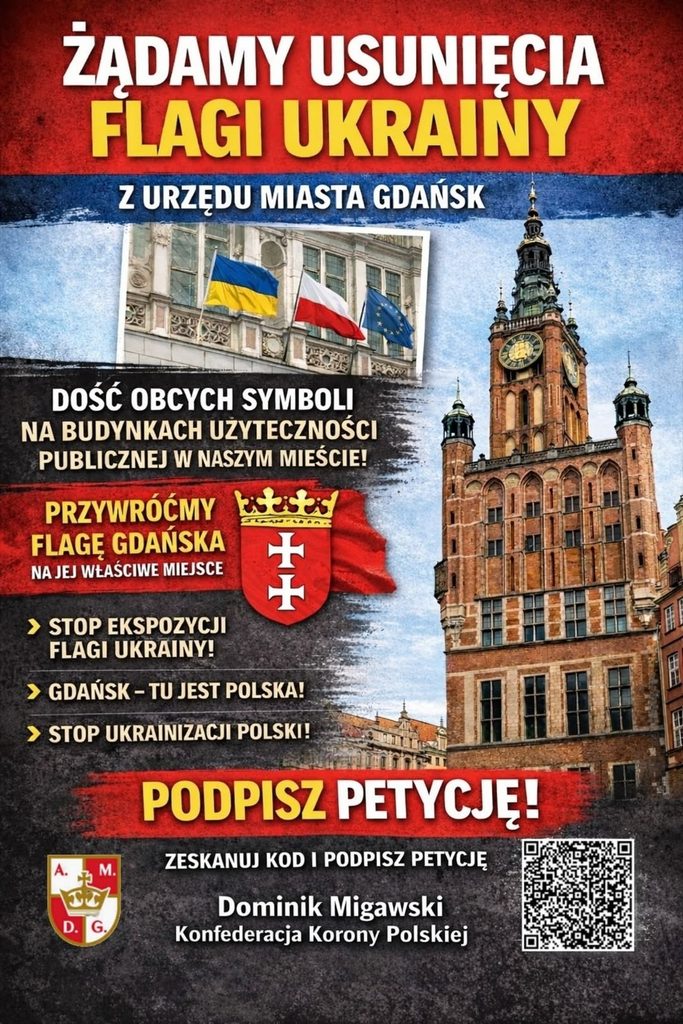
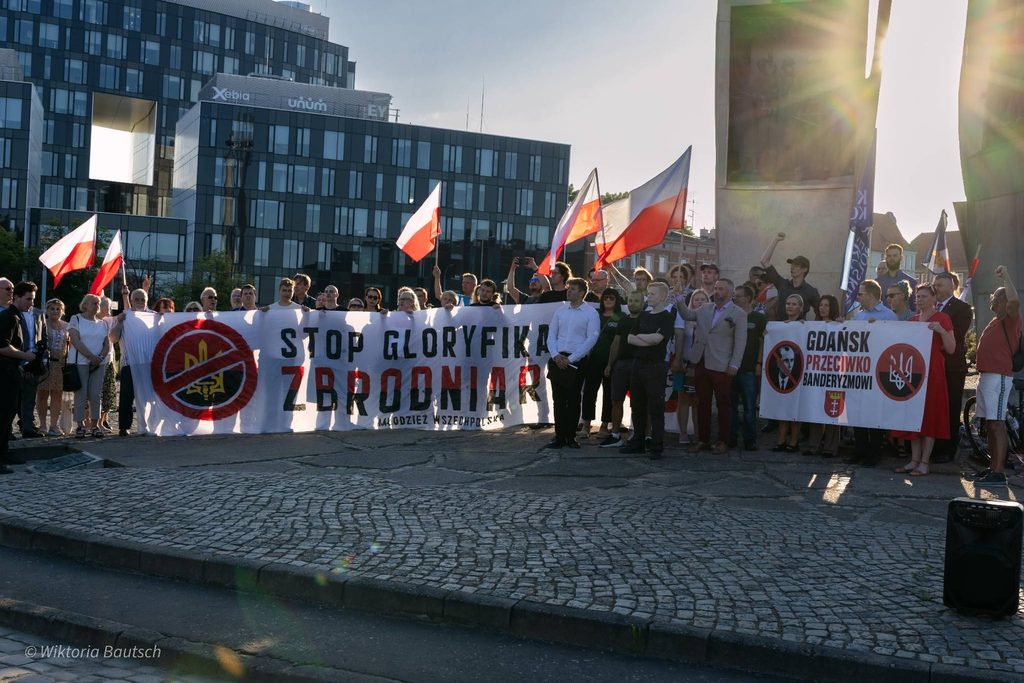
In spring and summer 2026, the dispute moved from offices onto the streets. On 25 June, as a two-day international Conference on the Reconstruction of Ukraine was starting in Gdańsk, the city saw two protests organized by nationalist circles. In the morning, participants in the action “Volhynia we remember. Protest against the Banderisation of Ukraine”, initiated by the Łączy nas Polska foundation, linked to regional assembly councilor Natalia Nitek-Płażyńska, gathered at Targ Rybny. In the evening, at Solidarność Square by the Monument to the Three Crosses, several dozen people took part in the demonstration “Gdańsk against Banderism”, organized by Dominik Migawski of KKP. Participants were handed leaflets with a petition to take the flag down from City Hall; the main slogan of the entire event was “Not for revenge, but for remembrance.”
This was Migawski, a local activist of the Confederation of the Polish Crown, who became the face of the campaign against the presence of the Ukrainian flag at Gdańsk City Hall. Interestingly, the whole matter did not begin at all with Zelensky’s May decision—the first posts encouraging people to sign the petition appeared on his profile as early as February, on the occasion of the fourth anniversary of the outbreak of the war, when the original collection deadline was set for early March, with the proviso that it could be extended. At the time, Migawski criticized the city, which—in his view—on the one hand cannot cope with basic matters such as snow removal from streets, and on the other is preparing several-day, lavish celebrations of the anniversary of the war in Ukraine. The collection deadline was then moved several times, until it was ultimately set for 31 July 2026—already after the matter had been reignited by Zelensky’s decision regarding the UPA.
In the formal text of the petition posted on Petycjeonline.com, addressed to Mayor Dulkiewicz, it demanded that the permanent display of the Ukrainian flag be discontinued and that the Gdańsk flag be restored in its place—in line, as the author emphasized, with the practice from before 2024. The justification referred, among other things, to the lack of a city council resolution on the matter, the principle of legality from Article 7 of the Constitution, the need to maintain the office’s neutrality toward all residents, and unresolved historical disputes surrounding Volhynia. In Facebook posts accompanying the petition, Migawski assured that his objection was not directed at Ukrainians as a nation, but at the policies of the authorities in Kyiv, who—as he wrote—surround the perpetrators of the Volhynia massacre with a cult of reverence.
The signature-collection deadline ultimately passed at the end of July. Migawski announced its closure, stating that the result had exceeded the 2,500-signature threshold required to submit a petition—without indicating the exact number. It is worth noting that the form on Petycjeonline.com itself, at the moment it was closed by the author, showed 1,652 signatures collected electronically. The difference between that number and the declared surpassing of the 2,500 threshold suggests that the final result also included signatures collected in the traditional way, on paper—for instance during the aforementioned demonstrations on the streets of Gdańsk.
The petition as part of a larger story
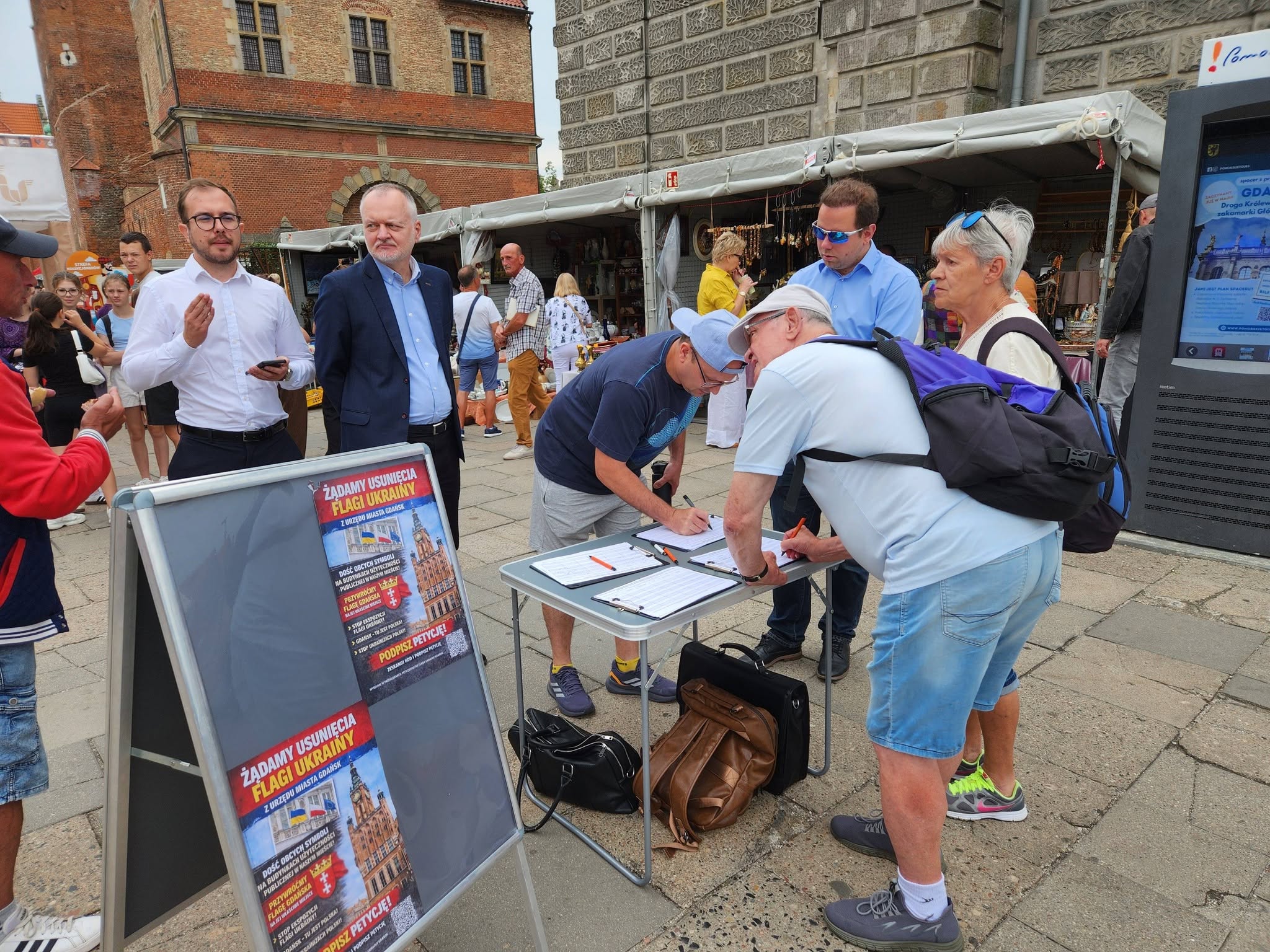
It is worth looking at Migawski’s campaign a bit more broadly, because the petition itself was, in his messaging, only one thread in a much more extensive narrative. In subsequent Facebook posts, he linked the flag issue with a whole set of allegations against Ukraine’s policy and the Polish authorities’ policy toward it. He described, among other things, an incident at one of Sopot’s high schools where, as he claimed, the Ukraine logo was supposed to have been hanging in a classroom next to the Polish coat of arms; he called it “indoctrination of young people.” In a similar tone, he used the terms “Ukropol” and “Ukropolin,” suggesting the existence of a plan to gradually erase Polish national identity—rhetoric also present in the petition’s text itself, where these formulations also appear.
Migawski also emphasized that KKP had warned about what it called the “Ukrainization of Poland” long before the topic entered the mainstream of the debate—he cited a brochure published by the group in 2022 and the “five points for Ukrainians” staying in Poland, presented two years later. In another post, published on the occasion of the government Conference on the Reconstruction of Ukraine in June, he compared that event with heating system failures and water problems in Gdańsk, claiming that the authorities had focused on rebuilding the neighboring country instead of patching holes in their own infrastructure. The post ended with the slogan “STOP the Ukrainization of Poland.” Some of this content Migawski published with a referral to the friendly portal Wbijamszpile.pl, which regularly reported on his activities.
These threads—the school incident, municipal spending, geopolitical warnings—are not part of the petition itself or the formal demands addressed to Mayor Dulkiewicz. They do, however, form an important backdrop to the entire campaign: it was precisely thanks to a fairly intense presence on social media that the issue of the flag on Gdańsk City Hall gained publicity going beyond the petition’s content itself.
Right-wing front: from the Confederation to youth organizations
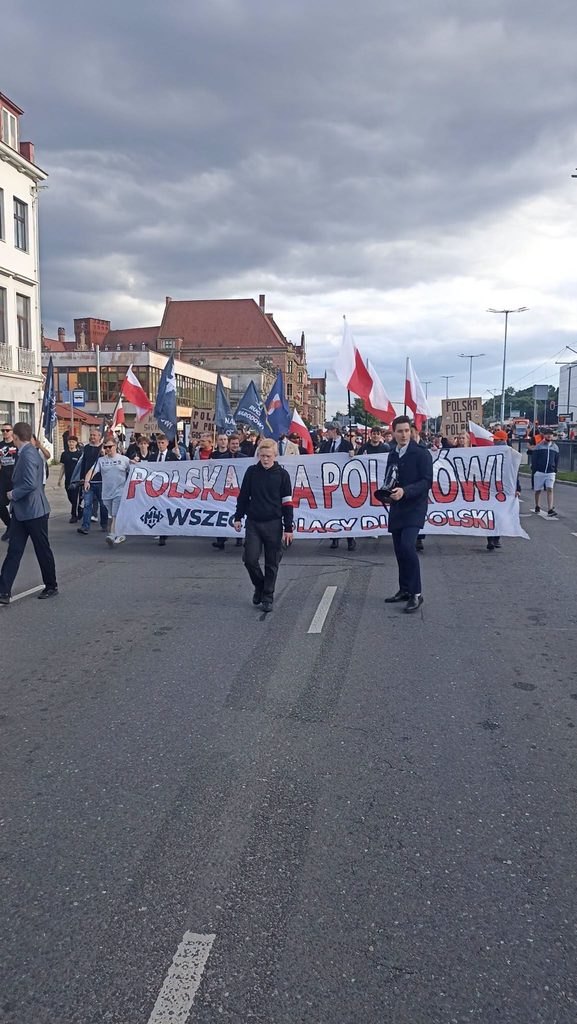
The issue of the flag on the city hall has for months been uniting a broad spectrum of right-wing and nationalist circles in the Tri-City. Besides KKP and the PiS councillors’ club, the structures of the National Movement, New Hope, All-Polish Youth, as well as smaller, more loosely organised groups calling themselves the March for Freedom, also speak out on it regularly. The individual circles differ in methods and rhetoric—Confederation of the Polish Crown focuses on spectacular direct actions such as taking the flag down from a ladder; PiS acts through interpellations in the city council; nationalist youth groups are involved mainly in organising and providing the setting for street demonstrations—but they are united by a common belief: the permanent presence of Ukrainian colours on the building of a Polish public office has ceased to be a gesture of solidarity and has become, as the authors of the petition put it, a “political demonstration” and a symbol of something they call the “Ukrainianisation” of Polish public space.
It is worth adding that for months the same circles have also been involved in related actions—from demands to remove the Ukrainian flag from Kościuszko Mound in Kraków, through opposition to transporting the ashes of Stepan Bandera through Poland, to organising the Volhynia March in Gdynia in July 2026. The dispute over the flag above Gdańsk City Hall is therefore a local manifestation of a much broader conflict, taking place in parallel in many Polish cities.
A response from the other side: an appeal by the Everything for Gdańsk club
At the turn of July and August 2026, tensions around the issue ceased to be merely a dispute over symbols. On Sunday, a few days before mid-August, the “Don’t Be Indifferent” march went through the streets of Gdańsk—part of a nationwide series of events drawing attention to the growing hostility toward Ukrainians living in Poland. That same day, several kilometers away in Sopot, an attack took place on the family of one of the participants in the Gdańsk protest; the attacker, it was reported, was a resident of Poland.
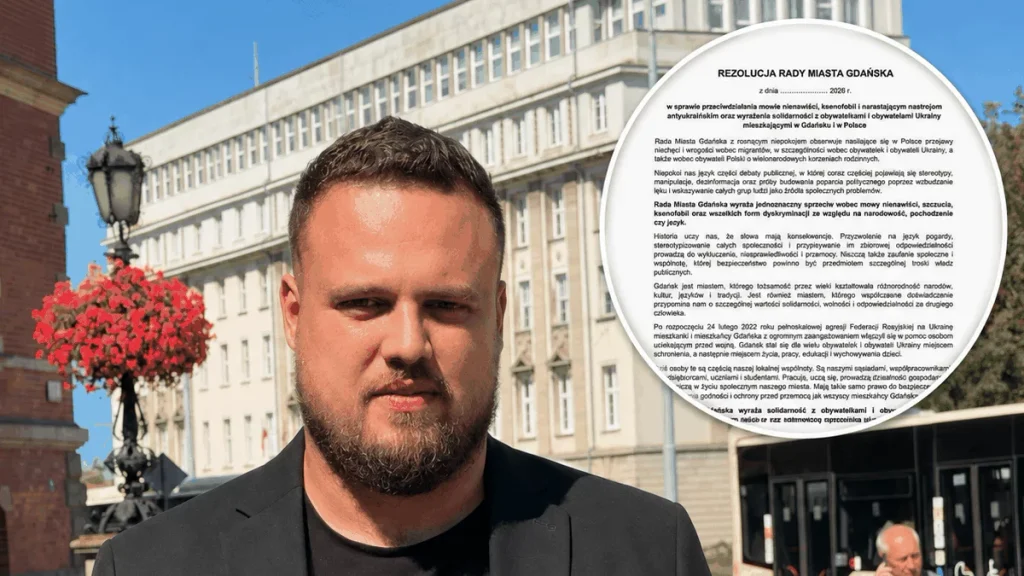
This incident became a direct impetus for councillors from the Everything for Gdańsk club, who announced that they would prepare a resolution opposing hate speech against Ukrainians. Councillor Marcin Makowski, the author of the draft, told reporters at PulsGdanska.pl that for some time now, in the public sphere—including the media—there has been a clear witch-hunt against people from other cultural backgrounds, above all Ukrainians now living in Gdańsk. He recalled that the attack in Sopot affected the family of one of his acquaintances—his friend’s wife and daughter were attacked by a resident of Poland, precisely at the moment when the march against indifference was underway in Gdańsk.
The draft resolution contains an explicitly stated objection to hate speech, xenophobia, and all forms of discrimination on the grounds of nationality, origin, or language. The document also notes that after February 2022 it was Gdańsk that became for many refugees from Ukraine a place of shelter, work, and education. Makowski emphasized that the problem must be addressed on several levels at once—both through the attitudes of ordinary residents and through the response of public authorities at every level. The club’s councillors wanted the resolution to be adopted as quickly as possible, still in August, at today’s session scheduled for 27 August 2026; at the same time, they announced that they were counting on the support of all groups on the council.
Asked whether the August initiative is not a form of retaliation for the June resolution—also adopted unanimously—by the PiS club criticizing Zelensky’s decision regarding the UPA, Makowski replied that it is not about revenge but about a response to genuinely growing anti-Ukrainian sentiments in the public sphere. He said he wants Ukrainians living in Gdańsk to feel safe.
Two resolutions, one city
Whether the unanimity of the Gdańsk council on Ukrainian matters, declared in June, will be repeated today, 27 August—this time in the vote on a resolution against hatred—remained an open question at the time of writing. Over the course of a single summer, Gdańsk has become the arena of two parallel, in fact opposing, legislative initiatives: one critical of Kyiv, calling for the removal of Ukrainian symbols from the public space, and another intended to protect Ukrainians living in the city from growing hostility.
The flag above the entrance to City Hall on Nowe Ogrody is still hanging in its place—where it was hung four years ago, in the first hours of the war.
