

After 2022, military cooperation between Russia and Iran clearly deepened. Its most visible element became Russia’s use of Iranian Shahed-131 and Shahed-136 unmanned aerial vehicles in the war against Ukraine. Next, Moscow launched production of these designs on its own territory and began modernizing them based on combat experience.
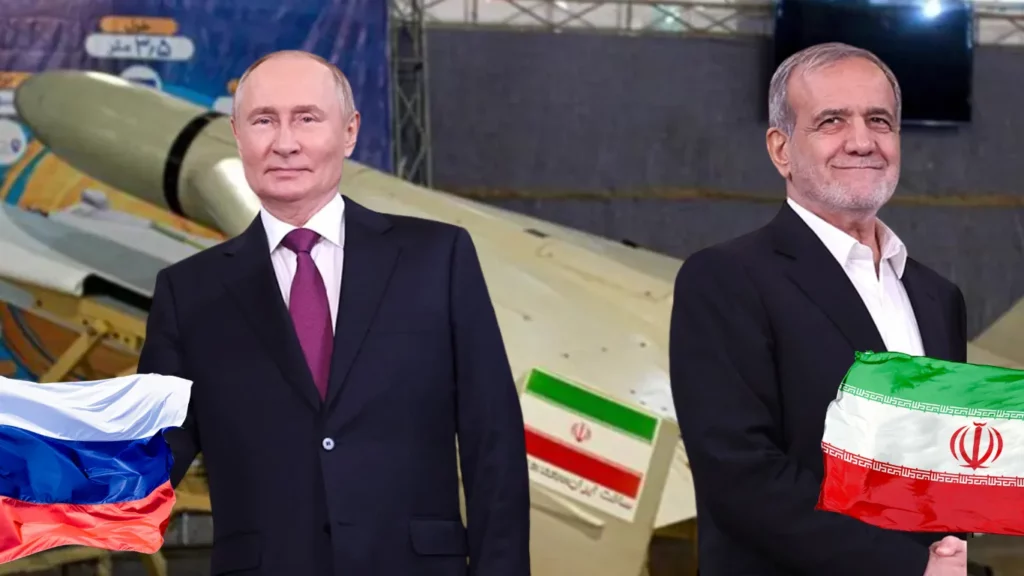


In 2026, there were also indications that during Iran’s campaign in the Persian Gulf region, a Russian variant, the Geran-2, may have been used. However, this is not sufficient evidence of a broad and systematic transfer of Russian drone technology to Iran.
Author’s analysis: the most important change is not merely the increase in the number of unmanned aerial vehicles. More significant is the emergence of a cooperation model that combines the transfer of designs, localization of production, testing weapons in a real war, rapid modifications, and scaling up industrial capabilities.
From the Iranian Shahed to the Russian Geran
According to CSIS, following contacts between Russian representatives and Iran in 2022, deliveries of Shahed-131 and Shahed-136 were agreed. In Russia they received the designations Geran-1 and Geran-2. The next stage was localization of production in the Alabuga special economic zone in Tatarstan.
CSIS, based on satellite imagery and open-source data, assesses that the plant in Alabuga was significantly expanded and in 2026 could have reached a production capacity of more than 5,500 unmanned aerial vehicles per month. This is an analytical estimate rather than an official Russian statistic, so this figure should be treated as an approximation.
Source: CSIS – A Closer Look at the Yelabuga UAV Factory
Russia has changed, among other things, navigation and communications systems, propulsion, payload, and the way the Gerans are employed. The solutions are tested on the battlefield, and effective modifications can be quickly implemented in subsequent production batches.
Source: CSIS – Shahed to Geran: How Russia Continues to Reinvent the One-Way Attack Drone
War as a development laboratory
CSIS indicates that the pace of changes in Russia’s Geran program is measured in weeks rather than years. This means that operators’ experience can quickly feed into the design and production process, and successive variants of the system are tested under combat conditions.
Source: CSIS – Shahed to Geran: How Russia Continues to Reinvent the One-Way Attack Drone
Author’s analysis: for Iran, the value of Russian experience does not have to mean transferring every new Geran modification. Tehran can, however, observe which solutions prove useful in operations against modern air defense and electronic warfare assets. This applies to resistance to navigation jamming, flight profiles, the use of large numbers of drones simultaneously, and responding to new interception methods.
The economics of mass attacks
The war in Ukraine has shown the economic dimension of using unmanned systems. RUSI notes that the mass use of relatively cheap Gerans can force air defenses to use much more expensive interceptors. As a result, the importance of cheaper and mass-producible methods of countering drones increases.
Source: RUSI – Octopus Adds an Additional Layer to Ukraine’s Air Defences
Ukrainian experience includes the use of acoustic sensors, mobile observation and fire teams, a digital air situational picture, electronic warfare assets, and interceptor drones.
Source: RUSI – Octopus Adds an Additional Layer to Ukraine’s Air Defences
Author’s analysis: the effectiveness of mass attacks depends not only on the parameters of a single drone. Unit price, production rate, the ability to quickly replenish losses, and the ability to adapt the system to the opponent’s actions are equally important.
Is the cooperation becoming more reciprocal?
In March 2026, CSIS described a case that could indicate a more reciprocal nature of Russian-Iranian cooperation. An analysis of debris and video materials suggested that during Iran’s retaliatory campaign in the Persian Gulf region, a Russian Geran-2 may have been used. The serial markings were said to point to the Kupol plant in Izhevsk, and the navigation equipment—to the Russian, jamming-resistant Kometa-M system.
Source: CSIS – Unpacking Iran’s Drone Campaign in the Gulf
Fact: publicly available data do not confirm the existence of a full and systematic mechanism for transferring Russian drone technology to Iran.
Author’s analysis: if the described case is confirmed, it may indicate a flow of solutions in the direction opposite to the initial deliveries of Shahed drones from Iran to Russia. More important than the transfer of individual components, however, may be a broader transfer of knowledge concerning production, employment tactics, and upgrading of unmanned systems.
Strategic partnership and Europe’s security
On 17 January 2025, Vladimir Putin and Masoud Pezeshkian signed a treaty on a comprehensive strategic partnership between Russia and Iran. The document also covers cooperation in the field of security and defense.
Source: Ministry of Foreign Affairs of the Russian Federation
Fact: the treaty does not establish an automatic mutual-defense mechanism comparable to NATO Article 5. It therefore should not be interpreted as an equivalent of NATO’s military alliance.
Russian unmanned capabilities matter beyond Ukraine as well. On the night of September 9–10, 2025, Polish authorities reported a violation of Polish airspace by Russian drones. The Ministry of Foreign Affairs stated that 19 objects crossed the border.
Source: Ministry of Foreign Affairs of the Republic of Poland
Poland’s Ministry of the Interior and Administration subsequently reported that at least 19 objects were detected, 16 of which were found.
Source: Ministry of the Interior and Administration
Fact: the incident in Poland does not directly prove a link to Iranian-Russian drone cooperation. It does show, however, that Russian capabilities developed during the war can directly affect the security of NATO states.
On September 12, 2025, NATO launched Eastern Sentry to strengthen the eastern flank. The initiative included both traditional military capabilities and technologies intended to counter drones.
Source: NATO – Eastern Sentry
Conclusions
The best-documented element of Russia-Iran cooperation after 2022 is the development of Russia’s Geran program: adopting the Iranian design, starting production in Russia, and gradually adapting it to the realities of war.
Sources: CSIS – A Closer Look at the Yelabuga UAV Factory; CSIS – Shahed to Geran: How Russia Continues to Reinvent the One-Way Attack Drone
The transfer of Russian technology to Iran is documented far less clearly. The possible use of the Geran-2 in Iran’s campaign in 2026 is an important indication, but it does not allow the scale or durability of such cooperation to be determined.
Source: CSIS – Unpacking Iran’s Drone Campaign in the Gulf
Author’s analysis: Europe should treat the drone threat not only as a technological issue, but also as an industrial, economic, and organizational one. Effective defense requires a layered system for detection and interception, electronic warfare capabilities, adequate stockpiles, and the ability to rapidly modernize and scale up production.
Source: CSIS / RUSI / Ministry of the Interior and Administration / Ministry of Foreign Affairs of the Russian Federation

Historian, ethnographer, and social media specialist. She has many years of experience developing YouTube channels, helping experts and businesses build their online presence. She has conducted academic research in ethnopsychology and ethnopedagogy in Galicia and the Northern Black Sea region. Her interests include the history of Ukraine and Europe, Polish-Ukrainian relations, and ethno-national and intercultural issues.
What do you think about this story?
Join the conversation. Please keep comments relevant to the article.
Write a comment