



Poles, like many other nations, know very little about history. Whether it’s general history or that of their own nation. The worst offenders in Poland are the right-wing, who exclusively discuss the Volhynian Massacre and Russia’s alleged rights to Ukraine. It’s astonishing how easily they equate these two narratives. Sometimes it’s difficult to read these idiocies; please forgive the language used. These are still the weakest descriptions that should be used to describe the right-wingers of both Confederations. It’s worth asking them: Since when does an occupier have any rights?
The history of Ukrainian in Soviet education is a tale of a dramatic shift: from a brief period of prosperity in the 1920s to its systematic displacement by Russian in the following decades. This was a deeply political process – schools and universities became one of the main instruments for shaping loyalty to the state. At the same time, however, despite pressure, there was constant – though often muted – resistance to Russification. Independent literature in Ukrainian was published, smuggled in from the West, especially from Canada. Interestingly, this resistance gained momentum in the 1980s, when news of the Polish rebellion reached Ukraine.
The uprising in defense of Anna Walentynowicz – a Polish woman of Ukrainian descent. The legend of this workers’ patriotic rebellion was heard throughout the Soviet Union. It was not without reason that the repercussions of these events were feared. Polish Fighting Solidarity established contacts with Ukrainians and, through trusted railway workers, sent leaflets there. And in 1981, at the congress of the Independent Self-Governing Trade Union “Solidarity,” the “Message of the 1st National Congress of Delegates of NSZZ “Solidarity” to the Working People of Eastern Europe” was adopted. Throughout the existence of legal Solidarity, until its dissolution on December 13, 1981, the Soviet Union confiscated all press published in Poland at the border. Even communist ones. But to the point.
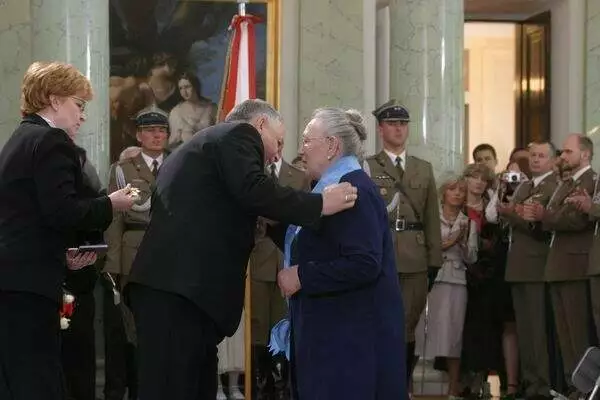
President Lech Kaczyński awards Anna Walentynowicz the Order of the White Eagle – the highest Polish decoration. Link Source: Wikimedia Commons.
The 1920s: Education as a Tool for Nation Building
In the first decade after the founding of the USSR, the Bolsheviks pursued a policy of so-called “Korenization” among the conquered nations, the Ukrainian version of which was Ukrainization. As part of this policy, the Ukrainian language was introduced into schools, administration, and – gradually – universities. This fulfilled promises made during the war and was intended to attract some of the conquered nations to the communist side. Their opponents, the Tsar’s supporters, could not afford even a propaganda gesture, thus gaining significant support.
The effects of this policy were clearly visible. By the mid-1920s, most primary schools taught in Ukrainian, and by the end of the decade, this figure had reached nearly 90%. Simultaneously, the presence of Ukrainian in universities grew. Russian had dominated at the beginning of the decade, but over time, more and more lectures began to be conducted in the vernacular. It’s important to remember that this was emerging from a period of complete Russification, where Ukrainian was restricted to rural areas.
This was not a spontaneous process, however. It was the result of the efforts of an entire generation of Ukrainian intellectuals and cultural activists, such as Mykola Khvylovy, who called for a “departure from Moscow” in the cultural sphere. In the 1920s, Ukraine experienced something of a national revival, with language as its foundation and schooling its primary tool.
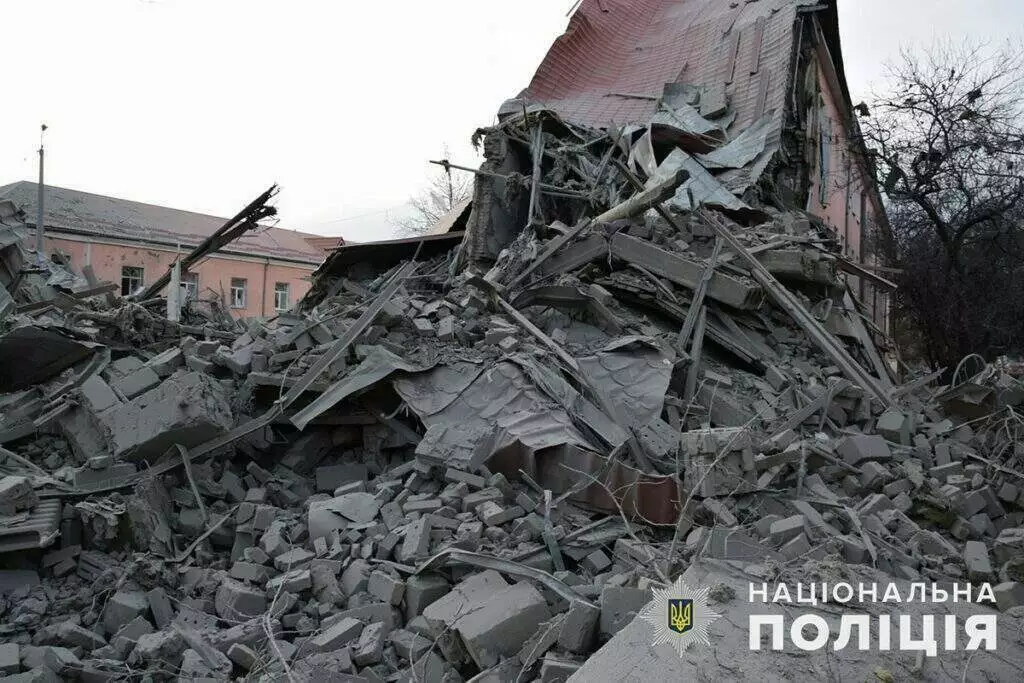
The school in Kramatorsk destroyed by the Russians Link Source: Wikimedia Commons
1930s. The return of Russification.
This development was brutally interrupted in the early 1930s, during the rule of Joseph Stalin. The policy of Ukrainization was deemed a threat to the unity of the state.
The following have started:
- purges among teachers and scientists
- liquidation of Ukrainian educational institutions
- the return of Russian as the dominant language
The symbolic end of the era was the fate of Khvylovy himself, who committed suicide in 1933 after a wave of repression. From that moment on, the Ukrainian language ceased to be a tool for development – it became a political problem.
Soviet School: Russification through “Utility”
In the following decades, Russification no longer involved open prohibitions (as in the 19th century), but rather more subtle mechanisms.
In primary and secondary education:
- Ukrainian-language schools were formally maintained
- in practice, Russian was promoted as a language:
- social advancement
- science and technology
- urban life
This was particularly evident in cities. In the 1970s and 1980s, the vast majority of schools in many major Ukrainian centers taught in Russian. Ukrainian remained the language of rural areas and lower levels of education. The 1958 educational reform played a key role, formally giving parents the “choice of language of instruction.” In reality, this choice was illusory – the system rewarded Russian-language schools, while Ukrainian schools gradually lost prestige.
Universities: complete domination of Russian
The process of Russification was even more visible in higher education.
While Ukrainian was gaining ground in the 1920s, the situation reversed completely from the 1950s onward. Universities and technical institutes became almost exclusively Russian-language.
The reasons were systemic:
- Russian was the language of scientific publications in the USSR
- enabled a career in all-Soviet structures
- was a tool for the integration of elites
As a result, due to ruthless state policies, by the late 1980s only a small percentage of students studied in Ukrainian. The national language was relegated to the margins of academic life.
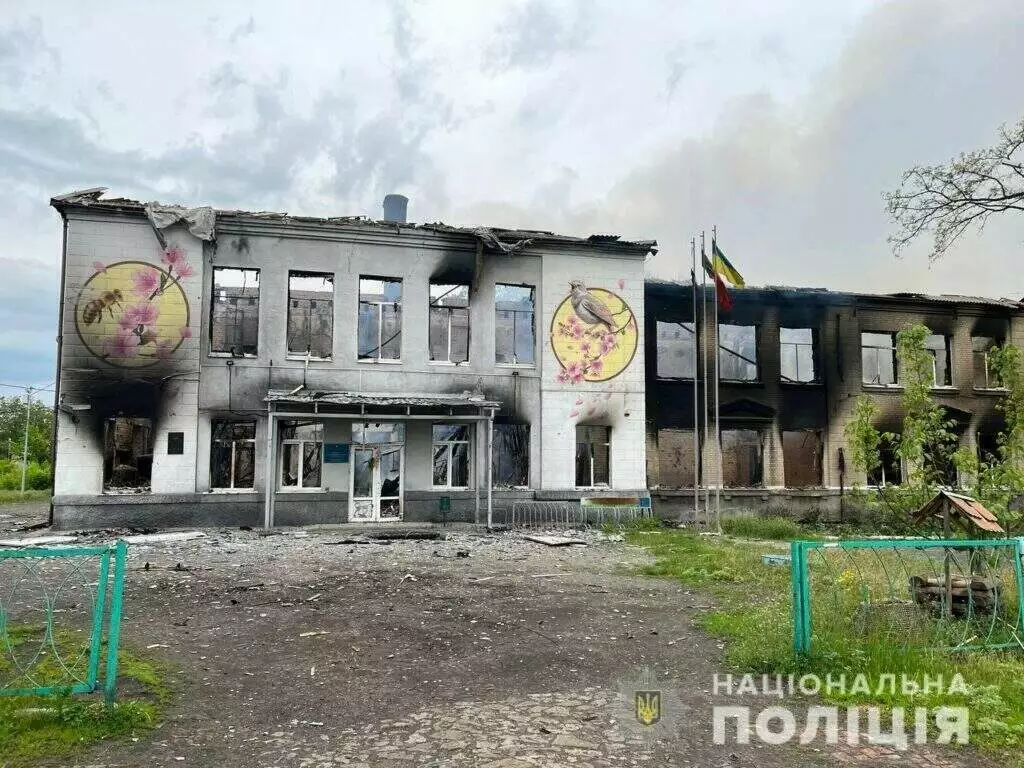
A school in Avdiyevka bombed by the Russians. Link Source: Wikimedia Commons
Resistance: Defending Language as a Defense of Dignity
Despite this pressure, resistance to Russification never faded. It took various forms, from intellectual activity to outright opposition. Many intellectuals and ordinary people sought to fight for their language..
One of the most important figures was Ivan Dziuba, author of the renowned work “Internationalism or Russification?” (1965). In his analysis, he demonstrated that Soviet policies were effectively leading to the denationalization of Ukrainians. Since there was no chance of legally publishing this essay, the author decided to have it illegally printed in an underground samizdat. Published in a limited number of copies, mostly by typewriter, it rapidly spread throughout Ukraine and was smuggled to the West, where it was published as a book. For this essay, Dziuba was sentenced to five years in a labor camp and five years of exile. But the word spread and was read like gospel.
Another symbol of resistance was Vasyl Stus, a poet and political prisoner who defended the right to use the Ukrainian language and paid for it with his life in a labor camp. He published poems and articles exclusively in Ukrainian, for which he was persecuted. First, he was fired, then he was given a job significantly below his qualifications as a philosopher and philologist—he was an ordinary laborer. Unable to publish officially, he wrote for samizdat (illegal magazines, leaflets, and newspapers), for which he was convicted twice. He spent the years 1972-85 in prison. He died while serving his sentence. Punishments for the Ukrainian language.
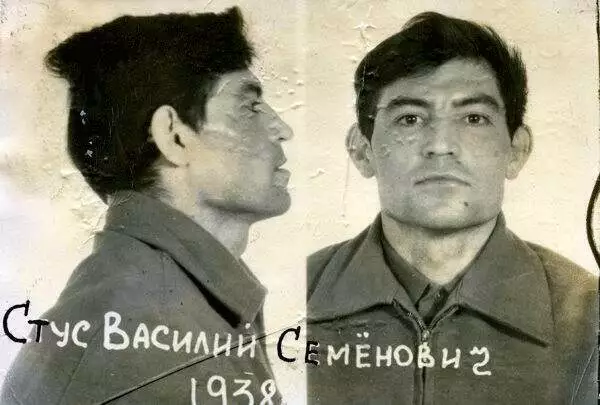
Vasyl Stus, photo taken by the KGB in prison. Link Source: Wikimedia Commons
Another important event was the premiere of the film Shadows of Forgotten Ancestors, directed by Sergei Parajanov. During the screening in Kyiv, a public protest against the repression of the Ukrainian intelligentsia took place – one of the first open acts of defiance against the system. The person who initiated the rebellion in the cinema was the aforementioned Vasyl Stus.
Resistance also had an everyday dimension:
- teachers secretly used Ukrainian
- families passed on the language to children outside of school
- Intellectuals created the “second circulation” of the so-called samizdat culture.
The 1980s: the system in decline
By the end of the USSR, Ukraine’s educational system had become deeply Russified, especially in cities and at the higher education level. At the same time, however, national consciousness was growing.
During the perestroika period, initiatives for the revival of the language began to emerge:
- social movements demanding its reinstatement in schools
- the activities of organizations such as the People’s Movement of Ukraine
It was then that the Ukrainian language once again became a symbol not only of culture, but also of political independence.
The table below shows the number of Ukrainian-language schools in the 1920s and 1980s.
Primary and secondary schools
| Period | Ukrainian | Russian |
|---|---|---|
| 1920s | ~80–90% | ~10–20% |
| 1970s–1980s (average) | ~55–60% | ~40–45% |
| cities (70s–80s) | ~0–30% | ~70–100% |
Universities
| Period | Dominant language |
|---|---|
| 1920s | Ukrainian (rising to ~70%) |
| 1980s | Russian (dominant up to 90%, Ukrainian marginal) |
How to read it?
The history of Ukrainian education in the USSR shows a clear trajectory: from the widespread presence of Ukrainian in the 1920s, through its systematic displacement, to the almost complete dominance of Russian in the 1980s.
Schools and universities were key arenas of this struggle. It was there that decisions were made about which language would be the language of the future.
At the same time, however, this history demonstrates that even the most extensive system of state pressure cannot completely eradicate a language. Thanks to the efforts of intellectuals, teachers, and ordinary people, Ukrainian survived—and in the twilight of the USSR, it became the foundation for the rebirth of an independent state.



What do you think about this story?
Join the conversation. Please keep comments relevant to the article.
Write a comment