

The following text is the author’s journalistic commentary.
• Estimated reading time: 6-7 minutes


Biting in its dying stages: How the Kremlin masks its decline with a wave of online hate.
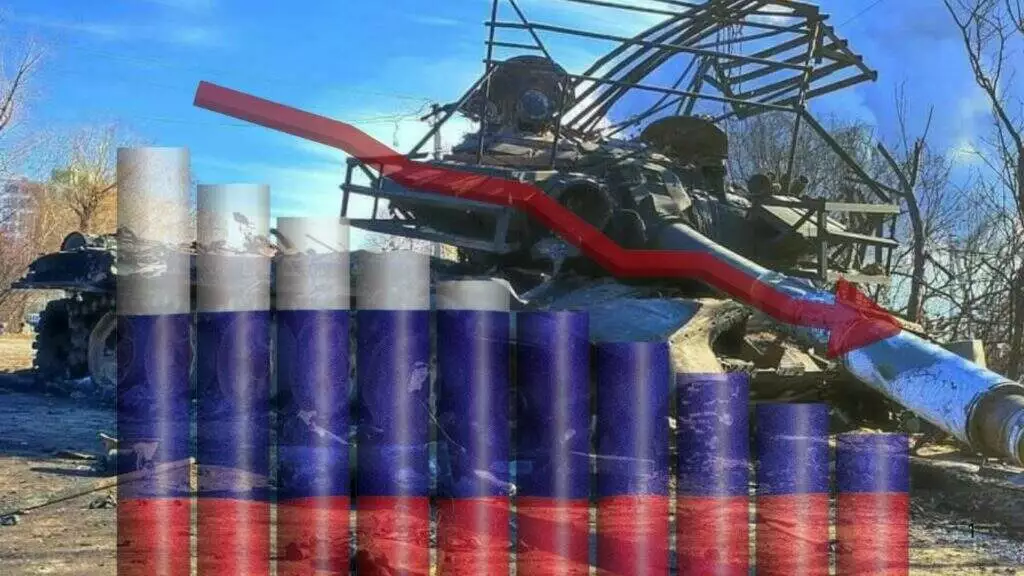
What’s the deal with Russia? Russia is falling, that’s my thesis, which I’ll allow myself to present here. Many internet users want to prove that Russia is a superpower. This is mainly the work of bots and trolls who love Moscow more than Poland. (“Online discussions often feature accounts that replicate pro-Russian narratives. It is difficult to clearly determine which of them are authentic users and which are part of an organized propaganda operation – ed.”). Even those who hate Poland for some reason known to them. They write nonsense about “Żymians”—there’s so much hatred within them that Russia exploits it. I, and people who can analyze the slippery slope this country has found itself on, are seeing more and more signs of the collapse of even the remnants of the Soviet Union. The attempt to build a state based on the whip and corruption has failed, which probably doesn’t surprise anyone. It’s a crumbling empire, biting in its dying stages. How much further it might bite is difficult to predict. That depends on the citizens of the Russian Federation in Moscow and St. Petersburg. They have a real influence on the potential level of pressure on the authorities. Putin values the opinions and sentiments of these cities.
From the Pacific to Crisis: How Russia Shrunk Before Our Eyes for a Century
Russia experienced its greatest territorial expansion at the end of the 19th century. In the west, it bordered directly with Prussia (Germany) and Austria-Hungary. In the south, it held the entire Caucasus, and in the east, it reached the Pacific Ocean coast. Along the way, it occupied Manchuria and Port Arthur in China. It also occupied the entire railway line from Changchun to Port Arthur. It was one of the colonial powers occupying China. It also wielded influence in Korea, where its troops were stationed as border guards and as “workers” for a Russian company that exploited the local forests. There was also an official military representation in Korea under the king, safeguarding Russian interests. China was weak and partially dependent on Russia. Russia’s total area in 1866 amounted to an impressive 23,700,000 square kilometers, a figure that remained unchanged until 1905.
The first signs of the empire’s fracturing appeared during the Russo-Japanese War of 1904-05, when Japan regained part of Sakhalin and forced Russia out of both Korea and Manchuria (China). This already foreshadowed the later events of this colossus. All its problems stemmed from poor management, the system implemented to control such a vast territory and a large number of conquered nations. The inefficient and corrupt system of this state caused numerous problems, including weakening the army and its capabilities. Essentially, the army triumphed solely on the strength of its mass. Where it couldn’t utilize its strength, it suffered defeats – as in Crimea half a century earlier. Although Crimea remained part of the empire, the lost war signaled Russia’s failure in the industrial revolution. Industry, the resulting modernization of the army, and the military training adopted therein lagged behind the West.
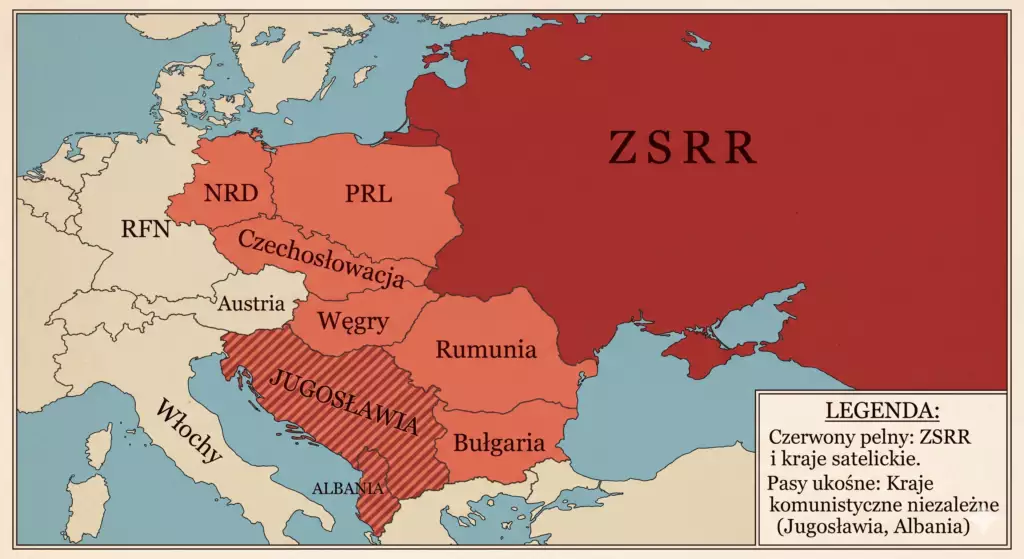
Following the war with Japan, Russia suffered further losses during World War I. Poland, Finland, Moldova, and the Baltic states were eliminated. The empire was shrinking, but it had not yet lost its strength. The country’s modernization by the Bolsheviks, a return to Russian nationalism, and collaboration with Hitler allowed it to regain some of its lost territories during World War II, and even expand its holdings to include previously unoccupied countries like Czechoslovakia, Bulgaria, Romania, and Hungary. Formally independent, they were 100% governed from Moscow, with the Russian occupation army stationed on their territories. However, this was a brief period, lasting only about 45 years.
Source – own work
36 percent of its former strength. Figures that prove the greatest catastrophe in Russian history.
These countries liberated themselves between 1989 and the collapse of the Soviet Union. We, as Poles, have credit for this. Putin hates us for removing the first brick from the Berlin Wall; without the Polish transformation, the Russian empire could still occupy many countries.
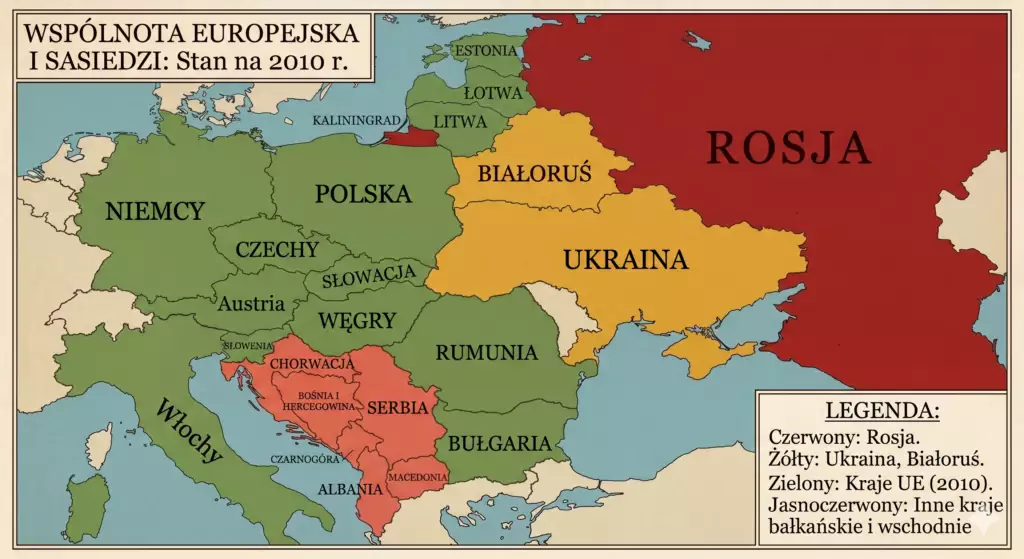
This event was Russia’s greatest downfall to date. As a result, Russia lost over 25% of its territory and more than half its population. The Soviet Union ruled over approximately 280 million citizens. If you include the non-republican countries – Poland, Czechoslovakia, Hungary, Romania, and Bulgaria – the scale of the disaster becomes even more apparent. Together with the countries subject to Russia and its armaments, approximately 400 million people worked (280 million in the USSR and 120 million in the occupied countries mentioned above). We only count European countries, as Cuba, for example, was too far away and Russia was more likely to have to support it. As you can see, Russia’s defeat is devastating, which is why Putin calls the collapse of the Soviet Union the greatest catastrophe. From ruling over 400 million people, Russia shrank its population to 146 million. To visualize this, simply calculate that this is 36.5% of its original population. This is still much more than any single European country, but not enough to take this economic and political dwarf seriously.
Source – own work
Europe’s Economic Dwarf: Russia’s GDP Compared to Poland and the West
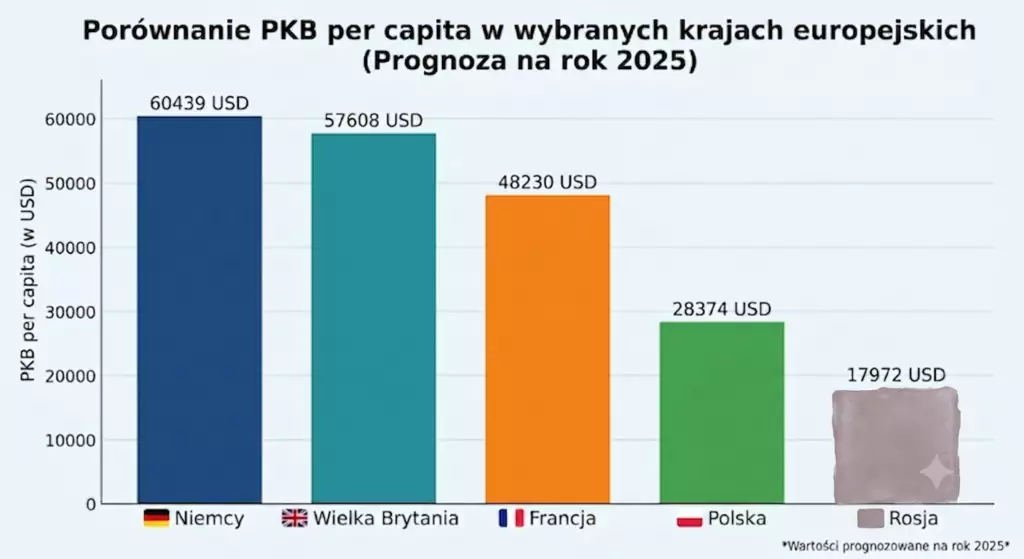
And what about economically? Economically, Russia is in an even worse situation. Despite having a head start relative to Poland (in 1989) and possessing many valuable raw material deposits (oil, gas, rare earth elements) at a much higher level, Russia has failed to capitalize on this. Russia has always directed its surplus production towards waging war – Chechnya, Georgia, meddling in Africa, Ukraine. GDP per capita data in US dollars for 2025 shows: Germany 60,439, France 48,230, Great Britain 57,608, and Poland 28,374. Compared to this, Russia pales in comparison. Its net income is $17,972. Source: Worldometer
Source: Worldometer, own study
If we look at national data on nominal, total GDP, in 2025, the German economy was worth $5.05 trillion. The French economy was $3.37 trillion, and the United Kingdom was $4 trillion. Each of these countries has a population two to four times smaller than Russia, and the economy of this supposed powerhouse amounted to $2.59 trillion. This means that a country with a population several times larger has an economy several times smaller. The situation is interesting for Poland, a country with virtually no raw materials and about four times smaller than Russia. Our GDP amounted to $1.04 trillion in the comparable year. Source: Worldometer
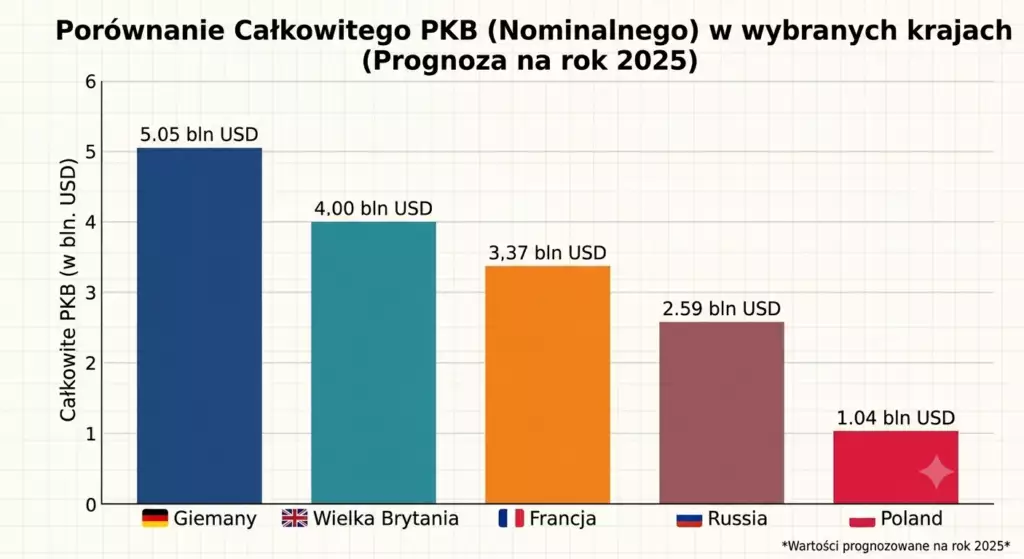
Source: Worldometer, own study
As you can see, even in a single scenario, Russia is a dwarf. If I wanted to torment this country, I’d compile a table of the European Union’s total GDP, but the disparity is so absurd that it’s pointless. It’s easy to predict what will happen to the Russian economy if EU countries continue to support Ukraine. Russia will experience another economic collapse, but much worse than the one in the 1990s. This time, Russia is fighting a full-scale war. Its economy is in war mode, and even these modest figures seem inflated and “empty.” After all, what real GDP value does producing a drone or a tank, which will end up as scrap in Ukrainian fields? Not to mention ammunition…
The only sensible conclusion is that Russia is already a country in decline, and its outbursts of rage should be viewed as such. Increasing attacks on civilian targets are merely a sting to the dying former empire. The sting is painful, but it hasn’t brought Ukraine down. This is also why we should consider the flood of trolls and bots in the comments under posts in Poland and Ukraine. Russia wants to divide us, and to some extent, it’s achieving this thanks to irresponsible Polish and Ukrainian politicians, to put it mildly.
So, my dears, wait for the end of Russia.

What do you think about this story?
Join the conversation. Please keep comments relevant to the article.
Write a comment