
National Holodomor Museum in Kyiv published official statement calling for the symbols commemorating the Holodomor victims not to be used outside their historical context. The announcement came after controversy surrounding the use of an image of a girl from the Kyiv Holodomor Victims Memorial on a poster commemorating the anniversary of the Volhynia massacre.
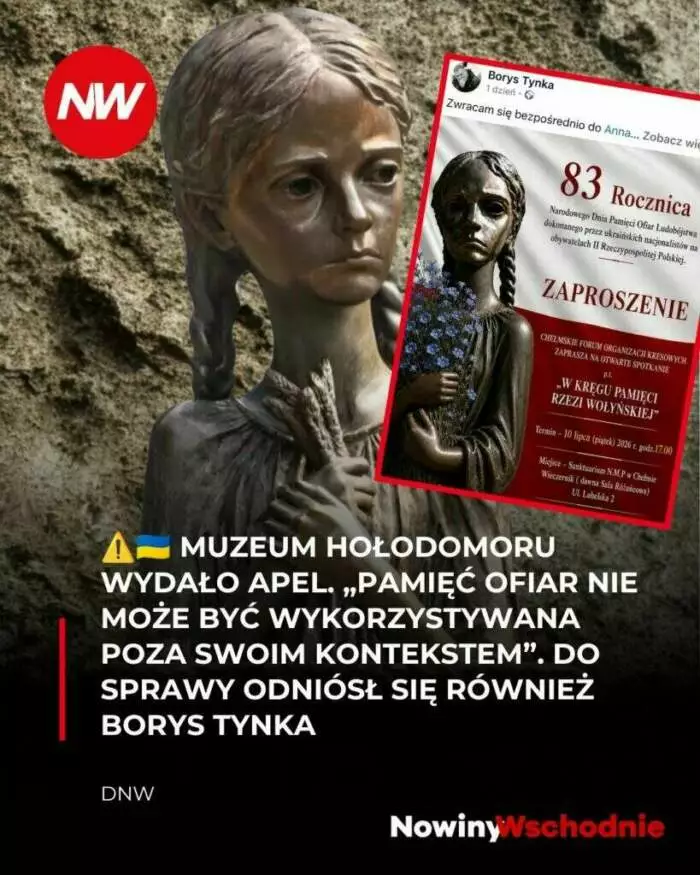


Museum emphasizedthat the monuments and their images were created solely for the purpose of commemorating the victims of the Holodomor, conducting scientific research and educational activities devoted to this crime.
According to the institution, any modification, alteration or use of these symbols in a different context distorts their meaning and shows disrespect towards the memory of the millions of victims of the Holodomor.
In its statement, the museum appealed to state institutions, social organizations, politicians, the media and all those using such materials in public spaces to refrain from using images of Holodomor memorial sites for purposes unrelated to commemorating this tragedy.
Criticism of the use of the monument
To the matter he succeeded also Boris Tynka, who criticized the use of the image of a girl from the Kyiv Holodomor Victims Memorial on a poster published by MP Anna Dąbrowska-Banaszek, promoting the celebrations related to the anniversary of the Volhynia massacre.
As he pointed out, the sculpture depicts a girl holding ears of grain – one of the most important symbols of the Holodomor. It refers to the so-called. “law of five ears of corn”, introduced by the Soviet authorities, under which even picking a few ears of corn left in the field could be punished with long prison terms or death. The ears of corn became a symbol of the deprivation of people’s right to bread and life, and of the tragedy of the millions of Ukrainians who perished during the Great Famine of 1932–1933.
According to Tynka, using this symbol to commemorate another historical tragedy is inconsistent with its original meaning and violates the memory of the Holodomor victims.
Every tragedy deserves its own memory
In his commentary, Borys Tynka noted that both Holodomor, What the Volhynian crime are among the most tragic events in the history of the 20th century and each of them deserves a dignified, reliable and separate commemoration.
In his opinion, symbols associated with one tragedy should not be used to illustrate another, as this leads to the blurring of their historical meaning and weakens the message of places of remembrance.
An appeal for responsibility
The National Holodomor-Genocide Museum emphasized that remembering the victims of the genocide requires special responsibility and respect. The institution emphasized that symbols created to commemorate the Holodomor should remain associated with education, research, and preserving the memory of the millions of people who perished as a result of Stalin’s famine policies.
The Museum appealed for the responsible use of historical symbols and to avoid their use in contexts unrelated to commemorating the victims of the Great Famine.
Who is Borys Tynka? Author, traveler, and expert on Ukraine.
Boris Tynka – Polish publicist, author of books and guide specializing in Ukraine, Odessa, Kyiv and Ukrainian Bessarabia. Honorary Ambassador of Odessa to Poland. Author of articles published in, among others, “Gazeta WyborczaIn his journalistic work he deals with the history, culture and contemporary events concerning Ukraine, actively opposes Russian propaganda, disinformation and hate speech against Ukrainians, while supporting the development of good Polish-Ukrainian relations.
Source: Borys Tynka (Facebook) / Holodomor Museum
Journalist and Editor-in-Chief of Nowiny Wschodnie, a news platform followed by more than 140,000 people on social media. A graduate in Journalism and Social Communication, he has been co-creating and developing Nowiny Wschodnie since 2017. He gained professional experience working with local and international media.
He specializes in fact-checking, countering disinformation and propaganda, and information security. His work focuses on Poland, Ukraine, Eastern Europe, and Polish-Ukrainian relations. He is also the founder of a non-profit organization working in the fields of integration and intercultural dialogue.
What do you think about this story?
Join the conversation. Please keep comments relevant to the article.
Write a comment