

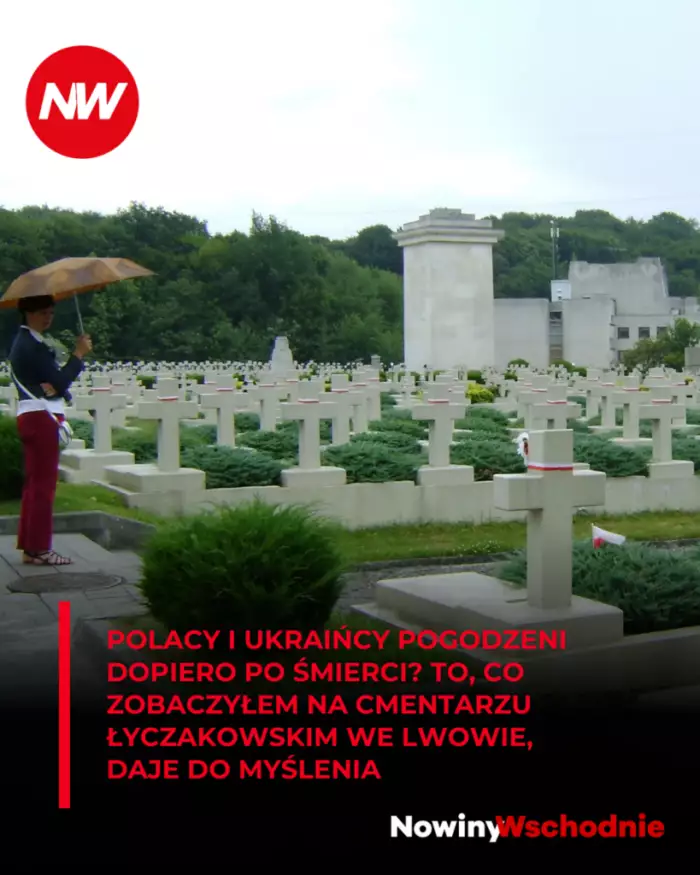
July 2015 – Lychakiv and the memory of Lviv
July 2015. The weather seemed to match the location. A few minutes of rain, a strong wind, then sunshine, gray clouds. And so it went all day. That day I visited the Lychakiv Cemetery, a symbol for us Poles of Lviv’s past and its inhabitants, who, scattered across the hills, bear witness to a difficult history, often marked by the blood shared in defense of the land against enemies. Unfortunately, it also included fratricidal struggles between Poles and Ukrainians, when the nobility overly undermined the Cossacks’ freedoms. And there’s another side to this past – for several hundred years, we lived in relative harmony. There was a lack of will and imagination to engage the Cossacks in building a common Republic, to make it the mother of three nations, not two.

Graves beyond divisions and silence stronger than ideologies


In Łyczaków, regardless of one’s views, nationality, or religion, one can find the gravestones of various figures. The most interesting ones contain the remains of those distinguished in Polish culture and science – Banach, Konopnicka, Zapolska. There’s also Ordon himself, the hero of Mickiewicz’s poem. His countrymen erected a beautiful monument to him. And many, many others – including Ukrainians, such as their poet Ivan Franko and Polish senator Mykhailo Cherkavsky, whose family was murdered by the NKVD after the invasion of Poland. Looking at the graves, one becomes calmer, adjusting even the width of one’s smile, the intensity of one’s reflection, the intensity of one’s gaze. This fosters one’s own thoughts, alien to the pulp of television and the internet, where various haunted individuals attempt to convince us of their thesis through real and imagined events. Ghosts in the alleys ask for prayer and concentration, and in return, they provide a flood of positive energy that overwhelms those who stroll by. There’s no sense of hatred anywhere—the same kind you can practically see pouring off your computer screen when you open some of the websites occupied by pseudo-nationalists and their sympathizers. But the pseudo-left has also made significant contributions in this area—their calls sound like the worst nightmares of a Christian resident of the Islamic State.
Crosses, history, and remorse
All this flashes before my eyes as I walk the green paths of the cemetery. When I thought about this, the Catholic crosses mockingly tilted, pretending to be Greek Catholic crosses, while the other crosses pretended to be Catholic crosses, making me understand how out of place our fights, our verbal sparring, and the buckets of filth they carry are. They are all reconciled here—indeed, even friends. Nikolai lies next to Jan, and Jan cherishes their company. Together they commune with the Absolute, granting love, beauty, and rest after what must have been a successful life. As soon as I understood this, the crosses returned to their original forms. I continued reading the various inscriptions, constantly stumbling upon Polish patriots, November Uprising participants, Napoleon’s soldiers, participants in the Spring of Nations in Hungary. They all reminded me of the waste of their sacrifices, the blood of their comrades-in-arms. They fought not for war, but for peace, which we are unable to preserve, and now they admonish us that the most important thing is morality, acting in accordance with the commandments – then there will be no need for war.
Insurgents, Conscience and the Courage to Refuse
Very tired (in my physical condition…), I found the most beautiful place – the highest peak among the Łyczakowskie hills. There I found the January Uprising insurgents. They died at different ages, but the two years of war they had participated in had forged such strong bonds that even as they lay dying, they wanted to be buried among the comrades of their unequal struggle. Oh, I’d heard so much there… I was afraid that one of them would soon rise and treat me as a representative of human stupidity, which compels us to kill each other. They know best what it means to kill and be killed… And they don’t want that for their descendants. Having confronted their patriotism with God, they received the TRUTH. They received apples from that tree when they arrived after their earthly journey; they try to pass on their taste to us, and we… Because who talks to the dead? The village idiot, and no one wants to be one. I descended, pursued by their laughter, full of reproach for our arrogance. Can we preserve the independence we won after such bloody years? Can we preserve it in such a way that, after crossing the threshold of life, we await HIS judgment without fear? Because one can be cynical, playing upon the weaknesses of the lesser, living at their expense. But one can help them, teaching the world the need for love—not war. Even in aggressor nations, there are cases of refusal to obey inhumane orders issued supposedly in defense of the homeland. Otto Schimek, Franz Jägerstätter, the anonymous grave of a Wehrmacht soldier on the Końskie-Kielce road, Jehovah’s Witnesses shot in Dachau—these are evidence of human behavior of the utmost sacrifice.
Poles, Ukrainians, and the War – Then and Now
The sun broke through the foliage. I glimpsed the hill where Poles who defended Lviv from Ukrainians and Russians were buried – the famous Hill of the Lviv Eaglets. To reach it, I had to descend into the valley where Ukrainian patriots who died fighting against Poles and Russians – soldiers of the Ukrainian Galician Army – lie buried. Their colleagues later fought shoulder to shoulder with the Poles against the Bolshevik onslaught. Descending, I noticed a group of fresh graves drowning in flowers. I guessed who lay there. I felt my melancholy replaced by pain and sympathy. Besides the standard information, the graves contained additional information – where, who died, and why. Sadness, grief for so many young men who fell fighting in an unequal battle, initially lacking weapons, training, or even professional leadership. And I thought of some photographs revealing the truth about Russians killed in Donbas. Burials are carried out secretly, with the location of death falsely recorded—a military training ground or a car accident. The constant question “why?!” echoes in my currently empty head.
The Lviv Eaglets and the responsibility of the living
I walked down the aisles, reading the surnames – they were all different: Polish, German, Jewish. On the wall where the Eaglets were immortalized, I also found German and Jewish surnames. While the elderly stayed at home, young Jews and Germans fought shoulder to shoulder with their Polish peers for the POLISH Lviv. The Lviv Eaglets Cemetery has been beautifully rebuilt. The remains of our soldiers were laid to rest with respect. This was thanks to the enormous sacrifice of the Poles of Lviv and many people of good will from Poland. The Bible is a very wise book: “Judge not, lest ye be judged.” Let us remember this when we want to hold others accountable.


author’s photos
Source: FoundationWiP
What do you think about this story?
Join the conversation. Please keep comments relevant to the article.
Write a comment