
What does the Benedictine abbey in Tyniec have in common with Ukraine? It turns out, much more than you might think. As a guide showing tourists around this unique place, I not only recount its rich history but also strive to rediscover it, expanding my knowledge with threads related to my interests and passions. Behind the walls of one of the oldest and most important monastic centers in Poland lie tales of eastern invasions, Russian imperialism, and the contemporary Benedictine mission in Ukraine. It’s a history that not only unites two countries but also demonstrates that spirituality and solidarity know no boundaries.
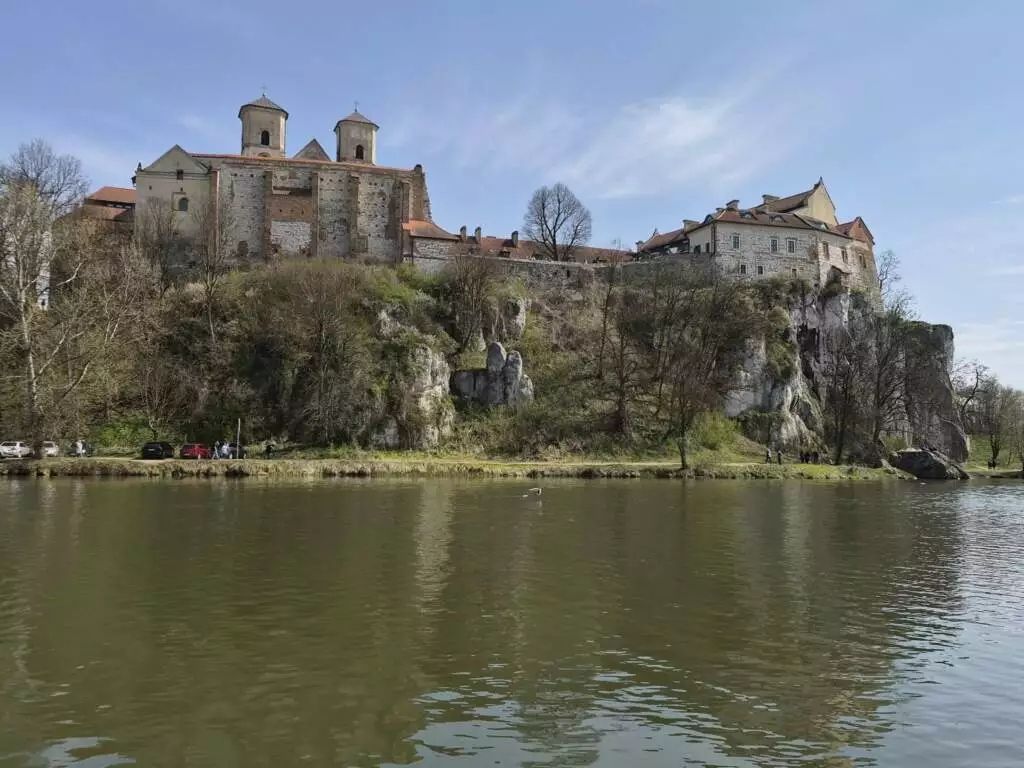


Benedictine abbey in Tyniec (photo: Borys Tynka)
“You didn’t expect this?” – a story that surprises tourists
“You didn’t expect this?” – these words, sometimes uttered by me while guiding tourists around Tyniec Hill, can completely change the visitors’ perspective. Most tourists come here to see the famous abbey, the oldest in Poland, learn about its history, admire the architecture, and feel the extraordinary atmosphere of this place towering over the Vistula River. Tyniec, after all, is primarily associated with the beginnings of Polish monasticism, the Latin tradition, and the Benedictine motto. Ora et labora – pray and work.
And with good reason. This is a truly unique place. And at the same time, incredibly intriguing. The Tyniec Abbey is one of the oldest Benedictine centers in Poland. Its origins are traditionally linked to the foundation of Casimir the Restorer in 1044, although the exact date of the monastery’s founding remains a subject of historical research. The hill, limestone cliffs, and expansive panorama of the Vistula Valley create a space that is impressive regardless of the season.
I have the pleasure of guiding tourists through this extraordinary place. It’s during these encounters that I discover that the abbey’s history can be much more interesting when we go beyond the most obvious facts. As a guide, I strive to present not only the monuments but also the contexts that allow for a better understanding of their significance..
For me, as someone who has been studying Ukraine, its history, and culture for years, the connections with it and the broader Christian East are a particularly fascinating thread. It turns out that the walls of Tyniec conceal a story that takes us much further than the borders of present-day Poland.
From Tatar invasions to Russian imperialism
Standing in the abbey courtyard and gazing at the church, the abbey, the remains of the massive defensive walls, and the Vistula River running beneath them, it’s worth taking a step back in time to the 13th century. Tyniec wasn’t just a place of prayer back then. Its location on a high limestone hill above the Vistula River held enormous strategic significance. The natural terrain, proximity to a river crossing, a major trade route, and proximity to Kraków allowed the monastery to also serve defensive purposes.
In 1260, the abbey was plundered and burned during a Tatar invasion. The Mongol armies that were ravaging Polish lands at the time had previously swept through what is now Ukraine. This is one of the first moments in which the history of Tyniec intersects with the dramatic events unfolding in Eastern Europe.
This wasn’t the last devastation to befall the monastery. The Bar Confederation brought further tragedy. In 1771–1772, Tyniec Hill was transformed into a heavily fortified Confederate stronghold. The monastery’s walls, bastions, and earthworks became part of a defensive system intended to secure access to Kraków.
In May 1771, Russian troops under the command of Alexander Suvorov attacked Tyniec, but the confederates repelled the attack. Fighting for the hill continued for months thereafter, resulting in significant damage to the monastery buildings.
The war left painful scars. Damaged buildings required reconstruction, and some rooms had to be rebuilt almost from scratch. Over time, the abbey regained its former character, but its fate continued in the shadow of the Partitions. In 1816, the Austrian authorities dissolved the monastery. The Benedictines did not return to Tyniec until 1939, and the actual reconstruction of the complex began after World War II.
When visiting, I like to draw attention to this multi-layered history. Today’s Tyniec isn’t simply a medieval monastery that luckily survived the centuries. It’s a place that has been destroyed, rebuilt, and reclaimed many times. In a sense, it’s a symbol of rebirth after catastrophe.
For the Polish tourist, the story of Russian troops besieging Tyniec is part of the history of the Bar Confederation. For those interested in Ukraine, however, it provides additional context. The Russian empire, which fought the Confederates in the 18th century, consistently sought to subjugate neighboring nations and territories over the following centuries. Therefore, today’s Russian aggression against Ukraine is not without historical roots.
This doesn’t mean, of course, that the events of the 18th century can be identified with the current war. However, they do illustrate the long history of Russian imperial policy and its consequences for the nations of Central and Eastern Europe.
Benedictines return to Ukraine – an extraordinary mission from Lviv
What is most surprising for many visitors, however, is the fact that Tyniec is not just a witness to ancient events. The history of the abbey’s ties to Ukraine is still being written today.
In March 2021, Polish Benedictines, including monks associated with Tyniec and Lubiń, arrived in Lviv. Their mission was to support the emerging Benedictine community and the ministry at the new Benedictine monastery in Solonka, near Lviv. On March 19, 2021, the Church of St. Benedict and the monastery were consecrated there.
This was an event of particular significance for the Catholic Church in Ukraine. After decades of communist persecution and the near-total destruction of contemplative life during the Soviet period, a tradition that had been part of the religious landscape of these lands for centuries was being revived.
It’s worth emphasizing that this wasn’t an attempt to transplant the Polish monastic model to Ukraine. The goal was to support the reviving community and restore the Benedictine presence in a country with an exceptionally rich and multinational Christian history.
For me, this is particularly important because Lviv is a city where the histories of Poland and Ukraine have intertwined for centuries on many levels. The presence of Benedictines from Polish abbeys is another example of how a shared heritage can be a foundation for cooperation, not a reason for dispute.
When a monastery becomes a refuge from war
A few months after the new community launched, something no one could have predicted happened. On February 24, 2022, Russia launched a full-scale invasion of Ukraine. For many residents, this meant immediate exodus from their homes. People fled bombed cities, leaving behind their life’s work, often unsure if they would ever be able to return.
In this situation, the Solonka monastery received a completely new mission. The Benedictine nuns opened the doors of their cloister to those fleeing the war. A place previously intended primarily for prayer and contemplative life became a refuge for internally displaced persons.
In April 2022, the monastery housed over a hundred people. Among them were children, women, the elderly, and Benedictine nuns who had been forced to leave Zhytomyr due to the threat of Russian bombing.
In December 2022, it was reported that over 700 refugees had passed through the monastery. The sisters were supported by monks from Tyniec and Lubiń. The monastery provided not only shelter and meals, but also a place where people could regain a sense of security, receive spiritual support, and simply feel at home for a moment.
Particularly moving are the accounts of children running around the monastery cloister. Where silence and concentration had previously dominated, the bustle of children appeared. For the nuns, this meant a huge change in their daily lives, but also the opportunity to help those who needed it most.
There’s something incredibly symbolic about this. The monastery, which for centuries was a place of isolation, opened up to people fleeing war. Benedictine hospitality was no longer just an element of spiritual tradition. It became a concrete action.
Tyniec also helped Ukraine
It’s worth emphasizing that aid to Ukraine wasn’t limited to the monks who left for Lviv. After the Russian invasion began, the Tyniec Abbey itself also became involved. As early as March 2022, the Tyniec community organized a collection of donations and prepared a humanitarian transport to Lviv. Some of the collected goods, including medicines, medical supplies, and supplies needed for children, were to be delivered directly to the Benedictine monastery where Father Leopold served. The Tyniec parish also participated in organizing aid for Ukrainian refugees in Poland. This was a very concrete example of solidarity with the invaded country. The Benedictine principle of hospitality and service to others found practical application at the time – on both the Polish and Ukrainian sides of the border.
Tyniec – a place that teaches you to look at the bigger picture
Why do I sometimes touch on these themes during tours of Tyniec? Because I believe a good guide shouldn’t limit himself to conveying dates, names, and architectural information. Of course, historical knowledge is the foundation of a guided tour. Without it, it’s impossible to understand why a given place was built, what function it served, and why it has survived to this day. But equally important is skillfully presenting its significance in a broader context.
Tyniec is a unique place in this regard. Here, one can explore the origins of the Polish state, medieval monasticism, Romanesque and Gothic architecture, Renaissance reconstructions, the Baroque period, the Confederation of Bar, the partitions, and the reconstruction of the monastery. One can also speak of culture, art, manuscripts, the library, and the centuries-old Benedictine tradition.
But we can also talk about Ukraine. About the ancient ties between the Christian East and West. About Russian imperialism, which for centuries left its mark on the history of this part of Europe. And finally, about contemporary solidarity, which does not end with declarations but takes the form of concrete actions.
For me, as a guide and someone who has been involved in Ukraine for years, the opportunity to combine these two worlds is particularly valuable. Tyniec is not just a beautiful monument located a dozen or so kilometers from the center of Krakow. It is a living abbey where history, knowledge, spirituality, and modernity create an extraordinary whole.
Next time you visit Tyniec Hill, look beyond the Vistula River, the Romanesque and Gothic relics, and the mighty defensive walls. Think also of Lviv and Solonka. Think of the monks and nuns who, a few years ago, began a new chapter of Benedictine history there, and after the Russian invasion, opened their doors to those in need.
Because Tyniec is not just Polish history. It’s also part of a much larger, European story of faith, culture, survival, and solidarity.
And that’s precisely why it’s worth coming here. Not only to see this unique place, but also to better understand the history that still endures.
Sources: Kraków.pl – Benedictine Abbey in Tyniec; History of Krakow – 18th Century 1751-1775; Via Benedictina – History of the Tyniec Abbey; Zabytek.pl – Tyniec – Benedictine Abbey Complex; National Archives in Krakow – Bar Confederates in Krakow; Benedictine Abbey in Lubiń – Consecration of the church and monastery in Lviv-Solonka; Vatican News – Ukraine: Consecration of the Benedictine monastery in Lviv; Vatican News – Ukraine: Benedictine nuns open monastery for refugees; Misyjne.pl – Lviv: how Benedictine nuns and monks help refugees; Tyniec parish – Help for Ukraine – new information; Tyniec parish – Humanitarian transport to Lviv

Journalist, columnist, author of books about Ukraine, tour guide, and commentator on developments in Ukraine and Polish-Ukrainian relations.
A certified guide to Odesa, the Odesa catacombs, Ukrainian Bessarabia, and Kyiv. He is the author of numerous publications on Ukraine’s history, culture, and contemporary affairs, some of which have been translated into Ukrainian and published in Ukraine. In 2020, he received the honorary title of Ambassador of Odesa in Poland from the Mayor of Odesa.
On 24 February 2022, the day Russia launched its full-scale invasion of Ukraine, he was in Odesa. He remained there for several months, helping coordinate humanitarian aid and reporting on the war for Polish media outlets. He described his experiences during this period in his book Odessa 4.5.0.
At Nowiny Wschodnie, he publishes articles and commentary on the Russo-Ukrainian war, Russian propaganda and disinformation, Ukrainian history, particularly that of Odesa, as well as Polish-Ukrainian relations and changing public attitudes.
He collaborates with Ukrainian newsrooms and online news outlets and appears in Polish media as a commentator on Ukrainian affairs.
What do you think about this story?
Join the conversation. Please keep comments relevant to the article.
Write a comment