
- 1567. The day of the war—the real one, in defense of Ukraine and Europe. And the thirteenth day of another, symbolic war: one of insults, declarations, and medals, waged not
against Moscow, but between Warsaw and Kiev. Enough.
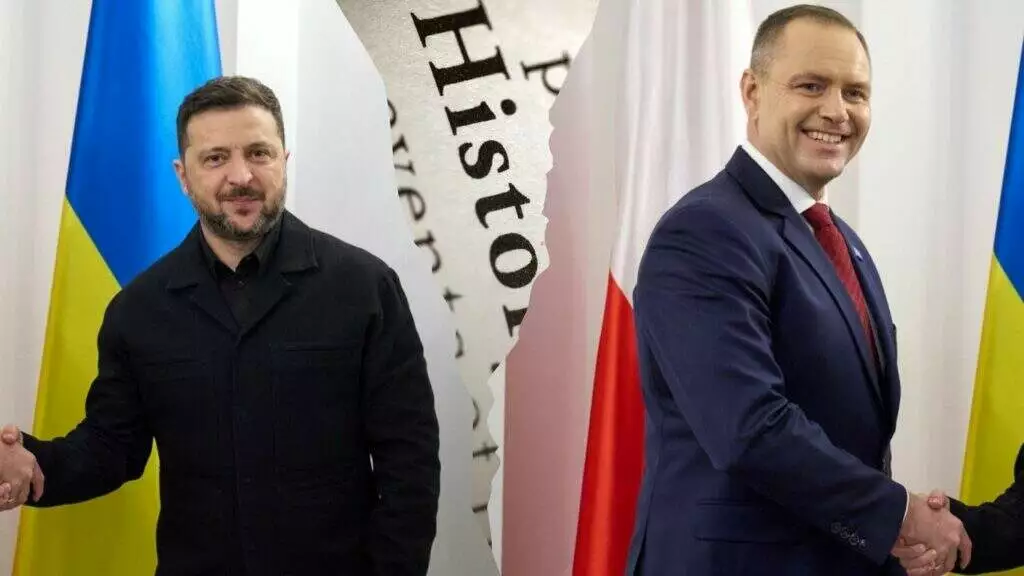
“I’m sorry, gentlemen, it wasn’t supposed to be like this” — Piłsudski is said to have told the interned Ukrainian officers, his former allies, whom the Treaty of Riga left on the Soviet side of the border. A hundred years later, this sentence returns not as a quote from a textbook, but as a reproach.. The dispute over the Ukrainian unit named after the Heroes of the UPA continues, Karol Nawrocki announces the pickup Zelensky The Order of the White Eagle, and the wrongs of eighty years ago are again standing between us – just when we can least afford it.


Because a Ukrainian soldier is dying this morning near Pokrovsk, a child is dying under the rubble in Kyiv, and a bombed-out hospital is burning in Sumy. This soldier fought for Kharkiv, but also to prevent a Russian tank from moving several hundred kilometers further, toward Przemyśl. This line separates Polish peace from the Polish war, pushed eastward by someone else’s life—and that’s why we have one priority, though we lack the courage to name it.
It’s not about forgetting about Volhynia. These tens of thousands of people slaughtered in barns and orchards cannot be relegated to a footnote or a campaign ad.. Their deaths were real, their graves are still often unmarked, and the demand for exhumation and a dignified burial is just. Their memory deserves more than the role of a token in the dispute between one poll and another.
There were also Polish sins — and only a fool or a cynical political scoundrel pretends that they did not exist.
Pacification of Ukrainian villages in the 1930s. One hundred dozen Orthodox churches were destroyed in 1938 in the name of Polonization of the Chełm region—long before Volhynia. Operation Vistula in 1947: one hundred forty thousand Ukrainians, Lemkos, and Boykos brutally displaced from their homes to cut off the UPA from its hinterland. An action that the Polish Senate itself later condemned. The list goes on and on, going back hundreds of years.. And that is why an honest account of wrongs has two columns, both long; whoever shows only one is not looking for truth, but ammunition.
This calculation cannot be closed on one knee, in anger, between two statements by a politician counting columns – we will work through it when the guns fall silent, not when it happens to fit the electoral calendar.
Every hour that Warsaw and Kyiv waste on this quarrel is an hour given to Moscow. —and Moscow knows this better than we do. The same accounts that yesterday fueled panic over grain are today hyping Volhynia, because the enemy, who can’t break through with tanks, is trying to break through with our memories. This is prime material for Russian television: look, they are fighting each other, you don’t even have to separate them. Tusk initially didn’t pretend to be a mediator in this dispute, placing the blame squarely on Kyiv, saying that “at this point, all responsibility rests with the Ukrainian side,” and later that the presidents should talk to each other. Even this political theater shouldn’t obscure the fundamental point: real support for a struggling Ukraine remains a strategic necessity for us.
Why do we remember wrongs and forget solidarity?
Spring 2022. Platforms in Przemyśl, thousands of women with children and bags of all their belongings, Polish homes open without asking for generational bills. We sent them generators when the power went out; we took in a million people when they had nowhere to flee.
We knew then where the boundary between history and the present was – today we pretend we don’t know it.
Why do we prioritize bad memories among us, rather than good ones?
Władysław Broniewski knew more about divided loyalties than we do today. He wrote “Bayonet on the Gun” in April 1939, sensing a war that hadn’t yet happened—and he wrote it as a man who had served eight years earlier in a Sanation prison for communist blotters. The state gave him a taste of prison bread; when push came to shove, he cycled five hundred kilometers in five days to catch up with his unit. Because he saw the difference between internal calculations and the enemy at the gates—and he wrote it down himself:
There are accounts of wrongs in the homeland, and a foreign hand will not erase them, but no one will refuse the blood: we will drain it from our chests and from our songs.
When someone sets fire to a house, the negligence and wrongdoing of the tenants is not dealt with first – the fire is extinguished first.
The bills remain and they will have to be paid, every penny, when the fire goes out.
Piłsudski said: “It wasn’t supposed to be this way, gentlemen.” This time it doesn’t have to be this way—and it mustn’t be. Let’s not reenact the scenario written in Moscow as zealously as if it were our own—neither in Poland nor in Ukraine.
And the Order of the White Eagle? That’s the most theatrical point of the whole affair: the ribbon, the chapter, the announcement on the website. Send it, receive it, send it again. Maybe it should wait in limbo.
The crown will not fall from his head.
Source: sestry.eu
What do you think about this story?
Join the conversation. Please keep comments relevant to the article.
Write a comment