

When Poland and Czechoslovakia regained independence in the autumn of 1918, geography and the balance of power in Central Europe suggested one thing: the two countries should have become the closest, inseparable allies. Instead, our relations began with a war over a small piece of land. The two decades between the wars were marked by incomprehensible rivalry, a mutual sense of superiority, and tragic diplomatic blunders. The culmination of this dispute in 1938–1939 led to the elimination of the Czechoslovak buffer zone, the vast extension of the Polish border with aggressive Germany, and, ultimately, military disaster. This historical lesson in the geometry of the front and the cost of neighborly resentment carries a strikingly timely warning today. The very same mechanisms that shattered the Polish defense plan in 1939 after the fall of Czechoslovakia determine the strategic importance of an independent Ukraine today. A shift in the border of the Russian threat to the southeast and the possible fall of Kiev would place Poland in a similar, deadly strategic trap, which our own history warns us against.
1. The Founding Sin: From Rivalry for Cieszyn Silesia to Distrust (1918–1920)


“Difficult neighborhood” is definitely an understatement to describe what united our countries in the interwar period. Countries that seemed destined to become close allies, completely incomprehensible to their ally, France, engaged in fierce competition with each other.
At that time, Czechoslovakia held a completely different weight than today’s Czech Republic or Slovakia. After World War I, it was one of the richest and most modern economies in Europe. For this reason, politicians in Prague looked down on a poor, partitioned, and largely agricultural Poland, believing that Warsaw would be far from reaching their level. This created a vast space for mutual prejudice – from cool rivalry, through feigned friendship, to open hostility.
Communism and the Russian occupation devastated this wealthy country. It descended from a once-wealthy country to one of the poorest in Europe. Anyone who crossed the Czechoslovak border during the communist era remembers extorting bribes to transport anything across the border. While the country was richer than Poland, the mentality of Russian officials had firmly established itself there. The Czechoslovak lands were subjected to Russian influence for a short time, barely a few decades. And the occupation itself lasted only 21 years.
We emerged from the ravages of World War I as independent entities almost simultaneously. In the autumn of 1918, Czechoslovakia and Poland declared independence, frantically trying to erect border posts where they believed their historical or ethnic rights extended. And here, a violent clash occurred. The bone of contention became Cieszyn Silesia – crucial to the Czechs, among other things, due to the strategic Bohumín-Žilina railway junction and the coalfield. In January 1919, Czechoslovak forces exploited Poland’s difficult situation and launched an offensive in the disputed territory. At that time, Poland was fighting the Ukrainians for Lviv, the border in Greater Poland was burning, and the Bolshevik threat was growing in the east. Mustering even a small force to defend against an attack from the south was extremely difficult. During this “little war,” Czech soldiers executed Polish prisoners of war in Stonawa (where their graves and monument remain to this day). Poland, overwhelmed by the superiority of its enemies, had to rely on the verdict of the Entente powers, which ultimately divided Cieszyn Silesia.
Shortly thereafter, Poland was engaged in a deadly war with Bolshevik Russia. It was a struggle for the country’s survival. It did not begin, as many believe, in the summer of 1920, but already in early 1919, with the withdrawal of German troops from the Eastern Front and the immediate occupation of these territories by the Red Army. While the Poles were bleeding in battle against the Bolsheviks, Czechoslovakia sought to hamper our defense. Under the pretext of neutrality and under pressure from left-wing trade unions, shipments of weapons and ammunition for the Polish army from Hungary and France were blocked. Prague pursued a strongly pro-Russian policy at the time, stemming from the former Tsarist Russia’s support for Czechoslovak independence and its belief in an alliance with Moscow. Ultimately, the weapons reached Poland, but this situation cast a lasting shadow on the relations between the two countries.
2. Twenty years of mutual prejudice and the tragic year 1938
Throughout the interwar period, Czech politicians considered Poland a “seasonal” state, and Edvard Beneš even suggested to the great powers that Polish borders were untenable and that Gdańsk should belong to Germany. Things were no better on the Polish side. Attempts at reconciliation failed due to mutual distrust and a Czech sense of superiority. The failed 19th-century uprisings and Galician poverty were remembered; poor economic performance and widespread illiteracy were observed. The multinational nature of the Polish-Lithuanian Commonwealth also discouraged Prague from entering into an alliance – it was believed that national minorities would tear the Polish state apart from within. At the same time, the Czechs were actively pursuing the Czechization of the Polish minority in Zaolzie: Czech teachers were brought in, Polish schools and associations were closed, and promotions or jobs in state-owned enterprises or offices were reserved for those who were Czechized.
Finally, the tragic year of 1938 arrived. After the Munich Conference, at which the Western powers ceded the Czech Sudetenland to Hitler, Poland issued an ultimatum to Czechoslovakia demanding the return of Zaolzie. Pressured from all sides, Czechoslovakia yielded. The consequences of this move proved disastrous and far-reaching. It was this act that gave our opponents the pretext to accuse Poland of complicity in Hitler’s partition of their neighbor. And the incantations that we were “merely” pursuing our “national interest” are of no avail today. The reality was ruthless: along with the Third Reich and Hungary, we participated in the rapacious dismantling of Czechoslovakia. The shortsightedness of this policy became apparent only a dozen or so months later.
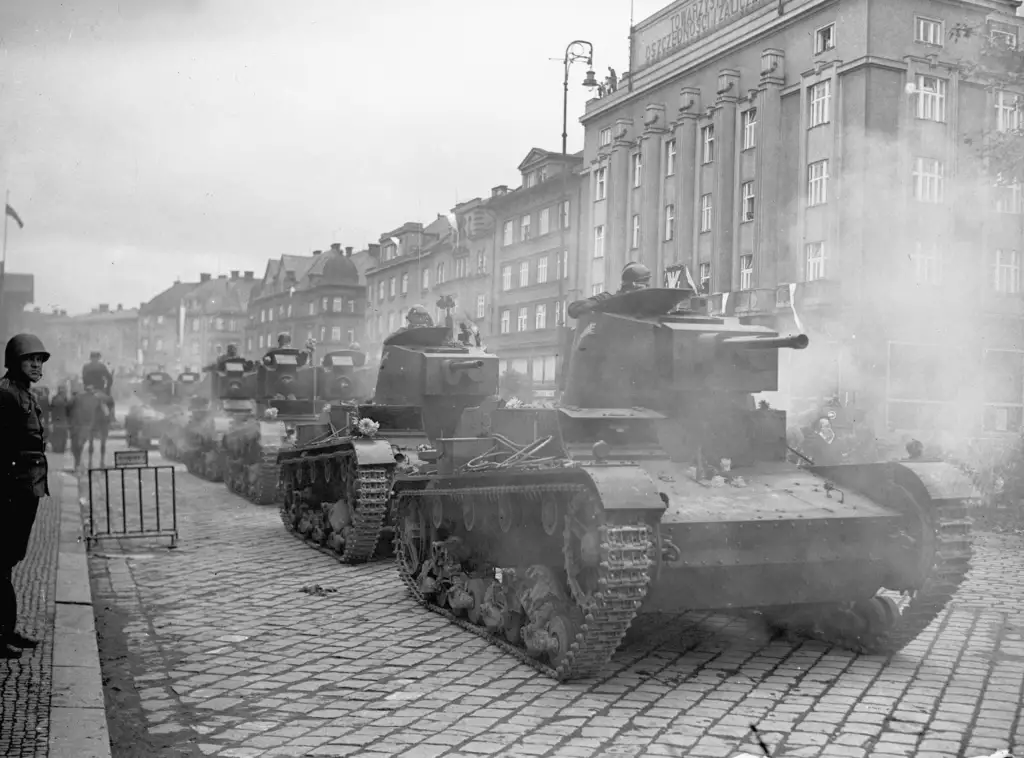
Polish tanks occupy Zaolzie. Source Wikipedia.
The consequences of that decision are still felt today. In 2009, Vladimir Putin, representing Russia at the Westerplatte commemoration of the outbreak of World War II, openly blamed Poland for the Zaolzie incident. He continues to do so regularly to this day. This narrative has haunted us for over 80 years, exploited by politicians and journalists hostile to Poland to portray our country as a former collaborator with Hitler.
Adding an additional bittersweet note to the Polish government’s policy is the fact that, just before the Munich Crisis, Czechoslovakia offered Poland economic support and access to its modern, European-leading arms industry. This could have significantly modernized the Polish army. However, this offer arrived too late – when Prague was already facing a knife at its throat and seeking rescue at all costs.
Neither Poland nor Czechoslovakia had statesmen in the interwar period capable of seeing beyond the horizon of current disputes. Tomáš Garrigue Masaryk died in 1937, handing power to Edvard Beneš – a politician with modest horizons, incapable of facing the impending catastrophe on his own. On the Polish side, the situation looked even worse. After Józef Piłsudski’s death in 1935, a team of former legionnaires took power. While their patriotism was undeniable, they were – to put it mildly – neither outstanding strategists nor intellectuals. Furthermore, they were burdened by authoritarian rule, which undermined Poland’s credibility in the eyes of the democratic West, to which Czechoslovakia strongly aspired culturally and politically.
3. Geometry of Disaster: The Rise of Threat and the Catastrophe of September 1939
The tragic culmination of this series of errors was the final collapse of Czechoslovakia in the spring of 1939. The occupation of the Czech Republic by the Reich and the creation of the puppet Slovak State (with Hitler as midwife) resulted in our shared border with Germany and its satellites being extended by a gigantic southern section. Poland’s strategic situation deteriorated catastrophically.
Extending the border with an aggressive state isn’t just about abstract numbers on a map. It’s about concrete divisions that must cover every kilometer of the front. Given the Wehrmacht’s colossal material and technical superiority, this had tragic consequences. The Polish command had neither the time nor the resources to expand its fortifications on the Czech and Slovak sides. As a result, in September 1939, the Germans (with the symbolic Slovak forces supporting them) gained enormous operational freedom, attacking from the south and rapidly advancing on the flanks and rear of the Polish armies.
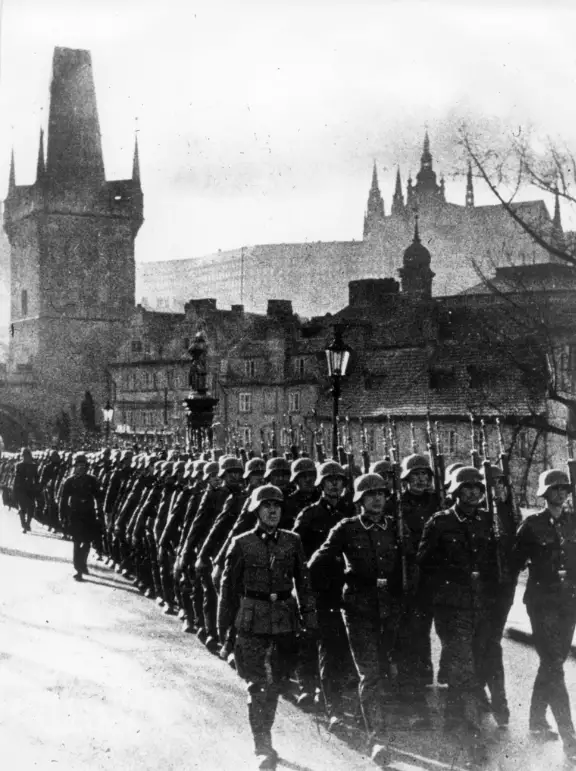
The Germans enter Prague. March 1939. Source: Wikimedia Commons
4. Lesson from history: Why does border length matter today?
Today, Poland has no shortage of “geniuses” who claim that since we already border Russia (via the Königsberg Oblast), a potential Ukrainian defeat won’t change our situation. While such analysts can be given satisfactory grades in geography, they deserve a failing grade in history, logic, and military geometry.
It’s worth reminding them of the painful lesson of 1939, when the elimination of the buffer zone of Czechoslovakia completely derailed the Polish defense plan. From the border of the liquidated Czechoslovakia, German armored columns were much closer to Lviv, Kraków, and the Rumuńskie Bridge than from then-German Opole or Silesia. Each additional kilometer of border defense requires a certain number of soldiers, artillery, tanks, combat vehicles, anti-aircraft systems, and aircraft patrolling the airspace and attacking the hinterland (supply lines are lengthening, and junction points become easier targets). And the “geniuses” will argue that Poland bordered Germany anyway…
Logic dictates a simple question: is it easier to defend against a stronger opponent on a shorter border, or on one that’s many times longer? It’s elementary mathematics. If we have a narrow corridor where three soldiers can stand side by side, those three can hold off even ten attackers for a long time, because the aggressor has no way to exploit their numerical advantage. The situation becomes dramatic when defending a corridor that’s several times wider.
When Germany invaded Poland after the fall of Czechoslovakia, it ruthlessly exploited its geographical advantage. A power of 80 million with a modern, motorized army attacked a country of 35 million, industrially weaker and less well-armed. The outcome of this campaign would have been tragic even without the additional blows, but two factors sealed Poland’s fate: the treacherous attack by Soviet Russia on September 17th and the inaction of its Western allies.
In fact, immediately after Hitler’s attack on Poland, Soviet disinformation agencies in the West launched a propaganda campaign strikingly similar to the one Moscow is currently conducting against Ukraine. Public opinion in France and Great Britain was led to believe that Poland “only had itself to blame,” citing the pre-war persecution of national minorities and its participation in the partition of Czechoslovakia. This was intended to demobilize Western societies. The result for Poland was disastrous. The slogan that gained popularity in France at the time was:Why should we die for Gdańsk?”. While it must be admitted that only a small portion of society succumbed to this demagoguery, not even 20%. However, they were very vocal.
How similar this slogan is to today’s cliché:This is not our war”. The former was born in minds infected with Russian and German propaganda – the latter has exactly the same origins and aims at the same goal.
End
History rarely repeats itself literally, but it does so with remarkable precision, replicating the same rules of the game and political psychology. Poland’s defeat in 1939 stemmed not solely from the Wehrmacht’s technological superiority, but from years of diplomatic blindness, which allowed the aggressor to gradually eliminate the buffer state and encircle the Republic of Poland on three sides.
Today, facing Russian aggression against Ukraine, we must not repeat past mistakes. Ignoring the fact that the collapse of an independent Ukraine means a direct extension of the potential conflict front with Russia by hundreds of kilometers (including the complete liquidation of Belarusian independence) is not only historical ignorance but also a crime against the Polish national interest. If we fail to learn from the tragic fate of Czechoslovakia and Poland in 1938–1939, we will once again be forced to learn military geometry on our own territory. And the Polish state simply cannot afford this.


What do you think about this story?
Join the conversation. Please keep comments relevant to the article.
Write a comment