
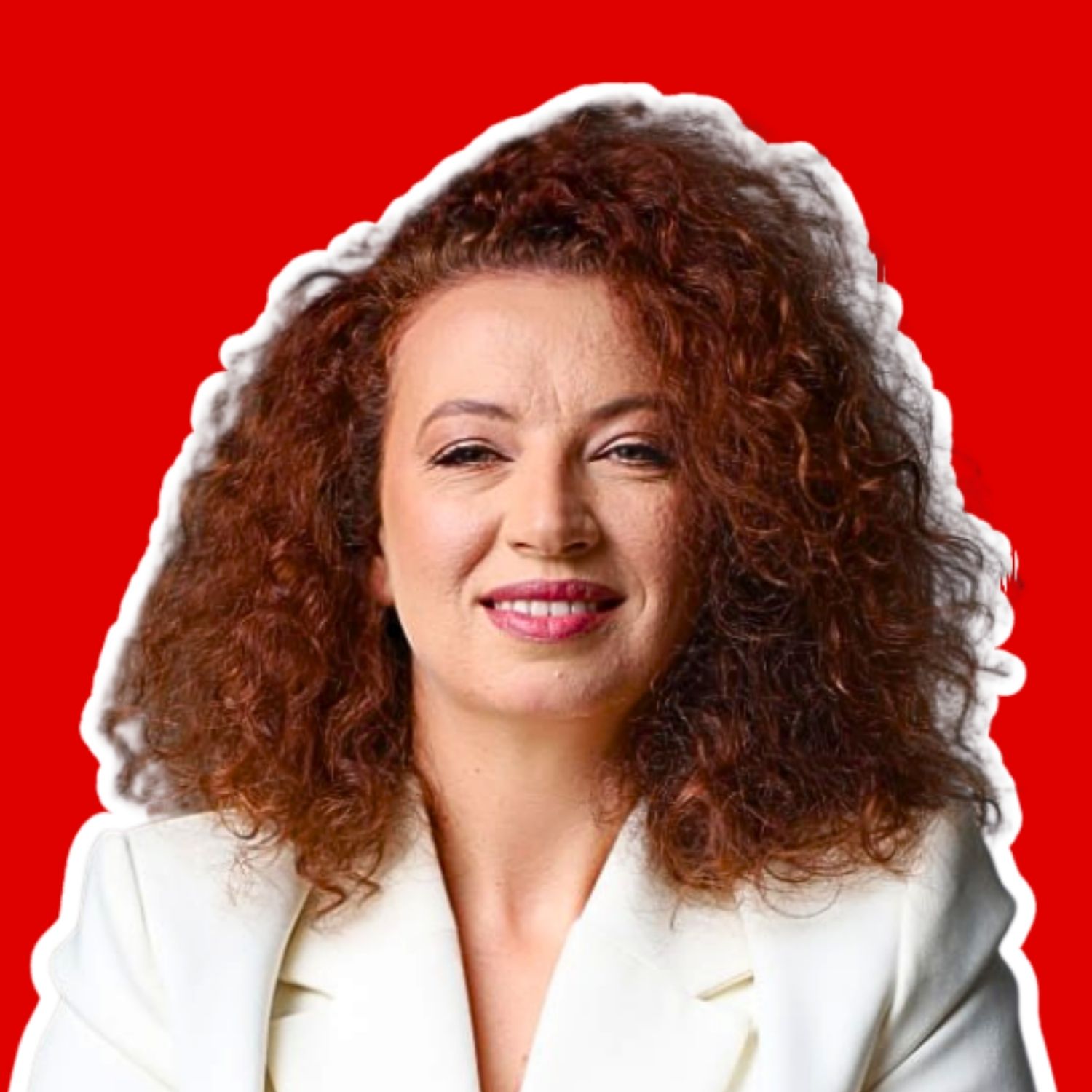
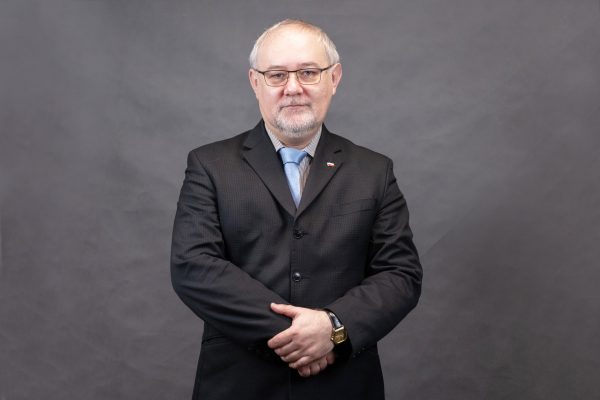
A Lviv native of Polish descent in the seventh generation, an international relations expert and a lecturer at the Lublin University of Enterprise and Administration (WSPA) Dr. Jarosław Kit has been fighting fake news since 2005. In a conversation with Nowiny Wschodnie, he explains why the most popular falsehood about Ukrainians in Poland concerns the healthcare system, why the Kremlin for decades rewrote the history of the Ribbentrop–Molotov Pact, and why it is worth starting reconciliation between Poles and Ukrainians not with conferences, but with dance and cinema.
“I don’t see a border between Lviv and Lublin”


Doctor, how would you introduce yourself to our readers? Who are you more — a scholar, a social activist, a lecturer?
I am a lecturer, a social activist, a columnist, and a scholar — I deal with many matters and don’t limit myself to one field. Once a professor told me that this was very bad: whoever takes on many things gets distracted. Over time, however, it turned out he was wrong. We live in such a dynamic, global environment that there’s no other way — you have to be everywhere. Above all, though, I see myself as an expert in international relations and information.
You have Polish roots, you studied in Lviv and in many Polish cities, and you defended your PhD in Germany. Where is your home and who do you feel you are?
I feel like a Lviv resident of Polish origin. I belong to the seventh generation of Lviv residents; all my ancestors come from Lviv. And fortunately that Polish side has been preserved in our family—unlike among those Poles who found themselves in Lviv after the war and had completely different experiences.
So I am a Lviv resident, but my home is now in Poland. It may sound strange, but I don’t see a border between Lviv and Lublin. For me it is one region and I feel like its inhabitant—local, you could say. It is very important to me not to divide two countries by a border, but to feel like a resident of Central Europe.
Perhaps because these lands are culturally similar?
Yes and no. Similar when it comes to the culture that remained in Lviv from the interwar period—both Ukrainian and Polish. But both in Poland and especially in Ukraine there are a great many elements of Eastern culture. It is precisely because of this meeting of civilizations that we have in Ukraine the situation we have now.
It started in 1991, when the presidential election was won by Kravchuk, not Chornovil (ed. note: this refers to the first election of the president of independent Ukraine on 1 December 1991, held simultaneously with the independence referendum; Leonid Kravchuk won more than 61% of the vote, Viacheslav Chornovil—about 23%). Ukraine then took a different path than Lithuania, Latvia, Estonia, and Poland. There they chose democratic presidents, former dissidents—people who saw their countries in Europe. And Ukraine chose a post-communist, post-Soviet path. That was the first step backward, which civilizationally pushed Ukraine back into an environment where it doesn’t matter what language and what country, as long as sausage is cheap.
Many people have forgotten how they voted for Yanukovych, for the Party of Regions (ed. note: Viktor Yanukovych — President of Ukraine in 2010–2014, fled to Russia during the Revolution of Dignity; the Party of Regions — his pro-Russian party, in power in the same years), for the communists. And now they say: Berdiansk and other cities are under occupation. So why did you once vote for the communists, for Yanukovych, for the “regionalists”? It’s a kind of memory trap.
So people don’t see the consequences of their own actions? And what’s happening now is a direct result of decisions made 10, 20, 30 years ago?
Absolutely. Gandhi said that change must start with yourself. If someone wants change, let them start with themselves. And for the worse — I doubt anyone would want to change; everyone wants things to be better.
History should teach us through negative experiences. But in Ukraine, as with many Europeans, historical memory is short. It’s not about what happened a hundred years ago, but about what happened five or ten years ago. Take Poland: today’s representatives of the opposition talk about negative phenomena that they themselves introduced into politics a few years ago. They think people have forgotten about it. And many, indeed, have forgotten.
Could you give a specific example?
If we’re talking about Poland, then pressure on business, the tax system, prices, the budget deficit. Under the previous government — that is, under PiS rule — the deficit grew, prices were rising. Now they are in opposition, the party has split into two parts, and they blame today’s problems on the current government. They do not reflect that they were in power for more than eight years and could have done a lot of good, but did not.
The same thing happened in Ukraine. Many have forgotten what was going on two weeks before February 24: there was no will at all to prepare for war. I’m not even talking about the president’s barbecue parties. And here, in the Lublin Voivodeship, even a week before February 24, 2022, crisis teams were meeting and considering where to house people in the event of real aggression. A week before the invasion, they were already planning here for what might happen.
The formula is very simple: use negative experiences for the future. If we don’t use them, it’s as if we didn’t know them.
“The Pope can’t swim”: how manipulation works
You wrote your PhD dissertation on the Ribbentrop–Molotov Pact (ed. note: a non-aggression agreement between the Third Reich and the USSR of August 23, 1939; its secret protocol divided Eastern Europe, including Poland, into spheres of influence), and today you are known as someone who fights fake news. How did this transformation happen?
I wouldn’t even call it a transformation. I believe that every resident of Ukraine — regardless of whether they are of Ukrainian origin and whether they have citizenship — should contribute to the fight against the enemy. I also have, in addition to Polish, Ukrainian citizenship and I am not giving it up. Someone pays high taxes, someone serves in the army, someone helps in other ways. For me, this is one of the ways of fighting the aggressor.
I dealt with disinformation one way or another the whole time; it’s just that in recent years it has reached the level of television, radio, and the press. In fact, I started dealing with fake news back in 2005, when I founded the internet portal “Ukrajinska oswita” (“Ukrainian Education”) in Ukraine. It operated for almost ten years; young Ukrainian journalists did internships there — including the now well-known and award-winning Chrystyna Berdynskych and Mariczka Paplauskajte. Like most great media people, they did not have a journalism degree as their first education; some even had a technical, polytechnic background.
We were already writing then about untruth, about distorting information—not necessarily about fake news, but also about twisting facts, about manipulation. This is very important, because information can be manipulated in such a way that the source seemingly exists, but the context will be completely different. At the beginning of classes, I always tell my journalist students an anecdote about the Pope.
Please tell it.
A well-known Italian journalist had been asking the Pope’s press office for an interview for a long time, but he kept being refused. Finally, they said: all right, please come to the summer residence. He arrives, and there he hears: The Holy Father wants to rest a bit and take a boat out on a small lake—please get in with him and talk for half an hour. The journalist is delighted: an intimate atmosphere, a one-on-one conversation. They set off, the sun is shining, the journalist asks, the Pope answers.
And suddenly a light breeze picks up, and the Pope’s zucchetto falls off his head. It drops into the water a few meters away. The Pope stands up, steps over the side of the boat, takes a few steps on the water, picks up the zucchetto, comes back, sits down, puts it on, and says, “All right, let’s continue.” The journalist’s eyes pop out of his head, but he says nothing and continues the conversation. The next day, the interview with the Pope appears in the largest Italian newspaper under the headline: “The Pope Can’t Swim.”
The fact is true. But how to present it, in what context—here is an example of manipulation. It’s funny, but in the media world things like this happen very often. Media people chase audiences and ratings, want to be famous, fear they’ll be fired for poor work. As a result, manipulation often occurs—unnecessary, and even harmful.
We need to fight it. That is what reliable journalism is all about—journalism that operates in the United States and in countries where the media are free and have been shaped not for two to five years, but for thirty to fifty years. The principle of reliable media is standards that are followed. When Donald Trump says he will not let journalists from certain TV stations in because they speak badly about him, it is an attempt to break the classic standards of reliable journalism that have been in force for many decades. Similarly, Zelensky does not like the truth, and neither do some other leaders who take criticism negatively because they believe they are doing a lot of good.
American media responded with solidarity: some newsrooms, even those favorable to Trump, did not cover his activities for several days until their competitors were allowed in. How do you assess that?
Lately I haven’t been following who supports whom. I only know that there was a ban on journalists from certain stations. It reminded me very much of the Yanukovych era: “temnyky” (ed. note: unofficial instructions for editorial offices specifying what to report and how), bans on journalists entering the chamber of the Verkhovna Rada or the Cabinet of Ministers. It was like that in Poland too: six or seven years ago, barriers were set up in the Sejm and unaccredited journalists could not enter and report on its work. This concerned primarily the then-opposition media—the authorities wanted to fence themselves off from them. And some politicians have already forgotten about it. Such things happen, then, even in democratic countries of the European Union.
Who pays for fake news about Ukrainians?
Today, in 2026, where are there more fake news and manipulation—Ukraine or Poland?
To be honest, I don’t have such statistics and I don’t know whether anyone does. I only know the Polish dynamics recorded by services and institutions dealing with disinformation. And those dynamics are constantly growing. The number of posts on social media — not only on Facebook, but also on X, Instagram, and others — keeps increasing. If, say, in 2024 there were 100 thousand such posts, then in 2025 — already 200 thousand.
I mean negative posts — anti-Ukrainian, anti-immigrant. Most of them are created, of course, by troll farms and fake accounts. What is very worrying, however, is that the influence of these fakes on real people is constantly growing.
Among my online acquaintances there are even a few university professors who believed fake news and unreflectively share falsehoods. There was a case where a political scientist spread false information only because it had gone through the IPN website and was posted there. The enemy therefore approaches the introduction of manipulation, fake news, and disinformation very professionally. This is not a spontaneous action, but a serious disinformation strategy, very generously funded.
There are many willing to support such content for small amounts of money — especially young people, because you can get extra money for shares or comments. On Telegram there are plenty of channels with various ways to earn money. And the most dangerous thing is that under the pressure of financial problems, many people’s morality fades away.
On top of that, people are willing to carry out assignments for the special services for money. They say: I have nothing to live on — so why not drop off a package at a police station, why not share some disinformation. The morality of readers and social media users is declining year by year, and that is very dangerous, because in countries with democratic elections it has a direct impact on the electoral process.
Which fake news about Ukrainians has stuck in your memory the most? One that, thanks to trolls and people’s ignorance, spread across social media and the media, and ultimately turned out to be untrue.
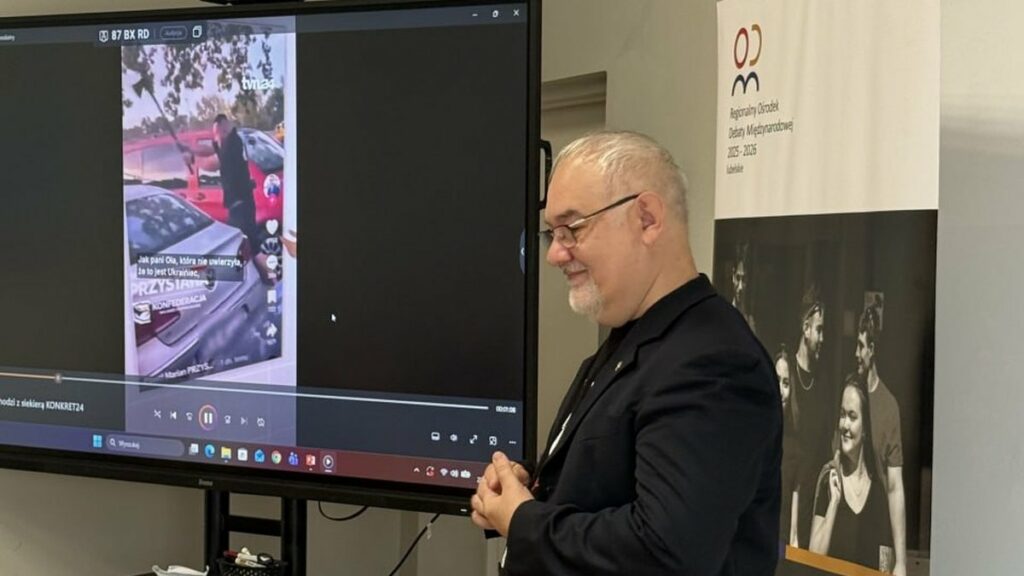
Probably the most widespread—and it’s still alive today, even though official sources have debunked it many times—is the claim that Ukrainians in Poland consume huge amounts of healthcare resources. Supposedly, Poland funds their treatment, and Poles have fewer opportunities to receive treatment than Ukrainian migrants. It started being fueled more or less in the autumn of 2022 and gradually gained traction. The peak came in 2024, when it spread in massive waves that Poland treats Ukrainians for free and Poles can’t get into hospitals because Ukrainians are there.
There was also fake news that Ukrainians get priority in queues and are registered first.
These are derivative fake news stories. Healthcare is a very painful topic in Poland, and certain groups deliberately choose precisely such sensitive topics to raise tension in society and stir up hostility. Hence: “Ukrainian soldiers in many cities have priority in queues, and Poles don’t,” and “Ukrainian children are being treated for cancer instead of Polish ones,” and “Ukrainians go to sanatoriums for rehabilitation, and there’s no room for Poles.” All of it revolves around one topic.
The downside is that official debunkings are one-off. Once the prime minister says it, once the health minister says it—that it’s not true. Meanwhile, the funds Ukrainians generate for the Polish budget exceed the costs of their treatment by roughly four times. Ukrainians earn money and pay taxes four times more than their medical care costs.
Hardly anyone also talks about the fact that over the last four years the European Union has allocated, according to estimates, about 40 billion euros to support Ukrainian emigrants. This money is often counted as part of the aid the EU has provided to Ukraine. But in reality it stayed in Poland: for maintaining refugees, medical care, paying for housing, vocational and language courses. But people don’t talk about that.
What advice would you give to a Pole who reads online: “Ukrainians live off our welfare,” “they take our jobs,” “they increased crime”? What should one pay attention to in order to ask oneself: is it true?
First of all, the headline. “Ukrainians are taking Poles’ jobs,” “Ukrainian women marry Polish men and Polish women are left without husbands,” “Ukrainians are criminals” — there are a lot of such messages. If the headline is short, punchy, and immediately stirs emotions — it’s a signal that something is wrong.
Please verify the information. Today, for example, Google has built-in artificial intelligence that cites sources and shows whether something is true — you don’t need to look for special fact-checking services. See where it was published. If the source is some post, page, or a Confederation website or portal, that is always a reason to think twice. It’s obvious that such information will not be disseminated by the prime minister, a minister, or a genuine authority.
And let’s remember that many such pieces of content are created using deepfakes: President Nawrocki, the prime minister, famous actors, politicians, celebrities supposedly call for something, when in reality nothing of the sort happened. These artificial images advertise something or urge something on social media — you need to pay attention to that. So before we share anything, let’s think about whom it serves. Let’s not spread such content — because we simply give someone the chance to take a trip to the Canary Islands or buy a new car: he released a fake news story, and we boosted it. Such content is paid for, and for example Facebook is reluctant to remove ads it profits from. And that’s tens of millions of dollars in profit a year.
A pact that “did not exist” for half a century
Today the Kremlin presents the Ribbentrop–Molotov Pact as a forced step by the Soviet Union, and even shifts part of the blame for the war onto Poland. Is this also disinformation, only spread out over decades? After all, the document exists, and responsibility is gradually being shifted onto the victim.
Of course. After the pact, Europe’s geopolitical map changed completely: World War II redrew the borders of many countries — Poland, Ukraine, and Russia itself. The Kaliningrad Oblast was created, which had not existed before.
You have to be very careful with such topics, because these forgeries are old; they didn’t come out of nowhere. The Soviet Union, through the mouths of all its foreign ministers, including Andrei Gromyko, right up to 1989 denied the very existence of the pact. So for fifty years Moscow denied that this document existed at all.
Even Polish historians tried not to say much about it. I have a book on the history of Polish diplomacy from the 1970s, and one can only be surprised: it names the Germans as the main cause of World War II, and the Soviet Union supposedly had nothing to do with it. This disinformation functioned for many years.
Under Gorbachev and Yeltsin, the pact was acknowledged, and under Putin this disinformation was brought back. At first it was still possible—I myself went to the Archive of the President of the Russian Federation and worked with documents. Today even Russian scholars have no right to use documents concerning World War II and the diplomatic relations of that time. It is a ban on truth and a ban on research. Putin closed access to the archives, forbade telling the truth, and officially allowed his version to be promoted—at the level of Patrushev’s security structures, the Ministry of Education, and school and academic textbooks. Russian textbooks are a very important topic. I spoke about them at one of the conferences—what is happening there is shocking.
There, it is allowed to say that the war broke out because it was impossible to divide up Gdańsk: it should have been handed over to the Germans, they failed to reach an agreement, diplomatic means were lacking. Any causes that whitewash the Soviet Union. Not to mention that in Russia it is forbidden to bring up the joint German-Soviet parades on Polish territory in the autumn of 1939.
Recently I was telling students about two foreign ministers: the current Russian one—Lavrov—and the then German one, Ribbentrop. Ribbentrop was a minister throughout the war and—like Lavrov—spread disinformation, lies, and manipulation. I asked how his life ended. The students replied: by suicide. But in reality he was hanged under the sentence of the International Military Tribunal in Nuremberg.
So the representatives of the Russian authorities—the foreign minister, the president, and others—are therefore awaiting, at best, sentences for crimes against humanity. Because what the Russian Federation is doing is the equivalent of the crimes from the time of World War II.
Start with dancing, not with a conference
If you were to become a mediator between Warsaw and Kyiv today, where would you begin? What would you pay attention to first?
I wouldn’t start with conferences, round tables, economic or political forums. They produce a much smaller effect than joint meetings of ordinary citizens—especially young people, who are the ones meant to build Polish-Ukrainian relations.
I wouldn’t involve people over sixty in this at all. As someone who knows how strongly information influences people, I’ll say this: the ages from 14 to 25 are the most receptive period to raise aware individuals—those who understand the historical context and understand that Poles and Ukrainians—as my teacher Bohdan Osadczuk used to say (ed. note: Ukrainian publicist, longtime contributor to Jerzy Giedroyc’s Paris-based “Kultura”)—are destined for good relations and coexistence. They have lived next to each other for over a thousand years, and no one has moved them to different continents. If they do not live in harmony, it will be very, very bad.
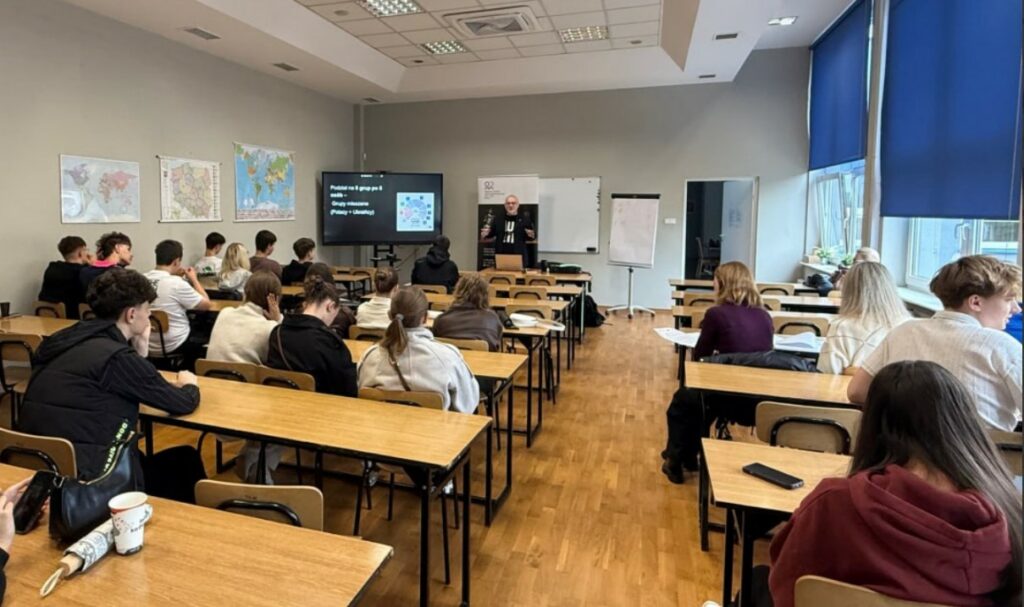
I often run training sessions for young people. The last one was very successful—for high school students aged 15 to 18 from Ukraine and Poland, 40 people. They worked on media education: they searched for information, prepared videos against hate, talked in an informal atmosphere. At the beginning, Ukrainians spoke mainly in English because it was hard for them to switch to Polish, and it was the same with the Poles. And by the end of the week everyone already understood one another: Poles—Ukrainian, Ukrainians—Polish.
In my opinion, it is precisely such projects that produce the greatest effect: informal meetings, youth exchanges, trips by Poles to Ukraine and Ukrainians to Poland, educational and cultural contacts. Cultural diplomacy achieves much more than academic diplomacy. Please believe me: a festival of traditional cuisine or Polish or Ukrainian cinema has a much greater impact than a two-day Polish-Ukrainian conference on historical topics.
Last week I spoke with Nadia Moroz-Olszańska, who runs a Ukrainian café in Kraków. She described how Ukrainian-Polish dance parties are organized there: young people come — Ukrainians, Poles, foreigners — and dance to Ukrainian and Polish folk songs. As she said, it connects people better than a million words: people dance, relax, absorb that culture and see how much we have in common. Is this the cultural diplomacy you are talking about?
Yes. There is a quote from one of the international experts on disinformation:
Hate and hostility appear when natural interest in one’s neighbor disappears.
If there is a desire to learn to dance, to watch your neighbor’s cinema, to see what they eat, how they cook, how they behave, how they dress, how they talk — if there is that curiosity, then there are also good, neighborly relations. And if it disappears and revenge for the crimes of ancestors comes to the fore — and the enemies of both Poles and Ukrainians are very interested in that — then the problems we see now begin: hatred, hostility. It is precisely from things like these dances, from cultural diplomacy, from so-called soft power that good neighborliness begins. On this, you can build good relations.
And then — economic and political?
Yes. After the cultural and neighborly ones come the economic, and only at the very end — the political aspects. That is how it should be, not the other way around. If one starts reconciliation between Poles and Ukrainians with a series of conferences of experts and scholars who in any case stick to their own views, each writes from their own side and criticizes exhumations, then there will be no quick positive effect. There will be marking time, which we absolutely do not need.
There is the formula “We forgive and ask for forgiveness” (editor’s note: with these words the Polish bishops addressed the German bishops in 1965; in 2005 it was repeated in a joint statement by the Synod of the Ukrainian Greek Catholic Church and the Polish Bishops’ Conference), initiated back in the days of Presidents Kwaśniewski and Kuchma at their meetings in the early 2000s. But that was over 20 years ago, and there is such a thing as generational memory. A generation is 25 years, and what happened then is already almost forgotten; it is history. Almost no one remembers that reconciliation. And it is a great pity that today we lack the readiness to forgive and to ask for forgiveness. There is nothing painful about it — to ask for forgiveness, and even more so to forgive. Because we have to move on.
After all, it is not a crime committed by you, but a crime committed by your ancestors, or some difficult, critical situation. Children cannot be held responsible for their parents, but they can try to ensure that hatred does not keep growing. And here we return to the Soviet context: only in the Soviet Union and in Nazi Germany were children held responsible for their parents’ crimes. We remember how many people were repressed — and their children were repressed as well. My mother, when she was six months old, was deported to Siberia for my grandfather’s political activity.
This is exactly what Russia would very much like in Polish-Ukrainian relations: for a resident of Zaporizhzhia, whose ancestors had nothing to do with the Volhynia tragedy, to be held accountable to Poles and condemned by them for what happened in 1943. Russia is very interested in this.
Why is war fatigue an illusion?
You say that Poles and Ukrainians are called to be good neighbors, because they have lived next to each other for over a thousand years. But there is also another neighbor — Russia, and it is not going anywhere. How do you live next to a neighbor from whom, over the last five hundred years, we have not seen anything good?
There is a very good book by Paweł Sztepa, “Moskowstwo” (editor’s note: Ukrainian émigré publicist; the full title of the book — “Moskowstwo: its origin, content, forms and historical continuity”), reissued several times. I also recommend the books by the Polish journalist Krystyna Kurczab-Redlich (editor’s note: for many years she wrote from Russia; author of the books “Pandrioshka”, “Head Against the Kremlin Wall”, and “Vova, Volodya, Vladimir. The Secrets of Putin’s Russia”) about the Russian Federation. It is worth conducting an interview with her: she reveals many interesting facts from Putin’s biography and about the Russian mentality — perhaps she will explain even better than I can who the contemporary Russian is.
I do not think that the Russian mentality in itself is a threat to Europeans. However, we have an interesting phenomenon: within ten years, disinformation and propaganda in Russia have generated hatred among Russians toward Ukrainians that did not exist until the middle of the first decade of the 21st century. The level of this hatred was gradually stoked, and today it is at such a stage that, according to estimates, 95% of Russians hate Ukrainians — because of streams of disinformation and propaganda. A nation whose mentality is so unstable and subject to such influences is easy to manipulate. Goebbels once said: if you repeat a lie to people a thousand times, they will start to believe it. That is exactly what is happening in Russia.
I don’t venture forecasts. But if something completely different doesn’t happen in Russia over the next 10–15 years, society there won’t think differently about Europe, America, or Ukraine. It’s an example of a society without classic European traditions and democracy. It lives by the carrot-and-stick principle; it’s indifferent to who votes for whom, because it will be as the authorities say anyway. And it needs a tsar-father who will decide everything for it. This mentality, frozen in the feudal 19th century, is easy to manipulate. That’s why Putins rule there—they feel very comfortable there. A democratic leader of Nemtsov’s caliber is unrealistic for Russia, because he allows people to live in freedom, and the average Russian doesn’t want to live in freedom—he wants a tsar.
I agree that there is an aware Russian diaspora that opposes the war and embraces democratic principles. An example is Garry Kasparov, who was recently in Warsaw and, in my opinion, has a very good civic attitude. But let’s not forget: a Russian passport is often a small but hidden element of Russia’s soft power. People who leave Russia but do not renounce their citizenship still feel the pull of the homeland. We have examples of journalists and scholars who left Russia back in 1922 but did not renounce imperial traditions: “Let Russia not fight Ukraine, let there be peace, but after all we are an empire, we are among the strongest in the world.” These imperial thoughts remain in a person with a Russian passport.
And one more important thing: a Russian passport is very easy to obtain. Russian law has changed so that any citizen of the world can come to the embassy and write an application: “Mentally, I feel Russian and I want to receive Russian citizenship.” And Russia will give it to them. In America, Poland, or Ukraine this is absolutely impossible. It’s a completely absurd situation.
Some Poles have become weary — of the war in Ukraine, of the fact that Ukraine has become such a huge topic in their information space and in their lives. What could we, Ukrainians, say to them? Or would it be better to say nothing?
This can be explained with a simple example of Germany in the 1930s, which is in both Polish and Ukrainian textbooks and which all Europeans know. In 1933, in the name of political compromises, a coalition government headed by Adolf Hitler was allowed to be formed in Germany. That is when the persecutions began — first of communists, then of Jews — and it all ended with World War II.
We forget that this weariness is illusory, because the geopolitical interests of Poland and Ukraine’s neighbor do not change at all. They are counting on us getting tired, wanting it all to end, and agreeing to imposed conditions. And if we agree, they will impose even more, and even worse ones.
In 1933, Germans did not see any threat in Hitler. He promised jobs, new living space for Germans, economic development — and people voted for him. Seemingly everything was fine. And how did it end? From the East today come the same promises. The President of Russia is following exactly the same path. He himself sends his own citizens to their deaths. How should this be judged? The President of the United States can send a thousand soldiers by plane to rescue two Americans, because they are U.S. citizens. And the President of Russia sends hundreds of thousands of people into a senseless war for his own geopolitical interests.
That is why this fatigue is deceptive. It is only needed to lull us to sleep — and we will wake up in a completely different reality. If we say: “Alright, Europe is tired; let Ukraine give up half its territory, let Russia do whatever it wants there, and we’ll live calmly” — it won’t be like that. It won’t be like that, because we have completely different experiences. If agreements are concluded the way Russia dictates to Europe and the world, it will end the way Putin says: wherever the Russian boot has stood, there is Russia. From Crimea to Warsaw, Berlin, and other territories. They will not stop.
So let us not give in to such influences. This may be the beginning of a very difficult geopolitical situation — up to open aggression, which Europe fears greatly. It would mean changing the map of Europe, the rules of geopolitics, international law, and the rules of how the UN operates, which already blocks most decisions anyway, because a permanent member of the Security Council with veto power is Russia. Conservative Europeans, the conservative world, are very afraid of deterioration, and unfortunately many experts believe that peace can be achieved at Ukraine’s expense. That was already the case in Munich in 1938, when Chamberlain came and, through agreements, they wanted to push the war away.
We know well how that ended.
Interview by Nadiya Halushka
Source: Nowiny Wschodnie
© Nowiny Wschodnie. Publication and distribution of the material only with attribution of the author and an active link to the original article.

What do you think about this story?
Join the conversation. Please keep comments relevant to the article.
Write a comment