

Over 5.5 thousand reactions and 826 comments according to Facebook’s counter. The Nowiny Wschodnie editorial team carried out a detailed analysis of the discussion under its own post asking about voting again for Karol Nawrocki.
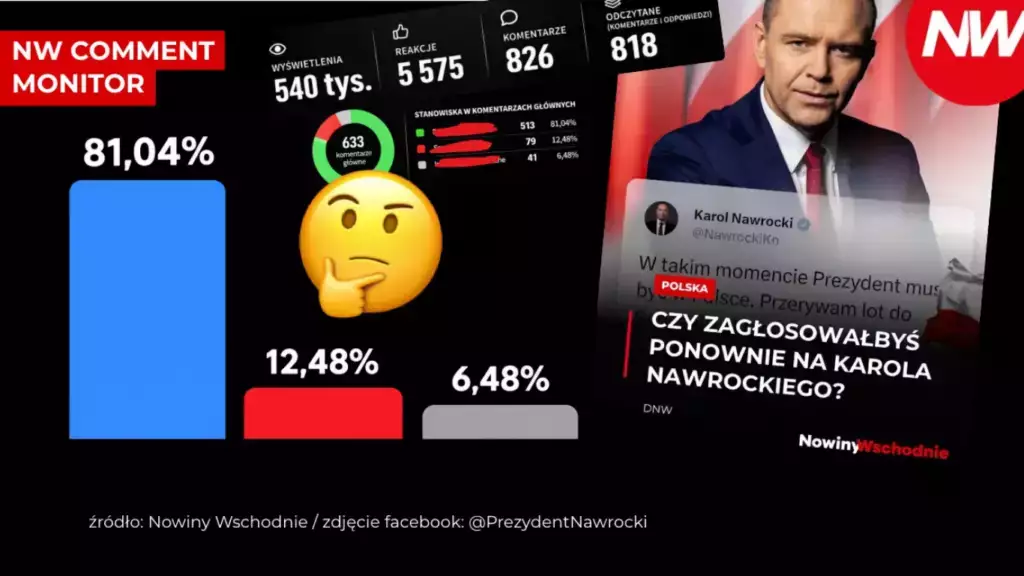
Why did we decide to analyze the comments?


On Nowiny Wschodnie’s Facebook profile, we posted the question:
“Would you vote for Karol Nawrocki again?”
The post took the form of an informal online poll. We encouraged readers to share their opinions and, above all, to answer the question of whether they would vote again for the current President of Poland.
The post sparked a lot of activity. Hundreds of comments and thousands of reactions appeared, and the discussion quickly went beyond simple declarations of “yes” and “no.”
We therefore decided to check which positions actually dominated among the statements, which arguments appeared most often, and to what extent the discussion was based on assessments, emotions, and claims requiring verification.
We did not want to limit ourselves to just a few of the most visible comments or select statements that fit a particular thesis. We wanted as broad and orderly a view as possible of the entire available discussion.
Nowiny Wschodnie is a portal independent of political parties. The people who co-create the editorial team may hold different views; however, our shared duty is to present facts reliably.
We do not intend to persuade readers whom they should vote for. One of the aims of our activity is, however, to counter disinformation, propaganda, and hate speech, regardless of which side of the public debate they come from.
How did we conduct the analysis? NW Comment Monitor
To carry out the study, we used NW Comment Monitor – a tool for the systematic retrieval and analysis of comments published under Nowiny Wschodnie posts.
The system uses the official Meta Graph API interface, version v26.0.
The control data readout began on 2 November 2026 at 18:44:38 Polish time.
The tool retrieved available comments and replies, moving through successive pages of results provided by the API. The obtained datasets were then compared, duplicate records with the same identifiers were removed, and the completeness of the readout was checked.
In the next stage, an analysis of the content of main comments was conducted, covering declarations of support, opposition, and ambiguous statements.
Recurring phrases, selected linguistic indicators, the nature of the discussion, and claims potentially requiring verification by the editorial team were examined separately.
An artificial intelligence assistant and text analysis rules were used in the process.
The classification of positions was a single review supported by AI. It was not independently verified by a second reviewer; therefore, its results should be interpreted taking into account the possibility of misjudging statements, especially ironic or ambiguous ones.
The analysis did not include obtaining users’ private information or circumventing restrictions on access to data.
How many comments did we actually analyze?
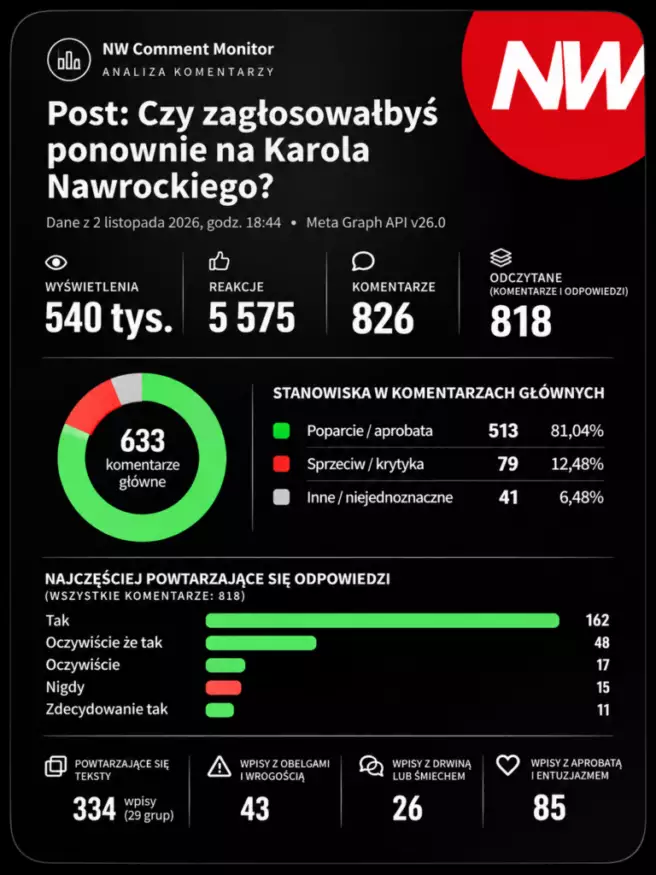
At the time of the first observation, Facebook showed 826 comments and 5534 reactions.
The number of reactions changed during subsequent readings. The control script recorded 5572 reactions, and the last full test – 5575.
At the time the article was prepared and published, the post had accumulated 5810 reactions and 827 comments.
These are not contradictory results, but readings taken at different times.
NW Comment Monitor obtained a total of 818 unique entries, including:
- 633 top-level comments,
- 185 replies to comments.
This means that the number of retrieved records corresponded to 99.03% of the value indicated by the counter of 826 comments.
The remaining eight entries could not be read.
We do not know the reason for this discrepancy. It may have resulted, among other things, from visibility restrictions, changes in the discussion, or differences in the way Facebook counts data.
However, we cannot confirm any of these hypotheses.
Therefore, we emphasize that the report covers 818 statements actually read, and not all comments that may have existed at a given moment.
Analysis results: more than 81% of top-level comments expressed approval
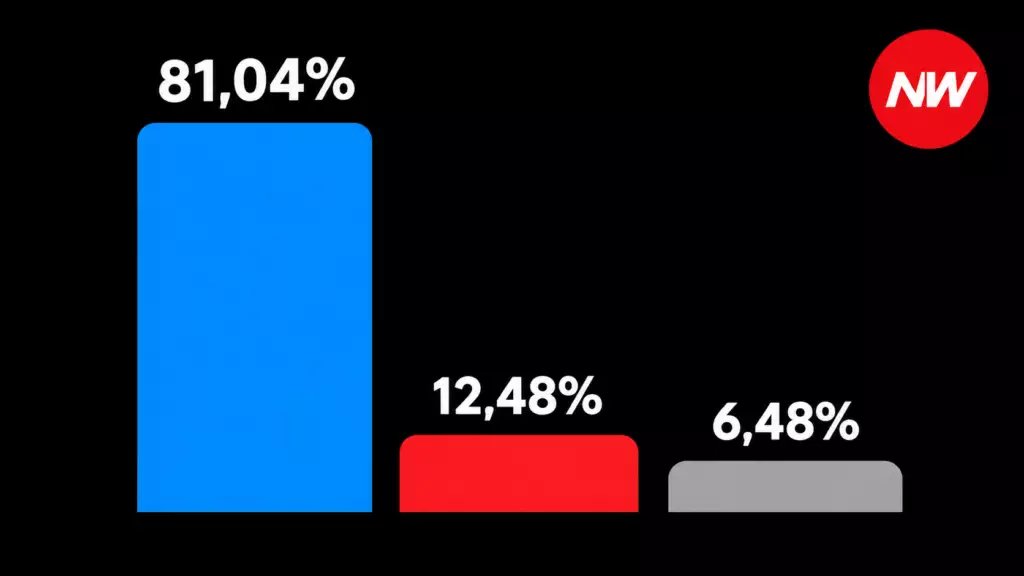
The most important element of the study was the classification of 633 top-level comments according to the stance expressed toward the editorial question.
We obtained the following results:
| Stance | Number of comments | Share |
|---|---|---|
| Support or approval | 513 | 81.04% |
| Opposition or criticism | 79 | 12.48% |
| Other or ambiguous | 41 | 6.48% |
| Total | 633 | 100% |
Among the analyzed top-level comments, statements positively assessing Karol Nawrocki or declaring readiness to vote for him again clearly predominated.
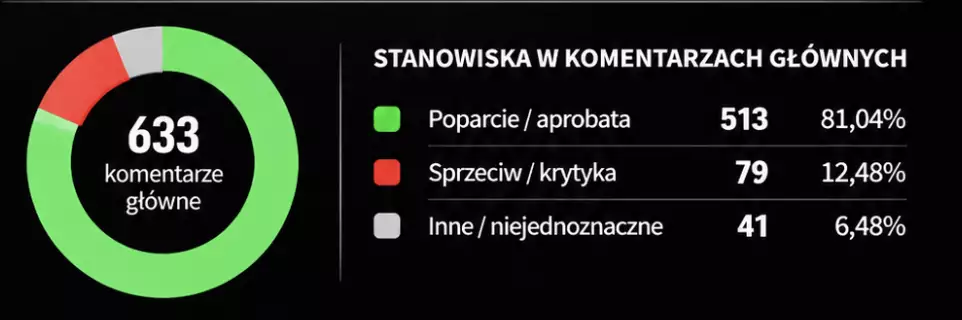
Critical comments constituted a smaller part of the discussion. They included both short negative responses and more extensive opinions regarding the president’s public activity.
The third category included statements not directly related to the question, ambiguous comments, alternative declarations, and entries with no text.
Does this mean that 81% of Poles support Karol Nawrocki? Definitely not.
The result of 81.04% refers only to the main comments analyzed under a single post by Nowiny Wschodnie.
This is not the result of a representative public opinion poll.
Participants in the discussion decided on their own to speak up. They were not randomly selected for the research sample, and the system did not allow us to determine the number of unique commenters.
One person could post more than one comment. We also do not know the opinions of people who saw the publication but did not decide to comment on it.
Therefore, there are no grounds to extrapolate these proportions to all followers of Nowiny Wschodnie, Karol Nawrocki’s voters, or Polish society.
Why didn’t we include replies in the poll result?
Out of 818 read entries, 185 were replies posted within existing discussion threads.
They were not included in the calculations of support and opposition.
The reason is simple: a “yes” or “no” reply addressed to another user does not necessarily refer to the question asked by the editorial team.
It may mean agreement with someone else’s comment, opposition to a specific argument, or be part of a completely different conversation.
Automatically adding such statements to the result could lead to misinterpretation.
We used the replies instead to analyze the style of the discussion, recurring arguments, and the presence of offensive language.
What opinions and arguments appeared most often?
The analysis identified several recurring themes.
In positive comments, there were assessments portraying Karol Nawrocki as a strong leader, a patriot, and someone representing Poland’s interests.

Some users emphasized their satisfaction with the choice of president, while others compared him with political rivals.
The discussion repeatedly referenced Donald Tusk and Rafał Trzaskowski.
Critical comments focused, among other things, on assessments of the president’s public activity, his biography, and his behavior.
Some statements contained claims about specific events that require separate verification.
A lexical analysis of all 818 posts showed the following numbers of matches:
| Topic or group of terms | Number of posts |
|---|---|
| Poland, Poles, patriotism, or the Polish flag | 82 |
| Donald Tusk and the indicated nicknames | 34 |
| Criminal allegations, prison, or intoxicants | 28 |
| Terms such as “the best,” “wonderful,” “great,” “a statesman” | 20 |
| Germany, Berlin, or Angela Merkel | 11 |
| Mentions of assault, yanking, pushing, or Ms. Ania | 9 |
| Ukraine, Ukrainians, and selected insulting terms | 5 |
| Allegations concerning bots, trolling, or fake accounts | 4 |
The above categories may overlap. A single comment could contain several of the analyzed terms.
Importantly, detecting a given word does not automatically mean that its author supports a particular narrative.
For example, a user could quote an insulting term in order to criticize it.
Therefore, we treat the results of the lexical analysis as indicators of topic occurrence, not as a measurement of the political beliefs of individual people.
Emotions and the language of the discussion. Not all comments were about the president
The analysis also showed that some conversations quickly turned into disputes among the commenters themselves.
Alongside substantive opinions and brief declarations, there were insults, mockery, offensive references to age and gender, as well as anti-Ukrainian and homophobic terms.
Across the entire set of 818 posts, the lexical analysis found:
| Language indicator | Number of posts |
|---|---|
| Expressions of approval or enthusiasm | 85 |
| Hostile or insulting terms from the adopted list | 43 |
| Selected signs of mockery or laughter | 26 |
| Words associated with shame, regret, or disgust | 8 |
These results do not mean that exactly 43 comments constituted hate speech within the meaning of the law.
The system identified certain words and phrases. Assessing their meaning requires taking context into account.
Similarly, the presence of a laughing emoji does not necessarily mean mocking a specific person.
For the editorial team, it is particularly important to distinguish between political criticism and statements that violate the rights of others.
Criticizing the president, the government, the opposition, or the media is a natural element of democratic debate.
It should not be automatically equated with disinformation or hate speech.
Threats, incitement to violence, or statements that demean specific individuals or groups should be assessed differently. However, each such case requires an individual analysis.
Were there bots commenting under the post? We checked how repetitive the statements were
One of the questions that arises with intense political discussions on the internet is the authenticity of accounts and the possible automation of comments.
In our study, we checked the repetitiveness of the texts and the availability of basic information about the profiles.
After standardizing letter case, removing punctuation and emojis, and tidying up spacing, the tool detected 29 groups of identical, non-empty statements.
In total, they covered 334 posts.
The most frequently repeated replies are:
| Reply | Number of occurrences |
|---|---|
| “Yes” | 162 |
| “Of course yes” | 48 |
| “Of course” | 17 |
| “Never” | 15 |
| “Definitely yes” | 11 |
| “No” | 9 |
| “Yes yes yes” | 9 |
| “Always” | 8 |
Does such repetitiveness mean that bots posted the comments?
No. We have no grounds for such a conclusion.
Our publication encouraged short answers. It is therefore natural that many people used the same words.
The mere presence of identical declarations is not evidence of automation, coordination, or buying comments.
Among the downloaded content, one long bilingual entry containing a call to share was also identified. It may require a separate editorial assessment; however, in this case as well, its origin and the method of distribution were not established.
What do we know about the commenting profiles?
NW Comment Monitor also attempted to read, via the API, the available information about the authors of the statements.
We wanted to check whether it is possible to determine the presence of profile photos, account creation dates, and the number of friends.
However, the results showed significant access limitations.
Out of 818 entries, the author data and information regarding the profile photo were obtained for only one record.
For the remaining 817 entries, the relevant fields were not made available.
It was also not possible to obtain account creation dates or the number of friends.
This means that we cannot reliably assess the age of the profiles, their activity, or the number of unique discussion participants.
Nor can the absence of data about a profile photo be equated with an actual lack of a photo.
Therefore, we do not specify any percentage share of bots, fake accounts, or organized groups of commenters.
Such claims would require additional, reliable evidence.
Disinformation and unverified allegations
The analyzed comments also included claims concerning alleged crimes, politicians’ behavior, legal proceedings, announcements of asylum in the United States, and historical disputes.
Some statements were opinions, while others contained specific claims about facts.
This is an important distinction.
Saying that someone does not support the president or considers him a bad politician is an assessment.
By contrast, attributing a specific crime, particular behavior, or a legal decision to a specific person may be a claim that requires verification.
As part of NW Comment Monitor, several topics were identified for possible further verification, including allegations concerning an incident involving a woman referred to in the comments as Ms. Ania, information about an alleged announcement of asylum in the USA, and selected claims regarding the biography and public activity of politicians.
Based on the comments alone, the truthfulness of these allegations cannot be confirmed.
Nor do we automatically regard them as disinformation.
Only confronting them with documents, credible accounts, recordings, and other source materials allows for a reliable assessment.
Do Facebook reactions show political support?
More than 5.5 thousand reactions were recorded under the post. (At the time of publication of the article, the post had gathered 5,810 reactions)
This is an important indicator of interest in the post, but it cannot be equated with the number of votes cast in an informal poll.
Facebook reactions can express different emotions and intentions. A user may react to the question itself, the photo, the content of the post, or the ongoing discussion.
We did not conduct a separate analysis of the distribution of individual reaction types, so we do not attribute specific political positions to them.
We also do not have data on the post’s reach that would allow us to assess what percentage of people who saw the post decided to interact with it.
The number of reactions therefore shows the scale of activity around the post, but it is not a measure of electoral support.
What really follows from our study?
The key conclusion is unequivocal: among the 633 analyzed top-level comments under a specific Nowiny Wschodnie post, statements expressing support or approval for Karol Nawrocki predominated.
They accounted for 81.04% of the classified top-level comments.
At the same time, the study revealed a great diversity of forms of expression—from simple declarations, through political arguments, to personal disputes and unverified allegations.
However, we did not determine what the actual level of support for the president in Poland is.
We did not determine the number of unique participants in the discussion, nor did we confirm the involvement of bots.
We also cannot rule out the influence of the way the post was distributed by Facebook’s algorithm, the platform’s audience structure, or the motivations of people deciding to comment.
Therefore, the presented results should not be compared directly with representative election polls.
They are a picture of a specific online discussion, conducted in a particular place and time.
Why are we publishing the results?
At Nowiny Wschodnie, we believe that the role of the editorial team is not only to report on events, but also to explain how the presented data are produced and what the limits of their interpretation are.
Social media have become one of the most important venues for public debate. At the same time, individual comments taken out of context are sometimes used to build misleading pictures of public sentiment.
That is why we decided to present the results along with the methodology, the number of statements actually read, and the study’s limitations.
We do not hide the fact that analysis using automated tools may contain classification errors. Nor do we claim that we gained access to all data about the commenters.
Our goal is to develop journalism based on facts, transparent methods, and honest interpretation.
We do not expect unanimity from readers. Differences of opinion are a natural part of democracy.
We believe, however, that even the most emotional political discussion should leave room for mutual respect, fact-checking, and responsibility for the words being spoken.
Study methodology
Prepared by: Nowiny Wschodnie Editorial Team
Tool: NW Comment Monitor
Data source: Meta Graph API v26.0
Analysis date: 2 November 2026
Start of control readout: 18:44:38 Polish time
Analyzed publication: “🇵🇱 Would you vote again for Karol Nawrocki?”
Number of entries read: 818
Main comments: 633
Replies: 185
Facebook counter during the first observation: 826 comments
Method: Data readout via API, record deduplication, AI-assisted content classification, and lexical analysis.
Study limitations: No representative sampling, no independent verification of the classification by a second reviewer, eight records missing compared to the Facebook counter, no data enabling determination of the number of unique commenters, and limited access to profile information.
Rights to the study
© 2026 Nowiny Wschodnie. Original editorial study.
When using the results of the analysis, please indicate the source: “Nowiny Wschodnie, NW Comment Monitor, 2 November 2026” and provide a link to the original publication.
Use of elements of the study protected by copyright is subject to applicable regulations. This reservation does not limit the statutory right of quotation or the use of facts and numerical data not covered by copyright protection.

Journalist and Editor-in-Chief of Nowiny Wschodnie, a news platform followed by more than 140,000 people on social media. A graduate in Journalism and Social Communication, he has been co-creating and developing Nowiny Wschodnie since 2017. He gained professional experience working with local and international media.
He specializes in fact-checking, countering disinformation and propaganda, and information security. His work focuses on Poland, Ukraine, Eastern Europe, and Polish-Ukrainian relations. He is also the founder of a non-profit organization working in the fields of integration and intercultural dialogue.
What do you think about this story?
Join the conversation. Please keep comments relevant to the article.
Write a comment