
From the very first hours after the tragedy of 2 May 2014, Russian media began portraying the events in Odessa as a repetition of the crime committed during World War II in the Belarusian village of Khatyn. The similarity was supposed to be obvious: Ukrainian nationalists, defenseless people, a locked building, and fire. The problem is that this story was not a description of events, but a carefully constructed propaganda narrative. Its purpose was not only to distort the picture of the Odessa tragedy, but also to present Ukraine as a state ruled by Nazis.
Propaganda manipulation


Russian propaganda did not need much time to find a term that was to dominate the way the events in Odesa on 2 May 2014 would be talked about for many years. Already in the first hours after the tragedy, the phrase “Odesa Khatyn” appeared. This pairing of names was no coincidence. It referred to one of the most recognizable tragedies of World War II in Belarus, and at the same time to a symbol that for decades held a special place in Soviet historical policy.
The message was simple and extremely evocative. In Odesa, Ukrainian nationalists were said to have acted exactly like the Nazi perpetrators and their collaborators in 1943. Defenceless people—among them women, the elderly and children—were allegedly locked in the Trade Unions building and then burned alive by Ukrainian fascists. Propaganda materials showed images of people jumping out of windows, chants of “Glory to Ukraine!”, and stories about an alleged ethnic cleansing.
In this way, the term “Odesa Khatyn” became something far more than just an emotional comment on tragic events. It began to function as a ready-made interpretation of the entire day of 2 May. Before information about the course of the clashes in central Odesa had even been gathered and verified, audiences were being given the answer as to who was the executioner, who the victim, and what the alleged purpose of the whole operation was.
To understand why this narrative proved so effective, one must first go back to March 1943.
Khatyn – a real tragedy
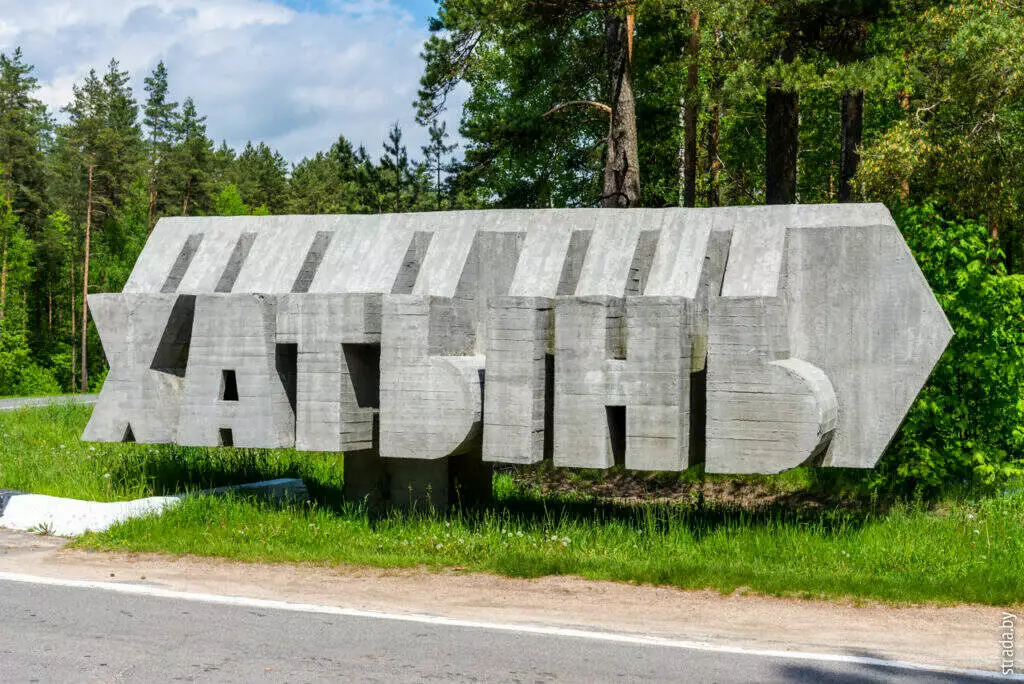
Khatyn is a small locality in Belarus, located about 60 kilometres north of Minsk. On 22 March 1943 it was destroyed during a German reprisal action. 149 residents were killed, including 75 children. Some people were burned alive in a wooden barn; the others died from bullets. Only a few managed to survive.
The immediate backdrop to the tragedy was the activity of Soviet partisans, who attacked a German convoy. As a result of the clash, several officers of a German police formation were killed. The Germans applied the principle of collective responsibility, directing reprisals against the inhabitants of a nearby village.
The pacification was carried out by German officers as well as members of the 118th Schutzmannschaft Battalion, an auxiliary unit of the German police composed largely of Ukrainian collaborators. Among those playing an important role in the battalion was Hryhoriy Vasura, a former lieutenant of the Red Army who, after being taken prisoner by the Germans, went over to the occupier’s side. However, this was not a unit of the Ukrainian army, nor a formation representing Ukrainian society. It was a unit operating within the structures of the German occupation apparatus.
It is worth emphasizing this fact, because it was precisely the participation of Ukrainian collaborators that later became one of the most frequently used elements of a propaganda narrative, since in Soviet and contemporary Russian historical narratives it is very easy to move from the responsibility of specific people and formations to assigning guilt to an entire nation. Meanwhile, responsibility for the crime in Khatyn lies with the perpetrators acting within the German occupation system. This does not change the fundamental fact: the inhabitants of Khatyn were innocent victims of the German policy of terror and collective reprisals.
The history of Soviet manipulation
After the end of World War II, Khatyn for some time remained one of many Belarusian localities destroyed by the German occupiers. During the war in Belarus, thousands of villages and settlements were burned. In many cases, their inhabitants were also murdered. Khatyn’s tragic fate was therefore not an isolated event, although over time it was this locality that became the most important symbol of German repression in Belarus.
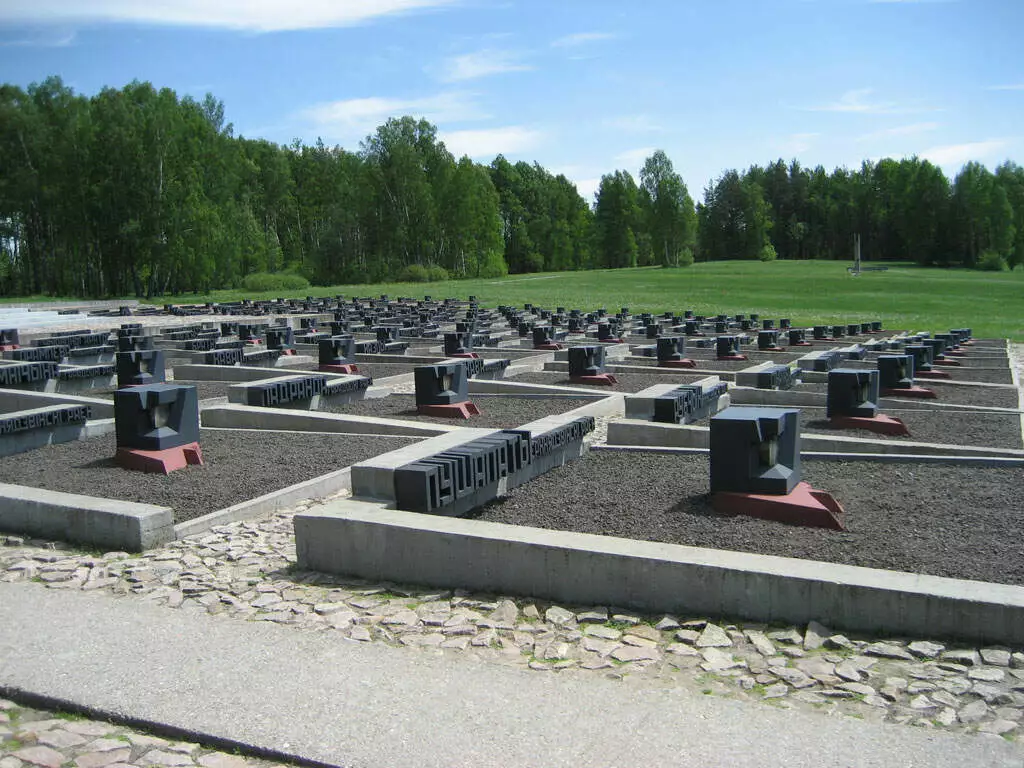
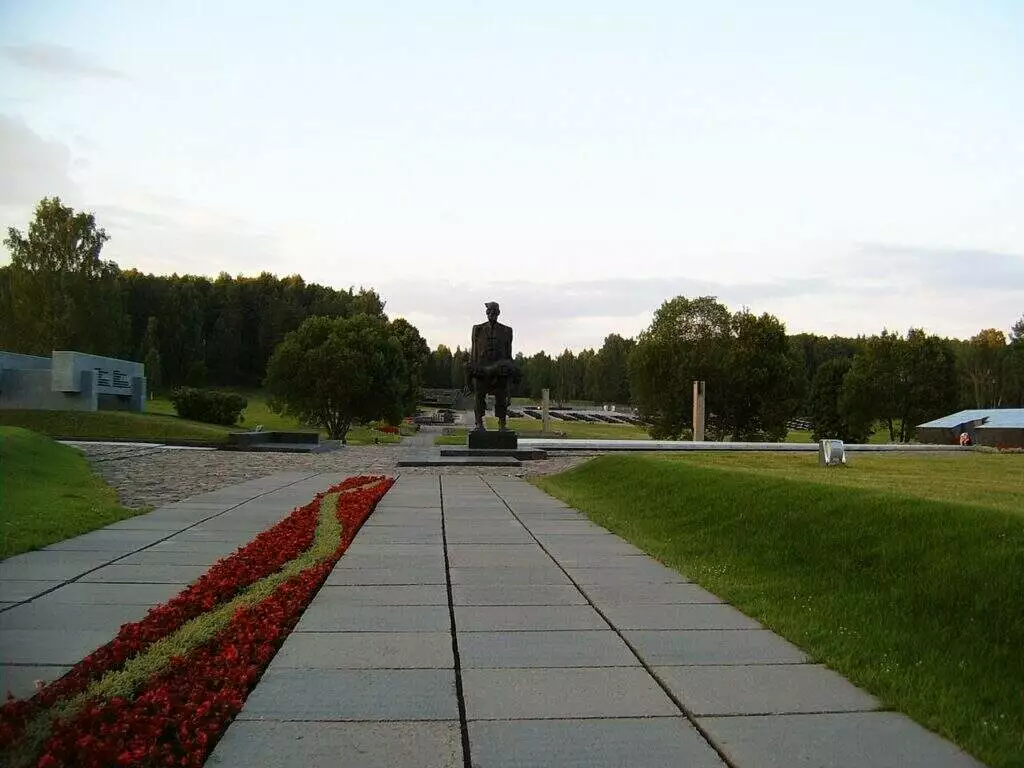
The idea to commemorate the residents emerged in 1965. Four years later, in 1969, a monumental memorial complex was opened. Its central element is a six-meter-tall sculpture depicting a man holding the dead body of a child. The figure symbolizes Józef Kamiński, one of the few surviving residents of the village. After regaining consciousness among the corpses, he found his son, who died in his arms.
Within the memorial grounds, the places where the burned houses had stood were also reconstructed. Twenty-six symbolic foundations were created, and in each of them an obelisk was placed resembling the chimney of the destroyed building. The entire complex covers about 32 hectares.
Khatyn was meant to commemorate not only the 149 murdered residents, but also thousands of other Belarusian localities destroyed during the occupation. Over time, it became a site of obligatory visits by foreign delegations, politicians, and representatives of various countries. Among those who visited it were Richard Nixon, Fidel Castro, Rajiv Gandhi, and Yasser Arafat.
Commemorating the victims of German terror itself raises, of course, no doubts. The problem is that the memory of Khatyn was incorporated into the broader historical policy of the Soviet Union, which also served very inconvenient aims for Moscow. One of them was the consistent concealment of the truth about the Katyn massacre.
Khatyn and Katyn – a similarity of names that was exploited politically
For a Polish reader, the similarity of the names Khatyn and Katyn is particularly striking. In English, the Belarusian locality is written as Khatyn, which further increases the possibility of confusion. These are of course not the same places or the same events. Khatyn is a Belarusian village destroyed by German units and collaborators in 1943. Katyn, on the other hand, is associated above all with the NKVD crime of 1940, when thousands of Polish officers, officials, and representatives of the Polish intelligentsia were murdered.
The Katyn massacre was extremely inconvenient for the Soviet authorities. It revealed the true face of Soviet policy toward Poland and undermined the propaganda image of the Soviet Union as solely the liberator of Europe from Hitler’s occupation. For decades, Moscow assigned responsibility for the murder of Polish prisoners to the Germans. The Katyn lie became one of the most important elements of Soviet historical policy.
The selection of Khatyn as the site of a monumental memorial and the later highlighting of this name in propaganda did indeed contribute to blurring the difference between Khatyn and Katyn. The similarity of the names was exploited in publications, propaganda materials, and during foreign visits.
However, precision must be maintained: the claim that the entire complex in Khatyn was from the outset designed solely to conceal Katyn is an oversimplification. The memorial also had the genuine function of commemorating victims of German repression. One can, however, say that the Soviet authorities consciously exploited the similarity of the names and monopolized the narrative about war crimes, while simultaneously concealing their own crimes.
It is precisely this mechanism that is particularly important for understanding the later use of Khatyn in Russian propaganda concerning Odesa.
How was the “Odesa Khatyn” born?
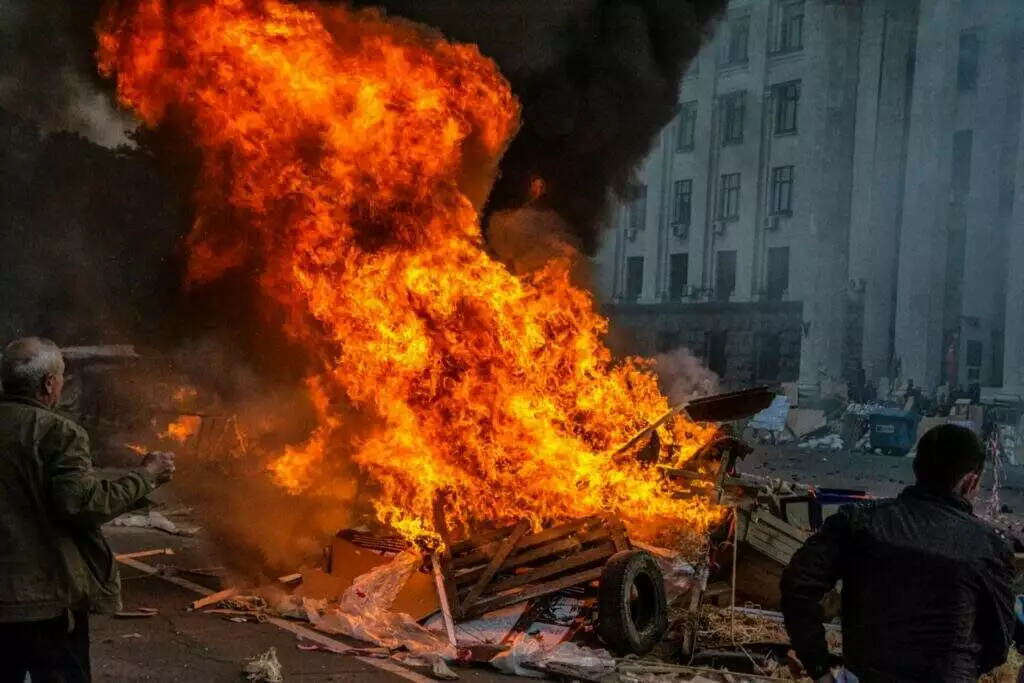
Let’s go back to May 2, 2014. The term “Odessa Khatyn” appeared in the public space around midnight on the website of one of the local Odessa newspapers. It was then quickly picked up by Russian media, bloggers, and social media users. By the morning, it was also being used in the official Russian media narrative. Russian portals, newspapers, TV programs, and bloggers began portraying the fire at the Trade Unions Building as a deliberately planned action by Ukrainian nationalists. In this narrative, there was no room for questions about what had happened earlier in the city center, why clashes broke out, who took part in the riots, and what actions the various groups undertook. It was enough to repeat propaganda claims thousands of times for audiences to start automatically associating the events in Odessa with the massacre in a Belarusian village. The recipient was given a ready-made picture: Ukrainian fascists surrounded the building, drove innocent people inside, locked the doors, and set the place on fire. They were then supposed to watch the trapped people die, shouting nationalist slogans. This was precisely the image that was meant to remain in memory.
What happened in Odessa on May 2, 2014?
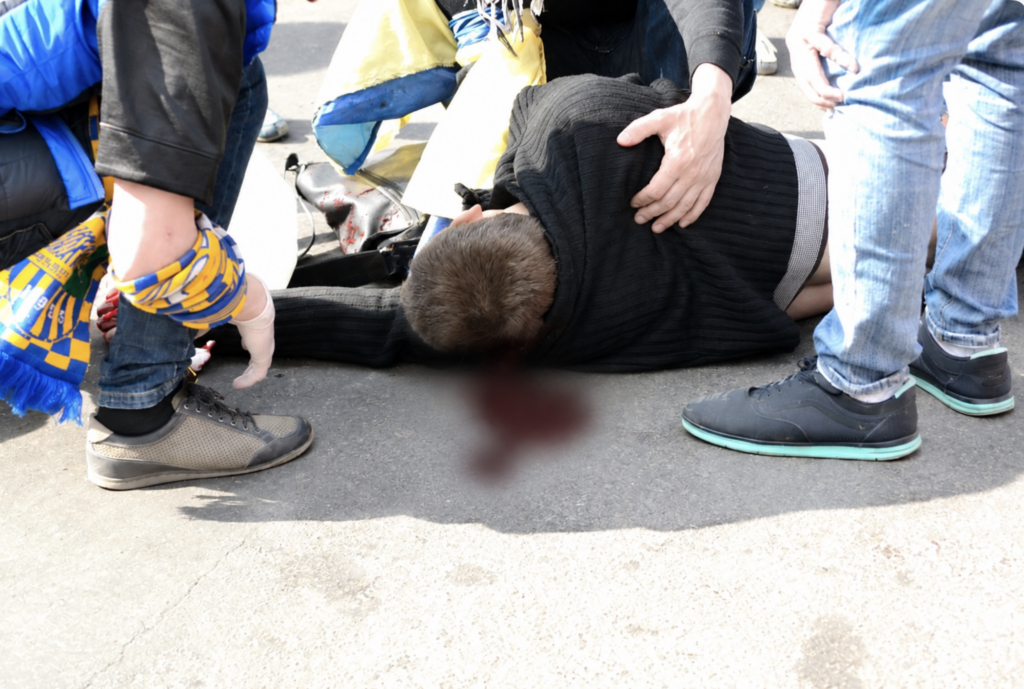
It is impossible to describe the tragedy in Odessa reliably without taking into account the events that had unfolded earlier. That day, violent clashes occurred in the city center between participants in a march of pro-Ukrainian football fans and activists and opponents of Euromaidan. During the riots, among other things, firearms, stones, and Molotov cocktails were used. People were killed, and the number of injured reached into the hundreds.
After the clashes in the city center, some of the Anti-Maidan participants retreated to Kulikovo Field, where their tent camp was located. A crowd of pro-Ukrainian activists soon arrived there. The tents were set on fire, and Molotov cocktails were thrown toward the Trade Unions Building. Opponents of Euromaidan took shelter in the building, but there were also people there connected with the pro-Ukrainian camp.
As a result of the fire and the day-long riots, 48 people were killed. Most of the victims died in the Trade Unions Building. And this is precisely what one of the most important Russian manipulations is about: real negligence, incompetence of the services, violence and people’s deaths were used to construct a completely different story—a story about a planned murder carried out by the Ukrainian state.
Were people driven into the building and locked inside?
One of the basic elements of the propaganda narrative was the claim that Anti-Maidan participants were forcibly driven into the Trade Unions House, then locked inside it and set on fire. However, this does not match the findings about how the events unfolded.
Some Anti-Maidan activists entered the building even before the crowd of pro-Ukrainian demonstrators arrived at Kulikove Field. This, of course, does not mean their behavior was sensible or that they could foresee all the consequences of staying in the building. They did, however, have the opportunity to leave the square before the situation escalated.
It is also important that there were pro-Ukrainian activists in the building as well. One such group took shelter from the fire in the conference hall on the third floor. It is difficult to reconcile this fact with the propaganda version according to which the entire building was covered by a uniform, pre-prepared operation whose participants knew exactly what was happening inside.
This does not mean that there were no attacks on people, that Molotov cocktails were not thrown toward the building, or that all participants in the events acted rationally. On the contrary. It was a violent, chaotic, and dangerous situation in which the behavior of individual people had tragic consequences.
But the Trade Unions Building was not a wooden barn in Khatyn. One cannot automatically transfer the image of the German pacification from 1943 onto the events in Odesa.
It is also important that Russian propaganda consistently ignored earlier clashes in the city center, casualties on both sides, and the involvement of various groups in the escalation of violence. Such selective presentation of facts made it possible to create a story in which one side was solely a defenseless victim, while the other was an organized group of murderers.
Dehumanization as the goal of the propaganda operation
The term “Odessa Khatyn” had yet another very important purpose. It was not only about portraying Ukrainians as the perpetrators of a specific tragedy. It was about calling their humanity into question and creating an image of the entire nation as a community made up of ruthless fascists. In propaganda messages, Ukrainians began to be portrayed as people capable of the worst atrocities against anyone who did not share their views. Labels such as “Banderites,” “neo-Nazis,” and “fascists” were repeated. Viewers of Russian television were supposed to believe that in Ukraine power had been taken over by forces that intended to physically eliminate Russian-speaking residents.
This mechanism can be described using the concept of cultural trauma. It refers to a situation in which a particular event is introduced into collective consciousness as an experience that threatens the fundamental values and sense of security of a given community. It does not have to involve a personal experience of violence. An appropriately constructed message, repeatedly broadcast by the media and authorities, is enough.
In the case of Russian society, the image of Odessa was intended to provoke a reaction similar to the one that, among many Ukrainians, was triggered in 2022 by information and photos from Bucha. In both cases, audiences were confronted with an image of cruelty that was meant to arouse not only terror but also a desire for revenge.
In the Russian media space, there were comments about “non-humans,” “monsters,” and “worse than fascists.” The Ukrainian soldier ceased to be perceived as a person defending their own country. In the propagandistic image, he became a representative of a criminal collective that must be punished. Such portrayal of the enemy makes social acceptance of violence easier. If an entire society is presented as a threat, war can be framed not as aggression, but as a necessity to defend against alleged evil.
From the Odessa Khatyn to justifying Russian aggression
The narrative about the Odessa Khatyn did not end in 2014. On the contrary, over the following years it was consistently used as one of the arguments meant to justify Russia’s actions toward Ukraine. This was especially clearly visible on February 21, 2022. That day Vladimir Putin delivered a speech in which he announced the recognition of the self-proclaimed Donetsk and Luhansk republics as independent states. The decision was accompanied by the signing of documents paving the way for the deployment of Russian troops on their territory.
In the speech, Putin again invoked the events in Odessa. He said: “It is impossible to recall the terrible tragedy in Odessa without shuddering, where participants in a peaceful protest were brutally murdered, burned alive in the Trade Unions House.” He then stated that the perpetrators had not been punished, no one was looking for them, but Russia knows their names and will do everything to find and try them.
This was not an accidental excerpt from the speech. Putin reached for a story that for eight years had been intensely present in Russian propaganda. He presented it as evidence of the alleged persecution of Ukraine’s residents, and at the same time as an argument justifying Russian involvement. In this way, the tragedy in Odessa was used to prepare the social and political justification for the next stage of aggression.
It is worth paying attention to one more element of this narrative. Putin appeared in the role of a defender of the victims, declaring a willingness to punish those responsible. At the same time, he omitted the responsibility of the Russian state for stoking the conflict in Ukraine and supporting forces destabilizing the situation in that country.
The “Odessa Khatyn” thus became one of the elements of the propaganda justification for the war, which began long before February 24, 2022.
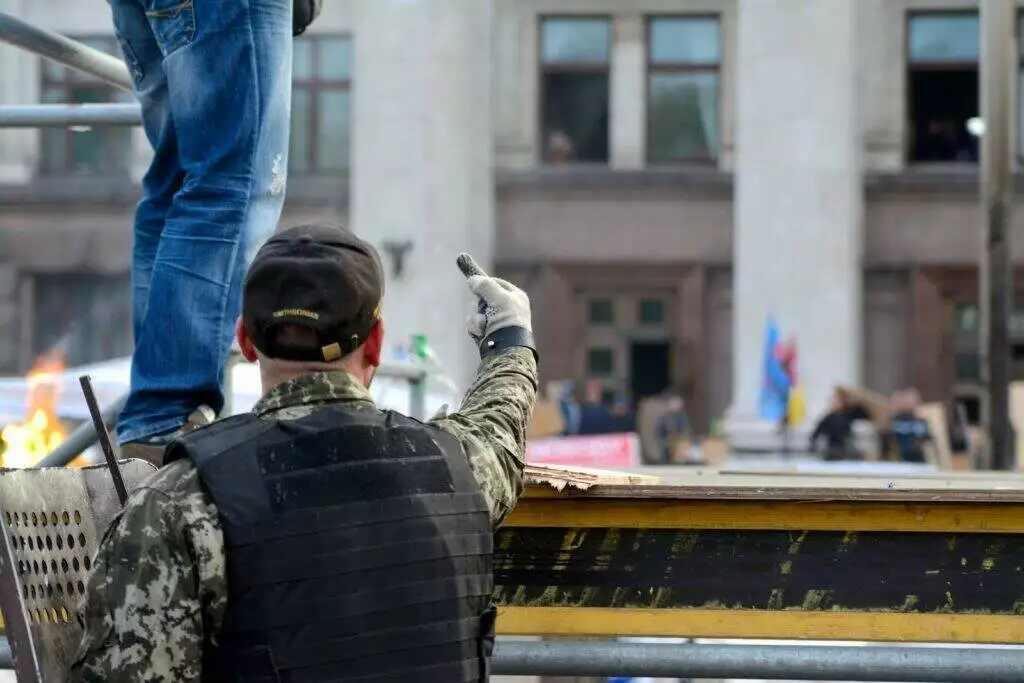
Odessa, May 2, 2014. Kulikovo Field (photo: Strakhov Ivan).
Khatyn as a tool of information warfare
In this whole story, what is particularly striking is that Russian propaganda used two real tragedies to create one false image. The first was the crime committed in Khatyn in 1943. The second was the death of 48 people during the tragic events in Odessa in May 2014. Both deserve remembrance and a reliable clarification of the circumstances. Neither, however, should be used to manipulate the history of the other.
Russian propaganda did not stop at comparing these events. It created a story in which the Odessa tragedy was presented as a repetition of a Nazi crime, and responsibility for people’s deaths was attributed to the entire Ukrainian nation. In this way, one of the most important myths later used to justify Russian aggression was constructed.
In the propaganda narrative, it was Odessa that was supposed to be the moment of the final awakening of Ukraine’s Russian-speaking population. The image of people burned in the building of the Trade Unions was repeated hundreds of times. It appeared in politicians’ statements, television material, online publications, and the accounts of people who later fought against Ukraine. In some cases, stories about women allegedly burned alive, including pregnant women, became a personal justification for joining the fight.
It is hard to overestimate the importance of such manipulation. A person who has come to believe that their homeland is threatened by hordes of ruthless Nazis may consider violence a moral duty. All the more so if this message is repeated by television, politicians, and people presented as witnesses to events.
That is precisely why the myth of the “Odessa Khatyn” was so useful to the Kremlin. It made it possible to portray Russian interference in Ukraine as a defensive action, and the later military aggression as a necessity allegedly arising from a duty to protect the Russian-speaking population.
Memory of the victims as a tool of propaganda
The history of Khatyn shows how easily an authentic tragedy can be used for political purposes. First, Soviet propaganda incorporated it into its own historical policy, marginalizing inconvenient facts and exploiting the similarity of the name to Katyn. Several decades later, Russian propaganda reached for this symbol again—this time to portray Ukraine as a Nazi state.
The truth about the events in Odessa is far more important than propaganda labels. The tragic events in Odessa are an example of how Russian propaganda can use the memory of a real tragedy to create a myth that serves to justify further crimes. And that is precisely why it is worth consistently dismantling this myth. Not to diminish the suffering of the victims, but to ensure that their deaths are not used again in the service of lies.
Sources and supplementary materials
- Coffee or Die Magazine – historical material.
- BBC News Russian – material concerning the events in Odessa.
- Smithsonian Magazine – the history of the crime in Khatyn and its commemoration.
- Institute of National Remembrance – “The Khatyn Case”.
- 2 May Group – topical archive and analyses from 2015 and 2016, March 2016.
- Borys Tynka, Odessa, 2 May 2014. The Bloody Trail of the “Russian Spring”, e-bookowo Publishing House, 2024.

Journalist, columnist, author of books about Ukraine, tour guide, and commentator on developments in Ukraine and Polish-Ukrainian relations.
A certified guide to Odesa, the Odesa catacombs, Ukrainian Bessarabia, and Kyiv. He is the author of numerous publications on Ukraine’s history, culture, and contemporary affairs, some of which have been translated into Ukrainian and published in Ukraine. In 2020, he received the honorary title of Ambassador of Odesa in Poland from the Mayor of Odesa.
On 24 February 2022, the day Russia launched its full-scale invasion of Ukraine, he was in Odesa. He remained there for several months, helping coordinate humanitarian aid and reporting on the war for Polish media outlets. He described his experiences during this period in his book Odessa 4.5.0.
At Nowiny Wschodnie, he publishes articles and commentary on the Russo-Ukrainian war, Russian propaganda and disinformation, Ukrainian history, particularly that of Odesa, as well as Polish-Ukrainian relations and changing public attitudes.
He collaborates with Ukrainian newsrooms and online news outlets and appears in Polish media as a commentator on Ukrainian affairs.
What do you think about this story?
Join the conversation. Please keep comments relevant to the article.
Write a comment